Here’s a quick overview of Michael Licona’s latest book on the resurrection, entitled “The Resurrection of Jesus“.
60 minutes of lecture, 20 minutes of Q&A.
Summary:
Dr. Licona’s background and education
The definition of history and philosophy of history
Postmodern approaches to history
Historical bedrock: facts that are historically demonstrable
Historical criterion 1: Explanatory scope
Historical criterion 2: Explanatory power
Historical criterion 3: Plausibility
Historical criterion 4: Ad Hoc / Speculation / non-evidenced assumptions
Inference to the best explanation
Investigating miracle claims: is it possible? How?
Objection of James D.G. Dunn
Objection of Bart Ehrman
New Testament sources: Gospels and Paul’s letters
The Gnostic gospels: are they good sources?
The minimal facts
The hallucination hypothesis
The best explanation
While watching this lecture, it struck what good preparation it was for understanding debates. This lecture is more about historical methods, but if you’re interested in Mike’s minimal facts case for the resurrection, here’s a video on that:
This is the case he uses in his debates with Richard Carrier, Dale Allison, Bart Ehrman, etc.
One overwhelming impression of these engagements is the way in which the intellectual defense of Christian faith attracts men. Both at Texas A&M and again at Miami every single student who got up to ask a question was a guy! I wondered if the girls are just shy. But then I remembered a lengthy clip Jan and I watched of cast members of Downton Abbey doing a Q&A with an audience in New York. Almost every person who came to the microphone at that event was a woman! It wasn’t until late into the evening that a man finally asked a question, which was remarked by all the cast members. Why the difference between that session and the ones I experienced?—simply because the Downton Abbey program is highly relational, which is more appealing to women, whereas my talks were principally intellectually oriented, which is more appealing to men.
Churches have difficulty attracting men, and the church is becoming increasingly feminized. I believe that apologetics is a key to attracting large numbers of men (as well as women) to church and to Christ. By presenting rational arguments and historical evidences for the truth of the Gospel, by appealing to the mind as well as the heart, we can bring a great influx of men into the Kingdom. I’m so pleased that the church in Canada seems to be awakening to this challenge! I’m convinced that we have the opportunity to revolutionize Western Christianity by reclaiming our intellectual heritage.
I could tell you many, many stories of what it was like for me being shut down by churches who were overly sensitive to the desires of women. In college, I and the other male students had every attempt to bring in scholars to lecture or debate shut down by female leadership. Every single week it was prayer walks, testimonies, hymn sings… over and over. Eventually, the more manly Christians just quit going. Later on, I witnessed apologetics being shut down in the church from the top down and from the bottom up, as well.
I remember one week an excited male friend invited me to his church because his male pastor was giving sermons using Hugh Ross and Gerald Shroeder books. He was trying to tie in the existence of God to cosmology. Well, I showed up the next Sunday to hear, and was disappointed. I could tell that the pastor wanted to go back to that subject, but he never really did. Later on, we found out that a female parishioner had complained that too much science and evidence had ruined her experience of feeling good and being comforted.
I could go on and on and on telling stories like this. To this day, I cannot stand being in a church unless that church has organized things like apologetic training classes, public lectures, public debates or public conferences. But that’s the minority of churches. The fact is that churches are attended far more by women than by men, and pastors are catering to women more than men. Not only will apologetics not be mentioned, but elements of feminism will creep into doctrine (egalitarianism) and all political issues will be avoided. Church has become a place to have good feelings, and it is far divorced from anything like evidence or politics which might be viewed as judgmental and divisive. And yet those are the things that men like to talk about most: right and wrong, public policy, evidential apologetics.
BeThinking posted a new lecture featuring Dr. Simon Gathercole.
Here’s the speaker bio:
Dr Simon Gathercole is Senior Lecturer in New Testament Studies and Fellow of Fitzwilliam College, at the University of Cambridge. He is particularly fascinated by the connections between the New Testament and its contemporary literature.
Summary:
Simon Gathercole shows how the geographical information in the New Testament Gospels demonstrates their historical reliability and their basis in eyewitness sources. The illustrated lecture lasts about 60 minutes and is followed by about 20 minutes of Q&A.
BeThinking has a PDF containing all the slides used in the lecture.
The lecture is here:
Topics:
Detailed geography is difficult to fake, especially when it is far into the past
Bible authors would have to rely on eyewitness testimony if they wanted to get geographic details right
You can even cross-reference the geographic details mentioned in the New Testament with extra-Biblical sources of that time
Cities mentioned in the Bible are mentioned in other sources
Locations that are mentioned in Josephus, a Jewish historian
Locations that are mentioned in the Rabbis
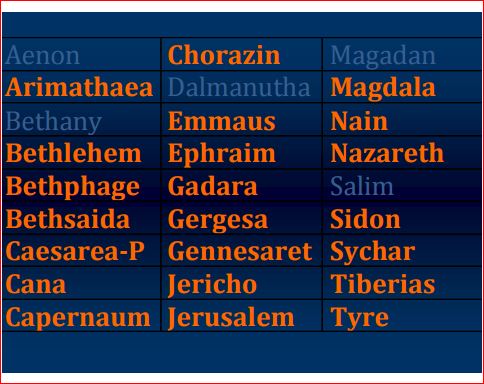
22 of 27 places mentioned in the gospels are attested
If you compare the gospels with Josephus they are as good
Example slide – he shows where these cities in orange are mentioned outside the Bible:
At the end of the lecture 22 out of 27 cities are attested in other sources
This lecture caught my eye because it was all about connecting the Bible to evidence outside the Bible. I like evidence. You should give it a listen.

 WINTERY KNIGHT