I am sometimes asked, by both skeptics and believers alike, why I was once an atheist and what convinced me to become a Christian. I will answer the latter in another post but let me deal with the former now.
I am a “PK” or “preacher’s kid.” My father served as the founding pastor of the largest church in southern Ohio. It is a non-denominational, evangelical congregation that grew very quickly.
As a PK, I was privy to a lot of “inside information” and it was not encouraging. I learned men and women who sang hymns with passion and shouted “Amen!” with gusto during the sermon were cheating on their spouse or on their taxes.
By the time I was a teenager I understood why those who called themselves Christians lived secret lives–they wanted to believe but really didn’t. I understood because I became one of them.
I was an active member of an ’80′s evangelical youth group. So, I rocked out to Stryper, had comedian Pat Hurley tapes and volunteered for the children’s ministry, which consisted of videotaping episodes of Superbook and The Flying House for the kids. However, I actually seriously doubted if God even existed.
I was struggling with the normal sins of a teenager and begged for help in prayer. I also petitioned God on a regular basis to feel His presence but that didn’t happen either.
I eventually came to the conclusion that Christianity simply didn’t work. I declared myself an atheist at age fifteen and remained an unbeliever for the next ten years.
I ran away from home at age fifteen as well eventually making my way to Hollywood. During those days I partied like it was 1999 (until 1997) and like Aldous Huxley is quoted as saying decades before, I came to not even want God to be real because even the possibility interfered with my desire to create my own morality.
Christianity is not something where you just profess it and suddenly you are automatically perfect. You get the gift of eternal life immediately by faith in Christ, but becoming more like Christ takes time. It’s easier to act consistently with the teachings of Christ if you have spent the time studying, practicing and growing as a Christian. You shouldn’t expect perfect behavior on day one – that is crazy. You should expect that as your beliefs become more solid, then your outward actions will change naturally. And often what you hear at home and in the church is not the best for finding truth through investigation and debate.
It would be terrible to have to put out “good” actions when you never settled the questions of what is true and how are we going to apply what is true in our own decisions. Sometimes, I think that young Christians face too much pressure to appear to be perfect when no one has been willing to help them work through the grounding for the behaviors they are expected to display. And I think a lot of the behaviors they are expected to display are either not important or not Biblical. Behaving like a Christian should be natural – it should proceed from free inquiry, not dogmatism.
Now I’m skipping a lot, but here is his advice for people who were in his situation:
I’ll get to my conversion later but keep in mind: (1) just because a person attends a church, even if they are a PK, that he or she truly comprehends the Gospel because I didn’t a full understanding; (2) pastors need to constantly remind their parishioners that sin is easy and living for Christ is difficult because believers are part of a cosmic struggle; (3) the spiritual disciplines are invaluable especially so for young people; and (4) there are many solid arguments for the existence of God and few for materialism and all Christians deserve to know them.
I’ve spent some time mentoring young Christians who had fallen away for some period of time, and I always make a point of asking them why. Their answer is usually something like this: “I knew that what I was doing was wrong, but I didn’t care because no one else cared.” The first thing to do with a person who is rebelling is to get in there and start to ask them questions and get involved in helping them to succeed in their lives. People do bad things because they feel that no one cares. So you better start caring for these young people, whether they are smart, dumb, pretty, ugly, poor, rich, popular, unpopular – it doesn’t matter. They all have souls, and they were all made to know God. Get in there and be real with them before they make a mess of their lives.
Two tough rams butt heads, and may the best ram win!
Looks like Justin Brierley on the Unbelievable radio show found a pastor with a Ph.D in philosophy, and he can really whip some ass. And that’s a good thing, because he is taking on one of the two leading proponents of religious pluralism, in my opinion, (the other being Paul Knitter).
The players:
John Hick is a noted philosopher and theologian who is a proponent of a pluralist view of religion – that there is one light (God) but many lampshades (religious expressions).
Chris Sinkinson is a pastor and Bible tutor who has critiqued Hick’s work. He says that pluralism empties Christianity of any content and in its own way disrespects other religions more than his own exclusivist stance.
Justin does a great job as moderator of this debate. He said what I was thinking of saying a number of times during the debate.
Anyway, here is my snarky summary. I creatively paraphrase some of the things that Hick says to make it more clear. And funny.
—-
Hick:
– had an experience looking at the buildings of other religions
– other religions have buildings, so all religions are equal
– I spent some time in the East, and met nice Eastern people
– since Eastern people are nice that means all religions are equal
Justin:
– isn’t Jesus’ claim to be the exclusive path to salvation offensive?
Sinkinson:
– all religions that are exclusive and have to deal with religious pluralism
– even John Hick writes polemically in favor of his own view
– even John Hick thinks that religions that are exclusive are false
Justin:
– what about the blind man and the elephant?
– the story seems to say that other people have a partial grasp?
– but the story-teller himself has the privileged view
– so isn’t the religious pluralist just as arrogant as exclusivists?
Hick:
– well, it’s not arrogant to claim to have the right answer
– Jesus never made the claim to be God incarnate
– Jesus never made the claim to be the exclusive path to God
– historians don’t think that John’s gospel is reliable because it is late
– the proclamation of exclusivity was added by evangelists much later
Sinkinson:
– the historians who doubt the high Christology are radical skeptics
– the mainstream of historical scholarship accepts a high Christology
– the EARLIEST history about Jesus has the highest Christology
Hick:
– the moderate scholars do think Jesus was divine but that he didn’t think he was divine
– the phrase “Son of God” was used to describe any remarkable person
– only later did the early church turn the generic term into “God the Son”
Sinkinson:
– there is reflection on Jesus’ identity and developments, but not invention
– Jesus and his followers were in trouble precisely for linking him to deity
– why else would Jesus get into trouble and get crucified?
Hick:
– the Romans crucified him because people were saying he was the Messiah
– but the Messiah was not identified as being divine, but political
– and that’s why the Romans crucified him
Justin:
– do you (Sinkinson) think that people in other religions can be saved?
Sinkinson:
– the traditional view is exclusivism
– the other world religions are logically contradictory with Christianity
– you have to respect their differences – they are not the same as Christianity
– exclusivists allow that people can be saved by responding to natural theology
– and there are also other cases where non-Christians are saved, like old testament saints and babies who die in infancy
Hick:
– but people’s religions are based on where they are born
– so it’s not fair for God to expect people to be saved in one religion only
Sinkinson:
– the plurality of religions grouped by location doesn’t make christianity false
– that would be the genetic fallacy – rejecting an idea because of its origin
– the real question to consider is whether it is true
– and even the objection assumes that God is a God of love, who should be fair
– but how do you know that God is loving? that is an exclusive view
– how can the “blob” ultimate of religious pluralism be “loving” and “fair”
Hick:
– the ultimate reality is loving or not loving depending on each person’s religion
Sinkinson:
– but some religions and theistic and some are atheistic
– how can those God exist and not exist?
Hick:
– God is beyond everyone’s understanding, except mine
– God is beyond all definitions, except mine
– God is beyond all human understanding, except mine
– i’m not contradicting myself, it’s a mystery! a mystery!
– as long as you don’t look to closely, they’re all the same!
– allow me to tell you about God, which no one can do but me
Justin:
– doesn’t your religious pluralism mean that Christianity is false?
Hick:
– well, Christianity can’t be true, because it disagrees with other religions
– Christianity can’t falsify other religions, that would be mean to them
– other religions are just as “profound” as Christianity – and that’s what matters – not whether a religion makes true claims
– some religions are older than Christianity, that means they can’t be disagreed with
– we can’t let Christianity be true, because then some people will feel bad
– if people feel bad, then they don’t like me and then I feel bad
– if there’s one thing I know about the unknowable ultimate reality, it’s that it wants me to be liked by lots of people
Sinkinson:
– your view seems to be agnosticism – that nothing can be known about the “ultimate real”
– if we can’t express in words what God is like, then why are you saying what God is like?
Hick:
– the indescribable ultimate is described (falsely, but interestingly) by various tradition
Sinkinson:
– does the “ultimate real” exist?
Hick:
– no
Justin:
– are all the exclusive religions wrong, and only you are right?
Hick:
– all propositions about God in all the religions are false
– the experience of being deluded and having feelings about your delusions is “valid” in all religions
– all religions are equally good ways to believe false things and to have feelings about your false beliefs
– only my propositions about God are true
– everyone who disagrees with me is wrong
Sinkinson:
– so all the propositions of all the religions are wrong
– but all the experiences and feelings are “right”
Hick:
– yes
– all propositions about God are humanly constructed, and so false
– except mine – mine are true!
Sinkinson:
– so everything distinctive about Christianity are literally false?
Hick:
– yes, Christian doctrines are all false
– because if they were true, other religions would be false, and they would feel bad
– and we can’t have that, because everyone has to like me
– only things that don’t offend people in other religions can be true
Sinkinson:
– so do we have to then treat all religions as non-propositional?
Hick:
– well just don’t ask people about the content of their beliefs
– just treat their religion as non-cognitive rituals, feelings and experiences
– don’t inquire too deeply into it, because all religions are all nonsense
– i’m very respectful and tolerant of different religions!
Sinkinson:
– but Muslims, for example, think their religion is making truth claims
Hick:
– but there can be tolerance as long as you treat religions as non-propositional nonsense
Sinkinson:
– um, I have a higher respect for religions than you do
– I actually consider that the claims of other religions could be true
– I think that other religions make truth claims and not nonsense claims
Hick:
– well they are all useful because they are all false
– I don’t emphasize beliefs, I emphasize living, experiences and feelings
– as long as everyone accepts my view and rejects their religion, we’ll all be tolerant
Justin:
– erm, isn’t that an exclusive claim?
– you’re trying to say that your view of what religion is is right, and everyone else is wrong
Hick:
– I’m not arrogant, I just think that all the religions of the worlds are false
– only my statements about religion are true – everyone else is wrong
– I’m tolerant, and Christians are arrogant
Justin:
– but you think Sinkinson’s view is wrong
– why should we accept your view and deny his view?
Hick:
– His view of salvation is false, and mine is true
Sinkinson:
– you use words with set meanings, but you mean completely different things
– when I say salvation, I mean deliverance from sins through Jesus
Hick:
– I get to decide what salvation means for everyone, you intolerant bigot
Sinkinson:
– but that word has a specific meaning that has held true in all of Christian history
– but what you mean by salvation is people having subjective delusions that are not true
Hick:
– I don’t like using the word salvation
Sinkinson:
– but you just used it!
– and you think that it is present in different world religions, but it isn’t
Hick:
– God is unknowable and indescribable
– God isn’t a wrathful God though
– and the Christian description of God is false
– Evangelical Christians are mean
– I had experiences with people of other faiths
– and these experiences taught me that religions that think that the universe is eternal are true
– as long as you reduce religion to behaviors and not truth, then religions are all good at producing behaviors
– if you just treat all religions as clothing fashion and food customs, they are all valid
– the main point of religion is for people to agree on cultural conventions and stick to them
– never mind the propositional statements of religions… who cares about truth? not me!
– but Christianity is definitely false
Sinkinson:
– the Judeo-Christian God is different – he reveals himself to humans
– he is distinct from the other religions
– he is personal, and is loving but also angry at sin
Hick:
– But God isn’t a person, and he isn’t a non-person
– I can’t say what he is – I’ll offend someone if I say anything at all!
– except Christians – I can offend them because they are arrogant bigots
– I’m also very spiritual – I meditate on my breathing
Sinkinson:
– you can’t assess a religion by the experiences that people have
– people who have weird experiences do all kinds of evil things
– so the real question has to be about truth – is the New Testament reliable?, etc.
This is a long treatment that talks about the challenge of moral relativism and the case for the pro-life view. He does show a clip of abortion in the video to the audience.
There’s also a 35-minute audio recording of Scott on the LTI web site. (H/T Apologetics 315) You can put that on your podcast player and listen to it. Listen to it a lot and soon you’ll sound like Scott.
Scott also has an article posted on the LTI web site for those who don’t have time for the video or the audio.
In the article makes three points:
Clarify the issue
Defend your pro-life position with science and philosophy
Challenge your listeners to be intellectually honest
Here’s the second point:
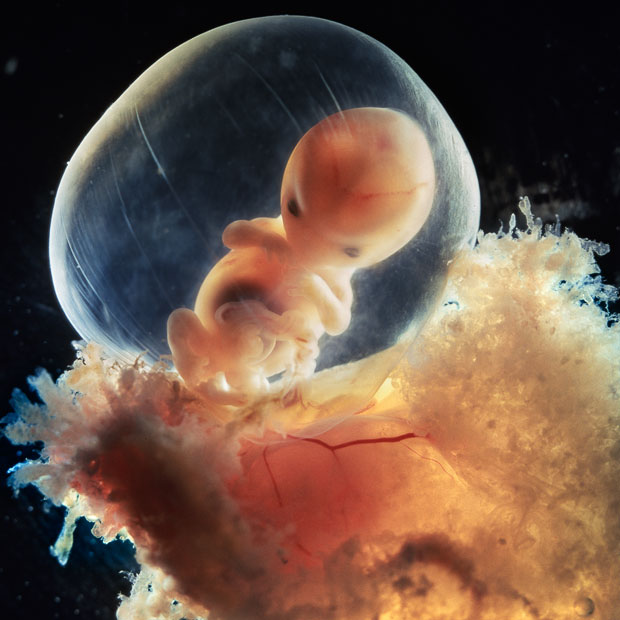
Scientifically, we know that from the earliest stages of development, the unborn are distinct, living, and whole human beings. Leading embryology books confirm this.2 For example, Keith L. Moore & T.V.N. Persaud write, “A zygote is the beginning of a new human being. Human development begins at fertilization, the process during which a male gamete or sperm … unites with a female gamete or oocyte … to form a single cell called a zygote. This highly specialized, totipotent cell marks the beginning of each of us as a unique individual.”3 Prior to his abortion advocacy, former Planned Parenthood President Dr. Alan Guttmacher was perplexed that anyone, much less a medical doctor, would question this. “This all seems so simple and evident that it is difficult to picture a time when it wasn’t part of the common knowledge,” he wrote in his book Life in the Making.4
Philosophically, we can say that embryos are less developed than newborns (or, for that matter, toddlers) but this difference is not morally significant in the way abortion advocates need it to be. Consider the claim that the immediate capacity for self-awareness bestows value on human beings. Notice that this is not an argument, but an arbitrary assertion. Why is some development needed? And why is this particular degree of development (i.e., higher brain function) decisive rather than another? These are questions that abortion advocates do not adequately address.
As Stephen Schwarz points out, there is no morally significant difference between the embryo that you once were and the adult that you are today. Differences of size, level of development, environment, and degree of dependency are not relevant such that we can say that you had no rights as an embryo but you do have rights today. Think of the acronym SLED as a helpful reminder of these non-essential differences:5
Size: True, embryos are smaller than newborns and adults, but why is that relevant? Do we really want to say that large people are more human than small ones? Men are generally larger than women, but that doesn’t mean that they deserve more rights. Size doesn’t equal value.
Level of development: True, embryos and fetuses are less developed than the adults they’ll one day become. But again, why is this relevant? Four year-old girls are less developed than 14 year-old ones. Should older children have more rights than their younger siblings? Some people say that self-awareness makes one human. But if that is true, newborns do not qualify as valuable human beings. Six-week old infants lack the immediate capacity for performing human mental functions, as do the reversibly comatose, the sleeping, and those with Alzheimer’s Disease.
Environment: Where you are has no bearing on who you are. Does your value change when you cross the street or roll over in bed? If not, how can a journey of eight inches down the birth-canal suddenly change the essential nature of the unborn from non-human to human? If the unborn are not already human, merely changing their location can’t make them valuable.
Degree of Dependency: If viability makes us human, then all those who depend on insulin or kidney medication are not valuable and we may kill them. Conjoined twins who share blood type and bodily systems also have no right to life.
In short, it’s far more reasonable to argue that although humans differ immensely with respect to talents, accomplishments, and degrees of development, they are nonetheless equal because they share a common human nature.
That’s the core of the basic pro-life case right there. There’s also a good interview of Mr. Klusendorf that I blogged about.
Advanced Objections
You can learn more by reading basic pro-life apologetics… from Francis Beckwith. You might recognize Frank Beckwith as the author of “Defending Life: A Moral and Legal Case Against Abortion Choice“. He wrote that book for Cambridge University Press, a top academic press. But before Cambridge University Press, Beckwith wrote easy-to-understand essays for the Christian Research Journal.
Here are four essays that answer common arguments in favor of legalized abortion.
A woman who becomes pregnant due to an act of either rape or incest is the victim of a horribly violent and morally reprehensible crime. Although pregnancy as a result of either rape or incest is extremely rare, [1] there is no getting around the fact that pregnancy does occur in some instances.
[…]Despite its forceful appeal to our sympathies, there are several problems with this argument. First, it is not relevant to the case for abortion on demand, the position defended by the popular pro-choice movement. This position states that a woman has a right to have an abortion for any reason she prefers during the entire nine months of pregnancy, whether it be for gender-selection, convenience, or rape. [3] To argue for abortion on demand from the hard cases of rape and incest is like trying to argue for the elimination of traffic laws from the fact that one might have to violate some of them in rare circumstances, such as when one’s spouse or child needs to be rushed to the hospital. Proving an exception does not establish a general rule.
[…]Fourth, this argument begs the question by assuming that the unborn is not fully human. For if the unborn is fully human, then we must weigh the relieving of the woman’s mental suffering against the right-to-life of an innocent human being. And homicide of another is never justified to relieve one of emotional distress. Although such a judgment is indeed anguishing, we must not forget that the same innocent unborn entity that the career-oriented woman will abort in order to avoid interference with a job promotion is biologically and morally indistinguishable from the unborn entity that results from an act of rape or incest. And since abortion for career advancement cannot be justified if the unborn entity is fully human, abortion cannot be justified in the cases of rape and incest. In both cases abortion results in the death of an innocent human life. As Dr. Bernard Nathanson has written, “The unwanted pregnancy flows biologically from the sexual act, but not morally from it.” [5]Hence, this argument, like the ones we have already covered in this series, is successful only if the unborn are not fully human.
Scott Klusendorf wrote the The Case for Life, which is the best book for beginners on the pro-life view. For those looking for advanced resources, Francis Beckwith, a professor at Baylor University, published the book Defending Life, with Cambridge University Press, 2007.
I found a very polished hour-long talk by Scott on Viemo. That talk was delivered to students and faculty at Furman University.
Finally, if you want to see Scott Klusendorf in a debate with a former ACLU executive, you can see it right here.



 WINTERY KNIGHT