New “Science Uprising” video series seeks to counter naturalist dogma

The Circumstellar Habitable Zone, where liquid water could potentially exist

What is the nature of reality? Is the universe self-existing and eternal or did it coming into being? Can we attribute the the diversity of life to natural processes, or was their a designing agent involved? Whether people have thought deeply about these questions or not, they all live their lives as if one view or another were true. Is there any way to educate these busy people?

I found an article in CNS News about a new series of short videos that challenge the naturalistic view of origins that dominates society today.

Excerpt:

A new YouTube series, Science Uprising, challenges the notion that the smart money is on atheism.

I was part of the creative team behind the project. One of our aims was to reach Generation Z, “digital natives” who get much of their impression of the wider world from the internet, including streaming services like YouTube.

This generation tends to encounter well-articulated arguments for unbelief much earlier than their parents did, and they often encounter those arguments online. Science Uprising is among an increasingly rich body of online video material that pushes back against the flood of anti-theistic online propaganda.

The video series features researchers at the forefront of the intelligent design movement, including Lehigh University biochemist Michael Behe and Cambridge-trained philosopher of science Stephen Meyer. But it also feature some top researchers outside this circle, including renowned research psychiatrist Jeffrey Schwartz, leading synthetic organic chemist James Tour, and physicist Frank Tipler. For you physics/cosmology folks out there—yes, that Tipler.

Each Science Uprising video is 6-8 minutes long, fast-paced, and produced by filmmakers with extensive experience in the television industry. David Arabia, whose camera work can be seen on the popular History Channel series Mountain Men, headed up the project.

Each episode begins with a masked host who appears to hack into television and internet feeds around the country to offer a contrary perspective. One moment people in restaurants, classrooms, living rooms, Times Square, etc., are watching science popularizers like Bill Nye and Neal DeGrasse Tyson peddle a vision of man and nature as mere matter in motion. The next moment, the hacker host has replaced them onscreen to question their claims and introduce the episode topic.

In the first episode, released June 3, Carl Sagan famously intones that “the cosmos is all that is, or ever was, or ever will be,” then the masked host crackles onto the screen and asks, “How do they know the cosmos is all there is?”

In the second episode, released Monday, evolutionary biologist Jerry Coyne tells his audience that free will is an illusion since humans are essentially just “robots made out of meat.” The masked host then asks, “Are you and I really robots?”

The point of this hacker framing device isn’t that we live in an Orwellian police state. The United States enjoys tremendous press freedom—a freedom we are taking full advantage of through this video series. The idea, rather, is that if you passively absorb mainstream media and public education in the West, you will get a blinkered sense of what the latest scientific evidence suggests about the nature and origin of humankind and the cosmos.

Subsequent episodes will be released every Monday into July. They explore everything from DNA and genetic mutations to the curious way Earth and the laws of nature appear to be fine-tuned to allow for life. Each video includes one or more experts providing evidence that reality is more than matter, and that the world is charged with purpose and design.

Here is the first video:


And here is the second video:


And here is the third video:


And the fourth video:

If you want to share something on your wall to start a discussion, then these videos would be a good choice. Of course, to be able to debate these topics, you might need to read an article or a book about each topic. But that’s what I had to do, and it’s pretty fun to win arguments and beat up atheists.

Why is America so much more prosperous than other nations?

It occurred to me that young people are being taught in government-run schools that central planning of the economy by the federal government works better than allowing states to decide policy for themselves. Naturally, the students – lacking life experience and at the mercy of the unionized teacher’s grading pen – have no choice except to be indoctrinated. But what are the facts?

The genius of America is that the Founding Fathers allowed the federal government to only have power in certain areas of life. Other areas of policy were delegated to the states. This allows states to try different policies to see what works best, or even just what works best for them. Then the other states have the option to emulate that success, or continue doing what doesn’t work. States that do what works will see more success, with more businesses and people migrating to their states. States that persist in doing what doesn’t work will see business and taxpayers flee. That is the genius of America’s design.

Federalism encourages states to operate according to the “principle of subsidiarity”, which is an economic principle that states that problems are best solved at the lowest level possible (individual -> family -> church – > business -> community -> local government -> state government -> federal government). This is because the people at the lowest level have the most KNOWLEDGE about how to solve the problem.

Case study: right-to-work laws

Let’s look at an example – unions and right to work laws. Starting after world war 2, some states decided to pass right to work laws. These laws allowed workers to decide for themselves whether to join a union or not. Since workers had the choice about whether to join the union, the union had to care about the workers and advocate for them, instead of enriching themselves at the expense of the workers via corruption and thuggery.

Here is how different states adopted right to work laws at different times:

Map of states showing adoption of right-to-work laws

What happened in these states? Well job creating businesses started to move from forced-union-membership states to right-to-work states. Why? Because unions were stopping them from innovating. Companies would figure out new ways to improve productivity, such as using machines and computers. But the unions would step in and insist that the old ways were best. The unions wanted their union members to just be able to do the same job, e.g. – pulling a lever over and over, for the entire 35 years of their career. And the unions wanted their members to be paid like a software engineer or a doctor for pulling a lever over and over. The unions also wanted to make sure that underperforming workers could never be fired, or replaced. And so on. Companies realized that they couldn’t compete in a global market like this, so they got up and left for right-to-work states.

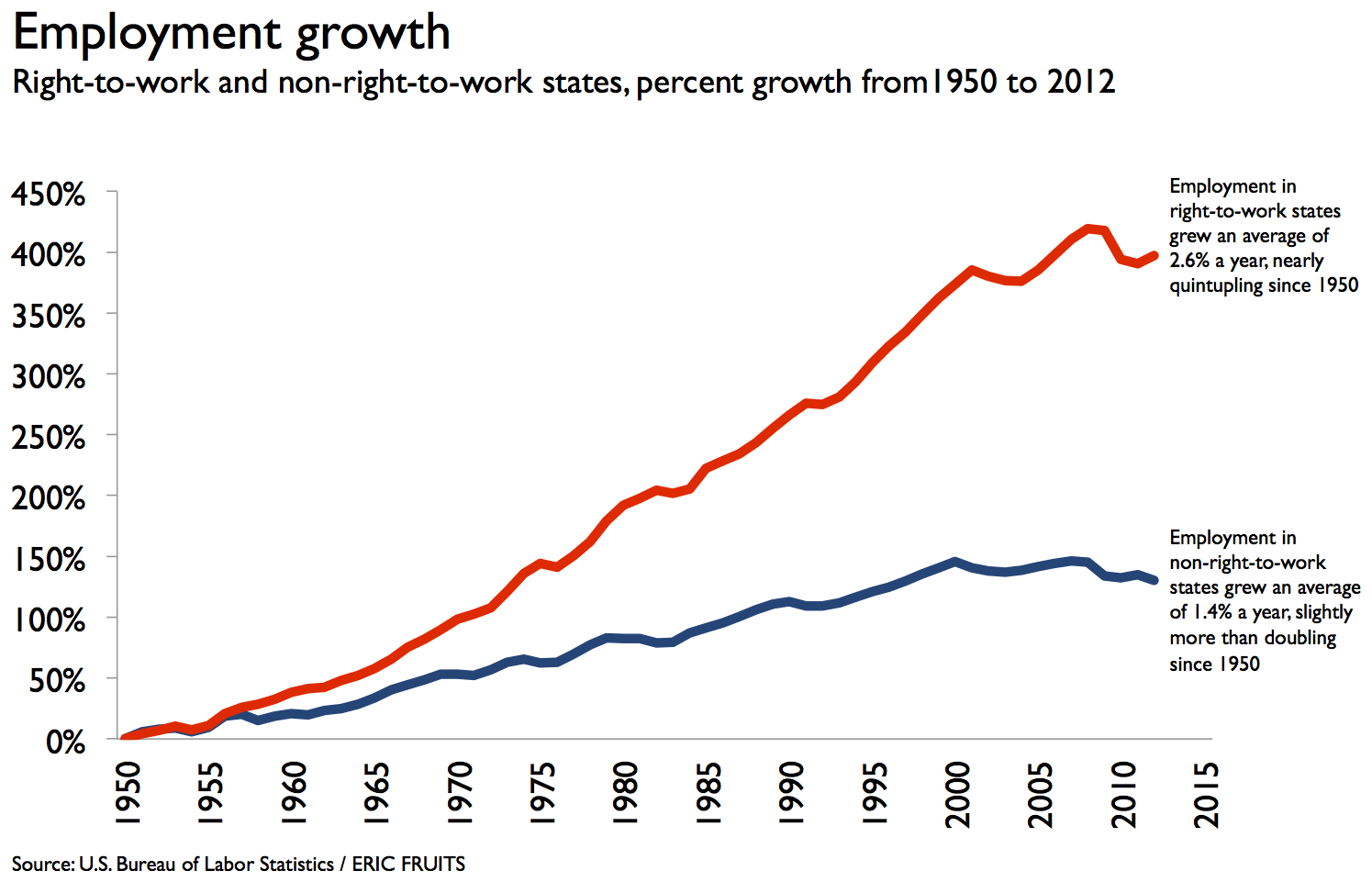
Here’s what happened next:

Rates of employment in forced union states vs right to work states

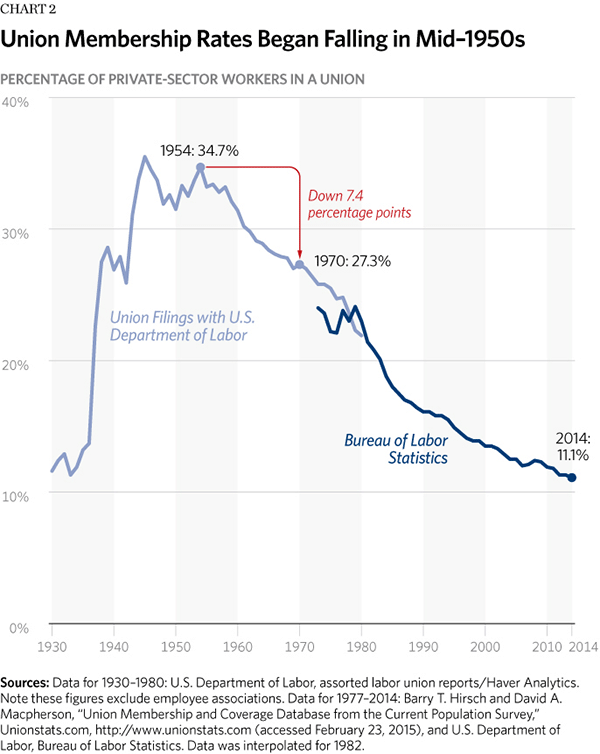
States with right-to-work laws never said that there couldn’t be unions, only that workers wouldn’t have to join a union to work. And in right-to-work states, not only did workers not join unions, they voted not to unionize at all. This resulted in a massive decline in private sector unions in America:

Decline in private sector union membership

As a result of job creating businesses not being hampered by union corruption and thuggery, American businesses quickly outpaced their rivals in forced union membership states in productivity, as measured by GDP. They also outpaced the productivity per worker in other economically illiterate countries. Why? Because allowing companies to innovate meant that workers were using more machinery and computers to do their jobs. They learned new skills. Underperforming workers could be replaced with workers who were willing to grow and adapt. Non-union workers higher productivity allowed them to find other jobs if they were laid off.

Right to work states innovate, creating more skilled workers

The job security of the American worker comes from his improved worker productivity – not from the union. Not only did unemployment go down in right to work states (more jobs!) but salaries and benefits also increases, as companies had to compete with each other for workers. However, companies were ok with paying more for workers, because they would rather pay ONLY the workers who deserved it, rather than pay one rate for all union workers, regardless of performance.

This article from the far-left New York Times explains how slaries and benefits rise when job creators move to right-to-work states: Income Rises When Right-to-Work Laws Are Passed because job creators must offer workers a lot in order to get them to sign. Not just salaries and benefits, but realistic development plans to grow the workers skills, making them even more resistant to layoffs and economic downturns.

Quote:

While some persons may favor right-to-work laws largely on philosophical grounds (people should have the freedom to decide whether they want to belong to a union or not), the major reason I support such laws is that they seem to promote prosperity — specifically, higher incomes. Real personal income in the right-to-work states rose nearly twice as much as in other states from 1970 and 2013.

To be sure, most of that reflected higher population growth in right-to-work states — there was massive in-migration to these states from the states denying workers the right to not join a union. Yet even after correcting for population growth, income per person on average rose somewhat more in the right to work jurisdictions. Capital moves to right-to-work states with a more stable labor environment, and that increases labor demand and, ultimately, income and wages.

Although unions mostly died out in the private sector, the ones that remained actually functioned well as unions – focusing on their workers instead of enriching union bosses. They had to, because if they didn’t, then the workers would just opt out of them. The only places where unions still survive is in the public sector, i.e. – government. This is because government is (by law) a monopoly, where consumers have no choice except to accept the garbage that they are offered. They can’t go anywhere else for a lower price, or a better product, or a better service. Public sector unions are immune to innovation, because they lobby the government to prevent any improvement or accountability.

Here is an example of a public sector union’s effort to “help the customer”:

Political contributions by the American Federation of Teachers union

And here’s what those efforts to “help the customer” produced for the customer:

Education spending has tripled since 1970

They aren’t really helping the customer, are they? What they do is collect dues, enrich their union leaders, intimidate their opponents with threats and force, and then give money to secular left politicians to prevent their customers from opting out of a system that doesn’t produce higher quality and lower prices for the customer. The secular left politicians pass laws that prevent the customers (parents) from being able to get a better product (education for their children) for a lower price. We should abolish public sector unions in order to get the benefits for the customer that we see in the private sector.

Utilitarianism and the Moral Life by J. P. Moreland

I have a key that will unlock a puzzling mystery

I found this essay on After All, but it looks like their site is not working well, so I’m just going to steal it and post it here, in case it disappears completely. This is one of my favorite short essays on utilitarianism, and it’s a wonder that the thing can’t stay up somewhere. Well, it will have a home here now. I’d be surprised to see anyone else be this awesome in a measly 1000 words as Dr. Moreland is below.

—-

Utilitarianism and the Moral Life

What Is Utilitarianism?

Utilitarianism (also called consequentialism) is a moral theory developed and refined in the modern world by Jeremy Bentham (1748-1832) and John Stuart Mill (1806-1873). It can be defined as follows:

An action or moral rule is right if and only if it maximizes the amount of nonmoral good produced in the consequences that result from doing that act or following that rule compared with other acts or rules open to the agent.

By focusing on three features of utilitarianism, we can clarify this definition.

(1) Utilitarian theories of value.

What is a nonmoral good? Utilitarians deny that there are any moral actions or rules that are intrinsically right or wrong. But they do believe in objective values that are nonmoral.

Hedonistic utilitarians say that the only intrinsic good is pleasure and the avoidance of pain. Quantitative hedonists (Bentham) say that the amount of pleasure and pain is the only thing that matters in deciding between two courses of action, I should do the one that produces the greatest amount of pleasure and the least amount of pain (measured by factors like the duration and intensity of the pleasure). Qualitative hedonists (Mill) say that pleasure is the only intrinsic good, but the type of pleasure is what is important, not the amount. They would rank pleasures that come from reading, art, and friendship as more valuable than those that come from, say, a full stomach.

Pluralistic utilitarians
say there are a number of things that have intrinsic, nonmoral value: pleasure, friendship, health, knowledge, freedom, peace, security, and so forth. For pluralists, it is not just the pleasure that comes from friendship that has value but also friendship itself.

Currently, the most popular utilitarian view of value is subjective preference utilitarianism. This position says it is presumptuous and impossible to specify things that have intrinsic nonmoral worth. So, they claim, intrinsic value ought to be defined as that which each individual subjectively desires or wants, provided these do not harm others. Unfortunately, this view collapses into moral relativism.

(2) Utilitarians and maximizing utility.

Utilitarians use the term utility to stand for whatever good they are seeking to produce as consequences of a moral action (e.g., “pleasure” for the hedonist, “satisfaction of subjective preference” for others). They see morality in a means-to-ends way. The sole value of a moral action or rule is the utility of its consequences. Moral action should maximize utility. This can be interpreted in different ways, but many utilitarians embrace the following: the correct moral action or rule is the one that produces the greatest amount of utility for the greatest number of people.

(3) Two forms of utilitarianism: act utilitarianism and rule utilitarianism.

According to act utilitarianism, an act is right if and only if no other act available maximizes utility more than the act in question. Here, each new moral situation is evaluated on its own, and moral rules like “don’t steal” or “don’t break promises” are secondary The moral agent must weigh available alternatives and choose the one that produces the best consequences. Rule utilitarianism says that correct moral actions are done in keeping with correct moral rules, However, no moral rule is intrinsically right or wrong. Rather, a correct moral rule is one that would maximize utility if most people followed it as opposed to following an alternative rule. Here, alternative rules (e.g., “don’t lie” vs. “don’t lie unless doing so would enhance friendship”) are compared for their consequences, not specific actions.

What Is Wrong with Utilitarianism?

Several objections show the inadequacy of utilitarianism as a normative moral theory.

First, utilitarianism can be used to justify actions that are clearly immoral. Consider the case of a severely deformed fetus. The child is certain to live a brief, albeit painless life. He or she will make no contribution to society. Society, however, will bear great expense. Doctors and other caregivers will invest time, emotion, and effort in adding mere hours to the baby’s life. The parents will know and love the child only long enough to be heartbroken at the inevitable loss. An abortion negates all those “utility” losses. There is no positive utility lost. Many of the same costs are involved in the care of the terminally ill elderly. They too may suffer no pain, but they may offer no benefit to society. In balancing positives and negatives, and excluding from the equation the objective sacredness of all human life, we arrive at morally repugnant decisions. Here deontological and virtue ethics steer us clear of what is easier to what is right.

Second, in a similar way, utilitarianism denies the existence of supererogatory acts. These are acts of moral heroism that are not morally obligatory but are still praiseworthy. Examples would be giving 75 percent of your income to the poor or throwing yourself on a bomb to save a stranger. Consider the bomb example. You have two choices — throwing yourself on the bomb or not doing so. Each choice would have consequences and, according to utilitarianism, you are morally obligated to do one or the other depending on which option maximized utility. Thus, there is no room for acts that go beyond the call of morality.

Third, utilitarianism has an inadequate view of human rights and human dignity. If enslaving a minority of people, say by a lottery, would produce the greatest good for the greatest number, or if conceiving children only to harvest their parts would do the same, then these could he justified in a utilitarian scheme. But enslavement and abortion violate individual rights and treat people as a means to an end, not as creatures with intrinsic dignity as human beings. If acts of abortion, active euthanasia, physician-assisted suicide, and so forth maximize utility, then they are morally obligatory for the utilitarian. But any moral system that makes abortion and suicide morally obligatory is surely flawed.

Finally, utilitarianism has an inadequate view of motives and character. We should praise good motives and seek good character because such motives and character are intrinsically valuable. But utilitarianism implies that the only reason we should praise good motives instead of bad ones, or seek good character instead of bad character, is because such acts would maximize utility. But this has the cart before the horse. We should praise good motives and blame bad ones because they are good or bad, not because such acts of praising and blaming produce good consequences.

In sum, it should be clear that utilitarianism is an inadequate moral theory. Unfortunately, ours is a pragmatic culture and utilitarianism is on the rise. But for those of us who follow Christ, a combination of virtue and deontological ethics is a more adequate view of common sense morality found in natural law and of the moral vision contained in the Bible.