New study: Angus Reid Institute analyzes Canada’s single payer healthcare system

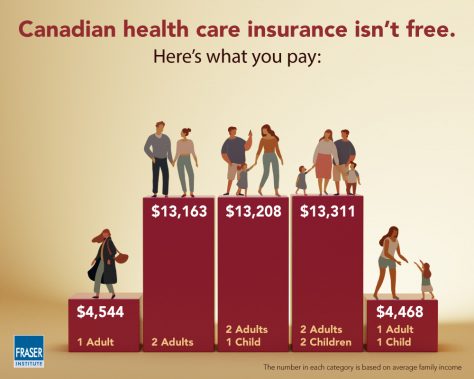
Price of healthcare per Canadian household (Source: Fraser Institute)
The cost of healthcare for average Canadian households

I found two interesting studies from Canada’s Angus Reid Institute describing single payer health care in Canada. I’m very interested in find out what things are like in countries that have true government-run health care. A typical Canadian family pays $13,000+ per year per household for healthcare, or about $585,000 over their working lives. What are they getting for all that money?

Here is the first Angus Reid article:

The study finds more than 2 million Canadians aged 55 and older face significant barriers when accessing the health care system in their province, such as being unable to find a family doctor or experiencing lengthy wait-times for surgery, diagnostic tests, or specialist visits.

Moreover, most Canadians in this age group have at least some difficulty getting the care they want or need in a timely manner.

The study focuses on the health care experiences of older Canadians, as well as their assessments of the quality of care they receive.

According to the article, 31% of respondents (aged 55 and older) rated access to the government’s healthcare system as “easy”. 48% had “moderate” problems with access, and 21% had “major” problems with access.

Remember: in the Canadian system, you pay your money up front in taxes, and then they decide how much healthcare you will get later – and how soon you will get it. If you worked from ages 20 to age 65, then your household will have paid 45 x $13,000 = $585,000 into the system, in order to get “moderate” problems with accessing healthcare after you’re aged 55.

And the Canadian system DOES NOT cover prescription drugs.

The second Angus Reid article explains:

This second part of the study finds one-in-six Canadians (17%) in the 55-plus age group – a figure that represents upwards of 1.8 million people – say that they or someone else in their household have taken prescription drugs in a way other than prescribed because of cost.

One-in-ten (10%) have decided to simply not fill a prescription because it was too expensive, and a similar number (9%) have decided not to renew one for the same reason. One-in-eight (12%) have taken steps to stretch their prescriptions, such as cutting pills or skipping doses.

Some 17 per cent of Canadians 55 and older have done at least one of these things, and that proportion rises among those who have greater difficulty accessing other aspects of the health care system.

In a previous blog post, I reported on how Canadians have to wait in order to see their GP doctor. If that doctor refers them to a specialist, then they have to wait to see the specialist. And if that specialist schedules surgery, then they have to wait for their surgery appointment. The delays can easily go from weeks to months and even years. The MEDIAN delay from GP referral to treatment is 19.5 weeks.

But remember – they paid into the system FIRST. The decisions about when and if they will be treated are made later, by experts in the government. This is what it means for a government monopoly to run health care. There are no free exchanges of money for service in a competitive free market. Costs are controlled by delaying and withholding treatment. And no one knows this better than elderly Canadians themselves. But by the time they realize how badly they’ve been swindled, it’s too late to get their money back out. You can’t pull your tax money out of government if you are disappointed with the service you receive. There are no refunds. There are no returns.

New study: parrots have similar brain mechanisms to humans

A cockatoo uses a little tool he made to reach a snack

OK, it’s a fun Friday post. I guess most of my readers know that I love almost all the birds, and especially parrots. I have owned parrots most of my life, and want to get more, too. I also like to feed the wild birds who come to visit my house. One reason I like them so much is that they are very intelligent and obviously designed by a very clever engineer.

First, let me explain what convergence is, then we’ll look at a recent peer-reviewed scientific publication.

We have to start this Science Daily post with the definition of convergence in biology.

In evolutionary biology, convergent evolution is the process whereby organisms not closely related (not monophyletic), independently evolve similar traits as a result of having to adapt to similar environments or ecological niches.

It is the opposite of divergent evolution, where related species evolve different traits.

On a molecular level, this can happen due to random mutation unrelated to adaptive changes; see long branch attraction. In cultural evolution, convergent evolution is the development of similar cultural adaptations to similar environmental conditions by different peoples with different ancestral cultures. An example of convergent evolution is the similar nature of the flight/wings of insects, birds, pterosaurs, and bats.

All four serve the same function and are similar in structure, but each evolved independently.

So, naturalists say that if two organisms have traits that are similar, it must mean that the trait evolved once in their ancestors, and then the modern species inherited the trait from those ancestors. If evolution is true, the only mechanism they have to develop traits shared by two organisms is mutation and selection. The problems occur when two organisms share similar traits, but they have no recent common ancestor, and no recent shared evolutionary history of mutation and selection.

Here’s the latest study from the New Scientist:

To learn more how these birds’ brains develop, Mello and his team compared the genome of the blue-fronted Amazon parrot with that of 30 other birds. They found that regions of the parrot genome that regulate when and how genes for brain development are turned on are the same as those found in humans. These so-called ultra-conserved elements evolved in both species at different times, but with similar results.

Well, parrots and humans are completely different creatures, with no recent evolutionary history, and no recent common ancestors. So, if these changes are due to evolution, then we should see them in the very very very distance common ancestor shared by birds and humans. But then shouldn’t they be in all the other animals who descend from that very very very distant common ancestor to?

Watch this:

I’ll tell you what the real explanation is: the real explanation is that God created birds and humans. And, like a clever engineer, he re-used components that produced the behavior he wanted in his birds and his humans. We know how this works, because this is how intelligent agents write code today. Why do we need a naturalistic theory that requires magic to work, when we have a simple explanation that we can  observe every time someone writes a blog post, or some code, or anything with information in it?

Anyway, however you feel about that, try to be kind to birds, as they are much smarter and more sensitive than most people think. Put out some bird feeders in the yard, if you don’t have an outdoor cat. And if you do have a cat, then why not put a bell on it, or keep it indoors?

Related posts

Making sense of evil and suffering within a Christian worldview

A long journey through the night

One thing I’ve noticed in talking to atheists who grew up in Christian homes is that they often leave their Christian worldview behind because of a disappointment with God. For some reason, they get this idea that God is our cosmic butler. We can do whatever we want in order to be happy, and if we want any help in this, then we just ring for him. When we encounter disappointment, our tendency is to just leave God behind.

Paul Copan explains the high points of the problems of evil and suffering in 17 minutes. (H/T Apologetics 315)

The MP3 file is here.

The video is here:

Topics:

  • the question itself reveals that we are moral beings
  • the problem of evil is the great interrupter of human well-being
  • every philosophy of life has to address this question
  • is God required to give us a life that is easy and comfortable?
  • evil is a departure from good, i.e. – the way things ought to be
  • a way things ought to be implies a plan for what ought to be
  • human evil implies a plan for the way we ought to be
  • free creatures have the ability to deviate from the plan
  • where does this plan for the universe and us come from?
  • how can there be a way we ought to be come from?
  • evil is the flip side of good so where does good come from?
  • God’s own moral nature is the standard of good and evil
  • where does evil from natural disasters come from?
  • how dangerous natural phenomena preserve Earth’s habitability
  • there is a benefit from tectonic activity
  • similarly, God lets humans freely choose knowing harm may result
  • people are free to try to find meaning in something other than God
  • God is able to use negative things to bring about positive results
  • e.g. – when good people suffer, they can comfort and care for others
  • can people be good enough on their own without God?

I do think it’s worth thinking about whether the New Testament portrays God as our cosmic butler, just waiting on us hand and foot so that we can be happy. Personally, I think you’d have to be crazy to get that impression of God from the Bible. Especially from the life of Jesus, who suffers in order to do the will of his Father. Wouldn’t it be funny if atheists were disbelieving in a God of their own making? Suffering in the pursuit of goodness has always been the center of the Christian life. I’m not sure where people get this idea that God’s job is to make us happy, according to our own desires. Seems kind of shallow. Certainly not Biblical. Do people even read the Bible any more to find out what God is really like? Maybe that’s the problem.