Ryan T. Anderson lectures on marriage and why it matters

A family praying and reading the Bible

Here’s the lecture:

About the speaker:

Ryan T. Anderson researches and writes about marriage and religious liberty as the William E. Simon Fellow at The Heritage Foundation. He also focuses on justice and moral principles in economic thought, health care and education, and has expertise in bioethics and natural law theory.

Anderson, who joined the leading Washington think tank’s DeVos Center for Religion and Civil Society in 2012, also is the editor of Public Discourse, the online journal of the Witherspoon Institute of Princeton, N.J.

Anderson’s recent work at Heritage focuses on the constitutional questions surrounding same-sex “marriage.” He is the co-author with Princeton’s Robert P. George and Sherif Girgis of the acclaimed book “What Is Marriage? Man and Woman: A Defense” (Encounter Books, December 2012).

The lecture starts at 7:20 in. The lecture ends at 49:35. There are 32 minutes of Q&A.

Introduction:

  • When talking about marriage in public, we should talk about philosophy, sociology and public policy
  • Gay marriage proponents need to be pressed to define what marriage is, on their view
  • Every definition of marriage is going to include some relationships, and exclude others
  • It’s meaningless to portray one side as nice and the other mean
  • Typically, marriage redefiners view marriage as a more intense emotional relationship
  • Marriage redefiners should be challenged in three ways:
  • 1) Does the redefined version of marriage have a public policy reason to prefer only two people?
  • 2) Does the redefined version of marriage have a reason to prefer permanence?
  • 3) Does the redefined version of marriage have a reason to prefer sexual exclusivity?
  • Also, if marriage is just about romance, then why is the state getting involved in recognizing it?
  • The talk: 1) What marriage is, 2) Why marriage matters, 3) What are the consequences of redefining marriage?

What marriage is:

  • Marriage unites spouses – hearts, minds and bodies
  • Marriage unites spouses to perform a good: creating a human being and raising that human being
  • Marriage is a commitment: permanent and exclusive
  • Male and female natures are distinct and complementary

The public purpose of marriage:

  • to attach men and women to each other
  • to attach mothers and fathers to their children
  • there is no such thing as parenting, there is only mothering and fathering
  • the evidence shows that children benefit from mothering and fathering
  • boys who grow up without fathers are more likely to commit crimes
  • girls who grow up without fathers are more likely to have sex earlier
  • Children benefit from having a mother and a father
  • can’t say that fathers are essential for children if we support gay marriage, which makes fathers optional
  • without marriage: child poverty increases, crime increases, social mobility decreases, welfare spending increases
  • when government encourages marriage, then government has less do to – stays smaller, spends less
  • if we promote marriage as an idea, we are not excluding gay relationships or even partner benefits
  • finally, gay marriage has shown itself to be hostile to religious liberty

Consequences redefining marriage:

  • it undermines the norm in public like that kids deserve a mom and a dad – moms and dads are interchangeable
  • it changes the institution of marriage away from the needs of children, and towards the needs of adults
  • it undermines the norm of permanence
  • we learned what happens when marriage is redefined before: with no-fault divorce
  • no-fault divorce: after this became law, divorce rates doubled – the law changed society
  • gay marriage would teach society that mothers and fathers are optional when raising children
  • if marriage is what people with intense feelings do, then how can you rationally limit marriage to only two people?
  • if marriage is what people with intense feelings do, then if other people cause intense feelings, there’s no fidelity
  • if marriage is what people with intense feelings do, then if the feelings go away, there is no permanence
  • the public policy consequences to undermining the norms of exclusivity and permanence = fatherless children and fragmented families
  • a final consequences is the decline and elimination of religious liberty – e.g. – adoption agencies closing, businesses being sued

We’re doing very well on abortion, but we need to get better at knowing how to discuss marriage. If you’re looking for something short to read, click here. If you want to read a long paper that his book is based on.

Excellent video from UK conservatives about state of men’s rights in the UK

An ex-co-workers from 1996(!) sent me a conservative video series from the UK, called Heresies. I watched the video below on the state of men and men’s rights in the UK. The UK has some of the most terrible laws for men of any Western country. The video is a series of interviews with men (or with the lawyers of men who committed suicide) who were victims of the government and the courts.

Here’s the video:

And here’s the blurb:

Whether it be deserving men unable to progress their careers due to female quotas & all-women shortlists, the naming of men in rape allegations whilst the female accuser remains anonymous, or the appalling treatment of men in the family court system — such as denial of custody rights over children, crippling divorce settlements & child maintenance orders that invariably favour wives over husbands –, many are now asking whether men are now second-class citizens.

In this documentary, (Episode 7 in the New Culture Forum’s acclaimed “Heresies” series) the Rt. Hon Ann Widdecombe explores the issue of men’s rights in the modern age, an age when men & masculinity are consistently derided and attacked. The ubiquity of the new phrase “toxic masculinity” provides a perfect example of this.

Featuring interviews with well-known figures in men’s rights and experts in the psychological damage these experiences are regularly causing men.

Well worth the listen. It’s important for men to be guarded about how society sees them, so they can adjust and make good decisions.

Did “thousands of women” die in “back alley abortions” before Roe v. Wade?

I get into debates about abortion, and sometimes my opponent will complain that if Roe v. Wade were overturned, then thousands of women would die in illegal abortions. Well, if that ever happens to you, this post will help you to know how to respond to it.

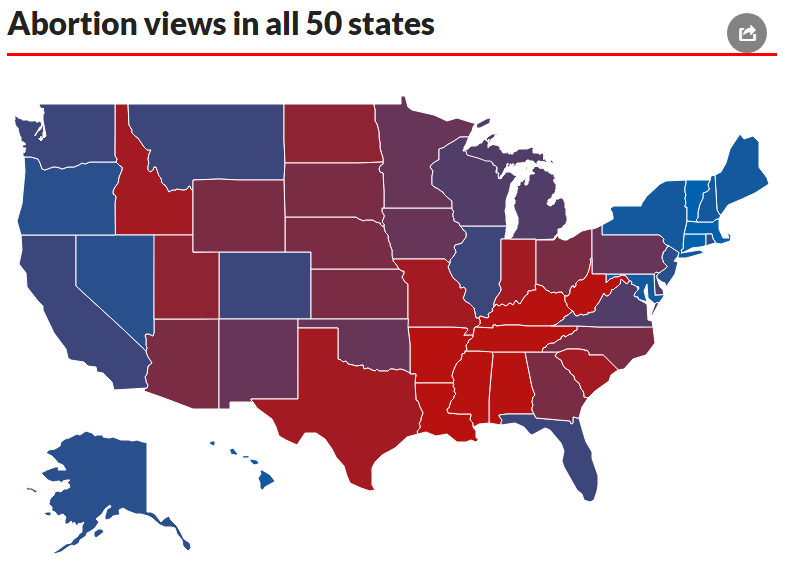
First of all, if Roe v. Wade were overturned, then each of the 50 states would pass legislation deciding when abortions would be legal.

Here’s a map taken from the Washington Examiner:

Abortion rights after Roe v. Wade is overturned

Red states are more pro-life than blue states in this map. For example, New York is ranked #6, and Tennessee is ranked #45.

So, if a woman did have irresponsible sex with a hot bad boy, then she easily could terminate her child in one of the blue states.

Second, the number thrown around by abortion advocates is not accurate. It’s simply not true that “thousands of women” were dying from poorly-performed abortions when abortion was still illegal. Actually, abortions were performed by trained medical personnel, but it just wasn’t reported to the police.

Here’s a recent article from the radically leftist Washington Post:

Erica Sackin, a Planned Parenthood spokeswoman, directed us to a 2014 policy statement issued by the American College of Obstetricians and Gynecologists (ACOG): “It is estimated that before 1973, 1.2 million U.S. women resorted to illegal abortion each year and that unsafe abortions caused as many as 5,000 annual deaths.”

There is no citation in the statement for the estimate of “as many as 5,000 annual deaths,” even though many of the other sentences are carefully documented. None of the citations around this sentence supports the figure, and there is no explanation about how it was calculated.

[…]Meanwhile, Sackin also sent a variety of reports, many of which were referenced in a footnote in a document published by NARAL Pro-Choice America. One of the citations especially caught our eye: Frederick Taussig, “Abortion Spontaneous and Induced: Medical and Social Aspects,” (1936).

Why was a study from 1936 being cited? Because in 1936, we didn’t have antibiotics! People were dying all the time from any kind of surgery – not just abortion.

More:

The advent of antibiotics such as penicillin and improved medical procedures suddenly made abortion less risky. Another prominent researcher, Christopher Tietze, argued in a 1948 paper that the number of deaths from abortion was rapidly declining because of three reasons: contraceptive methods had improved so fewer women were getting pregnant, abortion providers were getting better at avoiding infections, and many lives had been saved because of the introduction of sulfa drugs and penicillin.

[…]The data collected by Tietze showed 2,677 deaths from abortion in 1933, compared with 888 in 1945, with much of the decline in septic cases associated with illegal abortions. (The numbers also include deaths from “therapeutic abortions,” permitted by law, and “spontaneous abortions.”)

By 1959, a leading researcher wrote: “Abortion is no longer a dangerous procedure. This applies not just to therapeutic abortions as performed in hospitals but also to so-called illegal abortions as done by physicians. In 1957, there were only 260 deaths in the whole country attributed to abortions of any kind. In New York City in 1921, there were 144 abortion deaths, in 1951 there were only 15.”

The writer was Mary Steichen Calderone, at the time medical director of Planned Parenthood. She attributed the decline in the mortality rate to antibiotics and the fact that 90 percent of illegal abortions were done by trained physicians.

OK, so abortion advocates cite the study from 1936, which already relies on questionable estimates, because they know that the later numbers are far, far lower – thanks to the widespread use of antibiotics. They’re lying, essentially, because lying helps them to persuade people who think with their feelings, and don’t look too closely at facts.

Third, there are over 2,000 pregnancy care ministries and clinics operating throughout the continental United States. Women who want help with pregnancy or adoption can get help from one of these clinics.

Fourth, even if women hurt themselves during abortions, that wouldn’t be a reason to legalize abortion. Bank robbers hurt themselves during bank robberies, and drug dealers hurt themselves during drug deals. We do not legalize criminal activities just because criminals get hurt during the commission of those activities. So the real question is, what is the unborn? If the unborn is a living human being, then abortion on demand takes the life of an innocent human being without justification, and should therefore be illegal.