The importance of having a narrative when confronting the assumption of naturalism

How do you present theism as a rational belief to a person who thinks that the progress of science has removed the need for God?

Canadian science writer Denyse O’Leary writes about the history of cosmology at Evolution News.

Excerpt:

What help has materialism been in understanding the universe’s beginnings?

Many in cosmology have never made any secret of their dislike of the Big Bang, the generally accepted start to our universe first suggested by Belgian priest Georges Lemaître (1894-1966).

On the face of it, that is odd. The theory accounts well enough for the evidence. Nothing ever completely accounts for all the evidence, of course, because evidence is always changing a bit. But the Big Bang has enabled accurate prediction.

In which case, its hostile reception might surprise you. British astronomer Fred Hoyle (1915-2001) gave the theory its name in one of his papers — as a joke. Another noted astronomer, Arthur Eddington (1882-1944), exclaimed in 1933, “I feel almost an indignation that anyone should believe in it — except myself.” Why? Because “The beginning seems to present insuperable difficulties unless we agree to look on it as frankly supernatural.”

One team of astrophysicists (1973) opined that it “involves a certain metaphysical aspect which may be either appealing or revolting.” Robert Jastrow (1925-2008), head of NASA’s Goddard Institute for Space Studies, initially remarked, “On both scientific and philosophical grounds, the concept of an eternal Universe seems more acceptable than the concept of a transient Universe that springs into being suddenly, and then fades slowly into darkness.” And Templeton Prize winner (2011) Martin Rees recalls his mentor Dennis Sciama’s dogged commitment to an eternal universe, no-Big Bang model:

For him, as for its inventors, it had a deep philosophical appeal — the universe existed, from everlasting to everlasting, in a uniquely self-consistent state. When conflicting evidence emerged, Sciama therefore sought a loophole (even an unlikely seeming one) rather as a defense lawyer clutches at any argument to rebut the prosecution case.

Evidence forced theorists to abandon their preferred eternal-universe model. From the mid 1940s, Hoyle attempted to disprove the theory he named. Until 1964, when his preferred theory, the Steady State, lost an evidence test.

Here is a quick summary of some of the experimental evidence that emerged in the last few decades that caused naturalists to abandon the eternal universe that they loved so much when they were younger.

The importance of having a narrative

Now I want to make a very, very important point about Christianity and the progress of science. And that point is that it is very important that Christians present the evidence in exactly the way that Denyse presented it in that article – in its historical context, featuring the conflict between naturalists and the experimental evidence.

All Christians should be familiar with the following basic pieces of evidence which fit the war between science and naturalism narrative:

  1. The origin of the universe
  2. The cosmic fine-tuning
  3. The origin of life (biological information)
  4. The sudden origin of the Cambrian phyla
  5. The habitability/observability correlation

When you talk about these evidences as a Christian theist to non-Christians, you have to have cultivated a genuine interest in reconciling your beliefs with science. You have to accept that there are two books that reveal God’s character and attributes. The book of nature, and the book of Scripture. And you need to be flexible about getting these two books to fit together. The book of nature gives us natural theology (see Romans 1). It tells us that God is Creator and Designer. The book of Scripture tells us that God stepped into history as a man to save us by taking the punishment for our headlong rush away from God, which the Bible calls sin. Science is one way that humans can recover some of basic knowledge about God. Knowledge that is only possible because God created and designed the universe (and us) in such a way that we are capable of making discoveries, and that the universe is capable of being explored and understood.

It’s very important to present these five basic evidences to non-Christians in the historical context. And here is the story you must tell: “In the beginning, there was the naturalism, and the naturalism tried to argue from ignorance that God was not Creator and God was not Designer. And then came the science, and now people have to give up their naturalism in order to account for the science”. That’s the narrative you use when talking to non-Christians about science.

In the beginning was the naturalism:

  1. In pre-scientific times, atheists maintained that the universe was eternal
  2. In pre-scientific times, atheists maintained that a life-permitting universe was as likely as a life-prohibiting universe
  3. In pre-scientific times, atheists maintained that the cell was a simple blob of Jello that could spontaneously emerge in some warm pond
  4. In pre-scientific times, atheists maintained that the sudden origin of the Cambrian phyla would be explained by subsequent fossil discoveries
  5. In pre-scientific times, atheists maintained that there was nothing special about our galaxy, solar system, planet or moon

But then science progressed by doing experiments and making observations:

  1. Scientists discovered redshift and the cosmic microwave background radiation (evidence for a cosmic beginning) and more!
  2. Scientists discovered the fine-tuning of gravity and of the cosmological constant and more!
  3. Scientists discovered protein sequencing and exposed the myth of “junk DNA” and more!
  4. Scientists discovered an even shorter Cambrian explosion period and the absence of precursor fossils and more!
  5. Scientists discovered galactic habitable zones and circumstellar habitable zones and more!

And now rational people – people who want to have true beliefs about reality – need to abandon a false religion (naturalism).

Now naturally, science is in a state of flux and things change. But you have to look at the trend of discoveries, and those trends are clearly going against naturalism, and in favor of Christian theism. No one is arguing for a deductive proof here, we are simply looking at the evidence we have today and proportioning our belief to the concrete evidence we have today. People who are guided by reason should not seek to construct a worldview by leveraging speculations about future discoveries and mere possibilities. We should instead believe what is more probable than not. That’s what a rational seeker of truth ought to do. Proportion belief to probabilities based on current, concrete knowledge.

Atheism, as a worldview, is not rooted in an honest assessment about what science tells us about reality. Atheism is rooted in a religion: naturalism. And the troubling thing we learn from looking at the history of science is that this religion of naturalism is insulated from correction from the progress of science. Nothing that science reveals about nature seems to be able to put a dent in the religion of naturalism, at least for most atheists.

It falls to us Christian theists, then, to hold them accountable for their abuse and misrepresentation of science. And that means telling the story of the progress of science accurately, and accurately calling out the religion of naturalism for what it is – a religion rooted in blind faith and ignorance that has been repeatedly and convincingly falsified by the progress of science in the modern era.

Positive arguments for Christian theism

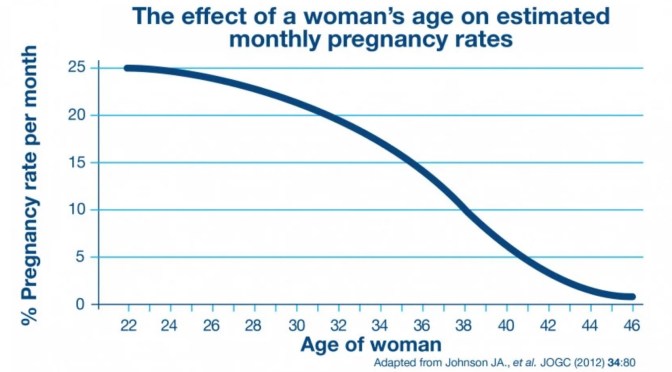
Is it easy for a woman to get pregnant after age 30?

This UK Daily Mail article is a bit old now, but I still it’s important to spread around the knowledge about when a woman’s fertility starts to decline. Somehow, in this age of feminism, there is this idea that women can put off pregnancy into their 40s. The truth is quite different. Let’s take a look at the facts from an unlikely source – the British socialist single-payer health system.

It says:

One of Britain’s top NHS fertility specialists last night issued a stark warning to women: Start trying for a baby before you’re 30 – or risk never having children.

In a strongly worded letter to Education Secretary Nicky Morgan, consultant gynaecologist Professor Geeta Nargund has also demanded that teenagers are taught about the dangers of delaying parenthood, because of the spiralling cost to the taxpayer of IVF for women in their late 30s and 40s.

Professor Nargund cites the agony of a growing number of women left childless as a key reason why fertility lessons must be included in the national curriculum. Her controversial intervention – in which she warns Britain faces a ‘fertility timebomb’ – will fuel the debate over the best time to start a family, amid the rise in women delaying motherhood to pursue careers.

[…]Arguing passionately for fertility lessons, she tells Mrs Morgan: ‘Information is power and the best way to empower people to take control of their fertility is through education.’ Prof Nargund said last night: ‘Ideally, if a woman is ready for a child, she should start trying by the time she is 30. She should consider having a child early because as a woman gets older, her fertility declines sharply.’

If a woman started trying early enough, doctors would still have time to diagnose problems and take action before it was too late, she said.

Her comments were endorsed by Professor Allan Pacey, outgoing chair of the British Fertility Society.

‘You need to be trying by 30 because if there is a problem and you need surgery, hormones or IVF, then you’ve got five years to sort it out,’ he said. ‘If a woman starts trying at 35, doctors have got to sort it out when she is already on a slippery fertility slope’.

Let’s see how accurate women’s beliefs about fertility and age are.

Consider this article from Aeon magazine.

It says:

Many studies show that women are not only woefully ignorant when it comes to fertility, conception and the efficacy of assisted reproductive technologies (ART) – but they overestimate their knowledge about the subject. For instance, a 2011 study in Fertility and Sterility surveyed 3,345 childless women in Canada between the ages of 20 and 50; despite the fact that the women initially assessed their own fertility knowledge as high, the researchers found only half of them answered six of the 16 questions correctly. 72.9 per cent of women thought that: ‘For women over 30, overall health and fitness level is a better indicator of fertility than age.’ (False.) And 90.9 per cent felt that: ‘Prior to menopause, assisted reproductive technologies (such as IVF) can help most women to have a baby using their own eggs.’ (Also false.) Many falsely believed that by not smoking and not being obese they could improve their fertility, rather than the fact that those factors simply negatively affect fertility.

[…]According to a 2011 study in Human Reproduction, which surveyed 410 undergraduate students, most overestimated a women’s chances of spontaneous pregnancy in all age groups, but particularly after receiving IVF beyond age 40. Only 11 per cent of the students knew that genetic motherhood is unlikely to be achieved from the mid-40s onward, unless using oocytes or egg cells frozen in advance. ‘This can be explained by technological “hype” and favourable media coverage of very late pregnancies,’ the authors concluded.

People see graphs of pregnancy chances, but they forget that the rate of miscarriage is also increasing as you age. So, even if you get pregnant, there is a higher risk of miscarriage. Not to mention ectopic pregnancies, and pregnancy complications. It’s also harder to get pregnant your first time after age 30. It’s easier to get pregnant after 30, if it’s not your first time. Also, pregnancies after 30 are much harder on a woman’s body than pregnancies in her 20s.

So, I guess now I’ll issue my advice to women in their 20s on how to avoid infertility:

If you went to college, chances are that you absorbed a lot of feminism. Feminism emphasizes being free of constraints, feeling happy, having fun, career over family, and independence from the needs of men and children. You need to renew your mind in order to undo the cultural denigration of marriage and children. Get yourself a marriage mentor, ask for book recommendations that will educate you about the challenges and rewards of marriage. A good marriage mentor will explain to you why marriage is a better plan than the feminist plan, and will emphasize self-denial, self-sacrifice, self-control and serving others. It’s only by getting specific about marriage and parenting that your heart will change to want to work on marriage rather than work on the things that the feminist culture prefers.

I guess my closing advice would be to be careful about the things you hear about marriage in the culture. It’s very tempting to just believe the words of other people, when they tell you what you want to hear. A lot of people have agendas that sound good, but ultimately, they don’t satisfy. Once your fertility is gone, it’s really gone. IVF and egg-freezing are expensive and unreliable. Again, you should look into this yourself, rather than rely on people who say whatever you want to hear so that you will like them.

Issues in educating children to be effective and influential Christians

So, in this post I’m going to briefly go over three challenges to producing effective, influential children. First, choose a better spouse. Second, Christian classical schools. Third, socialist countries make homeschooling and private Christian schools effectively illegal.

1. Choose a better spouse

So let’s start with the first one. Christian parents and pastors need to educate young people to choose spouses who are equipped educate to produce effective and influential children.

So in the case of choosing a man who will be involved in producing effective, influential children, here are some tips:

  • don’t choose a man based on attraction to his appearance or displayed wealth
  • whether homeschooling or private Christian schools, the man should have chosen a major and a career that allows him to pay to avoid public schools
  • it’s better to choose a man whose career allows him to work from home, so that he is available to supervise the education, and discipline the children as they grow
  • he should demonstrate his ability to move people in his circle of influence to greater effectiveness and influence, for example making them try harder at school and work, or get better at defending the Christian worldview, especially on controversial issues

So in the case of choosing a woman who will be involved in producing effective, influential children, here are some tips:

  • don’t choose a woman based on attraction to her appearance or sexual availability
  • children need their their mothers at home from birth to age 5, so if a woman has a career, then she needs to put it on hold during that time. If a woman wants to do a career to benefit the Christian community as a whole, e.g. – Supreme Court justice, then she should probably not have children between those ages
  • it’s better to choose a woman who has demonstrated the ability to do hard things, so that she has the ability to take responsibility and be accountable for producing results, e.g. – a degree in computer science, and two years of private sector coding experience
  • she should demonstrate her ability to move people in her circle of influence to greater effectiveness and influence, for example making them try harder at school and work, or get better at defending the Christian worldview, especially on controversial issues

It’s no good to complain when the children arrive that your spouse isn’t involved in spiritual and moral education. The time to settle that was when you were training to evaluate and choose your spouse. And Christian parents and pastors have a role to play in equipping young people to make better choices.

2. Classical Christian schools

I’ve looked over the curricula of a number of these classical Christian schools, and I am not convinced that they are useful for producing effective, influential Christians.

Suppose I were trying to educate my child to be the next Jay Richards or the next Stephen C. Meyer or the next Kristen Waggoner or the next Clarence Thomas. Are classical Christian schools useful for producing results like that?

Education has two goals. 1) educating the person in valuable skills, so that they can earn a lot of money without sacrificing family engagement, and without violating their conscience. 2) it should teach young people to resist the culture on the basis of reason and evidence. If we are talking about God’s existence or origins, then we are dealing with mainstream science. If we are talking about gospel reliability or the resurrection, then we are making historical arguments using mainstream evidence. If we’re talking about religious pluralism or the problem of evil, then we’re talking about mainstream philosophical theology and philosophy of religion. Etc.

I have yet to meet anyone involved with classical Christian schools who was steering young people into careers where they would make a lot of money, working from home, and not exposing themselves to cancel culture. You would think that these classical Christian schools would be focused on careers like developing software with open-source components, but they don’t have the skills. Secondly, apologetics is poorly handled in these curricula. If there is any, it’s presuppositional – an approach that is used by none of the most effective and influential Christian scholars. The ones who actually debate non-Christians and move the ball downfield in the culture.

3. Move to a conservative state in a conservative country

Many Christian men and women often pooh-pooh my seriousness about marriage and parenting planning. They say “I was born in Washington, and it’s a fine state. The public schools are great here. And I’m sure the government, although entirely Democrat, will respect my rights as a parent and as a Christian. After all, I pay their salaries.” But this is just laziness and ignorance. The people who say this don’t want the burden of having to make plans, and execute plans in order to produce effective, influential children.

Consider this article from Daily Wire, about Germany – a secular socialist state:

Home education has been outlawed in Germany for more than a century; four years ago, the European Court of Human Rights ruled against a family from Darmstadt, Germany, which had asserted the right to homeschool their children. Private religious schools, although legal, must follow state-mandated curricula from the area in which they are located.

Tobias Riemenschneider, a pastor at Evangelical Reformed Baptist Church in Frankfurt, Germany, said in an interview with The Daily Wire that the nation’s restrictive education laws present “great difficulty to parents who are convinced by their Christian faith that it is God’s will for them to raise their children themselves in the nurture and admonition of the Lord.” He noted that parents who defy government sanctions against home education risk incurring considerable fines, prison sentences, and the possibility that authorities will take their children.

The same kind of stuff is happening now, in states like Washington and California.

It’s just like those Christian-owned business in SOGI states. SOGI states elevate sexual orientation and gender identity to be a protected category, like race. Christian businesses in those states think “well, I was born here, and my family is here, so I’m going to start a business here, and keep right out of politics. I’m sure God will make my laziness and ignorance work out”. They are taken by surprise by being persecuted by secular left tyrants. A much better plan is to be serious about moving to a state with low taxes, high liberty, and support for the plans of Christian parents. It’s better to spend your own money on educating your kids, rather than to spend it on legal defense.