
Is Eugenie Scott right? Are there no peer-reviewed papers supporting ID?

The video above is discussed in this must-hear podcast, featuring Casey Luskin.

The MP3 file is here.

Details:

On this episode of ID The Future, Casey Luskin puts to rest once and for all the common assertion by opponents of intelligent design that there are no scientific papers supporting the claims of ID. This wasn’t true in 2005 when Eugenie Scott of the NCSE stated it on MSNBC and it certainly isn’t true six years later. Luskin discusses the most recent scientific paper, by Stephen Meyer and Paul Nelson, and talks about the importance of the peer-reviewed scientific literature: “These papers collectively make a case that intelligent causation is necessary to produce the sort of biological complexity that we are discovering in the cell today.”

If you listen to the podcast, Luskin goes over some of the recent peer-reviewed papers that support ID. But much more importantly, he proves that Eugenie Scott is a liar. She is literally caught in a lie in the video above. She claims that there are no peer-reviewed papers that support ID. Stephen Meyer cites a peer-reviewed paper that he authored. Eugenie Scott claims that the paper does not mention ID. Casey Luskin reads from the paper. The paper explicitly supports ID. Eugenie Scott lied in order to defend her religion of naturalism from the scientific publication that falsifies it.

Here’s an excerpt from the paper that Eugenie Scott claims doesn’t support intelligent design:

Does neo-Darwinism or any other purely materialistic model of morphogenesis account for the origin of the genetic and other forms of CSI necessary to produce novel organismal form? If not, as this review has argued, could the emergence of novel information-rich genes, proteins, cell types and body plans have resulted from actual design, rather than a purposeless process that merely mimics the powers of a designing intelligence? The logic of neo-Darwinism, with its specific claim to have accounted for the appearance of design, would itself seem to open the door to this possibility. Indeed, the historical formulation of Darwinism in dialectical opposition to the design hypothesis (Gillespie 1979), coupled with the neo-Darwinism’s inability to account for many salient appearances of design including the emergence of form and information, would seem logically to reopen the possibility of actual (as opposed to apparent) design in the history of life.

And:

Yet it is precisely for this reason that current advocates of the design hypothesis want to reconsider design as an explanation for the origin of biological form and information. This review, and much of the literature it has surveyed, suggests that four of the most prominent models for explaining the origin of biological form fail to provide adequate causal explanations for the discontinuous increases of CSI that are required to produce novel morphologies. Yet, we have repeated experience of rational and conscious agents–in particular ourselves–generating or causing increases in complex specified information, both in the form of sequence-specific lines of code and in the form of hierarchically arranged systems of parts.

And:

There is a third reason to consider purpose or design as an explanation for the origin of biological form and information: purposive agents have just those necessary powers that natural selection lacks as a condition of its causal adequacy. At several points in the previous analysis, we saw that natural selection lacked the ability to generate novel information precisely because it can only act after new functional CSI has arisen. Natural selection can favor new proteins, and genes, but only after they perform some function. The job of generating new functional genes, proteins and systems of proteins therefore falls entirely to random mutations. Yet without functional criteria to guide a search through the space of possible sequences, random variation is probabilistically doomed. What is needed is not just a source of variation (i.e., the freedom to search a space of possibilities) or a mode of selection that can operate after the fact of a successful search, but instead a means of selection that (a) operates during a search–before success–and that (b) is guided by information about, or knowledge of, a functional target.

And the conclusion:

An experience-based analysis of the causal powers of various explanatory hypotheses suggests purposive or intelligent design as a causally adequate–and perhaps the most causally adequate–explanation for the origin of the complex specified information required to build the Cambrian animals and the novel forms they represent. For this reason, recent scientific interest in the design hypothesis is unlikely to abate as biologists continue to wrestle with the problem of the origination of biological form and the higher taxa.

Those are just a few excerpts.

According to Eugenie Scott, this paper “doesn’t mention intelligent design”. She is a liar.

In listening to this podcast, it really struck me how proponents of evolution must lie in order to defend their religion – the religion of naturalism. You would think that the refutation of naturalism by the Big Bang cosmology would cause these naturalists to abandon the religion of naturalism, and be open to the reality of non-material intelligent causation. But it’s not the case. Naturalists must necessarily oppose the progress of science. They oppose the Big Bang cosmology. They oppose the cosmic fine-tuning. They oppose origin of life research. They oppose the fossils found in the Cambrian explosion. They oppose findings showing the high requirements for habitable galaxies, solar systems and planets.

It’s a case of religion versus science. The speculations of a blind-faith religion against the experimental results of scientific research. The anti-ID people have the religion of naturalism to defend, and the pro-ID people have the science.  One side is willing to lie about nature, and the other side tells the truth about nature.

If you missed it, my previous post noted how the list of pro-ID peer-reviewed papers is now up to 50.
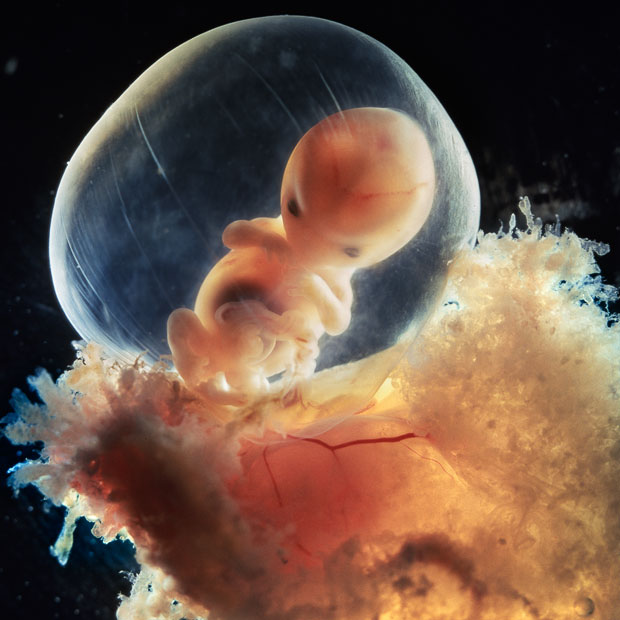
The return of the Life Training Institute podcast

Unborn baby scheming about the new LTI podcast

The LTI podcast features a pro-life look at news, law and policy.

You can grab the MP3 file here. (30 minutes)

Topics:

  • Susan G. Komen and Planned Parenthood
  • HHS forces religious organizations to cover contraception
  • Evangelicals and political engagement
  • Barack Obama: women need abortion in order to be equal
  • what does the Bible say about abortion?
  • do people have intrinsic value?

This podcast does not discuss how Susan G. Komen backed away from their decision to not fund Planned Parenthood after the mainstream media put pressure on them to continue funding the largest abortion provider in the United States. But the LTI  guys are smart – they were skeptical about giving money to Susan G. Komen even after the initial announcement.  Also note that one of the nice things about Scott Klusendorf is that he is an evangelical Christian – not a Roman Catholic. So it’s nice to see an evangelical Christian taking the lead on moral issues – it makes me proud to be an evangelical. Evangelical men ought to be as well informed about moral issues as they are about politics, science and foreign policy.

Susan G. Komen and Planned Parenthood

Mary sent me a story on the Susan G. Komen Foundation that analyzes how they are linked to Planned Parenthood from the Wall Street Journal. It’s by Robbie George of Princeton, so you have to read it!

Excerpt:

The Susan G. Komen Foundation, an organization dedicated since 1982 to fighting, and one day curing, breast cancer, decided to extricate itself from the culture wars by discontinuing grants to Planned Parenthood, the nation’s largest provider of abortions. The grants Komen had been making amounted to $650,000 last year, funding some 19 local Planned Parenthood programs that offered manual breast exams but only referrals for mammograms performed elsewhere.

The reality is that Planned Parenthood—with annual revenues exceeding $1 billion—does little in the way of screening for breast cancer. But the organization is very much in the business of selling abortions—more than 300,000 in 2010, according to Planned Parenthood. At an average cost of $500, according to various sources including Planned Parenthood’s website, that translates to about $164 million of revenue per year.

So how did Planned Parenthood and its loyal allies in politics and the media react to Komen’s efforts to be neutral in the controversy over abortion?

Faced with even the tiniest depletion in the massive river of funds Planned Parenthood receives yearly, the behemoth mobilized its enormous cultural, media, financial and political apparatus to attack the Komen Foundation in the press, on TV and through social media.

The organization’s allies demonized the charity, attempting to depict the nation’s most prominent anti-breast cancer organization as a bedfellow of religious extremists. A Facebook page was set up to “Defund the Komen Foundation.” In short, Planned Parenthood took breast-cancer victims as hostages.

Komen’s leaders had good reason to believe their organization could disintegrate under Planned Parenthood’s assault. On Friday the charity issued a statement “apologizing to the American public for recent decisions that cast doubt upon our commitment to our mission of saving women’s lives.” The statement assured Planned Parenthood’s supporters that, like any other organization, it is eligible to apply for grants in the future.

I think the bottom line is this. There are plenty of non-Christians giving money to causes like this. If you are a Christians, you’re much better off giving your money to an organization like Life Training Institute. At the very least, you should all buy “The Case for Life”, which is the best  small book on pro-life apologetics.

By the way, I blogged on the previous LTI podcast here. That one was from March 2010. I hope they make more of these regularly.

Ayaan Hirsi Ali talks about the war on Christians in Muslim countries

Map of Africa
Map of Africa

This story appeared in the radically left-wing Newsweek, of all places.

Excerpt:

From blasphemy laws to brutal murders to bombings to mutilations and the burning of holy sites, Christians in so many nations live in fear. In Nigeria many have suffered all of these forms of persecution. The nation has the largest Christian minority (40 percent) in proportion to its population (160 million) of any majority-Muslim country. For years, Muslims and Christians in Nigeria have lived on the edge of civil war. Islamist radicals provoke much if not most of the tension. The newest such organization is an outfit that calls itself Boko Haram, which means “Western education is sacrilege.” Its aim is to establish Sharia in Nigeria. To this end it has stated that it will kill all Christians in the country.

In the month of January 2012 alone, Boko Haram was responsible for 54 deaths. In 2011 its members killed at least 510 people and burned down or destroyed more than 350 churches in 10 northern states. They use guns, gasoline bombs, and even machetes, shouting “Allahu akbar” (“God is great”) while launching attacks on unsuspecting citizens. They have attacked churches, a Christmas Day gathering (killing 42 Catholics), beer parlors, a town hall, beauty salons, and banks. They have so far focused on killing Christian clerics, politicians, students, policemen, and soldiers, as well as Muslim clerics who condemn their mayhem. While they started out by using crude methods like hit-and-run assassinations from the back of motorbikes in 2009, the latest AP reports indicate that the group’s recent attacks show a new level of potency and sophistication.

The Christophobia that has plagued Sudan for years takes a very different form. The authoritarian government of the Sunni Muslim north of the country has for decades tormented Christian and animist minorities in the south. What has often been described as a civil war is in practice the Sudanese government’s sustained persecution of religious minorities. This persecution culminated in the infamous genocide in Darfur that began in 2003. Even though Sudan’s Muslim president, Omar al-Bashir, has been indicted by the International Criminal Court in The Hague, which charged him with three counts of genocide, and despite the euphoria that greeted the semi-independence he grant-ed to South Sudan in July of last year, the violence has not ended. In South Kordofan, Christians are still subject-ed to aerial bombardment, targeted killings, the kidnap-ping of children, and other atrocities. Reports from the United Nations indicate that between 53,000 and 75,000 innocent civilians have been displaced from their resi-dences and that houses and buildings have been looted and destroyed.

Both kinds of persecution—undertaken by extragovernmental groups as well as by agents of the state—have come together in Egypt in the aftermath of the Arab Spring. On Oct. 9 of last year in the Maspero area of Cairo, Coptic Christians (who make up roughly 11 percent of Egypt’s population of 81 million) marched in protest against a wave of attacks by Islamists—including church burnings, rapes, mutilations, and murders—that followed the overthrow of Hosni Mubarak’s dictatorship. During the protest, Egyptian security forces drove their trucks into the crowd and fired on protesters, crushing and killing at least 24 and wounding more than 300 people. By the end of the year more than 200,000 Copts had fled their homes in anticipation of more attacks. With Islamists poised to gain much greater power in the wake of recent elections, their fears appear to be justified.

Egypt is not the only Arab country that seems bent on wiping out its Christian minority. Since 2003 more than 900 Iraqi Christians (most of them Assyrians) have been killed by terrorist violence in Baghdad alone, and 70 churches have been burned, according to the Assyrian International News Agency (AINA). Thousands of Iraqi Christians have fled as a result of violence directed specifically at them, reducing the number of Christians in the country to fewer than half a million from just over a million before 2003. AINA understandably describes this as an “incipient genocide or ethnic cleansing of Assyrians in Iraq.”

The 2.8 million Christians who live in Pakistan make up only about 1.6 percent of the population of more than 170 million. As members of such a tiny minority, they live in perpetual fear not only of Islamist terrorists but also of Pakistan’s draconian blasphemy laws. There is, for example, the notorious case of a Christian woman who was sentenced to death for allegedly insulting the Prophet Muhammad. When international pressure persuaded Punjab Gov. Salman Taseer to explore ways of freeing her, he was killed by his bodyguard. The bodyguard was then celebrated by prominent Muslim clerics as a hero—and though he was sentenced to death late last year, the judge who imposed the sentence now lives in hiding, fearing for his life.

Such cases are not unusual in Pakistan. The nation’s blasphemy laws are routinely used by criminals and intolerant Pakistani Muslims to bully religious minorities. Simply to declare belief in the Christian Trinity is considered blasphemous, since it contradicts mainstream Muslim theological doctrines. When a Christian group is suspected of transgressing the blasphemy laws, the consequences can be brutal. Just ask the members of the Christian aid group World Vision. Its offices were attacked in the spring of 2010 by 10 gunmen armed with grenades, leaving six people dead and four wounded. A militant Muslim group claimed responsibility for the attack on the grounds that World Vision was working to subvert Islam. (In fact, it was helping the survivors of a major earthquake.)

Not even Indonesia—often touted as the world’s most tolerant, democratic, and modern majority-Muslim nation—has been immune to the fevers of Christophobia. According to data compiled by the Christian Post, the number of violent incidents committed against religious minorities (and at 7 percent of the population, Christians are the country’s largest minority) increased by nearly 40 percent, from 198 to 276, between 2010 and 2011.

The litany of suffering could be extended. In Iran dozens of Christians have been arrested and jailed for daring to worship outside of the officially sanctioned church system. Saudi Arabia, meanwhile, deserves to be placed in a category of its own. Despite the fact that more than a million Christians live in the country as foreign workers, churches and even private acts of Christian prayer are banned; to enforce these totalitarian restrictions, the religious police regularly raid the homes of Christians and bring them up on charges of blasphemy in courts where their testimony carries less legal weight than a Muslim’s. Even in Ethiopia, where Christians make up a majority of the population, church burnings by members of the Muslim minority have become a problem.

Please read the whole thing.

I am actually perplexed as to how this got published in Newsweek, a magazine that might as well be edited by George Soros. But there it is, so we need to read it and share it while it lasts. I would expect that this is the first that any of Newsweek’s readers have heard about how Christians are persecuted in the Middle East.