Are French parents superior to American parents?

From the Wall Street Journal, a shocking story.

Excerpt:

Rest assured, I certainly don’t suffer from a pro-France bias. Au contraire, I’m not even sure that I like living here. I certainly don’t want my kids growing up to become sniffy Parisians.

But for all its problems, France is the perfect foil for the current problems in American parenting. Middle-class French parents (I didn’t follow the very rich or poor) have values that look familiar to me. They are zealous about talking to their kids, showing them nature and reading them lots of books. They take them to tennis lessons, painting classes and interactive science museums.

Yet the French have managed to be involved with their families without becoming obsessive. They assume that even good parents aren’t at the constant service of their children, and that there is no need to feel guilty about this. “For me, the evenings are for the parents,” one Parisian mother told me. “My daughter can be with us if she wants, but it’s adult time.” French parents want their kids to be stimulated, but not all the time. While some American toddlers are getting Mandarin tutors and preliteracy training, French kids are—by design—toddling around by themselves.

And:

Authority is one of the most impressive parts of French parenting—and perhaps the toughest one to master. Many French parents I meet have an easy, calm authority with their children that I can only envy. Their kids actually listen to them. French children aren’t constantly dashing off, talking back, or engaging in prolonged negotiations.

One Sunday morning at the park, my neighbor Frédérique witnessed me trying to cope with my son Leo, who was then 2 years old. Leo did everything quickly, and when I went to the park with him, I was in constant motion, too. He seemed to regard the gates around play areas as merely an invitation to exit.

Frédérique had recently adopted a beautiful redheaded 3-year-old from a Russian orphanage. At the time of our outing, she had been a mother for all of three months. Yet just by virtue of being French, she already had a whole different vision of authority than I did—what was possible and pas possible.

Frédérique and I were sitting at the perimeter of the sandbox, trying to talk. But Leo kept dashing outside the gate surrounding the sandbox. Each time, I got up to chase him, scold him, and drag him back while he screamed. At first, Frédérique watched this little ritual in silence. Then, without any condescension, she said that if I was running after Leo all the time, we wouldn’t be able to indulge in the small pleasure of sitting and chatting for a few minutes.

“That’s true,” I said. “But what can I do?” Frédérique said I should be sterner with Leo. In my mind, spending the afternoon chasing Leo was inevitable. In her mind, it was pas possible.

I pointed out that I’d been scolding Leo for the last 20 minutes. Frédérique smiled. She said that I needed to make my “no” stronger and to really believe in it. The next time Leo tried to run outside the gate, I said “no” more sharply than usual. He left anyway. I followed and dragged him back. “You see?” I said. “It’s not possible.”

Frédérique smiled again and told me not to shout but rather to speak with more conviction. I was scared that I would terrify him. “Don’t worry,” Frederique said, urging me on.

Leo didn’t listen the next time either. But I gradually felt my “nos” coming from a more convincing place. They weren’t louder, but they were more self-assured. By the fourth try, when I was finally brimming with conviction, Leo approached the gate but—miraculously—didn’t open it. He looked back and eyed me warily. I widened my eyes and tried to look disapproving.

After about 10 minutes, Leo stopped trying to leave altogether. He seemed to forget about the gate and just played in the sandbox with the other kids. Soon Frédérique and I were chatting, with our legs stretched out in front of us. I was shocked that Leo suddenly viewed me as an authority figure.

“See that,” Frédérique said, not gloating. “It was your tone of voice.” She pointed out that Leo didn’t appear to be traumatized. For the moment—and possibly for the first time ever—he actually seemed like a French child.

There’s a young woman I was very impressed by and I was spending some time with her last year. One day she and I were over at a friend’s house and they have 3 kids. The lady was paying attention to the eldest boy – smiling and being gentle. He decided to start wielding a bean bag around and there was a danger of knocking things over. The lady leaned forward and said to the boy “NO” sternly. He sat there staring at her for a few seconds defiantly, and all conversation in the room stopped. He was trying to decide if she was in a position to command him, and if she was serious about her command. She kept looking sternly at him, right in the eyes. He never looked at his parents. Then he put the bean bag down, and his parents laughed. They were delighted. And so was I – with her. It was such a joy her to see how she paid attention to the boy and set boundaries on him – and he listened to her.
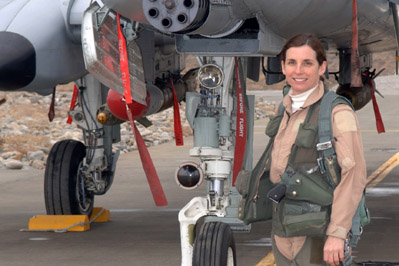
Colonel Martha McSally enters congressional race for vacant Arizona seat

Colonel  Martha McSally
Colonel Martha McSally

From Military.com. (H/T Gateway Pundit)

Excerpt:

The first woman to fly fighters in combat for the Air Force, and first to command a fighter squadron in combat, is entering Arizona’s special election to fill U.S. Rep. Gabrielle Giffords’ vacated congressional seat.

Martha McSally confirmed her intentions Wednesday to join the Republican primary. She made her decision after analyzing three factors: was it feasible, was she electable, and did she feel called to run.

McSally said she’s sure she is the right person for the job. “I believe my leadership and my demonstrated moral courage and experience is what this community and this nation needs right now.”

[…]She commanded a squadron of A-10 attack jets in Afghanistan. After that, she was sent to the Air War College in Alabama, where she finished first in a class of 225 people being groomed as senior leaders. She spent her final three years in the Air Force in Stuttgart, Germany.

Gateway Pundit adds:

Southern Arizona is buzzing with the possible entrance of a new candidate in the special election to replace Congresswoman Gabrielle Giffords. Martha McSally, the woman who, in 2002, challenged the Department of Defense rule requiring American servicewoman in Saudi Arabia to dress in a Muslim Abaya and headscarf when travelling off base, reportedly plans to formally announce her candidacy Thursday.

McSally, who retired from the Air Force as a colonel, was also the first woman in United States history to fly in combat, and the first woman to lead a squadron into combat, in the skies above Iraq and Afghanistan. McSally is a Distinguished Graduate of the Air Force Academy, earned her Master’s Degree, in Public Policy, from the JFK School of Government at Harvard, and in 1995 was one of only seven active duty Air Force officers selected for the prestigious Legislative Fellowship Program in Washington. She spent the last few years teaching military and foreign affairs to world leaders at the George C. Marshall Center in Germany.

She’s also champion triathlete and has climbed Mt. Kilimanjaro

Democrats in the Southern Arizona district, are lining up behind former Giffords’ aide Ron Barber to replace the outgoing congresswoman. Barber is being described by local Democrats as a “placeholder” or “caretaker” until the end of Giffords’ term. But it’s hard not to wonder if the entrance of a dynamic, young Republican woman will change the nature of this race.

McSally is conservative, pro-life, pro-2nd amendment, and everything else that voters in a Republican-leaning district are yearning for. So have the Democrats in Arizona’s 8th congressional district made a mistake? Some people are starting to think so. Martha McSally isn’t Gabrielle Giffords. But her dynamic personality, her clear convictions and accomplished resume could be just what conservatives need if they want to win the race that one Washington insider called, “the next biggest thing to the Presidential” race this year.

I’d like to know her views on the definition of marriage, but that’s still a good resume. I think I know one reason why she might be running – her A-10 Thunderbolt II was targeted in the Obama’s administration’s most recent round of cuts to American defense capabilities.

Here’s an interview she did with the radically left-wing 60 Minutes:

Here’s a bit more about the A-10 Thunderbolt II that she flew. (Picture, Specifications)

Part 1 of 2:

Part 2 of 2:

I built a model of one of these as a child, and hung it from the ceiling of my room. A great strike platform. I have mounted Rockeye cluster munitions on these guys when playing Steel Panthers and used them to immobilize/destroy multiple Russian T-72s in one pass. The AGM-65 Mavericks are effective at long range, as well.

Senator Marco Rubio’s speech at the conservative CPAC 2012 conference

If I had to choose one Republican who gives great speeches on what it means to be a conservative, I would pick Marco Rubio. (25 minutes)

Here’s an article from Human Events about the speech, for those who can’t watch it or listen to it.

Excerpt:

Rubio ranked the strength of the American people alongside the importance of economic and military strength, for it is our people – not our government – who have made us great.  He sees critical institutions of society, which contribute to the strength of citizens and families, under assault by the Obama Administration.  “We have a President who, just a few days ago, issued a mandate ordering religious institutions to follow his ideals… telling religious-based organizations that they must, by mandate of the federal government, pay for things that religion teaches is wrong.  You may not agree with that religion’s teachings, but that’s not the point.  The point is that the First Amendment still applies.  Religious freedom still exists.”

He confessed he isn’t sure what the foreign constitutions Justice Ginsburg admires might have to say on the matter, but he knows what the United States Constitution says: “The federal government does not have the power to force religious organizations to pay for things that organization thinks is wrong!”

On the scale of history, only a “moment” has passed since world wars were fought against totalitarian evil.  What followed could hardly be described as “world peace,” and cleaning the blood from the edge of the statist hammer has not softened its essential nature.  “Today millions of people around the world are part of the middle class because of the rise of democracy and free enterprise.  Did that happen on its own?  Is that the natural state of man?”  Rubio suggested a study of humanity’s long history beneath the boots of oppressors answers that question.

Democracy and free enterprise spread, not because they are humanity’s default condition, but because “the most powerful nation in the world believed in these things, fought for these things, spoke out for these things… and most importantly, was an example of these things.”  The power of the American example transcends military and political force, because “all around the world, there are people who know there is someone just like them, living here, doing things they cannot.”

“What happens if we diminish, because we can no longer afford to be the leader of the free world?” Rubio asked.  “What happens if we diminish because our leaders decide they don’twant to be the leaders of the free world anymore?  What happens if we retreat?  What happens is that we’ll leave a space, and that space will be filled by someone else.”  The likely candidates for our successor as global hyperpower are totalitarian states like Russia and China… whose measure Rubio took by noting that they’ve vetoed United Nations efforts to rein in Syria’s dictator, Bashar Assad, because they reserve the right to use such brutal tactics against their own people.

Rubio understands that the clash of civilizations cannot be won from an easy chair, or a death bed.  “The greatest thing we can do for the people of the world is be America,” he concluded.  “That’s what’s at stake here.  That’s what November will be about.”

It would be a shame if all the people who flee to America, to escape from socialist decay and totalitarian repression, found the very things they fled awaiting them on our shores.  It pays to take a moment and see our exceptional nation through the eyes of those tired, poor, huddled masses, as Marco Rubio has done.

You can listen to an MP3 of the speech here. (12 Mb)

He’s only 40 years old. We have a deep, deep bullpen.