Michael Behe and Keith Fox debate theistic evolution vs intelligent design

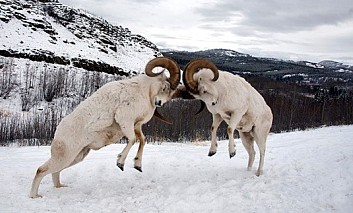
Two Rams butting heads: may the best ram win!

Michael Behe and Keith Fox debate evolution and intelligent design. (See below for link to video)

Details:

Michael Behe is professor of biochemistry at Lehigh University, Pennsylvania and the founder of the modern Intelligent Design movement. His book “Darwin’s Black Box” ignited the controversy 14 years ago when it claimed that certain molecular machines and biological processes are “irreducibly complex” and cannot be explained by Darwinian evolution.

Keith Fox is Professor of biochemistry at the University of Southampton and chairman of Christians in Science. As a theistic evolutionist he believes that Evolution is the best explanation going for the complexity we see and that ID is a blind scientific alley and theologically unappealing to boot.

They debate whether micromachines in the cell such as the “bacterial flagellum” could have evolved by a Darwinian process of evolution. When inference to design is and isn’t acceptable in science. Whether random mutation can mathematically stack up to complex life, and whether God is reduced to a divine “tinkerer” by ID.

Here’s the debate:

Summary

Note: the following debate summary is rated “S” for Snarky. Reader discretion is advised.

Michael Behe:

  • ID is not Biblical creationism
  • ID is not religion
  • ID is a scientific research program
  • People refuse to discuss ID because of personal philosophical assumptions
  • ID is like the Big Bang – it is based on evidence, but it has broad religious implications

Keith Fox:

  • ID is not Biblical creationism, but it isn’t science

Michael Behe:

  • ID is compatible with common descent
  • ID is only opposed to unplanned, unguided evolution (Darwinism)
  • ID is not necessarily opposed to long periods of time

Behe’s first book – the bacterial flagellum

Keith Fox:

  • Here are a couple of papers that show how parts of the flagellum evolved
  • They are possible pathways

Michael Behe

  • No, those are studies that show that there are similarities between bacterial flagella in multiple organisms
  • Similarities of proteins between different organisms do not necessarily imply a developmental pathway
  • The problem of having the instructions to BUILD the flagellum still remains

Keith Fox:

  • Maybe parts of the flagellum had other functions before they were used in the flagellum
  • Maybe you can use the parts of the flagellum for other purposes
  • Maybe, one can imagine, it’s possible that!

Michael Behe:

  • No, parts have to be modified and re-purposed in order to be used for other functions

Keith Fox:

  • But maybe the proteins can be used in other systems for other things
  • I re-purpose parts from of designed things to other purposes in my house when I do maintenance

Michael Behe

  • Uh, yeah – but aren’t you an intelligent designer? What does your home maintenance have to do with Darwinian evolution?

Is ID another God-of-the-gaps argument?

Michael Behe:

  • Well consider the Big Bang… there was a build-up of scientific evidence for that theory
  • Just because a theory has religious implications, doesn’t mean that it isn’t true
  • You really have to look at the specific evidence for a theory, and not decide in advance

Keith Fox: (I’m paraphrasing/inventing/mocking from now on)

  • But the Big Bang is based on discoveries, and intelligent design is based on gaps in our scientific knowledge
  • What if I did have evidence of a step by step pathway (which I don’t right now)? Then I would win the argument – what would you do then?

Michael Behe:

  • Well, if tomorrow you do manage to find expiremental evidence of a pathway, which you don’t have today, then I would be wrong
  • ID is falsifiable by experimental evidence
  • But what about your your view? Is that falsifiable by experimental evidence?
  • What if someone goes into a lab (someone like Scott Minnich?) and performs gene knockout experiments, and publishes the results
  • You knock out a gene from the bacterial flagellum, you wait for a large number of generations, and it never develops the missing gene
  • You repeat this with every one of the 50 genes in the bacterial flagellum and it never recovers for any of the 50 genes
  • There is no pathway to build up even one of the 50 genes – according to actual experiments
  • What do Darwinists do with experimental evidence that falsifies Darwinism?

Keith Fox:

  • No, I would not accept that experimental evidence could falsify Darwinism
  • Just because known published experimental evidence that we have today falsifies Darwinism, it doesn’t mean Darwinism is false because it’s not falsifiable
  • We don’t know how Darwinism even works – it happened so long ago, and it’s not repeatable or testable, so how could lab ,experiments falsify it?
  • Darwinism is science and intelligent design is faith, though

Which side has the experimental evidence?

Michael Behe:

  • Consider the largest longest-running lab experiment of evolution, Richard Lenski’s experiments on e. coli
  • Lenski has presided over 50,000 generations, (millions of years of evolution)
  • The bacterium did evolve and they did get better but not by evolving features, but by disabling features

Keith Fox:

  • But those are just LAB EXPERIMENTS! What do lab experiments prove?
  • What if? What if? What if? You don’t know, it happened so long ago, and you weren’t there! You weren’t there!
  • (clutches Flying Spaghetti Monster idol tighter and sobs pitifully)

Michael Behe:

  • See, the thing is that I have actual experiements, and here’s some more evidence that just got published last week
  • So I’ve got evidence and then some more evidence and them some other evidence – experimental evidence
  • And all the evidence shows that adaptation is done losing traits not by gaining traits
  • And the published observations are what we see in nature as well

Keith Fox:

  • But doesn’t Darwinism explain some things that we observe?

Michael Behe:

  • Well, I am not saying that micro-evolution doesn’t explain some things – it explains bacterial resistance, and other micro-evolution
  • it just doesn’t explain macro-evolution, and that’s what the experiments show

Keith Fox:

  • But ID is a science stopper! It stops science! You can’t produce experimental evidence to falsify Darwinism – that would stop science!

Michael Behe:

  • Well, you have to understand that the Big Bang postulated a non-material cause to the entire physical universe and yet the experimental evidence was allowed to stand because it was testable and verifiable evidence, even if the theory does have religious implications
  • All explanations in science are design to settle a question and it stops rival explanations that are not as good at explaining the observations
  • Finding the best explanation stops further study because it is better than rival explanations

Keith Fox:

  • Well you have to come up with a materialist explanation because that’s the only kind that a functional atheist like me will allow

Michael Behe:

  • Well, what if the best explanation for an observed effect in nature is non-material, as with the Big Bang?

Keith Fox:

  • But I have to have a material explanation because I am a functional atheist! (i.e. – a theistic evolutionist = functional atheist)

Michael Behe:

  • Well what about the cosmic fine-tuning argument? Do you accept that?
  • That’s an inference to design based on the latest scientific discoveries

Keith Fox:

  • Well I do accept that argument, but I don’t accept design in biology
  • When you apply it to biology, somehow it’s bad and you can’t do that or you losing research money and get fired
  • Anyway, your argument is based on a gap in our current knowledge

Michael Behe:

  • No, back in Darwin’s time we had a gap in our knowledge – we didn’t know what the cell was – we thought it was jello
  • Now, we know what the cell is really like, it’s irreducibly complex, and you can’t build up those molecular machines in a step-wise manner
  • The inference to design is based on the progress of science revealing the increasing levels of complexity
  • In experiments, Darwinian mechanisms cannot build anything useful, instead genes are disabled or dropped
  • You guys don’t have the evidence to prove your view that naturalistic mechanisms can do the creating
  • You keep issuing promissory notes

Keith Fox:

  • Well, you’re just seeing design subjectively, because you are a non-scientist
  • I’m being objective when I tell you that we will discover a materialist explanation later on – really really soon now, maybe even tomorrow, yeah
  • You won’t accept my speculations and you insist on these published experiments
  • You’re subjective and I’m objective
  • Just give me more research money so I can hide the decline better

Michael Behe:

  • Uh, you’re the one who is subjective – I cited evidence, and you are the one who is speculating
  • You have arguments from credulity, and I’ve got the lab experiments
  • You refuse to be skeptical, I am the one who is being skeptical

Keith Fox:

  • Maybe, maybe, maybe! Maybe tomorrow! Maybe in a parallel universe! Maybe aliens from Planet 9 from Outer Space!
  • Who knows! I certainly don’t know! And that somehow means you don’t know either! See?

Michael Behe:

  • Well, to prove me wrong, go into the lab, and run experiments and evolve some new genes (using Darwinian mechanisms) that have new useful functionality

Are there limits to what evolution can do?

Michael Behe:

  • You need multiple changes in the genome to get a new helpful feature (let’s say two specific mutations)
  • One specific change is possible
  • the odds are against getting multiple beneficial changes are really really small – you need two SPECIFIC changes to occur in order

Keith Fox:

  • Well, lots of things are really unlikely – any permutation of dice rolls is as unlikely as any other

Michael Behe:

  • Well, we are talking about TWO SPECIFIC mutations that are needed to get a beneficial function – lots of other mutations are possible, but we are looking for a specific outcome that requires two SPECIFIC mutations out of the whole genome
  • You aren’t going to get useful outcomes unless you direct the mutations

Keith Fox:

  • But then why does God allow evil!!!!1!1!!one!!!

Women, under the influence of feminism, are willing participants in the hook-up culture

A man leading a woman upward
Another post in which I try to pull women out of the quagmire of radical feminism

Note: in this article, when I refer to women, I mean young, unmarried women who have been influenced by feminism. I do not mean all women, and especially not married women.

My good friend Tom sent me this article from the ultra left-wing Vanity Fair. Tom is a veteran of the New York City dating scene and has been telling me for years about the practices described in this article.

The article is very, very long, so I can only quote a little, and then I’ll encourage you to read it, although be warned, it’s filled with sex and bad language, and it tries to present women as victims.

Excerpt:

It’s a balmy night in Manhattan’s financial district, and at a sports bar called Stout, everyone is Tindering. The tables are filled with young women and men who’ve been chasing money and deals on Wall Street all day, and now they’re out looking for hookups. Everyone is drinking, peering into their screens and swiping on the faces of strangers they may have sex with later that evening.

Tinder is a hook-up app that people use to find people to have sex with, based solely on their photograph. This is actually what studies say about how women choose men – it’s all physical appearance, and nothing that is learned subsequently alters that first impression.

The article says this:

“Romance is completely dead, and it’s the girls’ fault,” says Alex, 25, a New Yorker who works in the film industry. “They act like all they want is to have sex with you and then they yell at you for not wanting to have a relationship. How are you gonna feel romantic about a girl like that? Oh, and by the way? I met you on Tinder.

“Women do exactly the same things guys do,” said Matt, 26, who works in a New York art gallery. “I’ve had girls sleep with me off OkCupid and then just ghost me”—that is, disappear, in a digital sense, not returning texts. “They play the game the exact same way. They have a bunch of people going at the same time—they’re fielding their options. They’re always looking for somebody better, who has a better job or more money.” A few young women admitted to me that they use dating apps as a way to get free meals. “I call it Tinder food stamps,” one said.

Even the emphasis on looks inherent in a dating game based on swiping on photos is something men complain women are just as guilty of buying into. “They say in their profiles, ‘No shirtless pictures,’ but that’s bulls**t,” says Nick, the same as above. “The day I switched to a shirtless picture with my tattoos, immediately, within a few minutes, I had, like, 15 matches.”

And if women aren’t interested in being treated as sexual objects, why do they self-objectify in their profile pictures? some men ask. “There’s a lot of girls who are just like, Check me out, I’m hot, I’m wearing a bikini,” says Jason…

Men talk about the nudes they receive from women. They show off the nudes. “T*t pics and booty pics,” said Austin, 22, a college student in Indiana. “My phone is full of ‘em.”

Although the article, and the women who are interviewed, try to pass themselves off as victims, it’s very clear that they are full participants in this hook-up culture. It’s “fun” for them to be free and independent – no responsibilities, expectations or obligations from a relationship.

Feminist writer Hanna Rosin says that this hook-up culture is great:

Some, like Atlantic writer Hanna Rosin, see hookup culture as a boon: “The hookup culture is … bound up with everything that’s fabulous about being a young woman in 2012—the freedom, the confidence.”

The Vanity Fair author comments:

“Short-term mating strategies” seem to work for plenty of women too; some don’t want to be in committed relationships, either, particularly those in their 20s who are focusing on their education and launching careers.

Previously, I quoted a feminist professor writing in the New York Times. She also thought that it was great that women were hooking up with hot guys for fun, but staying focused on their educations and careers.

Here’s Amanda to explain it:

“There is no dating. There’s no relationships,” says Amanda, the tall elegant one. “They’re rare. You can have a fling that could last like seven, eight months and you could never actually call someone your ‘boyfriend.’ [Hooking up] is a lot easier. No one gets hurt—well, not on the surface.”

[…]It’s not, she says, that women don’t want to have sex. “Who doesn’t want to have sex? But it feels bad when they’re like, ‘See ya.’ ”

Who doesn’t want to have sex? Well, me for one. At least, not till I’m married.

Amanda later explains that she doesn’t want to care, because that would mean that she “somehow missed the whole memo about third-wave feminism”. She has to be independent – able to dismiss responsibilities, expectations and obligations in a real relationship – because third-wave feminism tells her so. I know Christian women who think they are fundamentalists who have this exact same attitude. They think that relationships are somehow compatible with doing whatever they want to do – that doing whatever makes them happy each and every moment is compatible with a lasting relationship. Married people laugh at this, but this is what most young, unmarried women believe. And of course most men are only to happy to take advantage of this and treat women like objects.

Why don’t women reject the men who use them like kleenexes? Why is the man’s appearance so much more important than his character and suitability for the marriage roles of husband and father? Feminism tells women that gender distinctions are “sexist”, that chivalry is “sexist”, that chastity is “repressive” because it blocks having recreational sex, that marriage is boring and must be delayed, and that having lots of sexual experience makes you more attractive. All nonsense, but this is what the vast majority of American women believe. They measure men by how the man makes them feel and whether he will be impressive physically to their peers. They believe in feminism and the denial of specific male roles and male virtues. I can’t speak for all the men, but all my male friends are either virgins or married, and we are horrified because we don’t know who we are supposed to marry.

Probably the most traumatic experiences that I have ever heard in my life are the stories I hear from women who are raised in Christian homes, with two married Christian parents, who nevertheless dump their Christianity late in high school, or sometimes when they get to university. One minute, they are adorable little kids playing with teddy bears or riding horses. The next minute they are hooking up and shacking up and avoiding marriage and child-bearing in order to have as much fun as possible.

Two interesting things about this. First, their parents never find out what is really going on. The parents always believe that the daughters are as pure as the driven snow, no matter how long the “lost” period is, where their daughters went crazy. Second, the young woman’s core desire to have fun and seek thrills never goes away. Conversion to Christianity doesn’t make an irresponsible woman responsible. And she usually is careful to surround herself with people who will affirm her in her recklessness, perhaps confidently calling her emotional desires “the voice of God speaking to her”. My friend Dina likes to tell me that these women do not want to be rescued – they are having a good time doing what they want to do, and they think it will go on forever – that the attention from men will always be there, and that chasing happiness will somehow “work out”.

What is interesting is how the parents don’t fix the problem when the girls are young. They are too busy with their careers, their own traveling and fun, etc. Usually, the girl’s mother has chosen a man who is not really strong on truth or moral convictions, because then he is easier to get along with and will not judge her. Women do not like being judged by men, either about factual claims or about moral claims. When the girl starts to act up, and the mother turns to the non-judgmental, postmodern relativist man she chose, and expects him to do something about it. Unfortunately, he does nothing to set boundaries on the daughter.

Finally, you might think that the pastors would be aware of this, and be doing something about restoring women back to the way they used to be. On Sunday, I was talking with a friend who is also in his 30s, also a virgin, also an engineer, and also went to graduate school. We both agreed that the church was doing nothing to counter the radical feminism that exalts this retreat from relationship, and denigrates chastity, marriage and child-bearing. There’s no response from the church to radical feminism.

As always, should you, as a young Christian man of some means, desire to get married, then I recommend using my checklist to validate your candidate. And remember, the right answers are unimportant – only the willingness to learn matters.

New study: natural selection can act to impede speciation

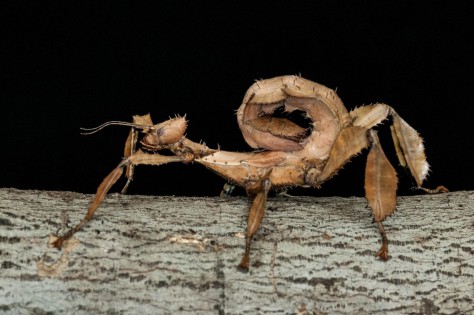
Australian Walking Stick

My friend KL sent me this press release from the University of Colorado at Boulder.

It says:

An intriguing study involving walking stick insects led by the University of Sheffield in England and the University of Colorado Boulder shows how natural selection, the engine of evolution, can also impede the formation of new species.

The team studied a plant-eating stick insect species from California called Timema cristinae known for its cryptic camouflage that allows it to hide from hungry birds, said CU-Boulder Assistant Professor Samuel Flaxman. T. cristinae comes in several different types — one is green and blends in with the broad green leaves of a particular shrub species, while a second green variant sports a white, vertical stripe that helps disguise it on a different species of shrub with narrow, needle-like leaves.

While Darwinian natural selection has begun pushing the two green forms of walking sticks down separate paths that could lead to the formation of two new species, the team found that a third melanistic, or brown variation of T. cristinae appears to be thwarting the process, said Flaxman. The brown version is known to successfully camouflage itself among the stems of both shrub species inhabited by its green brethren, he said.

Using field investigations, laboratory genetics, modern genome sequencing and computer simulations, the team concluded the brown version of T. cristinae is shuttling enough genes between the green stick insects living on different shrubs to prevent strong divergent adaptation and speciation. The brown variant of the walking stick species also is favored by natural selection because it has a slight advantage in mate selection and a stronger resistance to fungal infections than its green counterparts.

“This is one of the best demonstrations we know of regarding the counteractive effects of natural selection on speciation,” said Flaxman of CU-Boulder’s Department of Ecology and Evolutionary Biology, second author on the new study. “We show how the brown population essentially carries genes back and forth between the green populations, acting as a genetic bridge that causes a slowdown in divergence.”

A paper on the subject appeared in a recent issue of the journal Current Biology. 

[…]“This movement of genes between environments slows down the genetic divergence of these stick insect populations, impeding the formation of new species,” said Aaron Comeault, a former CU-Boulder graduate student and lead study author who conducted the research while at the University of Sheffield.

So, in the past I had read that natural selection can act as a stabilizing force in nature – keeping the organism operating within a type. This study seems to be confirmation of that. But there are other problems with generating macro-evolutionary change.

Also related to the problem raised by the study is this problem of genetic drift, which also works against the preservation of beneficial mutations.

Evolution News explains the genetic drift problem:

Evolutionary biologists often assume that once mutations produce a functionally advantageous trait, it will easily spread (become “fixed”) throughout a population by natural selection. For example, imagine a population of brown-haired foxes that lives in a snowy region. One fox is born with a mutation that turns its fur coat white, rather than brown. This fox now has an advantage in hunting prey and escaping predators, because its white fur provides it with camouflage. The white fox survives, passing its genes on to its offspring, which are also adept at surviving and reproducing. Over time, the white-haired trait spreads throughout the population.

This is how it’s supposed to work — in theory. In the real world, however, merely generating a functionally advantageous trait does not guarantee it will persist, or become fixed. For example, what if by chance the white fox trips, breaks a leg, and gets eaten by a predator — never passing on its genes? Random forces or events can prevent a trait from spreading through a population, even if it provides an advantage. These random forces are lumped together under the name “genetic drift.” When biologists run the mathematics of natural selection, they find that unless a trait gives an extremely strong selective advantage, genetic drift will tend to overwhelm the force of selection and prevent adaptations from gaining a foothold in a population.

This underappreciated problem has been recognized by some evolutionary scientists who are skeptical of the ability of natural selection to drive the evolutionary process. One of those scientists is Michael Lynch, an evolutionary biologist at Indiana University, who writes that “random genetic drift can impose a strong barrier to the advancement of molecular refinements by adaptive processes.”2 He notes that the effect of drift is “encouraging the fixation of mildly deleterious mutations and discouraging the promotion of beneficial mutations.”3

I guess the point of this is that if someone wants to convince you that macro-evolution is possible through the mechanisms of random mutation and natural selection, then they have some work to do. And it’s more work than just asserting that it happened.

People who are technical may benefit from reading Michael Behe’s book “The Edge of Evolution”, which studies how likely it is to get several positive adaptations in a row within a reasonable period of time.

UPDATE: A biologist friend tells me that “whether natural selection is driving speciation or preventing it, in neither case is it explaining how these organisms came to be in the first place. It only explains how existing organisms interact with their environment. And this can be explained at least as well through intelligent design as through naturalistic processes.” She also says that natural selection can drive speciation, but still within a kind.