DHS whistleblower: Obama more concerned with protecting Islamists than Americans

Is Barack Obama focused on protecting the American people?

This PJ Media article is by Debra Heine.

Excerpt:

Philip Haney, the Homeland Security whistleblower whose investigation into Islamic infiltration of the U.S. might have prevented the San Bernardino attack, has written an important op-ed for The Hill, warning of President Obama’s misplaced priorities when it comes to national security. In brief, says Haney, “the Obama administration is more concerned with the rights of non-citizens in known Islamist groups than with the safety and security of the American people.”

There are terrorists in our midst and they arrived here using legal means right under the noses of the federal law enforcement agencies whose mission is to stop them. That is not due to malfeasance or lack of effort on the part of these officers; it is due to the restrictions placed on them by the Obama administration.

Not only did the Obama administration shut down an important investigation that could have connected enough dots to prevent the San Bernardino terrorist attack, they went back and erased the dots Haney was “diligently connecting.” Worse yet, when he complained to the DHS inspector general, the DHS and the Department of Justice subjected him “to a series of investigations and adverse actions, including one by that same inspector general.”

None of them showed any wrongdoing; they seemed aimed at stopping me from blowing the whistle on this problem.

Debra (Nice Deb) was one of the first people to blogroll me when I was first starting out with blogging.

She links to Gates of Vienna, another of my blogroll friends, and quotes them about that:

The “behavioral indicators” listed to help DHS agents identify potential domestic terrorists include carrying around a copy of the Constitution, promoting First and Second Amendment rights, having a Gadsden flag sticker on one’s car, and advocating for a minimal federal government.

[The Obama administration’s approach] is thus designed to serve a dual purpose: (1) to protect Muslim Brotherhood organizations and their operatives who have penetrated federal, state, and local governments, and (2) to help the Obama administration crack down on its real enemies, domestic conservatives who want to re-establish constitutional governance.

Debra wrote a couple of prior articles on this DHS whistleblower, one from 12/14 and one from 12/11.

So is it really true that the Obama administration – in their mad rush to let in immigrants from countries that don’t like us very much – is not serious about keeping terrorists out?

CBS News reported that 5 different Obama administration agencies failed to detect one of the San Bernadino terrorists:

Tashfeen Malik arrived in the United States with her fiance Syed Farook in July 2014. Just two months earlier, her U.S. government background check found no suspected ties to terrorism.

She was granted a K-1 visa, even though the FBI now believes she was radicalized before she met Farook.

The State Department says Malik was thoroughly questioned during an interview at the U.S. embassy in Pakistan.

[…]Five U.S. agencies also vetted her, checking her fingerprints against two databases. Neither her name nor image showed up on a U.S. terror watch list.

One can only imagine that the questions were like “do you believe in the Constitution?” or “do you attend a Christian church?” or “do you think that abortion should be restricted?”. She would be rejected if she affirmed any of those, of course, but affirming Islamic jihad is nothing to be concerned about – if you’re a Democrat.

Homeland Security's new enemy!
Homeland Security’s new enemy! This little girl who supports the Constitution.

It seems to me our national security agencies have been indoctrinated by their Democrat leaders to target conservative taxpayers instead of radicalized Islamists. And in fact we have evidence of that, reported in the Washington Times way back in 2009:

The Department of Homeland Security is warning law enforcement officials about a rise in “rightwing extremist activity,” saying the economic recession, the election of America’s first black president and the return of a few disgruntled war veterans could swell the ranks of white-power militias.

A footnote attached to the report by the Homeland Security Office of Intelligence and Analysis defines “rightwing extremism in the United States” as including not just racist or hate groups, but also groups that reject federal authority in favor of state or local authority.

“It may include groups and individuals that are dedicated to a single-issue, such as opposition to abortion or immigration,” the warning says.

[…]The nine-page document was sent to police and sheriff’s departments across the United States on April 7 under the headline, “Rightwing Extremism: Current Economic and Political Climate Fueling Resurgence in Radicalization and Recruitment.”

It says the federal government “will be working with its state and local partners over the next several months” to gather information on “rightwing extremist activity in the United States.”

The joint federal-state activities will have “a particular emphasis” on the causes of “rightwing extremist radicalization.”

According to Democrats, radical Islam is not the real threat. American taxpayers who want to not pay for abortions are the real threat. And it turns out that many Democrat voters think that this is correct, even in an age of Islamic terrorism.

Nile Gardiner writes about a recent Rasmussen Reports poll in the UK Telegraph.

Excerpt:

[A]mong those who approve of the president’s job performance, just 29% see radical Muslims as the bigger threat. Twenty-six percent (26%) say it’s the Tea Party that concerns them most. Among those who Strongly Approve of the president, more fear the Tea Party than radical Muslims.

[…]Twenty percent (20%) of government workers see the Tea Party as the nation’s bigger terror threat.

That’s what we voted for, when we voted for Barack Obama.
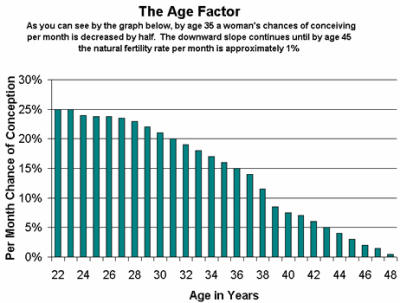
Fertility and pregnancy: how long can a woman wait before having a baby?

Woman's fertility by age
Woman’s fertility by age

This is from Aeon magazine. The author writes for several ultra-leftist publications, including the New York Times, the Los Angeles Times, Salon and Slate.

She writes:

Many studies show that women are not only woefully ignorant when it comes to fertility, conception and the efficacy of assisted reproductive technologies (ART) – but they overestimate their knowledge about the subject. For instance, a 2011 study in Fertility and Sterility surveyed 3,345 childless women in Canada between the ages of 20 and 50; despite the fact that the women initially assessed their own fertility knowledge as high, the researchers found only half of them answered six of the 16 questions correctly. 72.9 per cent of women thought that: ‘For women over 30, overall health and fitness level is a better indicator of fertility than age.’ (False.) And 90.9 per cent felt that: ‘Prior to menopause, assisted reproductive technologies (such as IVF) can help most women to have a baby using their own eggs.’ (Also false.) Many falsely believed that by not smoking and not being obese they could improve their fertility, rather than the fact that those factors simply negatively affect fertility.

Fertility fog infects cultures and nations worldwide, even those that place more of a premium on reproduction than we do in the West. A global study published for World Fertility Awareness Month in 2006 surveyed 17,500 people (most of childbearing age) from 10 countries in Europe, Africa, the Middle East and South America, revealing very poor knowledge about fertility and the biology of reproduction. Take Israel, a country that puts such a premium on children that they offer free IVF to citizens up to age 45 for their first two children. According to a 2011 study in Human Reproduction, which surveyed 410 undergraduate students, most overestimated a women’s chances of spontaneous pregnancy in all age groups, but particularly after receiving IVF beyond age 40. Only 11 per cent of the students knew that genetic motherhood is unlikely to be achieved from the mid-40s onward, unless using oocytes or egg cells frozen in advance. ‘This can be explained by technological “hype” and favourable media coverage of very late pregnancies,’ the authors concluded.

[…]For a woman over 42, there’s only a 3.9 per cent chance that a live birth will result from an IVF cycle using her own, fresh eggs, according to the American Society of Reproductive Medicine (ASRM). A woman over 44 has just a 1.8 per cent chance of a live birth under the same scenario, according to the US National Center for Chronic Disease Prevention and Health Promotion. Women using fresh donor eggs have about a 56.6 per cent chance of success per round for all ages.

Indeed, according to research from the Fertility Authority in New York, 51 per cent of women aged between 35 and 40 wait a year or more before consulting a specialist, in hopes of conceiving naturally first. ‘It’s ironic, considering that the wait of two years will coincide with diminished fertility,’ the group says.

[…]‘No one talks about fertility,’ said [reproductive endocrinologist Janelle Luk, medical director of Neway Fertility in New York City], who does not believe women are really open to hearing about it. ‘I don’t think women know that there’s a limit: the message is equal, equal, equal. Women say: “We want to go to college, we want to work on our careers, we want to be equal to men.” But our biological clock is not.’

[…]Another way women might even out the fertility playing field is by focussing on the so-called male biological clock. But is there one? Although there have been recent news stories about how advanced age in men (over 40 or 50) increases time to conception and the incidence of autism and schizophrenia, the absolute risk is negligible. ‘When you look at the numbers, you have to separate what the absolute risk and the increased risk is,’ said Natan Bar-Chama, director of male reproductive medicine and surgery at Mount Sinai Medical Center in New York. ‘The absolute risk is still really very small.’

I think if I ever have a daughter, I will be sure to urge her to be skeptical of her emotions and intuitions, to learn how to assess probabilities, to disregard exceptional cases when making plans, to resist the feminism in the culture, to get wisdom from older married women with children instead of young unmarried childless women, to accept that she is not so special that laws and rules don’t apply to her, and to accept that the universe is not malleable according to her needs and desires. I hope my wife will see the value of reining our daughter in before the catastrophes like infertility happen.

Where does the organized opposition to educating young women about fertility facts come from?

‘We feel that women should be able to talk to their ob/gyn about fertility,’ said Sandra Carson, ACOG’s vice president for education. ‘We certainly want to remind women gently that, as they get older, fertility is compromised, but we don’t want to do it in such a way that they feel that it might interfere with their career plans or make them nervous about losing their fertility.’ In other words, there are no guidelines for talking to a woman about her fertility unless she herself brings it up.

All this talk of ‘gentle’ reminders and ‘appropriate’ counselling has a history – a political one. Back in 2001, the ASRM devoted a six-figure sum to a fertility awareness campaign, whose goal was to show the effects of age, obesity, smoking and sexually transmitted diseases on fertility. Surprisingly, the US National Organization for Women (NOW) came out against it. ‘Certainly women are well aware of the so-called biological clock. And I don’t think that we need any more pressure to have kids,’ said Kim Gandy, then president of NOW. In a 2002 op-ed in USA Today, she wrote that NOW ‘commended’ doctors for ‘attempting’ to educate women about their health, but thought they were going about it the wrong way by making women feel ‘anxious about their bodies and guilty about their choices’.

We don’t want women to feel bad, so it’s best to let them follow their hearts. That view is not helpful to women! If we want to help women, we must tell them the truth, and take the consequences.

All this talk about fertility could be accompanied by a discussion of the hard fact that a woman’s attractiveness will decline as she ages. This is a troubling lesson that countless women have had to learn the hard way. When you are young, you stand a much better chance of finding a successful male with good values and who is willing to commit to marriage and parenting. Many women will testify that, as you get older, this convenience deteriorates quickly. The good men will be claimed by the responsible women who don’t waste their youthful years seeking thrills.  Men who are contemplating marriage value a woman’s appearance, fertility, vulnerability and submissiveness to his leadership. Women need to be careful not to embark on a course that will reduce their ability in any of these areas that are important to men, e.g. – careerism, premarital promiscuity, etc.

Related posts

J. Warner Wallace podcast: pluralism, relativism and postmodernism at the university

Students are learning less and less of value at college

The latest episode of the Cold Case Christianity podcast is useful to help parents understand what awaits their children at the university.

Details:

In this episode of the Cold-Case Christianity Broadcast, J. Warner examines four popular misconceptions and misstatements about the nature of objective truth, tolerance and our over-reliance on science. If there are no objective truths (or they can’t be known) there is little reason to examine the truth about God. We need to get to the truth about truth before we can ever know the truth about anything else.

The MP3 file is here.

Wallace does a lot of speaking on university campuses, so he gets to meet and talk with the college kids. It’s interesting to hear what an evidence-driven cold case homicide detective thinks about the squishy postmodern views of the average college student.