I finished listening to Alistair Begg’s series on Esther, and I’m now on to his series on Ruth. Sermon #3 stood out to me, because it touches on the important issues of free will vs determinism as well as the two methods of seeking God’s will: mysticism vs wisdom.
The discussion centers around Ruth’s decision to go to the barley fields to work, in order to get something to eat.
When we’re facing a future devoid of prospects or possibilities, it’s easy to become overwhelmed and discouraged. Ruth could relate. She was a penniless widow in a foreign land seeking a way to provide for herself and her widowed mother-in-law. Her future was totally dependent upon someone showing her unmerited grace and favor. Instead of giving up, she gives us an example of humility, initiative and faith as she seeks work and sustenance.
As things in the world spin out of control, it’s important to remember that you must always have a plan and be working on that plan. Even when things look very bleak, you have to do something reasonable and practical, and then pray to God for “favor”. That God will do something unexpected that will make your reasonable action bear unexpected fruit.
If you want to listen to sermons #1 and sermon #2 in the series on Ruth, you can find the whole series here. So far, I have listened to 5. The first two were also very good, so if you listen to the first 3, you will definitely benefit. Each one is 35 to 40 minutes.
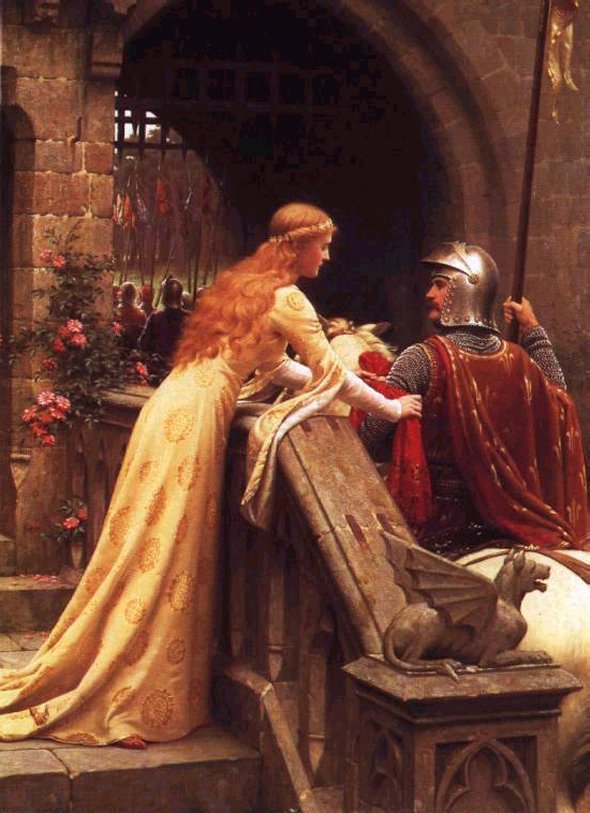
My favorite painting: “Godspeed” by Edmund Blair Leighton, 1900
A while back, I wrote a post that I really enjoyed writing about the movie High Noon. In it, I talked about the conflict between Marshal Will Kane and his new wife. He wanted to stay and protect his home town against outlaws who are coming to kill him and raze the town. His new wife cannot understand why he has to stand and fight, she wants him to run away with her. In the end, she helps him to defeat the outlaws, saving his life.
That post was inspired by something I heard Dennis Prager talking about on his radio show. He was talking about a survey of boys and girls done by the toy company Mattel. Well, I wanted to blog about his comments, so I ended up writing the High Noon post. But then Dina found an article about the Mattel survey on National Review. I think this is one of the wisest and most perceptive articles I have ever read, and it will really help you to understand what has happened in the last 50 years to this country.
Prager writes:
Last week the New York Times published an article, “Sweeping Away Gender-Specific Toys and Labels,” that contained three sentences that explain one of the most important phenomena in American life. In discussing the increasing move to do away with gender-specific toys — something the New York Times approves of — the article quoted Tania Missad, the “director of global consumer insights” at one of the world’s largest toy manufacturers, Mattel:
Mattel’s research showed some differences in what girls and boys wanted in their action figures, Ms. Missad said. “For boys it’s very much about telling a story of the good guy killing the villain. . . . [Girls] would tell us: ‘Why does the good girl have to kill the villain? Can’t they be friends in the end?’”
Prager comments on the part in red:
This difference may be the most important of all the sex differences. Indeed, it can actually shape the future of America and of the world.
Of course, there are women who want evil destroyed — the late Margaret Thatcher, for example. And there are men who oppose confronting evil — the men who lead the modern Democratic party, for example. (One such man is the president of the United States, who has a feminized view of those who do evil — talk to them, but don’t confront them, label them, or fight them.) But these exceptions happen in large numbers under two circumstances: when women get married and when men are feminized.
When women get married, they are often influenced by their husbands with regard to political and moral issues, just as married men are influenced by their wives on a whole host of micro issues. As a result, married women are more likely than single women to prefer to fight villains than to befriend them. Unfortunately, more and more American women are single.
Meanwhile American boys are increasingly raised by single women and taught almost only by female teachers. In addition, they are often taught to be ashamed of their masculine natures and to reject traditional masculine virtues.
As a result of the above two trends, the amount spent on national defense will continue to decline (while the amount spent on welfare will continue to increase), and America will confront the world’s evils less and less. The consequences will be disastrous for millions of people around the globe.
When America retreats from killing bad guys, bad guys kill more innocent people. We are witnessing this right now as a consequence of America’s abandoning Iraq and retreating from the world generally. Islamic State took over more and more territories as America abandoned them. Ironically, therefore, as American foreign policy becomes feminized, more Middle East females are raped.
Whenever I see on a car the liberal bumper sticker “War Is Not the Answer,” I look to see who is driving. In years of looking, I have seen one male driver.
Both women and men have flawed natures. They share human nature, which is deeply flawed, and the sexes have their own particular natures, which are also flawed. That is one reason men need women and women need men. Men need women to soften their intrinsic aggressive nature and to help them control their predatory sexuality; and women need men to, among other things, better understand that evil people and regimes must be fought, not nurtured.
So, there is something in male nature that thinks that it is acceptable to use violence as a last resort in order to defeat evil. Evil might be things like criminals, terrorists… even wolves and bears, if they attacked innocent people.
So what are the solutions?
Here’s what we should do:
We should stop paying women money to have children before they are married, so that boys have fathers to raise them who have made a commitment before they got handed free sex.
We should rollback no-fault divorce, which leads to fatherless children. People should be less emotional about who they marry, and not think “there’s an escape hatch if I feel unhappy”.
We should try to get more male teachers into classrooms, and maybe allow parents to pull boys out of failing schools and put them into all-male schools if they think those work better.
We should try to vote for policies that empower law enforcement, national security, and our armed forces to detect, attack and defeat evil. For example, we invest in defense spending, and avoid undermining the morale of police and armed forces with political correctness.
I guess the list could be longer, but that’s a start for the issues that Prager raised.
We need to work against the forces that demean male nature and male roles, and work to promote male nature and male roles.
Why do people think that CNN are biased leftist clowns?
First, the story from The Daily Signal. Then, we’ll see examples of how Facebook’s censorship allies are biased against conservatives.
Daily Signal:
Facebook announced Thursday an aggressive plan to combat so-called “fake news,” giving users more power to report hoaxes and empowering fact-checking outlets as arbiters.
[…]Facebook is working with outside fact-checking organizations accredited by Poynter’s International Fact Checking Network to help it determine what content is fake. They include ABC News, FactCheck.org, PolitiFact, and Snopes—all of which have been accused of liberal bias in the past.
“We’ll use the reports from our community, along with other signals, to send stories to these organizations,” Mosseri wrote. “If the fact checking organizations identify a story as fake, it will get flagged as disputed and there will be a link to the corresponding article explaining why. Stories that have been disputed will also appear lower in News Feed.”
By putting these stories lower in the News Feed—the page you see when you log in—Facebook is reducing the likelihood that its users will see the content, and therefore, less likely to share it. But even in cases when they do see it, a “warning” will appear noting that the story has been disputed. These “flagged” stories can’t be promoted with an ad.
Yes, the same ABC News that employs for Clinton hatchet man George Stephanopolous. That’s who will be doing the “fact checking”. An example of a “fake news” site, by the way, is The Daily Wire, which is run by Harvard Law graduate Ben Shapiro.
Let’s look at another far-left Facebook partner: Politifact. Politifact is just a group of journalists from the Tampa Bay Times newspaper.
Avik Roy, health care policy expert at Forbes magazine, writes about Politifact’s assessment of Obama’s promise to Americans about keeping their health plans after Obamacare.
2008 PolitiFact before the election: ‘We rate his statement True’
Roy writes: (links removed)
On October 9, 2008, Angie Drobnic Holan of PolitiFact published an article using the site’s “Truth-O-Meter” to evaluate this claim: “Under Barack Obama’s health care proposal, ‘if you’ve got a health care plan that you like, you can keep it.’” The article assures us in its headline that “Obama’s plan expands [the] existing system,” and continues that “Obama is accurately describing his health care plan here…It remains to be seen whether Obama’s plan will actually be able to achieve the cost savings it promises for the health care system. But people who want to keep their current insurance should be able to do that under Obama’s plan. His description of his plan is accurate, and we rate his statement True.”
[…]As per PolitiFact’s usual M.O., Holan didn’t seek out any skeptical health-policy experts to suss out the veracity of Senator Obama’s signature claim. Instead, its sources included Jonathan Cohn, a passionate Obamacare supporter at The New Republic, and various interviews and statements of Mr. Obama. Holan simply took the “keep your plan” promise at face value, dismissing as dishonest anyone who dared suggest that Obama’s claim would be impossible to keep. “His opponents have attacked his plan as ‘government-run’ health care,” she wrote, the scare-quotes around “government-run” being visible to all.
PolitiFact’s pronouncements about Obamacare were widely repeated by pro-Obama reporters and pundits, and had a meaningful impact on the outcome of the election. Indeed, in 2009, PolitiFact won the Pulitzer Prize for its coverage of the 2008 campaign.
Here’s the screen capture from 2008:
Politifact caught with its pants on fire
Before the election, it’s true! And Obama got re-elected, because people believed that. But what happened after the election?
2013 PolitiFact after the election: ‘We rate his statement Pants On Fire’
Roy writes: (links removed)
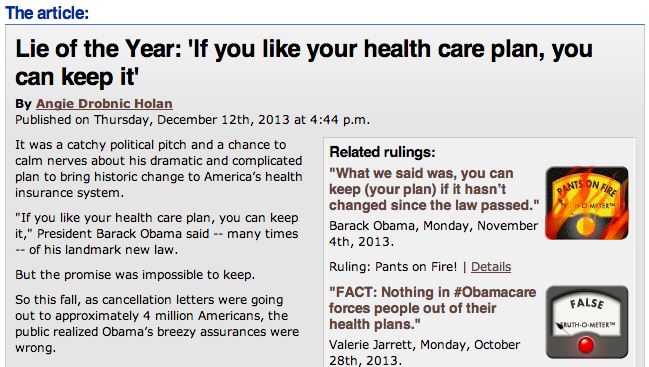
On December 12, [2013] the self-appointed guardians of truth and justice at PolitiFact named President Obama’s infamous promise—that “if you like your health care plan, you can keep it”—its 2013 “Lie of the Year.”
[…]On November 4, Jacobson rated as “Pants on Fire” the President’s new claim that “what we said was, you can keep [your plan] if it hasn’t changed since the law passed.” Both pieces were edited by Angie Drobnic Holan, who had initially granted PolitiFact’s seal of approval to Senator Obama’s 2008 promise. Holan delivered the coup de grâce, declaring as PolitiFact’s “Lie of the Year” the “keep your plan” promise.
“The promise was impossible to keep,” says Holan in her December piece. Now she tells us! But none of the key facts that made that promise “impossible” in 2008 had changed by 2013. The President’s plan had always required major disruption of the health insurance market; the Obamacare bill contained the key elements of that plan; the Obamacare law did as well. The only thing that had changed was the actual first-hand accounts of millions of Americans who were losing their plans now that Obamacare was live.
And the screen capture from 2013:
Politifact says: we were just kidding! Kidding!
So when Politifact rates a statement by a Democrat as true, what they really mean is that it’s pants-on-fire-false, but it’s election time so they don’t say that. It’s not like the critical assessments of Obamacare from health policy experts were not out there between 2007-2012. It’s just that the liberal journalism-major bloggers at Politifact couldn’t be bothered to read them.
What about Snopes? Maybe Snopes is more reliable than Politifact?
Snopes’ main political fact-checker is a writer named Kim Lacapria. Before writing for Snopes, Lacapria wrote for Inquisitr, a blog that — oddly enough — is known for publishing fake quotes and even downright hoaxes as much as anything else.
[…]She described herself as “openly left-leaning” and a liberal. She trashed the Tea Party as “teahadists.” She called Bill Clinton “one of our greatest” presidents. She claimed that conservatives only criticized Lena Dunham’s comparison of voting to sex because they “fear female agency.”
[…]Lacapria — in another “fact check” article — argued Hillary Clinton hadn’t included Benghazi at all in her infamous “we didn’t lose a single person in Libya” gaffe. Lacapria claimed Clinton only meant to refer to the 2011 invasion of Libya (but not the 2012 Benghazi attack) but offered little fact-based evidence to support her claim.
After the Orlando terror attack, Lacapria claimed that just because Omar Mateen was a registered Democrat with an active voter registration statusdidn’t mean he was actually a Democrat. Her “fact check” argued that he might “have chosen a random political affiliation when he initially registered.”
Snopes is just spin for Democrat gaffes – playing defense for the DNC.
Can we verify that Snopes actually lies in order to defend Democrats. Well, yes –right here. Snopes lied about American flags being present throughout the first day of the 2016 Democrat convention.
It’s groups like these who are being relied upon to spot “fake news” for Facebook. When you are on Facebook, it’s important to understand that it is a web site run by Democrats, for the benefit of Democrats. There is no balance. There is no critical thinking. The simple fact of the matter is that many fake news stories are pushed by the leftist mainstream media, and ignored by the leftist “fact checkers”. Here’s one recent example of how that works.