
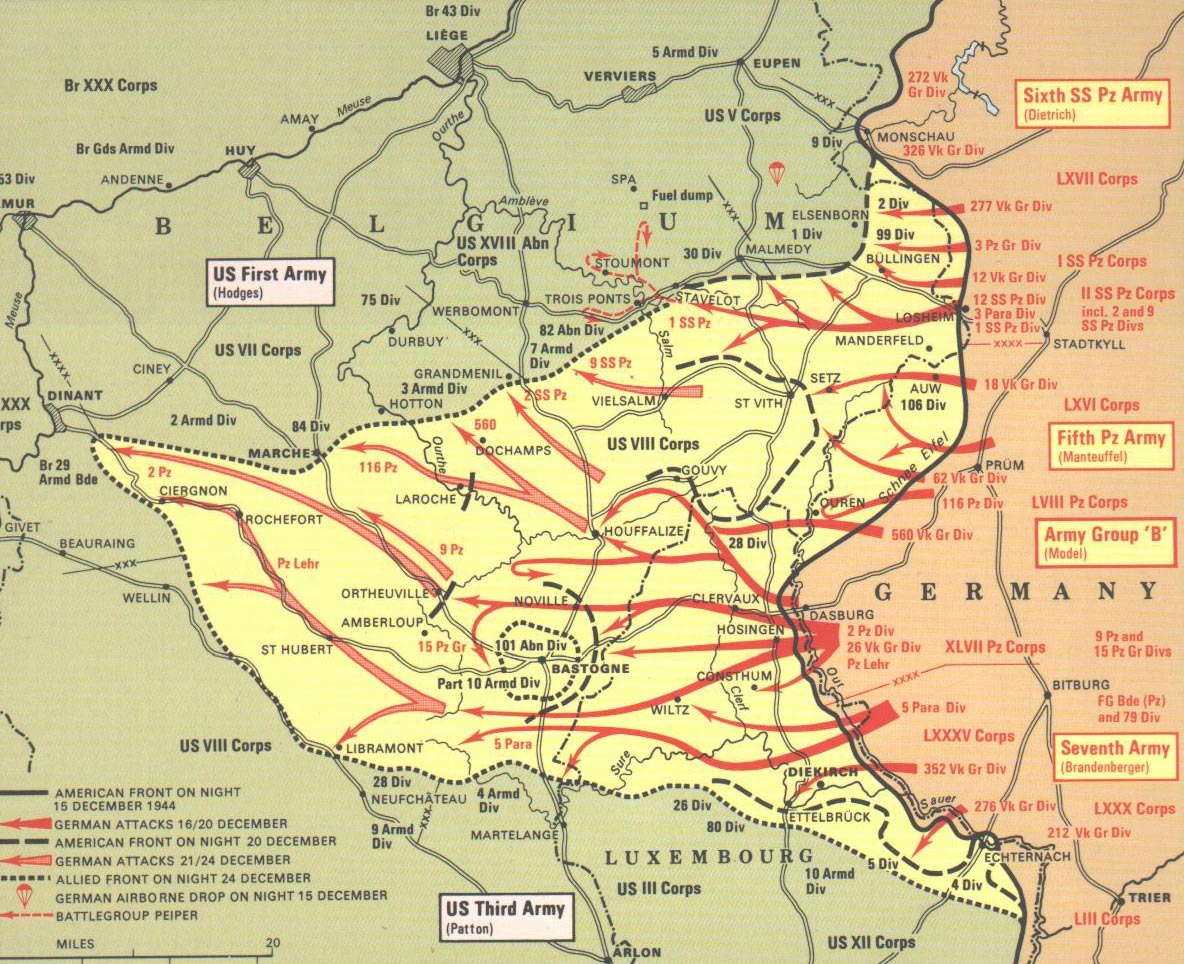
Well, it’s Christmas Day, and my boring family is just discussing popular shows on Netflix, iTunes and other nonsense which no one cares about. What is much more interesting to me is military history. I have been reading several books on the Korean War in the winter of 1950 and the Battle of the Bulge in the winter of 1944, during World War 2. Since I wrote a post about the Korean War last time, I have a post for you about the story of an American general I really admired, which I found in John Toland’s “Battle: The Story of the Bulge“.
Since I can’t quote that book, I found another book with the story on the U.S. Army web site by Hugh M. Cole entitled “The Ardennes: Battle of the Bulge“. The Day is December 24th, 1944. Following a surprise Axis attack in the Ardennes, British General Montgomery has ordered Allied forces north of Bastogne to retreat and form “proper” defensive lines. Major General J. Lawton Collins, located just north of the tip of the German force’s furthest advance west, sees an opportunity to attack the 2nd SS Armored Division, because their superior Panther and Tiger tanks have outrun their supply lines and are out of gas. Will he get permission to attack? If not, will he disobey orders and attack anyway?
Although the VII Corps had become involved in a defensive battle, General Collins still expected to launch the corps counterattack which would signal the beginning of aggressive operations against the north flank of the Bulge. In midafternoon on 24 December General Harmon telephoned the VII Corps command post and asked permission to throw another combat command of his 2d Armored Division against elements of the 2d Panzer which had been identified in the neighborhood of Ciney and Celles. (See Map VIII.) The corps commander was away from the command post visiting his divisions; so the call was taken by the corps artillery commander, Brig. Gen. Williston B. Palmer. Palmer knew that the First Army had attached strings to any wholesale commitment of Harmon’s division and that Hodges’ consent and probably Montgomery’s would be needed before more of the 2d Armored was unleashed. He therefore told Harmon to wait-it was too late in the day to launch an attack in any case-until the corps commander reached the 2d Armored command post. Harmon was persistent and called again asking for “immediate authority.” Palmer, sorely tempted to give Harmon the permission he needed, reluctantly steeled himself and told Harmon to await Collins’ appearance at the 2d Armored command post.
A few minutes later Palmer had a call from the First Army chief of staff, General Kean, who said that Collins was authorized to use all his corps and could change his defensive line. In guarded words Kean asked Palmer if he saw “a town A and a town H” on the map and then mentioned a “pivoting move.” Palmer, imbued with Collins’ attack philosophy and eager to give the green light to the 2d Armored, looked hastily at the map spread before him, picked out two villages southwest of Ciney and forward of the 2d Armored positions: Achêne and (Le) Houisse. This looked like the go signal for the VII Corps and an attack to advance its western wing. Because the wire line to the 2d Armored command post had gone out, Palmer sent his aide with a message for Collins giving his own optimistic interpretation of the conversation with Kean.
The aide had just departed when Kean called again. On further reflection, he said (perhaps Kean had caught a tone of exultation in Palmer’s voice), he doubted whether Palmer had understood him correctly. Then came the cold water douche: “Now get this. I’m only going to say it once. Roll with the punch.” Palmer’s glance flicked over the map, this time to the north; there, thirty miles to the rear of the villages he had selected earlier were the towns of Andenne and Huy. Palmer remembers that this was the only moment in the war when he was “ill with disapproval.”
Out went a second messenger with an explanation of Palmer’s mistake and an urgent request for Collins to come home. Collins, who had received the first message at Harmon’s command post, was just giving the finishing touches to an attack plan for the entire 2d Armored when the second messenger appeared. Telling Harmon to “hold everything” but making clear that the 2d Armored was to go ahead with plans for the attack on Christmas morning, Collins hurried back to his own headquarters. He arrived there about 1830 but nothing more could be done until a liaison officer, promised by Kean, came in from the First Army.
Two hours later the First Army staff officer (Col. R. F. Akers) appeared and confirmed the bad news. Montgomery and Hodges had agreed to shorten the First Army line in order to halt the German advance. The VII corps, therefore, was to go on the defensive and its commander was “authorized” on his own judgment to drop back to the line Andenne-Hotton-Manhay. In any case the VII Corps was to retain a firm contact with the XVIII Airborne Corps, which that evening was withdrawing to the Manhay position.
Collins was stuck – no permission to attack from higher up. If you check the map above, you can see that the withdrawal to the Andenne-Huy line would give up a lot of ground. More importantly, it would give the Germans time to refuel. But Collins was still seeing German tanks out of gas in front of him right now – what a perfect opportunity to attack! What should he do? What would you do in his place?
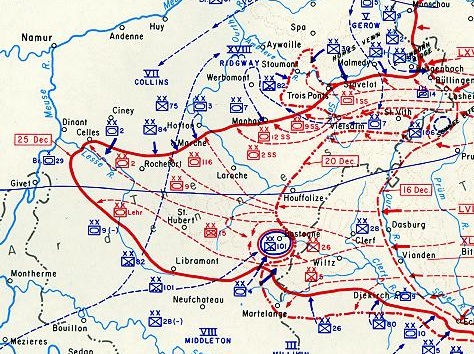
Here’s what Collins did:
Although General Collins courteously asked the senior members of his corps staff to give their opinions on the action now to be taken by the corps, neither he nor any of his officers considered giving over the attack planned for the 2d Armored. During the day Harmon’s tanks had inflicted very severe damage on the German columns; the 84th Division had experienced some reverses but seemed to be holding its own. On balance the picture as seen from the VII Corps’ point of view was far less gloomy than that apparently prevailing in higher headquarters. Collins recognized that a retrograde move would strengthen the defenses of Huy and Liège. He also knew that such a move would expose Namur and the major Meuse crossings south of that city, for example, those at Dinant. The final decision, made by the corps commander himself, probably could have been predicted: on 25 December the 2d Armored Division would advance as planned; the corps then would continue with limited objective attacks to break up any dangerous concentration of enemy forces on its front.7
So, what was the outcome of Collins’ decision to disobey Montgomery and the other higher ups?
The attack mapped out by Collins and Harmon late the previous afternoon was launched by CCB at 0800 on Christmas Day, the idea a double-pronged sweep to capture Celles and annihilate the German armor believed to be thereabouts.9 For this maneuver General White divided his command into two task forces. Task Force A (Lt. Col. Harry Hillyard) had its line of departure on the Achêne road and orders to take the Bois de Geauvelant, a large wood some thousand meters across, which lay midway between Achêne and Celles. It was to assemble for the final assault on high ground northwest of Celles. Task Force B (Maj. Clifton B. Batchelder), starting its move near Leignon, was to make the main envelopment and cut off Celles on the southeast. The 82d Armored Reconnaissance Battalion went in on the open right flank of the attack to screen toward the west and as far forward as the Lesse River, south of Celles. CCB would be supported by artillery emplaced west of Ciney and by both American and British fighter-bombers.
Task Force A, medium tanks to the front, went through the Bois de Geauvelant with almost no opposition. As it debouched it came under fire from a little farm near Foy-Notre Dame and lost three half-tracks. The 370th Fighter Group of the IX Tactical Air Command, flying in support of CCB, then flushed out four Panther tanks and put them out of action, at least temporarily. The column again drew fire near Boisselles, but two platoons of the 67th Armored Regiment moved in and destroyed three Panthers doing the shooting. By the middle of the afternoon Task Force A reached the high ground overlooking Celles, blocking the roads to the west and southwest. Task Force B had a brief battle at Conjoux, then rushed on-knocking out isolated tanks and guns- until it arrived on the ridge 1,300 yards southeast of Celles.
The British 29th Armoured Brigade was conducting its own private battle west of Foy-Notre Dame while pushing reconnaissance toward the Lesse River. The British knocked out three Panthers and some infantry near Sorinne, then shot up more German vehicles and took prisoners around Foy-Notre Dame. In the skirmish near Boisselles a few tanks of the British 3d Royal Tank Regiment and some British gunners gave a hand to Task Force A.10
Meanwhile the 82d Reconnaissance Battalion had run into the remnants of the 2d Panzer reconnaissance battalion at Foy-Notre Dame (part of this group had escaped eastward to rejoin the main force huddled in the woods northeast of Celles). These Germans intended to make a fight of it, though at first sight Foy-Notre Dame seemed a peaceful farming village-nothing more. When a platoon from the 82d moved in, the enemy began a fusillade of antitank and machine gun fire from hidden positions. Worse, four Panthers on high ground just south of the village took a hand. The American cavalry suffered some casualties, but Sergeant Rogers used his assault gun to charge a German antitank gun in the middle of the village and the mop-up began. The four Panthers were brought under fire by British gunners, then finally destroyed by air attack. (Probably these were the tanks which had struck Task Force A near the Bois de Geauvelant.) This skirmish marked the end of the German reconnaissance battalion: the commander and 147 others were captured, and much of its remaining equipment was taken.
When General White’s two task forces finally sent tanks into Celles they met little resistance. At first it seemed empty except for the townspeople who had gathered in the church; later some 200 dispirited prisoners were rounded up in and near the town. With the capture of Celles the string was drawn on the bag in the forest between that town and Conjoux. Harmon ordered CCB to turn back the next morning and give the coup de grâce to the trapped enemy.
Although Christmas Day had brought much sporadic action and occasional flare-ups like the fight at Foy-Notre Dame the main German pocket simply had been bypassed. It is known that Cochenhausen’s tanks had very little gasoline, probably not enough to permit any appreciable skirmishing or tactical movement, but the German sluggishness in the pocket may be credited to the gunners supporting CCB, the army pilots in their flying OP’s,” and the close coordination between the artillery and the fighter-bombers of the 370th Fighter Group and Royal Air Force 83 Group. At noon, for example, a spotter plane picked up a column of seven enemy tanks north of Celles-all were destroyed by artillery fire. Twelve P38’s and an unknown number of British Typhoons, taking time out only to replenish fuel tanks and ammunition racks, worked over the woods where lay Cochenhausen’s command and strafed roads and trails whenever vehicles showed signs of making a break for it.
What of the German efforts to reach Cochenhausen’s force? Two small forays were attempted during the day by the Panzer Lehr, whose commander had dispatched tanks along the Custinne road toward Celles, but these efforts were foiled by the ubiquitous Allied planes. That night the kampfgruppe with which the 2d Panzer had been blocking in the Hargimont sector was relieved by the 9th Panzer, and Lauchert finally was free to attempt Cochenhausen’s relief. The force which he led from the Rochefort road through the Bois de Famenne and Ciergnon was not likely to give much confidence of success: a company or two of tanks, a battalion of armored infantry, a light artillery battalion, two companies of engineers, and part of a flak battalion.
The Germans had neared the twin villages of Petite and Grande Trisogne, little more than a mile from Celles, when they saw the ridge ahead “crawling with tanks.” (These may have been British tanks because the 29th Armoured Brigade was blocking behind the CCB lines.) 11 The 2d Panzer never got to launch an attack, for the American guns opened “a hellish fire” (their targets spotted-as Lauchert later recalled-by five artillery planes). Then to top this came the P-38’s and Typhoons. On nearby roads more Allied tanks hove in sight but made no concerted attack. Lauchert’s group was saved by an order radioed from the XLVII Panzer Corps: he was to return to Rochefort at once; the troops in the pocket would have to destroy their vehicles, leave their wounded, and get out on foot. A Panzer Lehr attempt to reach the pocket via Custinne on 26 December was equally futile, and for the same reasons. Bayerlein’s kampfgruppe-at no time in the battles on the Marche front did the Panzer Lehr commander have his entire division in hand-also was ordered back to Rochefort during the night of 26 December.
The story of the 2d Panzer pocket is quickly told. CCB spent two days clearing the thick woods and dense under- brush between Celles and Conjoux. The procedure was simple and effective: first, heavy shelling on a given area, then a slow, methodical advance by the infantry line backed with the tanks. In an extension of the Bois de Geauvelant, where tanks could operate with some freedom, an armored sweep was made which killed about 150 of the enemy. In the main forest near Celles a final squeeze produced 200 prisoners, 12 guns, and 80 vehicles of various types to add to the larger bag. Nonetheless many of the German troops did succeed in escaping on foot. Major von Cochenhausen and nearly 600 of his men ultimately reached Rochefort, but all the equipment of the reconnaissance battalion, the 304th Panzer Grenadier Regiment, the 2d Battalion of the 3d Panzer Regiment, three artillery battalions, and two-thirds of the division flak battalion had to be left behind.12
And that was the turning point of the Battle of the Bulge. It was the end of Hitler’s powerful last major attack against the Allies. That happened on Christmas Day 1944, and since today is Christmas Day, may their “names. Familiar… as household words … be in [your] flowing cups freshly remember’d.” This story shall the good man teach his son.


