Sometimes, when you’re discussing reality with progressives, it helps to have a study. Because although you might think that conservatism is common sense, they think that their feelings are common sense. So you will have to give them evidence, and then call them stupid, until they either accept your evidence or run away screaming back to the New York Times building.
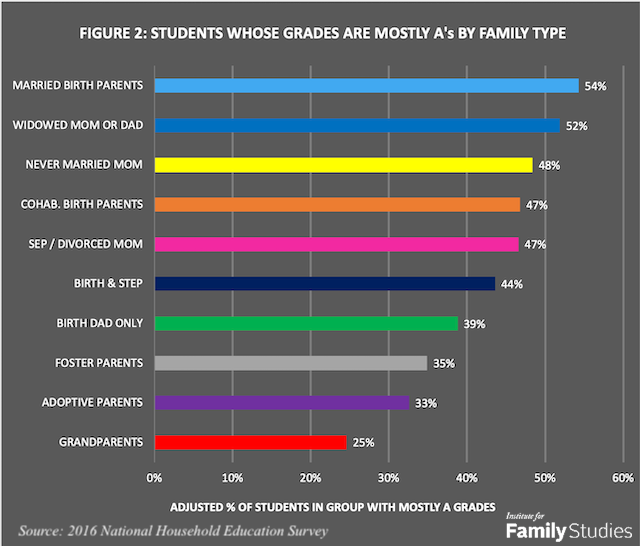
Beginning with the 1966 Coleman Report, a long line of studies have found that students from intact, married families do better in school than those from disrupted or unmarried families.5 My own analysis of data from a longitudinal study conducted by the U.S. Department of Education (the ECLS-K) demonstrated the impact that family transitions, such as parental divorce and remarriage, have on students’ task persistence and eagerness to learn, emotional distress, and misbehavior resulting in school disciplinary actions such as suspension.6 IFS studies of trends in Arizona, Florida, and Ohio indicate that school districts tend to be more successful and safer when more of their families are headed by married parents.7
And there’s a graph to go with it. Actually, several, but I just chose this one.
Why can’t non-STEM sociologists use apostrophes properly? It’s As not A’s
And here’s the conclusion:
The analyses showed that schoolchildren who live with both married parents do better on each of the three educational progress indicators. Children from married-couple families did better even after controlling for socioeconomic and demographic correlates of family structure.
They’ve also got graphs for student misbehavior by family type, and student disciplined by family type. Naturally, the traditionally family far outperforms the alternatives.
Now the first thing that a progressive will tell you is that adding more money from government social programs will solve the problem, so we just need to have more communism, and give the children to strangers at earlier ages. But the study corrects for socioeconomic factors. And demographic factors, too. So that deflection isn’t going to work.
Note: For a Christian response to the complaint that the Bible doesn’t condemn slavery, see this article and this article for slavery in the Old Testament, and this article for slavery in the New Testament. These are all by Christian philosopher Paul Copan. You can watch a lecture with Paul Copan on the slavery challenge here, and buy a book where he answers the challenge in more detail. There is also a good debate on whether the Bible condones slavery here, featuring David Instone-Brewer and Robert Price. My post is not a formal logical essay on this issue, it is more that I am outraged that atheists, who cannot even rationally ground objective morality, insist on criticizing the morality of the Bible. I think that atheists who are serious about finding the truth about these issues should check out those links, if they are interested in getting to the truth of these matters.
In other posts, I’ve argued that without an objective moral standard of what is right and wrong, any judgments about right and wrong are just individual opinions. So, when an atheist says slavery is wrong, what he really means is that he thinks slavery is wrong for him, in the same way that he thinks that,say, that chocolate ice cream is right for him. He isn’t saying what is wrong objectively, because on atheism there are no objective moral rules or duties. He is speaking for himself: “I wouldn’t own a slave, just like I wouldn’t eat broccoli – because it’s yucky!”. But he has no rational argument against other people owning slaves in other times and places, because their justification for owning slaves is the same as his justification for not owning slaves : personal preference and cultural conventions.
So do atheists oppose slavery? Do they believe in an objective human right to liberty? Well, there are no objective human rights of any kind on atheism. Human beings are just accidents in an accidental universe, and collections of atoms do not mysteriously accrue “rights”. There is no natural right to liberty on atheism. Now consider abortion, which is favored by most atheists. Like slavery, abortion declares an entire class of human beings as non-persons in order to justify preserving their own happiness and prosperity by means of violence. That’s exactly what slavery does, except abortion is worse than slavery, because you actually kill the person you are declaring as a non-person instead of just imprisoning them.
So how many atheists have this pro-abortion view that it is OK to declare unborn children as non-persons so they can kill them?
Well, according to Gallup, the “non-religious” are the group most likely to support abortion. In fact, 68% favor legalized abortion, compared to only 19% who oppose it.
Most atheists are OK with the strong killing the weak
The Gallup numbers might actually be low, because “No religion” might include people who are spiritual, but not religious. But what about atheists alone?
As a group, atheists tend to be among the most radical supporters of legalized abortion. The Secular Census of 2012 found that 97% of atheists vote for abortion. There are almost no pro-life atheists. Why is it that atheists look at unborn children and think it’s OK to kill them? Well, let’s see what atheists scholars think about morality, and from that we’ll find out why they think abortion is morally permissible.
Atheist scholars think morality is nonsense
Atheist William Provine says atheists have no free will, no moral accountability and no moral significance:
Let me summarize my views on what modern evolutionary biology tells us loud and clear — and these are basically Darwin’s views. There are no gods, no purposes, and no goal-directed forces of any kind. There is no life after death. When I die, I am absolutely certain that I am going to be dead. That’s the end of me. There is no ultimate foundation for ethics, no ultimate meaning in life, and no free will for humans, either.
Atheists Michael Ruse says atheists have no objective moral standards:
The position of the modern evolutionist is that humans have an awareness of morality because such an awareness of biological worth. Morality is a biological adaptation no less than are hands and feet and teeth. Considered as a rationally justifiable set of claims about an objective something, ethics is illusory. I appreciate when someone says, ‘Love thy neighbor as thyself,’ they think they are referring above and beyond themselves. Nevertheless, such reference is truly without foundation. Morality is just an aid to survival and reproduction, . . . and any deeper meaning is illusory.(Michael Ruse, “Evolutionary Theory and Christian Ethics,” in The Darwinian Paradigm (London: Routledge, 1989), pp. 262-269).
Atheist Richard Dawkins says atheists have no objective moral standards:
In a universe of blind physical forces and genetic replication, some people are going to get hurt, other people are going to get lucky, and you won’t find any rhyme or reason in it, or any justice. The universe that we observe has precisely the properties we should expect if there is, at bottom, no design, no purpose, no evil and no good, nothing but blind, pitiless indifference… DNA neither knows nor cares. DNA just is. And we dance to its music. (Richard Dawkins, River Out of Eden: A Darwinian View of Life (1995))
Most atheists are like this – although some affirm objective morality, without really having a rational basis for it. In general though, when atheists use moral language to condemn God, the Bible, or Christians, it’s very important to understand that it is just theater. They are trying to use words that describe realities that they do not even believe in, usually with the goal of getting you to stop judging them for their own sin. I blogged about two examples of this before – Richard Carrier and Michael Shermer.
Let’s take a closer look at Richard Dawkins’ statement that there is “no evil and no good”.
Richard Dawkins and morality
Here’s Richard Dawkins’ view of abortion:
Richard Dawkins explains morality on atheism
But wait! He goes even further than mere abortion:
Dawkins believes in Darwinian evolution. Survival of the fittest. The strong kill the weak. Where is protection for the unborn in that narrative?
So, what Dawkins really believes is that morality is nonsense. But in order to get you to stop condemning abortion, adultery, infanticide and a whole host of other atheistic misbehaviors, he will try to condemn you using moral language to stop you from making moral judgments. But the goal here is to intimidate you into not judging. By his own words, he thinks that the whole notion of objective moral values and objective moral duties is just nonsense.
Slavery was mostly eradicated from Western civilization–then called Christendom–between the fourth and the tenth century. The Greco-Roman institution of slavery gave way to serfdom. Now serfdom has its problems but at least the serf is not a “human tool” and cannot be bought and sold like property. So slavery was ended twice in Western civilization, first in the medieval era and then again in the modern era.
In the American South, Christianity proved to be the solace of the oppressed. As historian Eugene Genovese documents in Roll, Jordan, Roll, when black slaves sought to find dignity during the dark night of slavery, they didn’t turn to Marcus Aurelius or David Hume; they turned to the Bible. When they sought hope and inspiration for liberation, they found it not in Voltaire or D’Holbach but in the Book of Exodus.
The anti-slavery movements led by Wilberforce in England and abolitionists in America were dominated by Christians. These believers reasoned that since we are all created equal in the eyes of God, no one has the right to rule another without consent. This is the moral basis not only of anti-slavery but also of democracy.
And, in fact, you can see Christians pushing the culture hard against abortion today, just as we did with slavery. We also oppose frivolous divorce, and redefining marriage in a way that normalizes removing mothers and/or fathers away from their children. Defending the weak is what we do.
Here’s an article by Paul Copan which points out how father presence/absence and father quality affects belief and disbelief in God.
Excerpt:
Seventh, the attempt to psychologize believers applies more readily to the hardened atheist. It is interesting that while atheists and skeptics often psychoanalyze the religious believer, they regularly fail to psychoanalyze their own rejection of God. Why are believers subject to such scrutiny and not atheists? Remember another feature of Freud’s psychoanalysis — namely, an underlying resentment that desires to kill the father figure.
Why presume atheism is the rational, psychologically sound, and default position while theism is somehow psychologically deficient? New York University psychology professor Paul Vitz turns the tables on such thinking. He essentially says, “Let’s look into the lives of leading atheists and skeptics in the past. What do they have in common?” The result is interesting: virtually all of these leading figures lacked a positive fatherly role model — or had no father at all.11
Let’s look at some of them.
Voltaire(1694–1778): This biting critic of religion, though not an atheist, strongly rejected his father and rejected his birth name of François-Marie Arouet.
David Hume(1711–76): The father of this Scottish skeptic died when Hume was only 2 years old. Hume’s biographers mention no relatives or family friends who could have served as father figures.
Baron d’Holbach(1723–89): This French atheist became an orphan at age 13 and lived with his uncle.
Ludwig Feuerbach (1804–72): At age 13, his father left his family and took up living with another woman in a different town.
Karl Marx(1818–83): Marx’s father, a Jew, converted to being a Lutheran under pressure — not out of any religious conviction. Marx, therefore, did not respect his father.
Friedrich Nietzsche(1844–1900): He was 4 when he lost his father.
Sigmund Freud(1856–1939): His father, Jacob, was a great disappointment to him; his father was passive and weak. Freud also mentioned that his father was a sexual pervert and that his children suffered for it.
Bertrand Russell(1872–1970): His father died when he was 4.
Albert Camus(1913–60): His father died when he was 1 year old, and in his autobiographical novel The First Man, his father is the central figure preoccupation of his work.
Jean-Paul Sartre(1905–80): The famous existentialist’s father died before he was born.12
Madeleine Murray-O’Hair (1919–95): She hated her father and even tried to kill him with a butcher knife.
We could throw in a few more prominent contemporary atheists not mentioned by Vitz with similar childhood challenges:
Daniel Dennett (1942–): His father died when he was 5 years of age and had little influence on Dennett.13
Christopher Hitchens (1949–): His father (“the Commander”) was a good man, according to Hitchens, but he and Hitchens “didn’t hold much converse.” Once having “a respectful distance,” their relationship took on a “definite coolness” with an “occasional thaw.” Hitchens adds: “I am rather barren of paternal recollections.”14
Richard Dawkins (1941–): Though encouraged by his parents to study science, he mentions being molested as a child — no insignificant event, though Dawkins dismisses it as merely embarrassing.15
Moreover, Vitz’s study notes how many prominent theists in the past — such as Blaise Pascal, G.K. Chesterton, Karl Barth, and Dietrich Bonhoeffer — have had in common a loving, caring father in their lives.16
Not only is there that anecdotal evidence, but there is also statistical evidence.
Excerpt:
In 1994 the Swiss carried out an extra survey that the researchers for our masters in Europe (I write from England) were happy to record. The question was asked to determine whether a person’s religion carried through to the next generation, and if so, why, or if not, why not. The result is dynamite. There is one critical factor. It is overwhelming, and it is this: It is the religious practice of the father of the family that, above all, determines the future attendance at or absence from church of the children.
If both father and mother attend regularly, 33 percent of their children will end up as regular churchgoers, and 41 percent will end up attending irregularly. Only a quarter of their children will end up not practicing at all. If the father is irregular and mother regular, only 3 percent of the children will subsequently become regulars themselves, while a further 59 percent will become irregulars. Thirty-eight percent will be lost.
If the father is non-practicing and mother regular, only 2 percent of children will become regular worshippers, and 37 percent will attend irregularly. Over 60 percent of their children will be lost completely to the church.
Let us look at the figures the other way round. What happens if the father is regular but the mother irregular or non-practicing? Extraordinarily, the percentage of children becoming regular goesupfrom 33 percent to 38 percent with the irregular mother and to 44 percent with the non-practicing, as if loyalty to father’s commitment grows in proportion to mother’s laxity, indifference, or hostility.
[…]In short, if a father does not go to church, no matter how faithful his wife’s devotions, only one child in 50 will become a regular worshipper. If a father does go regularly, regardless of the practice of the mother, between two-thirds and three-quarters of their children will become churchgoers (regular and irregular). If a father goes but irregularly to church, regardless of his wife’s devotion, between a half and two-thirds of their offspring will find themselves coming to church regularly or occasionally.
A non-practicing mother with a regular father will see a minimum of two-thirds of her children ending up at church. In contrast, a non-practicing father with a regular mother will see two-thirds of his children never darken the church door. If his wife is similarly negligent that figure rises to 80 percent!
The results are shocking, but they should not be surprising. They are about as politically incorrect as it is possible to be; but they simply confirm what psychologists, criminologists, educationalists, and traditional Christians know. You cannot buck the biology of the created order. Father’s influence, from the determination of a child’s sex by the implantation of his seed to the funerary rites surrounding his passing, is out of all proportion to his allotted, and severely diminished role, in Western liberal society.
Basically, anyone who doesn’t have a benevolent, involved father is going to have an more difficult time believing that moral boundaries set by an authority are for the benefit of the person who is being bounded. The best way to make moral boundaries stick is to see that they apply to the person making the boundaries as well – and that these moral boundaries are rational, evidentially-grounded and not arbitrary. It is therefore very important to children to be shepherded by a man who studied moral issues (including evidence from outside the Bible) in order to know how to be persuasive to others. If you want your child to be religious and moral, you have to pick a man who is religious and moral. And it can’t just be a faith commitment that he makes, he can just lie about that. Women ought to check whether men are bound to what they believe by checking what they’ve read. A man usually acts consistently with what he believes, and beliefs only get formed when a man informs himself through things like reading.
My advice to Christian women is this. When you are picking a man, be sure and choose one who is already invested in Christian things and producing results. It’s very unlikely that he’s going to start from nothing after you marry him. If you value your kids, make a man’s interest in developing and acting on a Christian worldview the main thing you are looking for.




 WINTERY KNIGHT