
Category Archives: Polemics

Dr. Walter Bradley lectures on scientific evidence the creation and design of the universe

This lecture is special to me, because I bought a VHS tape of it just after I started working full-time, and watched it a million times. A lot of people come to their convictions about God’s existence because of parents or church or intuitions, but for me it’s all about the scientific evidence. This lecture changed my life. I wish more people taught their children about this evidence! This lecture was delivered at the University of California, Santa Barbara.

About the speaker:

Dr. Bradley received his B.S. in Engineering Science and his Ph.D. in Materials Science from the University of Texas in Austin.

Dr. Bradley taught for eight years at the Colorado School of Mines before assuming a position as Professor of Mechanical Engineering at Texas A&M University (TAMU) in 1976.

During his 24 years at Texas A&M, Dr. Bradley served as Head of the Department of Mechanical Engineering at Texas A&M University and as Director of the Polymer Technology Center, and received five College of Engineering Research Awards. He has received over $4,500,000 in research grants and has published over 140 technical articles and book chapters. He has also co-authored “The Mystery Of Life’s Origin: Reassessing Current Theories. He is a Fellow of the American Society for Materials and of the American Scientific Affiliation and serves as a consultant for many Fortune 500 companies.

He currently serves as Distinguished Professor of Engineering at Baylor University.

The lecture: (63 minutes lecture, 25 minutes audience Q&A)

Summary slide:

This slide summarizes the content of the lecture

Introduction:

  • At the beginning of the 20th century, people believed that the progress of science was pointing away from an intelligent Creator and Designer, and towards naturalism
  • A stream of new discoveries has shifted the support of science towards theism, and away from naturalism
  • Richard Dawkins, an atheist, says that nature only has the appearance of design, but that if you look closer, naturalistic mechanisms can account for the appearance of design
  • When deciding between design and apparent design (“designoid”), it matters whether you think there is an intelligence there to do the designing

Evidence #1: The Big Bang:

  • an eternal “steady state” universe is more compatible with naturalism, but a created universe is more compatible with a Creator
  • In 1929, Hubble used telescopes to observe that the light from distant galaxies was redshifted. The further away galaxies were, the faster they were moving away. Therefore, space is expanding in all directions, suggesting an explosive origin of the universe
  • In 1965, the discovery of the cosmic microwave background radiation matched a prediction of the Big Bang cosmology, and of the creation event
  • In 1992, the COBE space telescope allowed us to test four specific predictions of the Big Bang model, especially the predictions for light element abundances (hydrogen and helium), which matched the predictions of the creation model

Evidence #2: Simple mathematical structure of the physical laws

  • the simple mathematical structure of natural laws allows us to understand these laws, make discoveries, and engineer solutions to problems
  • early scientists saw the mathematical structure of the universe to mean that nature was designed by an intelligent to be understood
  • the fundamental equations of the laws of the universe can be easily written on one side of one sheet of paper
  • Eugene Wigner’s famous paper, “The Unreasonable Effectiveness of Mathematics in the Physical Sciences” makes the point that this simple structure is an unexpected gift that allows is to do science

Evidence #3: fine-tuning of the physical constants and quantities

  • in order for any kind of complex life to survive, we need stars that provide energy within specific ranges for long periods of time
  • in order for any kind of complex life to survive, we need planets with stable orbits that will not suffer from extreme temperature swings as it varies in distance from its star
  • in order for any kind of complex life to survive, we need stable atomic structure
  • in order for any kind of complex life to survive, we need to have chemical diversity and correct relative abundances of each element
  • organic life has minimum requirements: process energy, store information, replicate, and you can’t fulfill those functions if there is only one element, e.g. – hydrogen
  • the energy level from the photons from the sun have to match the energy levels of the different elements in order to drive the chemical bonding needed for life
  • These requirements for life of any imaginable type depend on the values of the constants and quantities. The constants and quantities cannot vary much from what they are, or the universe will lose the characteristics (above) that allow it to support complex life of any imaginable time
  • For example, ratio of strong force to electromagnetic force:
    – if 2% larger, then no stable hydrogen, no long-lived stars, no compounds containing hydrogen, e.g. – water
    – if 5% smaller, no stable stars, heavy hydrogen would be unstable, few elements other than hydrogen

Evidence #4: initial conditions for habitability

  • Universe: expansion rate of the universe must be fast enough to avoid a re-collapse, but slow enough to allow matter to clump together and form stars and planets for complex life to live on
  • Planet: right distance from the star to get the right climate
  • Planet: right mass to retain the right atmosphere

Evidence #5: origin of life and information theory

  • It’s possible to explain every process in an automobile engine using plain old naturalistic mechanisms – no supernatural explanation is necessary to understand the processes
  • But the existence of engine itself: engineering all the parts has to be explained by the work of an intelligence
  • Similarly, we can understand how living systems work, but the existence of the living systems requires an intelligence
  • Even the simplest living system has to perform minimal function: capture energy, store information and replicate
  • Living systems are composed of objects like proteins that are composed of sequences of components complex such that the order of the components gives the overall structure function
  • Developing the components for a simple living cell is very improbable – even given the large number of galaxies, stars and planets in the universe, it is unlikely that complex, embodied life would exist anywhere in the universe

Evidence #6: more initial conditions for habitability

  • Location within the galaxy: you need to be away from the center of the galaxy, because the explosions from dying stars, and excessive radiation will kill life
  • Location within the galaxy: you need to be close enough to the center in order catch the heavy elements you need for life from the explosions of other stars
  • Location within the galaxy: the best location is between two arms of  a spiral galaxy, where you can get the heavy elements you need from dying stars, but without being hit with explosions and harmful radiation
  • Star mass: determines rate at which the sun burns, determines the energy level of photons that are used to drive chemical bonding reactions, determines the length of time the star will be stable
  • Star mass: star mass must be the correct value in order to allow liquid water on the planet’s surface, while still preserving stable orbit

I wish there was more curiosity about science in churches, and young Christians understood how critical science is for grounding the rationality of the Christian worldview. We need to be training up more scientists who think about the big questions, like Dr. Walter Bradley.
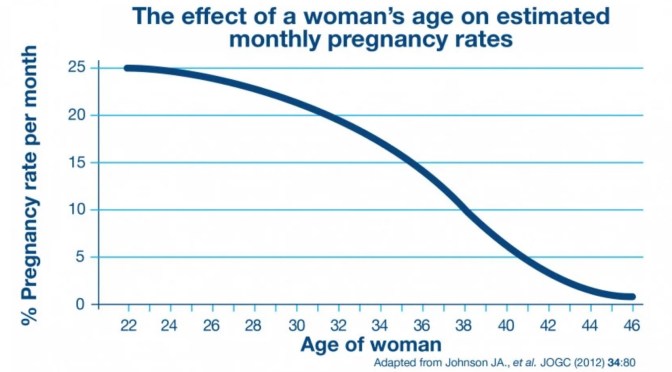

Is it easy for a woman to get pregnant after age 30?

This UK Daily Mail article is a bit old now, but I still it’s important to spread around the knowledge about when a woman’s fertility starts to decline. Somehow, in this age of feminism, there is this idea that women can put off pregnancy into their 40s. The truth is quite different. Let’s take a look at the facts from an unlikely source – the British socialist single-payer health system.

It says:

One of Britain’s top NHS fertility specialists last night issued a stark warning to women: Start trying for a baby before you’re 30 – or risk never having children.

In a strongly worded letter to Education Secretary Nicky Morgan, consultant gynaecologist Professor Geeta Nargund has also demanded that teenagers are taught about the dangers of delaying parenthood, because of the spiralling cost to the taxpayer of IVF for women in their late 30s and 40s.

Professor Nargund cites the agony of a growing number of women left childless as a key reason why fertility lessons must be included in the national curriculum. Her controversial intervention – in which she warns Britain faces a ‘fertility timebomb’ – will fuel the debate over the best time to start a family, amid the rise in women delaying motherhood to pursue careers.

[…]Arguing passionately for fertility lessons, she tells Mrs Morgan: ‘Information is power and the best way to empower people to take control of their fertility is through education.’ Prof Nargund said last night: ‘Ideally, if a woman is ready for a child, she should start trying by the time she is 30. She should consider having a child early because as a woman gets older, her fertility declines sharply.’

If a woman started trying early enough, doctors would still have time to diagnose problems and take action before it was too late, she said.

Her comments were endorsed by Professor Allan Pacey, outgoing chair of the British Fertility Society.

‘You need to be trying by 30 because if there is a problem and you need surgery, hormones or IVF, then you’ve got five years to sort it out,’ he said. ‘If a woman starts trying at 35, doctors have got to sort it out when she is already on a slippery fertility slope’.

Let’s see how accurate women’s beliefs about fertility and age are.

Consider this article from Aeon magazine.

It says:

Many studies show that women are not only woefully ignorant when it comes to fertility, conception and the efficacy of assisted reproductive technologies (ART) – but they overestimate their knowledge about the subject. For instance, a 2011 study in Fertility and Sterility surveyed 3,345 childless women in Canada between the ages of 20 and 50; despite the fact that the women initially assessed their own fertility knowledge as high, the researchers found only half of them answered six of the 16 questions correctly. 72.9 per cent of women thought that: ‘For women over 30, overall health and fitness level is a better indicator of fertility than age.’ (False.) And 90.9 per cent felt that: ‘Prior to menopause, assisted reproductive technologies (such as IVF) can help most women to have a baby using their own eggs.’ (Also false.) Many falsely believed that by not smoking and not being obese they could improve their fertility, rather than the fact that those factors simply negatively affect fertility.

[…]According to a 2011 study in Human Reproduction, which surveyed 410 undergraduate students, most overestimated a women’s chances of spontaneous pregnancy in all age groups, but particularly after receiving IVF beyond age 40. Only 11 per cent of the students knew that genetic motherhood is unlikely to be achieved from the mid-40s onward, unless using oocytes or egg cells frozen in advance. ‘This can be explained by technological “hype” and favourable media coverage of very late pregnancies,’ the authors concluded.

People see graphs of pregnancy chances, but they forget that the rate of miscarriage is also increasing as you age. So, even if you get pregnant, there is a higher risk of miscarriage. Not to mention ectopic pregnancies, and pregnancy complications. It’s also harder to get pregnant your first time after age 30. It’s easier to get pregnant after 30, if it’s not your first time. Also, pregnancies after 30 are much harder on a woman’s body than pregnancies in her 20s.

So, I guess now I’ll issue my advice to women in their 20s on how to avoid infertility:

If you went to college, chances are that you absorbed a lot of feminism. Feminism emphasizes being free of constraints, feeling happy, having fun, career over family, and independence from the needs of men and children. You need to renew your mind in order to undo the cultural denigration of marriage and children. Get yourself a marriage mentor, ask for book recommendations that will educate you about the challenges and rewards of marriage. A good marriage mentor will explain to you why marriage is a better plan than the feminist plan, and will emphasize self-denial, self-sacrifice, self-control and serving others. It’s only by getting specific about marriage and parenting that your heart will change to want to work on marriage rather than work on the things that the feminist culture prefers.

I guess my closing advice would be to be careful about the things you hear about marriage in the culture. It’s very tempting to just believe the words of other people, when they tell you what you want to hear. A lot of people have agendas that sound good, but ultimately, they don’t satisfy. Once your fertility is gone, it’s really gone. IVF and egg-freezing are expensive and unreliable. Again, you should look into this yourself, rather than rely on people who say whatever you want to hear so that you will like them.

Is the definition of atheism “a lack of belief in God”?

First, let’s see check with the Stanford University Encyclopedia of Philosophy:

‘Atheism’ means the negation of theism, the denial of the existence of God.

Stanford University is one of the top 5 universities in the United States, so that’s a solid definition. To be an atheist is to be a person who makes the claim that, as a matter of FACT, there is no intelligent agent who created the universe. Atheists think that there is no God, and theists think that there is a God. Both claims are objective claims about the way the world is out there, and so both sides must furnish forth arguments and evidence as to how they are able to know what they are each claiming.

Philosopher William Lane Craig has some thoughts on atheism, atheists and lacking belief in God in this reply to a questioner.

Question:

In my discussions with atheists, they  are using the term that they “lack belief in God”. They claim that this is different from not believing in God or from saying that God does not exist. I’m not sure how to respond to this. It seems to me that its a silly word-play and is logically the same as saying that you do not believe in God.
What would be a good response to this?
Thank you for your time,

Steven

And here is Dr. Craig’s full response:

Your atheist friends are right that there is an important logical difference between believing that there is no God and not believing that there is a God.  Compare my saying, “I believe that there is no gold on Mars” with my saying “I do not believe that there is gold on Mars.”   If I have no opinion on the matter, then I do not believe that there is gold on Mars, and I do not believe that there is no gold on Mars.  There’s a difference between saying, “I do not believe (p)” and “I believe (not-p).”   Logically where you place the negation makes a world of difference.

But where your atheist friends err is in claiming that atheism involves only not believing that there is a God rather than believing that there is no God.

There’s a history behind this.  Certain atheists in the mid-twentieth century were promoting the so-called “presumption of atheism.” At face value, this would appear to be the claim that in the absence of evidence for the existence of God, we should presume that God does not exist.  Atheism is a sort of default position, and the theist bears a special burden of proof with regard to his belief that God exists.

So understood, such an alleged presumption is clearly mistaken.  For the assertion that “There is no God” is just as much a claim to knowledge as is the assertion that “There is a God.”  Therefore, the former assertion requires justification just as the latter does.  It is the agnostic who makes no knowledge claim at all with respect to God’s existence.  He confesses that he doesn’t know whether there is a God or whether there is no God.

But when you look more closely at how protagonists of the presumption of atheism used the term “atheist,” you discover that they were defining the word in a non-standard way, synonymous with “non-theist.”  So understood the term would encompass agnostics and traditional atheists, along with those who think the question meaningless (verificationists).  As Antony Flew confesses,

the word ‘atheist’ has in the present context to be construed in an unusual way.  Nowadays it is normally taken to mean someone who explicitly denies the existence . . . of God . . . But here it has to be understood not positively but negatively, with the originally Greek prefix ‘a-’ being read in this same way in ‘atheist’ as it customarily is in . . . words as ‘amoral’ . . . . In this interpretation an atheist becomes not someone who positively asserts the non-existence of God, but someone who is simply not a theist. (A Companion to Philosophy of Religion, ed. Philip Quinn and Charles Taliaferro [Oxford:  Blackwell, 1997], s.v. “The Presumption of Atheism,” by Antony Flew)

Such a re-definition of the word “atheist” trivializes the claim of the presumption of atheism, for on this definition, atheism ceases to be a view.  It is merely a psychological state which is shared by people who hold various views or no view at all.  On this re-definition, even babies, who hold no opinion at all on the matter, count as atheists!  In fact, our cat Muff counts as an atheist on this definition, since she has (to my knowledge) no belief in God.

One would still require justification in order to know either that God exists or that He does not exist, which is the question we’re really interested in.

So why, you might wonder, would atheists be anxious to so trivialize their position?  Here I agree with you that a deceptive game is being played by many atheists.  If atheism is taken to be a view, namely the view that there is no God, then atheists must shoulder their share of the burden of proof to support this view.  But many atheists admit freely that they cannot sustain such a burden of proof.  So they try to shirk their epistemic responsibility by re-defining atheism so that it is no longer a view but just a psychological condition which as such makes no assertions.  They are really closet agnostics who want to claim the mantle of atheism without shouldering its responsibilities.

This is disingenuous and still leaves us asking, “So is there a God or not?”

So there you have it. We are interested in what both sides know and what reasons and evidence they have to justify their claim to know. We are interested in talking to people who make claims about objective reality, not about themselves, and who then go on to give reasons and evidence to support their claims about objective reality. There are atheists out there that do make an objective claim that God does not exist, and then support that claim with arguments and evidence. Those are good atheists, and we should engage in rational conversations with them. But clearly there are some atheists who are not like that. How should we deal with these “subjective atheists”?

Dealing with subjective atheists

How should theists respond to people who just want to talk about their psychological state? Well, my advice is to avoid them. They are approaching religion irrationally and non-cognitively – like the person who enters a physics class and says “I lack a belief in the gravitational force!”.  When you engage in serious discussions with people about God’s existence, you only care about what people know and what they can show to be true. We don’t care about a person’s psychology.