Category Archives: News

New study: switching male and female marriage roles makes both sexes unhappy

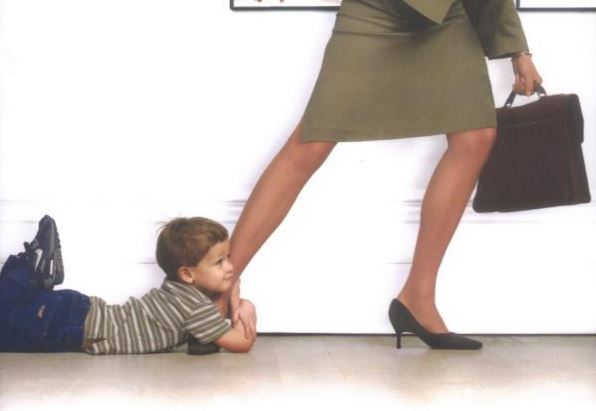
Child grabs for his mom, who is leaving for work

Here’s a report on a new study from the UK Daily Mail.

Excerpt:

When females were the main breadwinner in the family, they were discovered to report more symptoms of depression.

However, the opposite effect was found in men: Their psychological well-being was highest when they were the primary wage-earners.

Researchers at the University of Illinois examined data on nearly 1,500 men and 1,800 women, aged between 52 and 60. Their well-being was evaluated through surveys.

The researchers first found that men’s well-being decreased once they had exited the workforce to become home-makers.

Meanwhile, the inverse was not so for women: Women’s psychological well-being was not affected by leaving their jobs to become stay-at-home mothers.

‘We observed a statistically significant and substantial difference in depressive symptoms between men and women in our study,’ says lead researcher Karen Kramer.

‘The results supported the overarching hypothesis: well-being was lower for mothers and fathers who violated gendered expectations about the division of paid labor, and higher for parents who conformed to these expectations.’

If you don’t like the UK Daily Mail, CNN reported on a similar study back in 2014.

Indeed. The trouble is this: who can afford to provide for a stay-at-home wife on one salary, in a country where 30% of your income is taxed, and many things (e.g. – health care, college tuition, etc.) are way more expensive because of socialist welfare state policies? We have a $20 trillion dollar debt, and taxes are only going to go higher, making it that much harder for a working man to provide for a family – no matter how diligent he is about getting STEM degree(s) and working full time, non-stop. Marriages where the woman stays home with the children are happiest for everyone, but thanks to the voting patterns of radical feminists, husbands have been replaced by government programs, and those cost taxpayer money. You can either have a big government welfare state or you can have a stay-at-home wife. You can’t have both.

I got a snarky comment on a post I wrote last week about how marriages where the husband does not work full-time are more likely to fail.

Here is the comment:

Well done.
I’ll now await your follow-up article on the divorce rate for couples where the wife works full-time outside of the home and how men should choose a woman who has demonstrated an ability to do marriage tasks – like taking care of the household full time, raising and nuturing children, being loving and supportive of a husband when times are tough (especially if, God forbid, he should ever find himself unemployed and thus no longer a provider, in which case most wives’ base and visceral impulse is to abandon him), not wanting “a career,” and not insisting that her husband waste all his earnings on fun and thrills for her.

Well, I’m blogging about it again today, but if the commenter were very clever, then he would have found this post from June of 2013 entitled “STUDY SHOWS THAT FEMALE-BREADWINNER MARRIAGES ARE LESS HAPPY AND LESS STABLE”.

Excerpt:

Given these findings, it isn’t surprising that when a wife earns more than her husband, the risk of divorce rises, too. To study this, the authors used a survey conducted in two waves, 1987-88 and 1992-93. (There were no more recent data available for this particular test.) Then they investigated the likelihood of a divorce in the five-year interval. For this sample, some 12 percent of all couples were divorced during this period — a sobering fact about the stability of marriages in general. But the divorce rate rose by half, to about 18 percent, for couples in which the wife earned more than the husband.

When I was a high school student, I can remember trying to decide between being an English teacher, being a prosecuting attorney, or being a software engineer. It was my Dad who pointed me towards software engineering. As an avid stock picker, my Dad was seeing tech stocks exploding in value, and he knew that I would be able to find work even if I was laid off during tough times. I am glad that I listened to his advice, although my career still has not been easy, which is why I saved money for the two times where I was laid off (both times my subsidiary was folded by the parent company!). My reason for going into a field where I could earn more money was because I wanted to get married, have 4 children, and “heal” the experience of being neglected by my mother (who stuck me in day care after 6 weeks and worked full-time until she retired) by watching her parent my kids as a stay-at-home mom. I knew enough to know that marriage works better when the man provides and the woman focuses on the children – at least until they are 6 years old. Since then, I’ve discovered homeschooling, and I would definitely have done that. It’s not that I am opposed to women working, it’s that I am opposed to children not being raised by their mother.

As I explained in my lengthy reply to the snarky commenter, it’s gotten much harder for men to be the sole provider, and have a stay at home wife and homeschooling mom:

Regarding tough times, I think that the situation for men right now is horrible with respect to marriage and children. $20 trillion debt and a generation of unskilled snowflake millenials voting for socialism in droves. I also think that co-ed schools where teachers and administrators are 80% females produce lousy outcomes for boys (read Christina Hoff Sommers’ “The War on Boys”, 2nd edition). Affirmative action in higher education and in the workplace for women doesn’t help men become providers, either. Men also pay the same premiums for health care as women, and yet they use far less health care: more tilting the field against men. And so on, don’t even get me started on divorce courts and child custody.

This isn’t the first time that I’ve blogged on studies about male and female roles in marriage. If you want to get good results from your marriage, you definitely want to follow the studies below.

Related posts

Are solar eclipses common? What has to be in place to observe a solar eclipse?

Christianity and the progress of science

If there were a Designer of the universe, what would He have to do to allow creatures living on a planet to observe a solar eclipse?

Consider this article from Discovery Institute.

Excerpt:

A rare convergence of events allows Earthlings to witness not just solar eclipses, but perfect solar eclipses, where the Moon just barely covers the Sun’s bright photosphere. Such eclipses depend on the precise sizes, shapes, and relative distances of the Sun, Moon, and Earth. There’s no law of physics or celestial mechanics that requires the right configuration. In fact, of the more than 65 major moons in our Solar System, ours best matches the Sun as viewed from its planet’s surface, and this is only possible during a fairly narrow window of Earth’s history encompassing the present. The Moon is about 400 times smaller than the Sun. But right now, the Moon is about 400 times closer to the Earth than is the Sun. So, the Moon’s apparent size on the sky matches the Sun’s. Astronomers have noted this odd coincidence for centuries. And, since the Sun appears larger from the Earth than from any other planet with a moon, an Earth-bound observer can discern finer details in the Sun’s chromosphere and corona than from any other planet. This makes our solar eclipses more valuable scientifically.

The recent pictures of solar eclipses sent back from the Opportunity rover on Mars nicely illustrate how much better our solar eclipses are. The two small potato-shaped Martian moons, Deimos and Phobos, appear much too small to cover the Sun’s disk, and they zip across it in less than a minute.

Not only do you need things to be finely-tuned to see the eclipse, but you also need observers to be there.

More:

It’s intriguing that the best place to view total solar eclipses in our Solar System is the one time and place where there are observers to see them. It turns out that the precise configuration of Earth, Moon and Sun are also vital to sustaining life on Earth. A moon large enough to cover the Sun stabilizes the tilt of the rotation axis of its host planet, yielding a more stable climate, which is necessary for complex life. The Moon also contributes to Earth’s ocean tides, which increase the vital mixing of nutrients from the land to the oceans. The two moons around Mars are much too small to stabilize its rotation axis.

In addition, it’s only in the so-called Circumstellar Habitable Zone of our Sun–that cozy life friendly ring where water can stay liquid on a planet’s surface–that the Sun appears to be about the same size as the Moon from Earth’s surface. As a result, we enjoy perfect solar eclipses.

Why would the Designer of the Universe want his observers to exist in exactly the right place to observe the solar eclipse? What is the point of seeing a solar eclipse?

Here is the point:

Our ability to observe perfect solar eclipses has figured prominently in several important scientific discoveries, discoveries that would have been difficult if not impossible on the much more common planets that don’t enjoy such eclipses.

First, these observations helped disclose the nature of stars. Scientists since Isaac Newton (1666) had known that sunlight splits into all the colors of the rainbow when passed through a prism. But only in the 19th century did astronomers observe solar eclipses with spectroscopes, which use prisms. The combination of the man-made spectroscope with the natural experiment provided by eclipses gave astronomers the tools they needed not only to discover how the Sun’s spectrum is produced, but the nature of the Sun itself. This knowledge enabled astronomers to interpret the spectra of the distant stars. So, in a sense, perfect eclipses were a key that unlocked the field of astrophysics.

Second, in 1919, perfect solar eclipses allowed two teams of astronomers, one led by Sir Arthur Eddington, to confirm a prediction of Einstein’s General Theory of Relativity–that gravity bends light. They succeeded in measuring the changes in the positions of starlight passing near the Sun’s edge compared to their positions months later. Such a test was most feasible during a perfect solar eclipse. The tests led to the general acceptance of Einstein’s theory, which is the foundation of modern cosmology.

So, you’ve got fine-tuning for the eclipse, fine-tuning for the observers, and with that in place, the observers can collect scientific evidence… including evidence that confirms cosmic fine-tuning as well as general relativity. General relativity is important because if gives us the expanding universe – one of the evidences for the Big Bang cosmology. The Big Bang cosmology states that the entire physical universe came into being out of nothing, about 14 billion years ago. Who could have caused that? If we don’t have eclipses, we are losing out on evidence of cosmic fine-tuning and cosmic creation.

There’s a new Discovery Institute podcast featuring Jay Richards, co-author of the amazing book “The Privileged Planet”.

Details:

On this episode of ID: The Future, CSC Senior Fellow Jay Richards explains how perfect solar eclipses are the tip of an iceberg-size design argument found in a book he co-wrote, The Privileged Planet. The conditions for a habitable planet (right distance from the right size star, a big but not too big moon that is the right distance away to stabilize Earth’s tilt and circulate its oceans) are also conditions that make perfect solar eclipses from the Earth’s surface much more likely. And perfect eclipses aren’t just eerie and beautiful. They’ve helped scientists test and discover things, and are part of a larger pattern: The conditions needed for a habitable place in the cosmos correlate with the conditions well suited for scientific discovery. As Richards notes, this correlation is inexplicable if the cosmos is the product of chance. But if it’s intelligently designed with creatures like us in mind, it’s just what we might expect.

The MP3 file is here.

If you have not seen The Privileged Planet, you can get the same argument as in the book in just over an hour. You can either buy The Privileged Planet DVD, or click here to watch it on YouTube. And it’s narrated by John-Rhys Davies.

Making monergism make sense: a middle-knowledge approach to salvation

Lets take a closer look at a puzzle

This article at Free Thinking Ministries was written by my friend Tim Stratton. In it, he tries to rescue Calvinism from the horror of double-predestination.

Excerpt: (links removed)

Many reformed folks (freely?) choose to reject Molinism because they contend that this theological view “smells of synergism.” What is this stench that reportedly makes John Calvin turn over in his grave? Simply put, synergism is the view that man plays at least a small part in his own salvation process. Monergism, on the other hand, is the view that God is the author of salvation from beginning to end.

Since Molinism affirms that man is free to choose to reject God’s saving grace or not, many Calvinists jump to the conclusion and assume that Molinism must be synergistic. This does not necessarily follow.[1] Consider one possible model:

1- God, by nature, is a volitional unmoved mover who is free to choose between options in accord with His nature. (This is supported via the Kalam and the Argument from Time).

2- By God’s grace, humans are created in the “image of God.” By nature, then, we are free to choose between options in accord with our nature. (This is supported via the Freethinking Argument).

3- Adam & Eve freely chose to disobey God and this sin completely separates humanity from God. This is what it means to have a “totally depraved sin nature.” (Every aspect of man is separated from God).

4- In this state of depraved separation from God (sin nature), humans do not even know God exists if merely left to our own devices.

5- If humans do not even know God exists, then, left to our own devices and apart from God’s grace, it would be impossible to choose to love and follow God (thus, Pelagianism is impossible on this view).

6- God, in His love for all people, provides amazing prevenient grace to all people (Romans 1:20), writing the law on the human heart (Romans 2:15), conviction of the Holy Spirit (John 16:8-9), and draws all men (John 12:32). This is commonly referred to as “common grace.”

7- Therefore, by God’s grace, human nature has changed from a “totally separated from God nature” to a nature that has now experienced enough divine revelation (influences) allowing all mankind to start making some free and volitional choices in accord with our new nature; namely, to choose to resist God’s grace and revelation, or not.[2] Mankind is without excuse because we do not have to resist what God has made clear (Romans 1:18-20).[3]

[Note: According to Calvinist, Matt Slick (albeit inadvertently), Mark 4:10-12 implies that if an unregenerate person gets access to clear and accurate information, then they possess the ability to become Christians!]

8- If one does not reject or continually resist the grace and revelation God provides them, then God will continually provide more and more until the person reaches the point of “no return” and will become saved.

Thus, God does ALL the work in salvation from beginning to end on this Molinistic model; all the human can do is freely resist God’s grace and revelation, but he or she does not have to! The human does nothing to gain salvation apart from God’s grace on this Monergistic Model of Molinism.

I think that Stratton’s formulation above does indeed keep God as the sole initiator of salvation. And that’s good. But it also makes sure that human resistance to God is allowed, and that’s good. We want salvation to be 100% by faith alone in Christ alone. But we don’t want God to be the cause of people not being saved (because he is the ONLY ONE who can save them, and he chooses not to save them). On Stratton’s view, God wants everyone to be saved. If anyone is saved, it’s because God did ALL THE WORK to lead them and secure their salvation with the death of Jesus on the cross. But, on Stratton’s view, humans do get a choice – the choice to trust God or not. And so, if a person is not saved, then it’s their fault – not God’s. This works.

Read his whole post, and see what you think about it.