
Category Archives: Commentary

More and more women are asking why they can’t find a good man to marry

Do young women understand how to get to a stable marriage?

In the last few months, I’ve met 5 different Christian women in their 30s who all asked me the same question: where are all the good men who want to marry me?

Christian men’s rights blogger Dalrock had two different posts where he described the answer to this question.

Here is the first post from Dalrock that concisely illustrates the problem:

As I wrote in A very long season, feminists don’t want to waste a day more of their youth and fertility on their husbands than absolutely necessary. As if to prove this very point, 30 year old Mona Chalabi writes in the NY Times* I Want My 2.3 Bonus Years:

If I could prolong my time as a young adult by, say, 2.3 years, here is a list of things I would like to do:

• Go to more parties. Preferably wild parties that I can think about, years later, at mild parties.

[…]• Have more romantic partners.

[…]• Get a bit higher up the career ladder a bit earlier on. That would probably boost my earnings, giving me more financial security. I could use that money to go to more parties, get a membership to a fancy gym and maybe even meet a romantic partner on the ab machines.

To drive the message home, the image at the top of the article is a cartoon of a resentful Chalabi giving her future husband the side eye for her lost years of sampling penises!

Surely, this must be an isolated case just for New York Times feminists, right? It’s not widespread, is it?

Second post from Dalrock:

Margaret Wente at the Globe and Mail* asks where all the good men have gone.  Wente comes to the conclusion that women need a sex cartel:

…it’s up to us to make the rules. “Why buy the cow when you can get the milk for free?” my father used to say. It drove me crazy when he said that. Now, it’s dawned on me that he was right.

Since the women’s cartel collapsed, women’s bargaining power has seriously eroded. That’s why so many single women hate Tinder, which has further commodified sex for the benefit of men. Women are just another consumer good in the shop window.

The apex fallacy aside, Wente is partially right.  Women (as a group) have signaled to men that what they really want are exciting sexy badboys, not boring loyal dudes. It isn’t that women no longer want to marry beta providers, they just don’t want to waste a day more of their youth and fertility on their husband than absolutely necessary.

As a result, some up and coming boring loyal dudes aren’t knocking themselves out in their twenties while they wait for their future wife to tire of having sex with other men.

If you wonder why men are no longer performing in school, and exchanging careers for video games, the answer is simple. Men have realized that young women today, under the influence of feminism, are not interested in traditional husbands during their late teens and 20s. During these years, women are interested in travel, fun, drinking, hook-ups and cohabitation with amoral atheists. This is what I have personally observed. In the minds of young women, the highest value men are good-looking men who have no religion, and make no moral judgments, and are left of center politically – especially on abortion. There are many good men who are romantic about women from their youth, and want to get married. But when they see what young women really want, they just give up on school and work, since doing the traditional male roles has no value to young women. Many good men even give up on morality and Christianity because they want a relationship with a woman so badly.

More from second post:

What Wente doesn’t understand is that timing is everything.  From an economic point of view, women are dividing up sexual access that traditionally would have been reserved only for their husband into two blocks.  The first block contains their most attractive and fertile years, and it is dedicated to no strings sex with exciting badboys.  Then, once women reach what Rollo calls the epiphany phase, they want to bargain sexual access in their remaining (older and less fertile) years for maximum beta bucks.

The problem with this strategy is (generally speaking) not that the previously overlooked beta men will refuse to marry the suddenly reformed party girls.  The problem is that young men now look at the men 3-5 (and even 5-10) years older than them and don’t see an indication that signaling provider status will make them attractive to women.  They also see a society that holds married fathers in contempt**.  Most of these men are still working hard in their late teens and twenties to prepare to signal provider status in their 30s.  But a growing minority of young men are no longer doing so.  These men are instead working like women.  Once the reformed party girls are ready to find Mr. Beta Bucks, there is a shortage of 30 something men who fit the bill.  Even worse, no amount of complaining or shaming will cause the missing beta providers to go back in time and spend the prior decade preparing for this moment.

I’m one of the last men who followed the marriage-preparedness script for traditional men who wanted to marry and have four children and have a stay-at-home homeschooling mom to raise them from birth to graduate school. I find myself now in my early 40s, with a 6-figure income and a nearly 7-figure net worth. I declined to use those assets to play the field with hot bad girls, preferring instead to keep my sexual past completely clean for my eventual wife. However, what I observed in my late teens and 20s and even early 30s was a complete lack of interest in marriage ability, from non-Christian women and Christian women alike. Christian women aren’t learning to value early marriage from their married parents or their evangelical churches. None of the traditional husband skills are valued by young women, i.e. – chastity, gapless resume, alcohol abstinence, undergraduate and graduate STEM degrees, experience nurturing and mentoring others, stewardship of earned income.

I recently caused an uproar on my Facebook page by saying that even if the perfect woman showed up right now to marry me, I would not pursue her because the critical time where the woman could have applied maximum youth, beauty and fertility as a wife to make an impact on my education, early career, health, and finances has passed. A younger woman develops value to her husband precisely by applying herself to him and to her family in these critical early years. Men who have experienced this self-sacrificial love and support are loyal to their wives even after their wives lose their youth and beauty. Why? Because the men know that they are much better than they could have been, having enjoyed that early investment of value made by their young wives.

Young women very supportive of premarital sex

As Christian writer Matt Walsh notes in a recent article at the Daily Wire, this “follow your heart” focus on happiness in women is lethal to marital stability, and men know it.

Excerpt:

There was an article in Cosmo this week with a title that summarizes all that’s wrong with Cosmo and modern society as a whole: “I eloped at 25, divorced at 26, and dated my way across Europe all summer.” Of course, by “dated my way across Europe” she means that she slept with half the continent.

The author, Elise, says she “started fighting” with her husband and within a few months they both decided that their differences were irreconcilable. Despite counseling, she says, “neither of us was happy.” So, exhausted from 12 whole months of marriage, Elise embarked on a voyage of self-discovery and STD cultivation. She met random dudes in half a dozen countries and had sex with them, learning quite a lot as she went, though she can’t really explain what exactly she learned or why sex was a necessary component in learning it. Finally, she came home and started dating some other guy. The end.

Well, not really the end. 20 years from now I’m sure we’ll get the follow up article: “I’m alone and miserable and it’s everyone’s fault but mine.” After all, you may be able to fill the emptiness in your soul with frivolous sex when you’re young and physically desirable, but that phase is fleeting. People who don’t want to “waste” their beauty and youth on a spouse, so they waste it instead on strangers who don’t love them or even care what happens to them tomorrow, will be shocked when a tomorrow comes where even strangers aren’t interested anymore. This is where the single-minded, utterly selfish pursuit of “happiness” at all costs inevitably leads: to rejection, despair, and a quiet, unnoticed death on a lonely hospital bed.

As Elise helpfully demonstrated, “do what makes you happy” is poison in a marriage. Many a vow has been broken because one or both partners decide to chase “happiness” instead of commitment, fidelity, and love. “I deserve to be happy,” reports the legion of serial divorcees, as they drift on to the next spouse, and the next, and the next, and the next, looking for the one — the one, finally — who might cure the misery they’ve inflicted on themselves. Increasingly unhappy, yet increasingly convinced that they deserve to be.

And this follow your heart to happiness situation is alive and well in the church today. Marriage-minded Christian men who have prepared for husband roles are surprised to find that there is often little or no difference between Elise and the Christian women the church produces. Christian men who desire to invest in a marriage that is stable, productive and influential have nowhere to turn for a wife who is able and willing to help. In my experience, the problem with happiness-focused women who delay marriage is never discussed in churches from the pulpit. The “good men to marry” that today’s 30-something women are looking for were plentiful back when those same women were in their early-to-mid 20s.

Survey: young, unmarried women explain why they avoid having children

This article comes from the leftist Huffington Post.

They write:

The Huffington Post and YouGov asked 124 women why they choose to be childfree. Their motivations ranged from preferring their current lifestyles (64 percent) to prioritizing their careers (9 percent) — a.k.a. fairly universal things that have motivated men not to have children for centuries. To give insight into the complex, layered decisions women make, HuffPost asked childfree readers to discuss the reasons they have chosen not to have kids and gathered 270 responses here.

They grouped the responses into 5 categories:

  1. I want to prioritize my career
  2. I don’t like children
  3. I had a bad relationship with my parents
  4. I don’t want the financial responsibility
  5. I like my life as it is

And here are some interesting quotations:

Category 1:

I am a first-generation college graduate in my family. My mother was a single mom my entire childhood, and I was there to see that struggle. Being a parent, for a woman, means for life. Being a parent, for men, seems to be something very different. I understand raising children is a big life change and I don’t want to sell myself short on my potential to become something more and maybe even create change. I am childfree because I want to travel, move, pursue my career wholly and be able to push myself to be an inspiration to other women. If a child comes into my life, it won’t be until I am happy and successful in my work life, and not until I am secure with my finances and a marriage. I don’t want to one day wake up as an old woman wishing I had waited to have children so I could live my own life first, make mistakes, learn new things and find myself. Today kids are not for me.

Category 2:

I’m nearly 47; my boyfriend (domestic partner) of 17 years is nearly 50. I’ve never been pregnant and have taken every precaution to remain childfree. I tolerate other people’s children when I have to. I’m happiest when there are NO children around. I definitely don’t want them in my home. I like my life as it is. My boyfriend and I are both scientists. We also raise snakes and spiders! We like to travel. We travel to ride roller coasters (members of ACE — American Coaster Enthusiasts) and to attend rock concerts. I am also a performer in a senior winter guard. My plate overfloweth! I see no reason to procreate. I would be unhappy. Why be unhappy?

Category 3:

I have a great relationship with my husband. We have the time and money to travel, and that gives us precious memories. I had a bad relationship with my dad, and maybe I’m scared to treat my children like that. I’m very happy with my decision. I have a great relationship with myself too.

Category 4:

My spouse and I have talked in depth about having children. However, we both decided that our desire to travel the world is a financial burden in itself. If we have kids, we will never have the means to travel, and at the end of our life, we would rather be 100 percent committed to fulfilling our own realistic dreams rather than only able to provide a subpar life for a child. Comes down to the fact we are selfish, but at least we recognize this and made the choice early enough to avoid damaging a kid

Category 5:

The thought of having to do kiddie crap every weekend makes me want to shoot myself. I like having the extra money to save for retirement and not worry about braces, summer camp or college tuition. I can travel on a moment’s notice. I can give my all to my job and not have to worry about daycare, sick days, or having to leave my co workers to pick up my slack. I’m the “cool aunt” to all my nieces and nephews. I have more time to do the things that make me happy and productive. My relationship with my guy is not strained due to the constant neediness of children. I don’t want to put my body through pregnancy and childbirth. I can give my dog all the attention he needs and deserves.

If I had to choose one comment to represent the entire survey, it would be this one:

The moment you have children, you’re life ceases to be about yourself. Kids always take priority and I feel like I can do more for this world than just generate offspring.

I think this is the real reason why young, unmarried women choose not to prepare or plan for marriage and children . Marriage and children “some day” is like planning for your retirement by winning the lottery. It’s a way for the woman to signal to her family and friends that she will eventually want the responsibility of a husband and kids, but not right now.

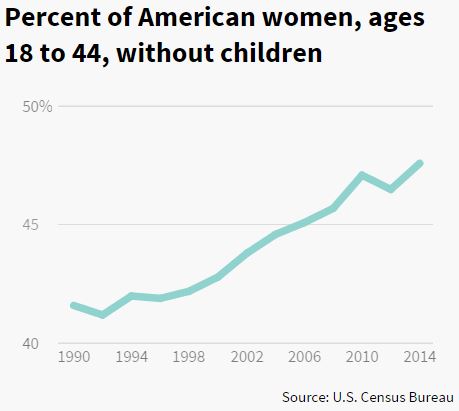
We need to move beyond a survey to quantify this, and this U.S. Census data does that:

Childless by choice, not because of men
Childless by choice, not because of men failing to “man up”

These quotations are very troubling to me. I’ve been serious about obtaining STEM degrees, saving money by not traveling, and making a plan to have a marriage and family that will serve God. I haven’t used my freedom to buy alcohol or to play the field sexually. I don’t see women being serious about choosing men who are serious about marriage – especially men who are financially prepared to pay for things like houses and children. A lot of women are even interested in men who are younger than they are, despite the fact that these men have not proven themselves in their careers and finances.

How can young, unmarried women be sincere about wanting marriage and children “some day” if they waste their 20s and 30s on men who aren’t prepared for the financial responsibility? And that’s not even to mention the fidelity responsibility – men who have self-control before marriage are more able to be faithful after marriage. It seems as if a faithful man who can provide for a family is that last thing that women want. Even if a man does find one who wants to get married, the financial situation between a marriage-minded man and a woman who has spent all her time traveling is going to be a huge mismatch.

Young, unmarried women seem to oppose marriage because they know it will impose responsibilities, expectations and obligations on them. And their parents, relatives, friends and co-workers are doing nothing to detect and counter this attitude. As Lindsay argued on this blog before, the marriage / children plan is an excellent way for Christians to make a difference. But it does take work – work that some young, unmarried women are deliberately avoiding.

Sean McDowell reviews new book on Darwinian evolution and intelligent design

Investigation in progress

I really love the two books on intelligent design written by Dr. Stephen C. Meyer, but they are just so big that you can’t really give them to a co-worker or a family member or a friend to read. I’ve been looking for a decent book that explains the issues in a compelling way, and now it looks like I’ve found one.

First, a review of the new book from Amazon:

Possibly the best ID book to read first

For those with a specific interest, there are many other excellent ID books that take a deep dive into a particular topic. Heretic stands out as being excellent as an introductory doorway into considering Intelligent Design.

One doesn’t need to be involved in the sciences to benefit greatly from this clearly written book. The great majority of the material can be readily understood by a general audience and the authors provide guidance if you want it on how to skim or skip ahead when the next part has more technical details.

That said, this is now my preferred and recommended first book for any scientist who has just assumed Darwin’s grand claim must be true and who hasn’t yet given any serious consideration to the possibility that design is real, not merely an appearance of design.

The book allows one to follow along as the main author begins from that same point of assuming Darwinism, but then must grapple and struggle with the hard realities of the evidence. Along the way, this book provides one of the clearest and most illuminating examinations of the influence of assumptions (and of career considerations) upon what people are willing to consider.

Ultimately the book invites the reader to make the same commitment made early on by the main author to follow the evidence wherever it leads.

I don’t know of a book that does a better job of calling scientists away from blind faith in an assumed paradigm and toward a return to sound science based on following the observed evidence — including those most troublesome facts that don’t agree with old assumptions.

OK, so this review gave me some hope, but it’s what Dr. Sean McDowell had to say that really caught my attention.

He writes:

Heretic: One Scientist’s Journey from Darwin to Design is the most recent book published by the Discovery Institute, the foremost Intelligent Design (ID) organization. If you are looking for a good, introductory text to help understand the current debate, this is an excellent place to start.

Unlike other recent book on intelligent design (such as Darwin’s Doubt by Stephen Meyer or Undeniable by Doug Axe) this book does not offer a fresh argument for intelligent design. But this is hardly a criticism, because the book does not aim to. Rather, it tells the story of Matti Leisola—an accomplished scientist, professor, and researcher from Finland—and how he became disillusioned with the Darwinian paradigm and came to embrace design.

The storied nature of this book is one of its greatest strengths. Rather than weeding into difficult scientific details (that can distract the non-specialist reader), Heretic takes readers on Leisola’s personal journey of wrestling with important issues like the fossil record and the origin of life (It is also co-written with Jonathan Witt). Leisola does discuss relevant scientific issues, but with full awareness of his primarily lay audience.

I am thrilled to see the Discovery Institute publishing books that take a narrative approach to origin questions. In our book Understanding Intelligent Design, William Dembski and I include a plethora of stories and examples. But Heretic is told entirely as a story, and my suspicion is that it may incite new readers to consider the arguments for intelligent design.

Heretic would be an excellent book to give to someone who is new to discussions over Darwin and design. Along with being interesting, the narrative approach is also much “softer” to read. Rather than directly trying to persuade readers, Leisola simply shares his personal conclusions regarding origins. And yet it is impossible for the thoughtful reader to miss the force of many of his arguments, even if he or she ultimately disagrees with Leisola’s conclusions.

Just in passing, I didn’t like “Undeniable” at all, although I’m a great admirer of Doug Axe and his story of getting his PhD from Caltech, and then post-doctoral research on protein formation at Cambridge University. He was able to get his research published multiple times in the peer-reviewed Journal of Molecular Biology. But I just don’t find him to be a good writer, especially for ordinary people.

OK, so after reading the Amazon review and then having it confirmed with Dr. McDowell’s review, I am officially excited. I decided to buy a copy of the book, but not for me. I have lots of friends who are voracious readers who can read it and then tell me what they thought of it. So, I bought a copy of it for my very best friend Dina – she has a couple of STEM degrees and a STEM career, so she’ll be able to make short work of it, and then she’ll tell me whether it is worth giving away to my friends and co-workers.

If anyone else has read the book and wants to send me a review, please do. My e-mail is in the About Me section. There have been so many good books coming out lately that I haven’t even gotten through them all: “A Fortunate Universe” (Cambridge University Press), “The Case for Miracles” (by Lee Strobel), “Why Does God Allow Evil?” (by Clay Jones), “Five Proofs of the Existence of God” (by Ed Feser), “Discrimination and Disparities” (by Thomas Sowell), etc. I hope everyone knows about these books and gets one or two or all to read.