Category Archives: Commentary

William Lane Craig reviews new Dawkins/Krauss movie “The Unbelievers” in The Blaze

Dr. William Lane Craig

On The Blaze, a major political news site, Dr. William Lane Craig reviews a new atheist movie entitled “The Unbelievers” starring Lawrence Krauss and Richard Dawkins.

Excerpt:

Richard Dawkins and Lawrence Krauss are two of the most important figures in the New Atheist movement. So one would naturally have high expectations that their new documentary, The Unbelievers, would present a vigorous, powerful attack upon the rationality of religious belief, featuring interviews with impressive scientists laying out the case against God.  Instead, the film turns out to be merely a travelogue of Dawkins and Krauss’ “magical mystery tour” of speaking engagements before their enthusiastic fans. Rather than thought provoking, the film is shallow, boring, and narcissistic.

[…]Featuring sound bites from celebrities and film stars in support of their cause fits Dawkins and Krauss’ purpose more than substantive interviews with qualified but largely unknown academics. The film’s purpose is not to present a case but primarily to rally the troops.

But there is a more fundamental reason for the absence of argument against religious belief. Dawkins and Krauss proceed on the unspoken assumption that science and religion are fundamentally mutually exclusive. Therefore, all one needs to do in order to discredit religion is to extol and celebrate the greatness of science. Science and religion are like two ends of a teeter-totter:  if the one end goes up, the other automatically declines. Thus, Krauss asks Dawkins which he would rather do:  explain science or destroy religion?  It is assumed that these are two ways to the same end. Dawkins, of course, chooses to extol science. “I’m in love with science, and I want to tell the world.” His implicit assumption is that one cannot love both God and science.

There is no argument given for the mutual exclusivity of science and religion; rather it is the unquestioned presupposition of the film. This is ironic because one of the repeated emphases of the film is the necessity of critical thinking. No view is off limits to examination; we must insist on permission to question everything. Yet Dawkins and Krauss are strangely oblivious to their own unexamined assumptions. Why think that science, restricted as it is to the exploration of the physical world, is incompatible with the existence of God?  Alas, we are not told.

[…]Indeed, given their ignorance of the literature, one cannot help but wonder if Dawkins and Krauss are not, in fact, incapable of engaging in substantive conversation on these matters. Hence, their open endorsement of ridicule as “a useful tool for illuminating reality.” Dawkins’ philosophical gaucherie is on display when complains that his dialogue with the Archbishop of Canterbury was “ruined” by the chairman (Sir Anthony Kenny, himself an agnostic), who “is a philosopher and so thought it his duty to clarify things,” which led, says Dawkins, to “skewing.”  Similarly, Dawkins breezily dismisses “Why?” questions as “silly.”

So what do we make of Dr. Craig holding Dawkins and Krauss accountable? Well. it’s one thing to treat Peter Millican and Walter Sinnott-Armstrong nicely. But Krauss and Dawkins really need to be spanked for their own good, at this point. What else do you do with ignorant children who run around insulting grown-ups?

What I find ironic is that there are 7 areas of science where theism has gained decisive support in the last 50 years:

  1. The Big Bang cosmology
  2. The cosmic fine-tuning
  3. The origin of life
  4. The origin of phyla in the Cambrian explosion
  5. Galactic habitability
  6. Stellar habitability
  7. Irreducible complexity

Each of these poses a threat to naturalism, and a few of them are lethal to naturalism on their own. Atheists have been reduced to holding onto speculations to get around them. You know the sort: nothing creating something, unobservable multiverses explain fine-tuning, unseen aliens seeded the Earth with life, undiscovered pre-Cambrian fossil record, and so on. It’s a bad time to be an atheist. Science has refuted atheism over and over again!

William Lane Craig podcasts about “The Unbelievers”

There are 3 of these podcasts so far in the series:
  1. What was the point of the film?
  2. Is science opposed to religion?
  3. Unscientific assertions in the film

Heather McDonald: the real risks of the Senate immigration amnesty bill

Here’s a post from the moderate Manhattan Institute about the Senate immigration bill. (H/T Doug Ross)

No border enforcement:

Mickey Kaus has demolished the Senate bill’s central claim: that it makes border security a precondition for the granting of permanent-resident status. In fact, the enforcement goals consist of empty promises; nothing actually hangs on their achievement or requires that they ever be met. Immigrant advocate Frank Sharry candidly echoed Kaus’s analysis in the Wall Street Journal: “The triggers [for obtaining green cards] are based on developing plans and spending money, not on reaching that effectiveness, which is really quite clever.”

Amnesty almost immediately:

But the legislation’s most critical amnesty comes right away, before even the pretense of beefed-up security. Illegal aliens will get their illegal status removed six months after the bill is passed upon payment of $500. The formerly illegal aliens will be allowed to remain in the country legally, under so-called “probationary status,” for ten years (while those who wish to enter the country legally wait patiently in their home countries for permission to enter).

Criminals are eligible for amnesty:

Not one amnesty proposal has ever required a clean criminal record to qualify. The current bill allows aliens with two misdemeanor convictions to legalize. Given the incessant pressures on district attorneys to accept a plea in exchange for downgrading the crime charged and to ignore most arrests entirely, it takes considerable effort to rack up two misdemeanor convictions—whether by dealing drugs, assaulting fellow gangbangers, stealing, or tagging. The bill’s authors apparently think that staying on the right side of the law is an insuperable burden and that having a criminal record is an ordinary part of being an American.

Permanent Democrat majority:

The political effects of the proposed amnesty won’t benefit the GOP, whatever the party’s hopes might be. Hispanics will not shift their vote to Republicans in the next presidential election unless Republicans promote the same big-government programs, such as Obamacare, that attract Hispanics to the Democratic Party in the first place.

Hurts the poorest Americans:

Harvard economist George Borjas has recently estimated that low-skilled American workers already suffer wage losses of $402 billion a year because of immigrant labor, a sum that does not include the costs to taxpayers of welfare paid to low-skill immigrant workers and their children. Amnesty proponents should explain how providing legal status to millions of illegal aliens will affect the job prospects of the poorest Americans.

Massive burden to taxpayers:

Reconfiguring immigration priorities is crucial, because many children of unskilled immigrants are assimilating into the underclass. They are also placing enormous burdens on the nation’s schools. California governor Jerry Brown proposes to redirect state taxpayer dollars from middle-class schools to those with high proportions of “English learners,” because Hispanic students lag so far behind whites and Asians. Most of these “English learners” were born and raised in the U.S. but are characterized as non-native speakers because their academic language skills are so low. Nationally, only 18 percent of Hispanic eighth-graders read at or above proficiency levels, according to the 2011 National Assessment of Educational Progress. Because of their low academic achievement (and their high rates of illegitimacy), second- and third-generation Hispanics rely on government welfare programs far more than native-born whites.

I just wanted to be clear with everyone. I am in favor of legal immigration and even automatic green cards for skilled workers – especially in Information Technology. Skilled workers who come here legally and work here for 6 years without committing any crimes should get an automatic green card. Skilled immigrants pay more in taxes than they take from welfare programs. But this immigration bill does nothing for skilled immigrants. It’s targeting unskilled immigrants who have already broken the law by coming here illegally and forcing enormous costs on taxpayers. We already have a $17 trillion debt and it’s going up by a trillion every year. We can’t afford this amnesty bill.

Thinking Christian reviews “Darwin’s Doubt”, a new book by Stephen C. Meyer

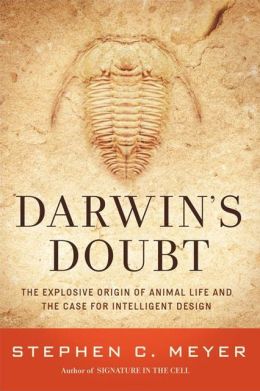
Darwin's Doubt: The Explosive Origin of Animal Life and the Case for Intelligent Design
Darwin’s Doubt: The Explosive Origin of Animal Life and the Case for Intelligent Design

NOTE: you can tune in to the Dennis Prager radio show  at 2 PM Eastern today in order to hear Dr. Meyer discuss the new book.

I found a book review of the new book on intelligent design by Dr. Stephen C. Meyer. This book is concerned with the fossil record, and it is the sequel to the highly acclaimed “Signature in the Cell“, which dealt with the origin of biological information in the first living cell.

Excerpt:

The title of the book refers to the difficulty [Charles Darwin] had in explaining the “Cambrian Explosion,” the vast proliferation of new animal body plans (new “phyla” or major animal groupings) that appears in fossils in the Cambrian strata, deposited some 530 million years ago. These animals appear suddenly in the fossil record, without any plausible predecessor such as Darwin’s theory predicted. Darwin wrote,

The difficulty of understand the absence of vast piles of fossiliferous strata, which on my theory were no doubt somewhere accumulated before the Silurian [i.e., Cambrian] epoch, is very great. I allude to the manner in which numbers of species of the same group suddenly appear in the lowest known fossiliferous rocks.

Darwin saw this accurately as a challenge to his theory. It remains one still. The animals appear too quickly in the record to be explained through his gradualistic theory.

And it remains a challenge from the perspective of mainstream science. Various theories have been proposed in explanation of the suddenness with which these new phyla came on the scene. Perhaps selective fossilization caused their predecessors to disappear from paleontologists’ view. Mainstream science casts serious doubt on that view. Statistical paleontology renders it deeply improbable. The soft-body hypothesis appears unlikely to succeed, since the evidence shows soft-bodied organisms have been frequently fossilized.

Or maybe the Cambrian animals’ precursors really are there in the record, in the form of exotic Ediacaran fossils. But these organisms are not clearly animals of any sort, and what they are is so in confusion that they could hardly be considered evidence for anything. Further,

As Nature recently noted, if the Ediacaran fauna “were animals, they bore little or no resemblance to any other creatures, either fossil or extant.” … This absence of clear affinities has led an increasing number of paleontologists to reject an ancestor/dependent relationship between the Ediacaran and Cambrian fauna.

Scientists have proposed genetic histories for these phyla, but as Meyer pointedly puts it, these scenarios all “assume a gene.” And a lot more besides. That is to say, they beg the question of evolution’s explanatory adequacy by assuming that it must be true. From there they suggest pathways according to which genes “must have” evolved. But there’s no evidence of it in the record.

Now the exciting thing is that at the time of writing (Monday night), the book is number one on Barnes and Noble:

Darwin's Doubt #1 at Barnes and Noble
Darwin’s Doubt #1 at Barnes and Noble

And number ten on Amazon:

Darwin's Doubt #10 at Amazon.com
Darwin’s Doubt #10 at Amazon.com

Now is this a book for the layman? Well, I’ve met the guy who wrote the book review above face-to-face, and his background is not in biology. I think if he can struggle through it, then I could do it too. And so could you. I think that both of Dr. Meyer’s books are must-read books for anyone interested in knowing how well the presumption of naturalism succeeds when confronted with the latest scientific evidence. These are the books you need to buy and read if you are serious about integrating science and religion. The thing to realize is that naturalists and atheists and materialists have no answer to these books. None. Do you like winning? Then spend the money and time on the books that are unstoppable in a debate.