
All posts by Wintery Knight

https://winteryknight.com/

Domestic violence rates are higher for homosexual couples than for heterosexual couples

Young people seem to like gay marriage more than they like individual liberties

Since June is Pride Month, I thought it might be a good idea to take a look at some data to decide what we should be telling young people about homosexuality. Although people on the secular left are very easily offended by any sort of disapproval these days, the safest approach is still to present the scientific facts – maybe from behind an alias (just for safety).

From the left-leaning Atlantic Monthly.

Excerpt:

Data on the rates of same-sex partner abuse have only become available in recent years. Even today, many of the statistics and materials on domestic violence put out by organizations like the Center for Disease Control and the Department of Justice still focus exclusively on heterosexual relationships, and specifically heterosexual women. While the CDC does provide some resources on its website for the LGBT population, the vast majority of the information is targeted at women.  Materials provided by the CDC for violence prevention and survivor empowerment prominently feature women in their statistics and photographs.

In 2013, the CDC released the results of a 2010 study on victimization by sexual orientation, and admitted that “little is known about the national prevalence of intimate partner violence, sexual violence, and stalking among lesbian, gay, and bisexual women and men in the United States.” The report found that bisexual women had an overwhelming prevalence of violent partners in their lives: 75 percent had been with a violent partner, as opposed to 46 percent of lesbian women and 43 percent of straight women. For bisexual men, that number was 47 percent. For gay men, it was 40 percent, and 21 percent for straight men.

The most recent statistics available on same-sex intimate partner violence from the National Coalition of Anti-Violence Programs, which focuses on LGBT relationships, reported 21 incidents of intimate partner homicides in the LGBT community, the highest ever. Nearly half of them were gay men and, for the second year in a row, the majority of survivors were people of color—62 percent.

In 2012, NCAVP programs around the country received 2,679 reports of intimate partner violence, a decrease of around 32 percent from 2011. However the report noted that many of the NCAVP’s member organizations were operating at decreased capacity due to limiting the number of cases they were able to take. The report said that excluding data from organizations, there was actually a 29 percent increase in reports of violence from 2011 to 2012.

That article comes from a source with a very clear pro-gay-agenda bias, so let’s take a look at an article from the Family Research Council to balance it out. They rely on mainstream data sources as well, like the CDC, the DOJ, the US Census, etc.

Excerpt:

A study in the Journal of Interpersonal Violence examined conflict and violence in lesbian relationships. The researchers found that 90 percent of the lesbians surveyed had been recipients of one or more acts of verbal aggression from their intimate partners during the year prior to this study, with 31 percent reporting one or more incidents of physical abuse.[69]

In a survey of 1,099 lesbians, the Journal of Social Service Research found that “slightly more than half of the [lesbians] reported that they had been abused by a female lover/partner. The most frequently indicated forms of abuse were verbal/emotional/psychological abuse and combined physical-psychological abuse.”[70]

In their book Men Who Beat the Men Who Love Them: Battered Gay Men and Domestic Violence,D. Island and P. Letellier report that “the incidence of domestic violence among gay men is nearly double that in the heterosexual population.”[71]

[…]Homosexual and lesbian relationships are far more violent than are traditional married households:

The Bureau of Justice Statistics (U.S. Department of Justice) reports that married women in traditional families experience the lowest rate of violence compared with women in other types of relationships.[72]

A report by the Medical Institute for Sexual Health concurred,

It should be noted that most studies of family violence do not differentiate between married and unmarried partner status. Studies that do make these distinctions have found that marriage relationships tend to have the least intimate partner violence when compared to cohabiting or dating relationships.[73]

In lesbian relationships, the rate of domestic violence is extremely high, from 17% to 45%, depending on the study. I do think that men exert a calming influence on women’s emotions, helping them to channel their feelings into words and reasoned arguments. That short-circuits the tendency toward violent outbursts. That’s why I urge men, if they must marry, to practice disagreeing and debating with women before the marriage is actualized. You need to find out what this other person does in a conflict situation before you commit to her for life.
Are Christians responsible for making plans and making good decisions?

Here’s a wonderful post on decision making and the will of God posted on Neil’s blog. In his post, Neil explains the Biblical model for making good decisions.

Excerpt:

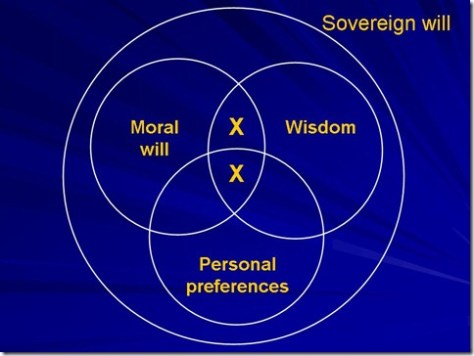
Really short version: Aside from direct and clear personal revelation from God, you don’t have access to his sovereign will when making decisions.  Therefore you must look at other factors.  If it isn’t moral, don’t do it.  If it is moral but not wise, don’t do it.  If it is moral and wise, then use your personal preferences.

Using this model you can end up with a wise and biblical decision, but you have avoided the traps of the “God told me to ____” routine.  People who run around saying that God told them this and that convey a super-spirituality that can leave less mature believers wondering if they really have a relationship with God (i.e., “God doesn’t tell me every little thing to do, so maybe I don’t really know him.”).

He has a helpful picture posted as well:

This is actually a very important topic for me, because I like making plans and making good decisions. I like being the quarterback or squad leader of my own life. I like to pick objectives and then make plans to achieve them. (Nothing too exotic, just simple stuff like saving money or reading more books)

Actually, I really oppose the idea that God has a magical fairy tale will for each person that will make them happy and fulfilled. For me, life isn’t like that. I don’t expect God to lead me along like a child at a scavenger hunt. I expect to survey the battlefield where I am and then do something to make a difference. There are lots of things you can do that will please God. Should you focus on your career and sponsor apologetics conferences? Or should you use your spare time preparing Sunday school lessons? There are lots of good things you could do to please God. Your job is to pick the one that will be the most effective. It doesn’t matter if it makes you happy, it only matters if it’s effective and if you are good at it.

Who is Rifleman Dodd?

A while back, I was busily working my way through the U.S. Marine Corps Official Reading List, and I came across a book by C.S. Forester called Rifleman Dodd, or alternatively titled Death to the French. It’s a work of historical fiction that takes place during the Napoleonic wars. The story is about a British marksman named Dodd, who is cut off from his own lines during a withdrawal maneuver. He is subsequently left to fend for himself behind enemy lines. An ordinary man might be full of despair and forget about his mission entirely. But Dodd is no ordinary man. Not only does he find a way to survive by finding food to eat, water to drink and places to sleep, but he also tries to remember his orders and to think about what he can do to advance the cause of his General, the Duke of Wellington.

Here’s an excerpt from a gritty book review:

It’s about a green-coated British infantry rifleman in the Napoleonic Wars, an age when rifles were a novelty and most of the army was red-coated and carried muskets. Private Matthew Dodd gets separated from his regiment during a retreat and finds himself stranded behind enemy (French) lines in Portugal. With the occasional aid of some natives, but mostly on his own, he harasses the French with his rifle and tries to prevent them from building a bridge across the Tagus River. It’s a remarkable tale of survival and solitary achievement, of a rank-and-file soldier who lives by his wits and slowly learns to make plans without orders, and shows leadership qualities and a knowledge of warfare.

I think we’re in the same situation as Dodd.

There is no point in us looking for breadcrumb trails to happiness at this point. That’s not the point of Christianity. The point of Christianity is friendship with God, imitation of Christ, honoring moral obligations, self-sacrificial love for your neighbor (and even your enemies!), and dedication to the truth – whether anyone else likes you or not. It’s not supposed to make you happy, and it’s not necessarily going to be a normal life like everyone else has. Things may not work out the way you’d like them to.

We seem to be making such a big deal about compassion and forgiveness in the Christian life these days – such a big emphasis on our feelings. Almost like we have forgotten that we have obligations to our friend. A relationship doesn’t mean that one person does whatever they feel like, completely disregarding the character and goals of the other person and then is automatically granted forgiveness whenever they want it. That’s not a friendship – that’s using someone else for your own ends.

For a lot of people today, Christianity only comes into play after you’ve made a mistake and you’re feeling guilty. For example, suppose you decide to go to a party with your secular friends, then you drink too much, and you do something sexual that you shouldn’t have done. Or maybe you watched some prosperity gospel preacher on TV, then made irresponsible business decisions thinking that God would bail you out and make you rich, and you went bankrupt. Most people think Christianity is for this situation: you’re a Christian so that you don’t have to feel guilty about sin. And so that you can tell people that God forgives you, so that they can’t think anything bad about you, either. You sort of get your idea about what you should be doing in order to feel good from the culture, and God is just there to forgive it all when it blows up in your face.

But in my case, putting myself in a situation like that is not even possible. I’m more likely to try to plan to do something for God. Like, I might try to mentor a young Christian by sending them books. Or, I might try to teach a class in apologetics at my church. These are things that are for God, not for me. I’m not just being dragged along by the culture, and trying to find happiness by feeling good (e.g. – with alcohol) or being liked by non-Christians. And if my plans fail because the mentoree doesn’t grow up into anything, or nobody comes to my apologetics class, that’s when I go to God and say “I screwed up. but can I still be in your army?” And God always says yes to that. You don’t have to be the best player on the team for the Coach to like you. He already likes you.

One of the great things about being a Christian is that you can never lose your identity as a Christian by failing to do something for him that you planned to do. That’s what forgiveness is for. If you set out to do something for God’s glory, and you mess it all up, that’s OK. But I do think that, like Dodd, our ambition should not be about just making ourselves happy, or making non-Christians like us. We should be trying to make plans and carry them out for God.

That’s how I understand forgiveness. It’s not just something that’s there for you to use to fix your feelings when you’ve been irresponsible while seeking your own happiness in secular ways. It’s also there when you’re trying to do something good for God, and you fail. A lot of times in life you try your best, but you fail, and then you lose something that you really wanted. With God, when you try your best for his glory, and fail, you don’t lose your identity as a member of his team. I think that not losing your identity in Christ is even more important than not feeling guilty about selfish decision making.

So, have you got a plan to serve your General? Let’s focus more on what operations we’re planning for God than on being happy and being popular with non-Christians. Your life should not be all about you, with God just there to make your bad feelings go away. Your life should be about God’s goals and God’s interests.

Will computers and robots ever become self-aware?

Lets take a closer look at a puzzle

There is a very famous thought experiment from UC Berkeley philosopher John Searle that all Christian apologists should know about. And now everyone who reads the Wall Street Journal knows about it, because of this article.

In that article, Searle is writing about the IBM computer that was programmed to play Jeopardy. Can a robot who wins on Jeopardy be “human”? Searle says no. And his famous Chinese room example (discussed in the article) explains why.

Excerpt:

Imagine that a person—me, for example—knows no Chinese and is locked in a room with boxes full of Chinese symbols and an instruction book written in English for manipulating the symbols. Unknown to me, the boxes are called “the database” and the instruction book is called “the program.” I am called “the computer.”

People outside the room pass in bunches of Chinese symbols that, unknown to me, are questions. I look up in the instruction book what I am supposed to do and I give back answers in Chinese symbols.

Suppose I get so good at shuffling the symbols and passing out the answers that my answers are indistinguishable from a native Chinese speaker’s. I give every indication of understanding the language despite the fact that I actually don’t understand a word of Chinese.

And if I do not, neither does any digital computer, because no computer, qua computer, has anything I do not have. It has stocks of symbols, rules for manipulating symbols, a system that allows it to rapidly transition from zeros to ones, and the ability to process inputs and outputs. That is it. There is nothing else.

Here is a link to the full article by John Searle on the Chinese room illustration.

By the way, Searle is a naturalist – not a theist, not a Christian. Now, let’s hear from a Christian scholar who can make more sense of this for us.

Here’s a related article on “strong AI” by Christian philosopher Jay Richards.

Excerpt:

Popular discussions of AI often suggest that if you keep increasing weak AI, at some point, you’ll get strong AI. That is, if you get enough computation, you’ll eventually get consciousness.

The reasoning goes something like this: There will be a moment at which a computer will be indistinguishable from a human intelligent agent in a blind test. At that point, we will have intelligent, conscious machines.

This does not follow. A computer may pass the Turing test, but that doesn’t mean that it will actually be a self-conscious, free agent.

The point seems obvious, but we can easily be beguiled by the way we speak of computers: We talk about computers learning, making mistakes, becoming more intelligent, and so forth. We need to remember that we are speaking metaphorically.

We can also be led astray by unexamined metaphysical assumptions. If we’re just computers made of meat, and we happened to become conscious at some point, what’s to stop computers from doing the same? That makes sense if you accept the premise—as many AI researchers do. If you don’t accept the premise, though, you don’t have to accept the conclusion.

In fact, there’s no good reason to assume that consciousness and agency emerge by accident at some threshold of speed and computational power in computers. We know by introspection that we are conscious, free beings—though we really don’t know how this works. So we naturally attribute consciousness to other humans. We also know generally what’s going on inside a computer, since we build them, and it has nothing to do with consciousness. It’s quite likely that consciousness is qualitatively different from the type of computation that we have developed in computers (as the “Chinese Room” argument, by philosopher John Searle, seems to show). Remember that, and you’ll suffer less anxiety as computers become more powerful.

Even if computer technology provides accelerating returns for the foreseeable future, it doesn’t follow that we’ll be replacing ourselves anytime soon. AI enthusiasts often make highly simplistic assumptions about human nature and biology. Rather than marveling at the ways in which computation illuminates our understanding of the microscopic biological world, many treat biological systems as nothing but clunky, soon-to-be-obsolete conglomerations of hardware and software. Fanciful speculations about uploading ourselves onto the Internet and transcending our biology rest on these simplistic assumptions. This is a common philosophical blind spot in the AI community, but it’s not a danger of AI research itself, which primarily involves programming and computers.

AI researchers often mix topics from different disciplines—biology, physics, computer science, robotics—and this causes critics to do the same. For instance, many critics worry that AI research leads inevitably to tampering with human nature. But different types of research raise different concerns. There are serious ethical questions when we’re dealing with human cloning and research that destroys human embryos. But AI research in itself does not raise these concerns. It normally involves computers, machines, and programming. While all technology raises ethical issues, we should be less worried about AI research—which has many benign applications—than research that treats human life as a means rather than an end.

When I am playing a game on the computer, I know exactly why what I am doing is fun – I am conscious of it. But the computer has no idea what I am doing. It is just matter in motion, acting on it’s programming and the inputs I supply to it. And that’s all computers will ever do. Trust me, this is my field. I have the BS and MS in computer science, and I have studied this area. AI has applications for machine learning and search problems, but consciousness is not on the radar. You can’t get there from here.