
All posts by Wintery Knight

https://winteryknight.com/

Meet four heroes of the D-Day invasion of Normandy on June 6th, 1944

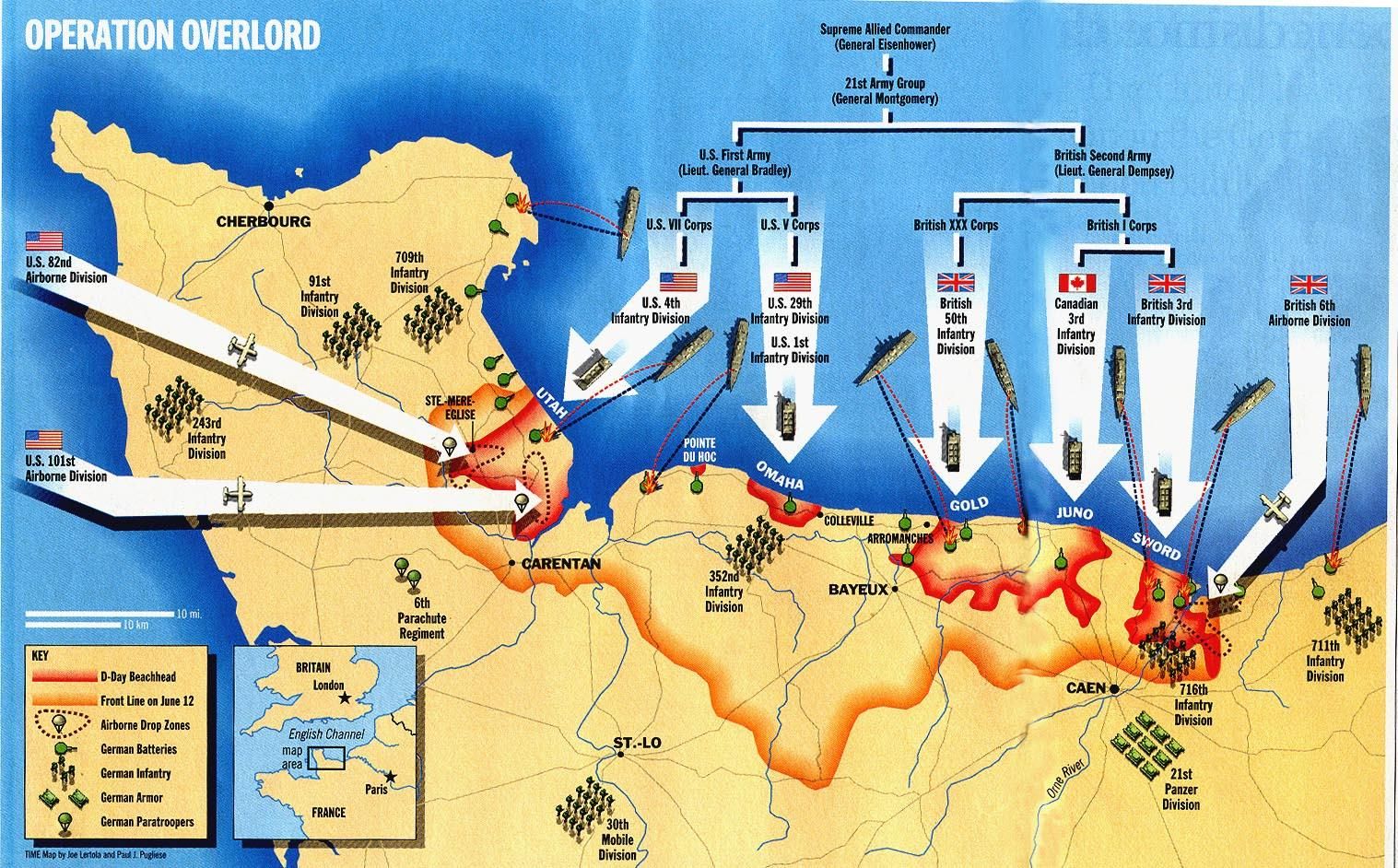
Map of D-Day landings (click for larger image)
Map of D-Day landings (click for larger image) (courtesy of Time magazine)

I thought it might be a good idea to write up something about D-Day in order to help people understand some of our military history, and to put the spotlight on some real heroes. I don’t regard artists, athletes, dancers, singers, actors, or other celebrities as heroes. It really alarms me that so many people know more about these fake heroes than they do about real ones.

Weakness emboldens aggressors

For one thing, many people don’t understand how British and American libertarian isolationism made World War 2 into a much bigger mess than it needed to be. As historian Victor Davis Hanson explains in the lecture I linked below, the Allied nations were much stronger and better equipped than the Axis nations before the war started. The Axis nations developed better weapons after the war started. But Germany and Japan didn’t think that the Allied nations would do anything if they were aggressive. We know this from their writings and correspondence. They thought that British and Americans were just too scared of war to stop them.

Germany and Japan tested their hypothesis out by re-arming and annexing territory from their neighbors. Britain and America were led by libertarian isolationists, so they didn’t fight back. The aggressors correctly understood that libertarian isolationists didn’t have the will to oppose them, even if they were weaker than the Allies. But the more they re-armed and annexed territory, the stronger they became. The Allied nations waited too long to confront them. And that’s why World War 2 was much harder to win than it needed to be.

Here’s a very good lecture about the causes of World War 2 by an actual military historian, Victor Davis Hanson:

So, that’s the first point I wanted to make: libertarian isolationism causes wars. Although libertarians claim to oppose war, they actually cause war, due to their weakness in the face of evil. So who stops wars? People who favor a strong defense, and show a willingness to fight back against aggression are the ones who REALLY oppose wars. This is called “peace through strength”, and you can see it in action in the Cold War, where Ronald Reagan defeated the Soviet Union by making their aggression costly.

Heroes of D-Day

My second concern was to promote the real heroes of D-Day, over the fictional heroes of movies, fiction, music, dancing, sports, and other entertainment nonsense.

Here are the four heroes I chose:

  • Major John Howard
  • Lieutenant Colonel Benjamin Vandervoort
  • Brigadier General Norman Cota
  • Major Richard Winters

Let’s take a look at each of them.

John Howard

Major John Howard led elements of the British 6th Airborne Division to take two vital bridges southeast of Sword beach. He did this in order to prevent German socialist counterattacks coming from the east. After they took the bridges, they had to repulse German tanks with nothing more than their useless PIAT (Projector Infantry Anti-Tank) grenade launchers. The PIAT was nothing more than a grenade launcher powered by a coiled spring. It was very inaccurate, and only effective to 50 yards. But that’s all the British paratroops had to stop tanks, and they made it work. You can read about him in this book by Stephen E. Ambrose, entitled: “Pegasus Bridge: June 6, 1944“. This New York Times article tells the story in brief. He also is played by Richard Todd in the famous movie “The Longest Day“.

Benjamin Vandervoort

Lt. Col. Ben Vandervoort served with the 82nd Airborne Division. I read about how he lead an infantry attack against German Tiger tanks (!) and infantry in Stephen E. Ambrose’s book “Citizen Soldiers: The U.S. Army from the Normandy Beaches to the Bulge to the Surrender of Germany“.  Ben Vandervoort broke his ankle during the D-Day landing, but he insisted that the medic just “lace it up tight” so that he could supervise the attacking and holding of Ste. Mere Eglise, southwest of Utah beach, against a vastly superior enemy force.  This article tells about how he defended against elite German SS infantry and heavy Tiger tanks at Trois-Ponts, during the Battle of the Bulge. He was outgunned and outnumbered 20 to 1, and had just a few lightly-armed soldiers, two weak 57mm anti-tank guns and some bazookas. He is portrayed by John Wayne in the famous movie “The Longest Day“.

Norman Cota

Brig. General Norman Cota is my favorite person in World War 2. At 51 years old, he nevertheless landed at  D-Day, and rallied terrified Army Rangers to follow him up the bluff, by telling them that Rangers ought to lead the way. “Rangers Lead The Way” later became the motto of the Army Rangers. He always led from the front, demonstrating how to attack a German machine gun position in a farmhouse to a group of American soldiers who were pinned down. He actually grabbed a bunch of grenades and led the assault team against a heavy machine gun! You can read about him in this short article and in Stephen E. Ambrose’s “D-Day: June 6, 1944: The Climactic Battle of World War II“. He is portrayed by Robert Mitchum in the famous movie “The Longest Day“.

Richard Winters

Major Richard Winters served in the 101st Airborne Division. Winters led an assault against a superior force of heavy machine guns and 105mm field guns. His tactics were so brilliant that they are still studied at West Point today. You can see Richard Winters and Carwood Lipton in the HBO “Band of Brothers” series, or read this book by Stephen E. Ambrose entitled “Band of Brothers: E Company, 506th Regiment, 101st Airborne, from Normandy to Hitler’s Eagle’s Nest“, which is the basis for that series.

I hope this convinces you that military heroes are far more important than the “heroes” of fiction and entertainment. It’s alarming to me that people invest more and have more respect for characters in Hollywood science fiction movies, and other such make-believe nonsense. We need to be rooted in reality. In reality, men who fight and die fighting evil to protect your freedoms are the real heroes. People who take military history seriously are able to give respect and gratitude where it is due – a very important part of being a mature, moral human being.

Audio, video and summary of the William Lane Craig vs. Sam Harris debate

Debate time! Here’s the video:

SUMMARY OF THE DEBATE

This debate summary is rated M for Moderately Snarky.

Dr. Craig’s opening speech:

Introduction:

  • Harris and Craig agree on objective morality
  • What is the foundation of morality?
  • What makes certain actions right or wrong?

Two claims

  1. if God exists, then we have a sound foundation for objective moral values and duties
  2. if God does not exist, then we do not have a sound foundation for objective moral values and duties

1) Theism grounds morality

Objective moral values

Theism provides sound foundation for objective moral values
– objective moral values are grounded in God
– God is the locus and paradigm of moral value
– God is, by nature, the standard for what is right and wrong

Objective moral duties

Theism provides a sound foundation for objective moral duties
– God’s nature is expressed as commands for us
– God’s commands for us are not arbitrary
– they must be consistent with his own nature
– and they reflect his moral character
– the essence of morality in theism is to love God and also to love your neighbor

2) Atheism does not ground morality

Objective moral values

What is the basis for objective moral values on atheism?
– on atheism, human beings are accidental products of evolution
– on atheism, there is no reason to believe that human well-being is any more important than the well-being of any other animal
– Harris denies that the objective moral value is from Platonic forms
– Harris wants to ground moral values in nature
– but nature is morally neutral
– the “morality” of humans is just a set of evolved customs that help them to survive and reproduce
– this morality is just a set of conventions, it doesn’t refer to anything that has an objective existence
– quotes Michael Ruse: “morality is just an aid to survival, and any deeper meaning is illusory”
– if we were to rewind evolution and start it again, another set of conventions might have evolved
– to say that morality is about human well-being is to commit “speciesism”
– quotes Richard Dawkins: “there is no purpose, no evil, no good, nothing but pointless indifference”

What does Harris say:
– Harris redefines the word “good” to mean the well-being of humans
– Harris “solves” the problem of moral value by just asserting that HUMAN well-being is the good
– Harris isn’t talking about what is good and evil
– Harris only talks about what is conducive to human “flourishing”

Objective moral duties

What is the basis of objective moral duties on atheism?
– first, natural science tells us only what is, not what ought to be
– quotes Jerry Fodor: “science cannot tell us that we have a moral obligation to take actions to increase human flourishing”
– on the naturalistic worldview, humans are animals – and there are no OBJECTIVE moral duties
– where do moral obligations come from on atheism?
– they are just conventions that are ingrained into us by social evolution
– as human societies evolve, certain actions are unfashionable
– people who act “immorally” against their society’s conventions are just being unfashionable
– bad actions like rape and murder happen all the time in the animal kingdom
– second, Harris believes that there is no free will – all human actions are causally determined
– if there is no free will, then there is no moral responsibility
– no one is responsible for the things they do, on atheism
– on atheism, humans have no control over the actions they take, and cannot make moral choices, or be morally responsible

Conclusion:
– Harris and I mostly agree on practical ethics, but only theists have a foundation for objective moral values and duties

Dr. Harris’ opening speech:

God is not needed to ground moral values and moral duties

  • Good means maximizing human well-being for the largest number of people
  • Religion is not necessary for a “universal” morality
  • Religion is a bad foundation for “universal” morality

Facts and values:

  • Moral values are the products of human evolution
  • E.g. – Sexual jealousy is the result of biological evolution
  • And then these ideas of right and wrong are enshrined in cultural institutions like marriage
  • Religious people insert God in to explain values, when evolution is the real explanation

Moral disagreements:

  • I personal don’t agree with the ethics of the God of Abraham
  • I have no basis for an objective moral standard, but the God of Abraham fails to meet my personal preferences
  • Dr. Craig lies when he quotes me, half his quotes are of other people I quoted, not me
  • But I’m not going to say which quote he lied about

Goodness is what makes you feel happy:

  • Questions of right and wrong depend upon brains
  • Brains are natural entities
  • Science can measure well-being in brain states
  • States of affairs in which the majority of brains have high well-being

I’m a good person because I don’t like the Taliban:

  • The Taliban is bad because the majority of their brains don’t have high well-being
  • I think throwing battery acid in women’s faces is bad
  • The Taliban thinks that throwing battery acid in women’s faces is good
  • What determines right and wrong is brain states of well-being

Insults against religion = Dr. Craig:

  • religion / Dr. Craig doesn’t value evidence
  • religion / Dr. Craig doesn’t value logic
  • religion / Dr. Craig doesn’t value intellectual honesty

Dr. Craig’s first rebuttal:

1) Theism is a good foundation for moral values and duties

Harris says:
– Craig thinks that if God doesn’t exist, then good and evil would have no meaning

Craig says:
– But Craig says that he is not saying that God is required for moral semantics
– He is addressing the question of the ontological grounding

Harris says:
– The God of the Bible is mean

Craig says:
– divine command theory doesn’t require that the Bible be the set of commands
– in any case, the old testament passages can be defended in Paul Copan’s book

Harris says:
– Religion isn’t needed for universal morality

Craig says:
– the issue isn’t universality, because the Nazis could have won, and put in a universal morality
– the issue is if they had won, would there be any standard to condemn them

Harris says:
– Good and evil are related to the number of brain states of well-being

Craig says:
– Harris uses good and evil in non-moral ways
– Harris isn’t talking about moral good and moral evil
– Harris is talking about pleasure and misery
– Harris is equating moral good and moral evil with feelings of pleasure and feelings of misery
– Harris claims that the property of being good is identical with human flourishing
– it is possible that the continuum of human well-being is not identical with the moral landscape
– in order for them to be identical, there cannot be this possibility or it fails the law of identity
– you could have psychopaths with happy brain states that represent a peak in the moral landscape

Harris says:
– If we have a moral duty to do anything, we have a duty to avoid feeling miserable”

Craig:
– moral obligations arise when there is an authority who can issue binding commands
– on atheism, there is no authority who can issue binding commands
– without free will, morality makes no sense since there is no free will
– no free will means no moral duties, and no moral responsibilities

Dr. Harris’ first rebuttal:

I don’t like Hell and I don’t like suffering and I don’t like Christians:

  • There is no evidence that Hell exists
  • Think of the parents of the children of people who die in tsunamis
  • If God allows people to suffer, then he doesn’t exist, because God’s job is to make us not suffer
  • God can’t exist, because some people are born in the wrong culture, and never hear about Jesus
  • Some people pray to the Monkey God, why don’t they go to heaven?
  • What about the people in the Lord of the Rings, are they going to Hell?
  • What about people who repent just before being executed, are they going to heaven?
  • God is cruel and unjust because he lets innocent people suffer
  • God is worse than a psychopath
  • People who believe in God are evil
  • People who believe in God are narcissists
  • God commanded stuff that I don’t like, so he’s evil
  • Suppose God were evil – then people would have to do evil things
  • Religious people think that saying Latin phrases turn pancakes into the body of Elvis Presley
  • The evidence for God is actually not very good, if you avoid read any Christian scholars
  • Christianity is a cult of human sacrifice
  • The people who wrote the Bible were really stupid
  • Christians are psychopaths

Dr. Craig’s second rebuttal:

Sam Harris cannot make any judgments about moral values and moral duties on atheism
On atheism, there is no foundation for making objective moral judgments

Harris didn’t respond to anything Craig said

Harris says that Christians only believe in God to avoid Hell

Red herrings:

Craig says that people who become Christians do it because God is the good
Christians don’t pursue a relationship with God for fire insurance

The problem of evil
– not relevant to the debate topic

The problem of the unevangelized
– not relevant to the debate topic

Evil actually proves that God exists
– if evil exists, then there is an objective moral standard
– if there is an objective moral standard, then God exists

Harris has no foundation for saying that Christian beliefs are morally bad
Harris has no basis for making moral judgments

Harris’ remark that theists are psychopathic
– Harris’ remark is as stupid as it is insulting

Harris says that the Old Testament promoted
– first, there was no slavery in the Old Testament it was indentured servitude
– second, that’s not relevant to the debate topic

Harris mentions the Taliban
– but the response to the Taliban is not to say that God doesn’t exist
– the response to the Taliban is to say that they have the wrong God
– the real God never commanded them to do those things

Dr. Harris’ second rebuttal:

I’m a scientist, Craig is stupid, I’ve meditated with wise yogis and lamas, I don’t like the Taliban:

  • When I make a scientific case for morality, I didn’t really mean that it was scientific
  • You just have to assume that misery is morally evil, and happiness is morally good, even if that can’t be proved scientifically
  • I’m a scientist
  • Science is great
  • Dr. Craig is stupid
  • Dr. Craig is not a scientist
  • Science is better than religion
  • You can ground an objective standard of morality and objective moral duties and moral responsibility on arbitrary brain states of accidentally evolved biologically determined monkeys
  • Dr. Craig’s question for me about my unproven assumptions is a stupid question
  • I prayed to the Monkey God in a cave and he told me about objective morality
  • I have spent a lot of time studying meditation with wise yogis and lamas
  • I consider some people to be spiritual Jesus
  • I can imagine that Jesus was very spiritual and charismatic
  • We don’t have to use logic and reason to debate about morality, we can meditate on the Monkey God
  • i don’t like the Taliban

Dr. Craig’s third rebuttal:

Harris didn’t reply to anything I said

Harris admitted that psychopaths can occupy the peaks of the moral landscape
So on Harris’ view, you can commit unspeakable acts of cruelty and still have a brain state with well-being

Dr. Harris’ third rebuttal:

Dr. Craig is a Muslim, Dr. Craig is the Taliban, Dr. Craig is a Muslim Taliban Muslim Jihadi:

  • How many of you in the audience are Muslims
  • Muslims think that non-Muslims are going to Hell
  • Christianity and Islam are identical
  • Dr. Craig is a Muslim!
  • Dr. Craig is the Taliban!
  • Dr. Craig wants to jihad me!

What can Christians learn from the bravest naval aviator at the Battle of Midway?

I have been reading lots of books about the World War II battles in the Pacific theater lately, and I wanted to write a post about one of the heroes I found who was the most compelling to me. You may have seen him in the old 1976 Midway movie or the new 2019 Midway movie. But neither movie tells the full story. The man I am talking about is Lt. Commander John C. Waldron.

John Waldron was the leader of the torpedo bomber squadron on the Hornet. This squadron was composed of outdated and slow Devastator torpedo bombers, armed with the Mark 13 Mod 1 torpedoes, which malfunctioned about 90% of the time.

I found an article on the Federalist that tells the story of John Waldron:

Now there are countless men and woman who deserve to be singled out for their valor, but with the 75th anniversary of the Battle of Midway just around the corner, I thought it would be appropriate to call your attention to one of the bravest men who ever lived. A man who, knowing he was facing certain death, led the first attack against the Japanese aircraft carriers and played a direct role in what would be a decisive victory for the United States, and a defeat from which Japan would never recover. That man was Lt. Commander John C. Waldron.

Now for those who don’t know, the Battle of Midway was the turning point in the Pacific theater. The Japanese had an elaborate plan that involved attacking the U.S. base on Midway Island in order to lure the Americans into a battle which the Japanese High command felt their experience and tactics would overwhelm and annihilate the American fleet. With no significant U.S. naval presence, Hawaii and the entire West Coast would be at risk of invasion. But the Americans broke the Japanese code and set a trap of their own – hoping to destroy their enemy’s carriers and thereby establish U.S. dominance in the Pacific. And that was exactly what happened : The U.S. fleet surprised the Japanese, sank their four carriers, and took the first real step to winning the Second World War.

John Waldron was 42 years old when the USS Hornet steamed towards Midway on June 1st, 1942. Born and raised on a reservation in South Dakota, he had never seen the ocean until he attended the Naval Academy. It wasn’t long after he graduated that he moved into naval aviation. He had been assigned to be the squadron leader of the Hornet’s torpedo bombers in late 1941 and had been drilling his men tirelessly ever since. Waldron had the reputation of a tough as nails, no-nonsense commander. Not surprising, since Waldron was a direct descendant of the warriors from the Oglala Lakota tribe – part of the Great Sioux Nation. The tough skin he developed came from decades of derision from his peers over his meager beginnings, and from the racism directed at his Native American heritage. Waldron didn’t care what anyone thought of him – all he wanted to do was fight for his country. He was a natural leader and his men would follow him into the gates of Hell, which, as fate would have it, is exactly what they would do in the upcoming battle.

On the morning of June 4th, the Americans were ready to spring their trap, but in the preflight briefing aboard the Hornet there was a problem. Stanhope Ring, who was in command of the carrier’s air group, directed his pilots to head northwest of the last reported position of the Japanese fleet. Waldron disagreed with this decision, feeling that they should head in the exact direction of that last sighting. He wasn’t shy about expressing this opinion, much the displeasure of Ring. Waldron continued to lobby his superior officer several times after the briefing ended, but to no avail.

The Federalist article doesn’t talk much about Stanhope Ring, but the book I just finished called “The Battle of Midway” by Craig L. Symonds did. Ring was a very tall, good-looking, and white officer who had breezed up the chain of command thanks to his good looks and confident manner. He loved to show off for cameras, and pull rank on subordinates. He was too proud to admit that Waldron was right in front of the other pilots.

More:

The air strike force took off from the deck of the Hornet – fighters, dive bombers, and the 15 planes in Waldron’s torpedo squadron. This force would be joined in the air by similar strike forces from the other U.S. carriers – the Yorktown and the Enterprise. Shortly after the Hornet’s air group was airborne, Waldron couldn’t contain his anger anymore. He broke radio silence to tell Ring that they were headed in the wrong direction. He repeated that comment and Ring issued a terse reply that he was in charge of this group and to stay the hell off the radio. Waldron waited a couple of minutes before replying “The hell with you” and peeled his squadron off and headed due west, where he felt the Japanese fleet was.

Less than an hour later, Waldron was proved right. He had led his squadron on a direct line to the enemy. Waldron broke radio silence again to signal to Ring that he had found the fleet, but Ring and the rest of the Hornet’s planes were too far away to hear. So now, Waldron was faced with a brutal decision. If he went in to attack, he would do so without any fighter protection, and they’d be totally at the mercy of the Japanese fighters. To make matters worse, the U.S. planes (Douglas Devastators) were hopelessly outdated aircraft – their top speed was about a third of what the Japanese fighters could do. They had hoped to get the newer Grumman Avengers, but the Hornet had left Pearl Harbor before they had arrived from the mainland. All of this meant that Waldron and Torpedo 8 were looking at a suicidal attack run. […]Waldron got on the radio again and told his men “We will go in. We won’t turn back. Former strategy cannot be used. We will attack. Good luck!”

And with that, the planes of Torpedo 8 closed up their formation and bore down on the Japanese fleet, some seven miles distant.

The Japanese fighters quickly pounced on the Americans, who were going in low and slow – the only way torpedo bombers can attack. One by one the planes from Torpedo 8 were shot down. […]Every single plane in Torpedo 8 was destroyed and not one torpedo hit a Japanese ship.

Not only were the torpedo bombers of John Waldron’s VT-8 (Hornet) shot down, but two more waves led by Eugene Lindsey VT-6 (Enterprise) and Edward Massey VT-3 (Yorktown) were also repulsed without a hit.

More:

History might have viewed Waldron’s attack as more insane than brave, and utterly pointless….except for what happened next. Shortly after his failed attack, the torpedo squadron from the Enterprise attacked the fleet – and right after that the torpedo squadron from the Yorktown. Both of those squadrons had devastating casualties as well (10 of 14 planes lost and 10 of 12 respectively) without inflicting any damage on any Japanese ship. But these three attacks in succession drew the Japanese fighter cover down so low, that it left their carriers exposed to dive bomber attacks. It also burned up a lot of fuel for the fighters, who now needed to land before they could continue their defense of the fleet. The attacks also forced the Japanese carriers into defensive maneuvers, so they were unable to land any planes or launch any for a strike on the American carriers.

In addition to using up their fuel and coming down to low altitude, the Japanese CAP (combat air patrol) fighters also used up most of their dangerous 20 mm ammunition. They mostly had much weaker 7.7 mm ammunition remaining when the dive bombers from the Enterprise and Yorktown arrived.

More:

As the Japanese were trying to compose themselves after the three fierce but harmless attacks, the American dive bombers from the Enterprise and Yorktown arrived and quickly struck. Within minutes, three of the Japanese carriers were in flames – the heart of the Imperial Navy had been gutted.

[…]The other planes from the Hornet never found the Japanese ships. Ring kept his planes flying in that northwesterly direction until they were too low on fuel to keep going. They returned to the Hornet with their full payload of bombs.

[…]Now, there were a lot of heroes that day – some who lived and some who died, but the valor that John Waldron displayed in defying orders he knew were wrong and then attacking the enemy when he knew it meant certain death, place him on a special level. His actions directly helped the Americans win this crucial battle, which turned the tide of the war in the favor of the United States. He got the Navy Cross for his actions that day, but it seems astonishing to me that he wasn’t awarded the Medal of Honor – he is definitely worthy of it.

You can learn more about the Battle of Midway in this helpful video:

So, here is what I wanted to say about this.

John Waldron was not properly equipped by his organization to make a difference at Midway. His planes were too old and slow, his torpedoes almost never worked. His leader was an arrogant, incompetent coward who prevented him from leading others to find and attack the actual targets. The only way he could do something to his enemy was to disobey orders and go off on his own. If he had lived, he probably would have been court-martialed for insubordination. After Waldron was shot down, every single one of the men in his squadron continued their attack until they too were all shot down. Everyone watching must have thought “what a waste of effort”. It was only later that it became evident to all that what he did was necessary for the second wave to succeed.

This plaque at the United States Naval Academy Club honors the three commanders of the torpedo bomber squadrons:

Plaque honoring the Torpedo Squadron commanders at Midway
Plaque honoring the Midway torpedo bomber squadron commanders

According to the Family Research Council, the plaque reads:

The torpedo attacks of Waldron, Lindsey, and Massey had followed hard upon each other by luck. What was not luck, but the soul of the United States in action, was the willingness of the torpedo plane squadrons to go in against hopeless odds. This was the extra ounce of martial weight that in a few decisive minutes tipped the balance of history.

When I read this story, it immediately occurred to me that this is the problem that serious Christians are facing today. Parents and pastors are not equipping young people to actually make a difference. Instead of finding and fighting the real targets: atheism, radical feminism, communism, etc., all our forces have been sent on wild goose chases, so that now “Christians” are actually trying to promote the priorities of the secular left, e.g. – global warming, wealth redistribution, affirming sexual immorality, open borders, critical race theory, etc.

The few of us who actually know how to do our jobs are poorly equipped. We are prevented from leading by organizations that are focused on feelings rather than results. We can only hope that our decision to attack against hopeless odds somehow paves the way for a second wave to succeed. It has happened before, and that’s why we should be brave and continue to engage our opponents using tools that work (philosophy of religion, evidential apologetics, scientific research, historical evidence, chastity, sobriety, self-control, good stewardship of our educations, careers and finances, effective charitable giving, self-sacrificial love, etc.).