All posts by Wintery Knight

https://winteryknight.com/

Friday night funny: overdue account, private property, civics

UPDATE: Spotted this video linked at Nice Deb:

Cute video of the best kind of bird ever made!

This is the funniest thing I ever got in an e-mail. It’s a real e-mail exchange.

It starts like this:

From: Jane Gilles
Date: Wednesday 8 Oct 2008 12.19pm
To: David Thorne
Subject: Overdue account

Dear David,
Our records indicate that your account is overdue by the amount of $233.95. If you have already made this payment please contact us within the next 7 days to confirm payment has been applied to your account and is no longer outstanding.

Yours sincerely, Jane Gilles

Click here for the rest of the exchange.

Second, here is a catchy tune for you to brighten your day from IMAO.us: (H/T Free Canuckistan)

And our weekly lesson in capitalism also from IMAO.us. (You have to click through to see the video)

Happy Friday!

UPDATE: I noticed that Dawn Eden had posted a serious post by Catholic Mark Shea about the different ways that Catholics and Evangelicals talk. Evangelicals are masculine and Catholics are feminine. Everybody knows that!

It’s funny to hear Catholics described like this, but it’s so true:

Similarly, Catholics should not dismiss Evangelicalism as simplistic chatter merely because Evangelicals tend to be more verbal about their faith. There is nothing noble or spiritual about the common lay Catholic’s inability to be always ready to give an account of the hope within us (cf. 1 Pet. 3:15).

But we Evangelicals also get whacked:

[1] Back in my Evangelical days, I saw a cartoon in The Wittenburg Door featuring an earnest Evangelical hunched over in prayer with eyes clamped shut, pleading, “Oh Lord, I just really worship you and I just really want to come before you and just really pray that you would just really take the words just and really out of my prayer vocabulary.” Not all spontaneous prayer is up to the glory of the task, and there is much wisdom in Catholics using the great and poetic prayers of the saints as their own.

It’s funny because it’s true!

What is intelligent design? What is capitalism?

Two new books have just come out by two of my favorite people in the whole world:

  • Stephen C. Meyer (Ph.D from Cambridge University)
  • Jay W. Richards (Ph.D from Princeton University).

Meyer’s book is about intelligent design, and Richards’ book is about capitalism. Let’s take a look.

What is intelligent design?

To understand what intelligent design is, you can watch two DVDs that are now online at Youtube. Both videos are by Illustra Media.

Here are the 2 playlists:

I give these videos my highest recommendation. If you have not seen them, you must see them.

Stephen C. Meyer’s new book

The new book by Stephen C. Meyer is called “Signature in the Cell: DNA and the Evidence for Intelligent Design”. It is being published by Harper-Collins.

Signature in the Cell

Here is the blurb:

Meyer tells the story of the successive attempts to solve this mystery of DNA and argues that fundamental objections now exist to the adequacy of all purely naturalistic or materialistic theories. The book then proposes a radical alternative based upon developments in molecular biology and the information sciences: it proposes the design hypothesis as the best explanation for the origin of the information necessary to produce the first life.

SIGNATURE IN THE CELL will not merely provide a critique of evolutionary theories. It also shows that, based on our uniform and repeated experience-the basis of all scientific reasoning about the past-there is a strong positive case for intelligent design. From our experience we know that intelligence alone produces large amounts of information. Thus, the book shows that the argument for intelligent design from DNA is not based on ignorance or a desire to “give up on science,” but instead upon just the opposite: our growing scientific knowledge of the inner workings of the cell and our experience-based knowledge of the cause-and-effect structure of the world. For just this reason the argument for design can be formulated as a rigorous and positive scientific argument-specifically one called “an inference to the best explanation.” The book shows, ironically, that the argument for intelligent design from DNA is based on the same method of scientific reasoning that Darwin himself used.

I pre-ordered mine! You can see Stephen Meyer debating against Skeptic magazine’s editor Michael Shermer here.

Now let’s turn to Jay W. Richards’ book.

What is capitalism?

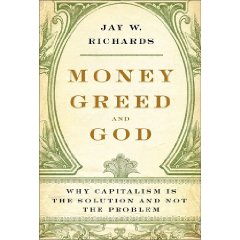
To understand what capitalism is, you can watch this lecture entitled “Money, Greed and God: Why Capitalism is the Solution and Not the Problem” by Jay W. Richards, delivered at the Heritage Foundation think tank, and televised by C-SPAN2. The book has the same title, and is published by Harper-Collins.

Money, Greed and God

Here is the blurb:

Does capitalism promote greed? Can a person follow Jesus’s call to love others and also support capitalism? Was our recent economic crisis caused by flaws inherent to our free market system? Jay Richards presents a new approach to capitalism, revealing how it’s fully consistent with Jesus’s teachings and the Christian tradition, while also showing why this system is our best bet for renewed economic vigor.

The church is bombarded with two competing messages about money and capitalism:

  • wealth is bad and causes much of the world’s suffering
  • wealth is good and God wants you to prosper and be rich

Richards exposes these myths, and other common misconceptions about capitalism, and reveals the surprising ways that capitalism is, in fact, the best system to respond to the biblical mandates of alleviating poverty and protecting the environment. Money, Greed, and God equips readers to take practical steps in their own lives to conduct business, worship God, and serve others without falling into the “prosperity gospel” trap.

I can hardly wait to get my copy!

If you can’t see the Richards video, here is an audio lecture by Jay Richards on the “Myths Christians Believe about Wealth and Poverty“. Also, why not check out this series of 4 sermons by Wayne Grudem on the relationship between Christianity and economics? (a PDF outline is here)

Walter Williams evaluates American academic performance

The article is here in Townhall.com. The left is always complaining that they need more money to raise test scores, and that schools are underfunded. But is more money the answer?

Excerpt:

The teaching establishment and politicians have hoodwinked taxpayers into believing that more money is needed to improve education. The Washington, D.C., school budget is about the nation’s costliest, spending about $15,000 per pupil. Its student/teacher ratio, at 15.2 to 1, is lower than the nation’s average. Yet student achievement is just about the lowest in the nation. What’s so callous about the Washington situation is about 1,700 children in kindergarten through 12th grade receive the $7,500 annual scholarships in order to escape rotten D.C. public schools, and four times as many apply for the scholarships, yet Congress, beholden to the education establishment, will end funding the school voucher program.

Teacher’s unions are not interested in being paid to perform, they want to be paid regardless of whether they perform. That is why they oppose voucher programs, which give parents a choice. If parents can choose, then schools that insist on retaining teachers who can’t teach will finally come under pressure to fire those teachers and find some better ones. More money thrown into the fire is not the answer.

Williams continues:

Any long-term solution to our education problems requires the decentralization that can come from competition. Centralization has been massive. In 1930, there were 119,000 school districts across the U.S; today, there are less than 15,000. Control has moved from local communities to the school district, to the state, and to the federal government. Public education has become a highly centralized government-backed monopoly and we shouldn’t be surprised by the results. It’s a no-brainer that the areas of our lives with the greatest innovation, tailoring of services to individual wants and falling prices are the areas where there is ruthless competition such as computers, food, telephone and clothing industries, and delivery companies such as UPS, Federal Express and electronic bill payments that have begun to undermine the postal monopoly in first-class mail.

Here is an article from the extremely left-wing Los Angeles Times that explains what it takes for a school to succeed. A school needs stay away from unions and educational bureaucrats, and stick with the basics: math, reading, writing and discipline. Let’s take a look at an Oakland school that serves the poorest, underprivileged minorities, but still manages to deliver the goods.

What kind of teachers teach in the American Indian Public Charter schools?

We are looking for hard working people who believe in free market capitalism. . . . Multicultural specialists, ultra liberal zealots and college-tainted oppression liberators need not apply.”

Good start. But are they “progressive”?

That, it turns out, is just the beginning of the ways in which American Indian Public Charter and its two sibling schools spit in the eye of mainstream education. These small, no-frills, independent public schools in the hardscrabble flats of Oakland sometimes seem like creations of television’s “Colbert Report.” They mock liberal orthodoxy with such zeal that it can seem like a parody.

Well, surely they must embrace teacher’s unions?

School administrators take pride in their record of frequently firing teachers they consider to be underperforming. Unions are embraced with the same warmth accorded “self-esteem experts, panhandlers, drug dealers and those snapping turtles who refuse to put forth their best effort,” to quote the school’s website.

But what about the need for compassion, tolerance and empathy?

Conservatives, including columnist George Will, adore the American Indian schools, which they see as models of a “new paternalism” that could close the gap between the haves and have-nots in American education. Not surprisingly, many Bay Area liberals have a hard time embracing an educational philosophy that proudly proclaims that it “does not preach or subscribe to the demagoguery of tolerance.”

The LA Times article shows that conservative, anti-union schools work for the poorest children. But there are challenges that are blocking the expansion of charter schools, such as “hostile state legislatures and arbitrary caps”, according to the Heritage Foundation.

Their article cites Rep. Buck McKeon (R-CA) as follows:

These caps are often the consequence of legislative trade-off – representing political deal-making designed to appease special interests who prefer the status quo rather than reasoned education policy. As a result of the caps, children across the country now languish on daunting wait lists, just waiting to enroll in the public school of their choice, simply because it happens to operate as a charter. An estimated 365,000 students are on charter school wait lists today. That’s enough students to fully enroll 1,100 new averaged-size charter schools.

As I discussed before, there are almost no males involved in education in the classroom, which means that the classrooms will emphasize compassion, tolerance, equal outcomes, non-judgmentalism and self-esteem. Competition and excellence are definitely out. In order for Americans to continue to have the same level of prosperity, we need to focus on academic excellence, not secular-leftist indoctrination.