All posts by Wintery Knight

https://winteryknight.com/

Do all the decisions a Christian makes have to be divinely directed?

There are two views on the topic of decision making and the will of God. The view you learn in the church is called “the traditional view”. I call this view the feminized/postmodern view. The more practical view is called “the wisdom view”. I call this view the battlefield/military view. I am a proponent of the wisdom view.

Let’s learn about the two different views:

[The traditional view is] that God has a plan for our lives and that we receive guidance through methods such as “open and closed doors”, “feeling led” and “the still, small, voice”. Once the view has been well explained, through the foil of a fictional seminar, the book continues to critique this view, explaining how it is based on a poor use and understanding of scriptures, and how some of the reasons given in support of the view do not apply.

[The wisdom view] holds that God does not have an “individual will” for our lives, but rather that all of God’s will can be summed up within two categories, God’s sovereign will and God’s moral will. Basically God’s sovereign will is all the things that god decrees will happen. It is hidden (mostly) from us, and does not play an active part in our decision, although some of it is revealed in the bible. God’s moral will is the part that we must concern ourselves with in making decisions. It is fully revealed in the bible and our decisions must be made within it. We may use wisdom in applying god’s moral will to our lives, or we may be in an area not covered by god’s moral will. We must finally submit in advance to God’s sovereign will, being prepared for him to sovereignty intervene and redirect us through whatever means he wills (see James).

Here’s a bit more from someone else:

Regarding the view that God has a personal will for us individually that we have to discern and find, J.I. Packer says, “The first thing to say is that the idea of guidance is actually a novelty among orthodox evangelicals. It does not go back farther than the last century. Second, it has led people to so much foolish action on the one hand, and so much foolish inaction on the other, as well as puzzlement and heartbreak when the ‘hotline’ to God seems to go silent, that it has to be discredited. Third, it must be said that Scripture gives us no more warrant constantly to expect personal ‘hotline,’ ‘voice-from-the-control-tower’ guidance than to expect new authoritative revelations to come our way for the guidance of the whole church.” (Hot Tub Religion, page 118).

As to the point of the question, how do I make decisions, I attempt to make decisions in light of three factors: God’s moral will, wisdom, and my personal desires. If something is opposed to God’s moral will, then I should obviously flee from it. If it’s not opposed, then I consider the wisdom of the choices. For example, would it be wise for me to marry a woman who loves Jesus, though we have nothing else in common? Probably not. If the options pass the criteria of wisdom, then I’m free to choose how I wish. If I’m offered two jobs, and both are honoring to God, and both would be wise to take, then I’m free to choose the job I would like more. I don’t need to put out a fleece or await some other confirmation from God. If it’s moral and wise, then the only question as to whether or not it will honor Him is my attitude.

Some examples of this model used in the Bible (in theological circles referred to as the Wisdom Model) are in Paul’s planning of a mission to Rome in Romans 1:9-15, 15:22-24, the Jerusalem Council (Acts 15:1-29), and Paul’s instructions for legal disputes (1 Cor 6:3-6).

The best book on this topic is Garry Friesen’s “Decision Making and the Will of God”. In it, you’ll find a full assessment about what the Bible teaches on this topic.

When I am trying to decide what will be effective, I look at Christian scholars, at their papers, books, and public debates. That’s effectiveness because it is addressed to a non-Christian audience in public with the force of reason and evidence. It is persuasion and it is addressed to rational minds. I want to change the minds of people who have a large influence on society on the whole. I don’t think that offering Christianity as life-enhancement or self-help is really “having an influence”. I think that offering Christianity as truth, with support, is “having an influence”.

So let me be clear about what I believe:

  • I don’t think that God normally talks to people directly
  • I don’t believe that life is an Easter egg hunt, filled with clues accessible only to emotion and intuition
  • I don’t believe that God expects people to discover a specific will for their lives using non-rational means
  • I think that people make up their own life plan that is consistent with the Bible
  • The goal of the life plan is to be effective, and there are no other considerations
  • I think that there are many good things a person can do, but that some are more effective than others
  • I think that with respect to the goal of serving God effectively, my happiness is expendable
  • I don’t think that the purpose of doing something for the Lord is to feel good about ourselves
  • I don’t think that people should choose ineffective things to do just because they like them
  • I don’t think that people should choose ineffective things to do just because they are good at them
  • I think people should do hard things that they don’t like – as long as it’s more effective
  • I don’t think that any course of action is as effective as any other – some plans accomplish more
  • I don’t think that life is totally unpredictable and irrational and subjective
  • I think that we can know what is or is not effective by studying and learning about the world
  • I think life is like a battlefield that must be surveyed, understood and acted upon deliberately

I think that every person is the commanding officer of his or her own life, and each person must study everything they can, make a plan that is consistent with the Bible’s moral prescriptions, execute the plan and achieve whatever they can achieve for the Lord. And the goal is not comfort or happy feelings, but real achievements. Life is more like a war than a vacation resort or a buffet or a shopping center. God’s will for us is not have happy feelings, but that we freely choose to sacrifice ourselves out of obedience and service to him. In my case, that means studying hard things, making money, saving money, and giving money away to good scholars, sponsoring good events and being persuasive to non-Christians. I cried when I had to learn calculus, because it was so hard. But who cares?

I think that it is very important to realize that God is not impressed by our not being smart and not being effective. If we have the ability to be smart, then we should be smart, whether it makes us happy or not. If we have the ability to make money, then we should make money, whether it makes us happy or not. If we have the ability have a great influence, then we should have a great influence, whether it makes us happy or not. There will be plenty of time for happiness after we’re dead. With respect to God’s purposes in the world, my happiness is expendable. The thought about what “I want” doesn’t enter into my mind.

Whenever someone questions my plans by saying that I am asserting my will over God’s will, the first question I want to ask that person is this: “how do you know what God’s will is?” and “what is your basis for thinking that my plan will not be effective?”. I want to know if I have misunderstood something about the way the world is, or miscalculated in some way. I want someone to look at my calculations and show where they are going to produce a less optimal result for the Lord. That’s the only concern I have – effectiveness.

This article by Greg Koukl may be helpful.

And I also found this summary of the Friesen book useful:

In nine parts.
Democrat lawmakers flee state to avoid voting on spending cuts

Video from Gateway Pundit.

Story from the Wall Street Journal.

Excerpt:

Democratic lawmakers fled the state in an effort to torpedo a closely watched vote on what would be the nation’s first major overhaul of union laws in years, as government workers flooded the statehouse for a third day seeking to block passage of the bill.

Surrounded by thousands of tightly packed protesters, including teachers who had been encouraged by union leaders to show up in force, state senators gathered around 11 a.m. to vote on Republican Gov. Scott Walker’s proposal to limit collective-bargaining rights for most state employees.

The governor’s proposal, part of a bill aimed at overcoming a $137 million deficit in the current budget and a projected $3.6 billion hole in the next two years, would allow collective bargaining on wages, but not pensions and health care. Workers would be required to pay more for both.

But a roll call revealed that the 14 Senate Democrats were absent, leaving the chamber short of the 20 votes needed to conduct business.

[…]Late Thursday, Gov. Walker, who could hear chanting every time he opened his office door, blasted the Democrats’ move as a “stunt” and urged them to return to vote on what he called as a “bold political move but a modest, modest proposal” that would preserve benefits for public employees that remained “better than what most people are getting across the state.”

The extraordinary scene was being followed in statehouses across the country, as a test case of both union clout and the political will of newly elected legislators. Wisconsin was at the front edge of voter discontent in 2010, with voters agitated about public spending electing Gov. Walker to succeed Democrat Jim Doyle and handing both houses of the legislature to the GOP.

[…]If the governor’s efforts succeed, other states are expected to try to follow, as governors grapple with deepening deficits. Many new governors in both parties have blamed the states’ fiscal crisis in part on what they say are overly generous benefits and pension obligations granted over many years to organized government workers.

Proposals similar to Gov. Walker’s have been made in New Jersey and Ohio. In Columbus, Ohio, thousands gathered Thursday to protest a Republican proposal that would eliminate collective-bargaining rights for many of that state’s 400,000 public-sector workers.

[…]Gov. Walker first introduced his “budget repair” bill just a week ago, setting off the firestorm that has swept the Capitol. Besides limiting collective-bargaining right for most workers—excepting police, firefighters and others involved in public safety—it would require government workers, who currently contribute little or nothing to their pensions, to contribute 5.8% of their pay to pensions, and pay at least 12.6% of health-care premiums, up from an average of 6%.

In exchange, Gov. Walker has pledged no layoffs or furloughs for the state’s 170,000 public employees. He has said 5,500 state jobs and 5,000 local jobs would be saved under his plan, which would save $30 million in the current budget and $300 million in the two-year budget that begins July 1.

The lawmakers are required by law to report to their posts to vote on all legislation, which is why the police were dispatched to locate them.

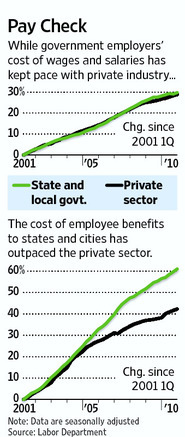
Here’s what the fuss is about:

Public Sector Benefits

And Gov. Walker is not the only one trying to stop the massive transfers of wealth from the productive private sector to non-productive public sector.

Excerpt:

Lawmakers around the country are looking at new ways to prevent budget disasters by changing the rules for overburdened state employee pension funds. But they are meeting stiff resistance from public employee unions.

Two Arizona state lawmakers this week, including the speaker of the House, introduced their plan to salvage the state’s budget by significantly changing the public retirement system.

Following the lead of Gov. Chris Christie, R-N.J., a pair of New Jersey assemblymen on Monday put forth their legislative solution to make solvent a fund that’s $54 billion in the red.

Also on Monday, in his first budget address as governor, Florida’s Rick Scott announced his effort to “stabilize and secure” government employee pensions.

The moves are part of a larger battle over pension reform between conservative budget hawks and government worker unions.

The national debt is currently over 14 trillion, and scheduled to be at 26 trillion by 2021.

Michelle Malkin has a breakdown of teacher salaries and benefits here.

Was Jesus really worshipped as God?

I found this interesting article at Please Convince Me that tries to find all of the places inside the Bible, and in later historical sources, where people put Jesus in the place of God and worship him.

Obviously, his followers worshiped him:

John Said That Jesus Is the Creator God Who Came to Us in Human Form
In the beginning was the Word, and the Word was with God, and the Word was God. He was with God in the beginning. Through him all things were made; without him nothing was made that has been made. In him was life, and that life was the light of men…The Word became flesh and made his dwelling among us. We have seen his glory, the glory of the One and Only, who came from the Father, full of grace and truth. (John 1:1-4, 14)

Paul Said That Jesus Possesses the Full Deity of God
For in Christ all the fullness of the Deity lives in bodily form, and you have been given fullness in Christ, who is the head over every power and authority. (Colossians 2:9-10)

The Writer of Hebrews Said That Jesus Possesses the EXACT Nature of God the Father
In the past God spoke to our forefathers through the prophets at many times and in various ways, but in these last days he has spoken to us by his Son, whom he appointed heir of all things, and through whom he made the universe. The Son is the radiance of God’s glory and the exact representation of his being, sustaining all things by his powerful word. (Hebrews 1:1-3)

Paul Said That In Jesus, God Makes Himself Visible to Us
He is the image of the invisible God, the firstborn over all creation. For by him all things were created: things in heaven and on earth, visible and invisible, whether thrones or powers or rulers or authorities; all things were created by him and for him. He is before all things, and in him all things hold together. (Colossians 1:15)

Paul Said That Jesus is Simply God the Father, Appearing in a Body
Beyond all question, the mystery of godliness is great: He appeared in a body, was vindicated by the Spirit, was seen by angels, was preached among the nations, was believed on in the world, was taken up in glory. (1 Timothy 3:16)

Paul Said That God the Father Willingly Submitted His Power As the Man We Know As Jesus
Your attitude should be the same as that of Christ Jesus: Who, being in very nature God, did not consider equality with God something to be grasped, but made himself nothing, taking the very nature of a servant, being made in human likeness. And being found in appearance as a man, he humbled himself and became obedient to death- even death on a cross! (Philippians 2:5-8 )

The Writer of Hebrews Said That Jesus is Called God by God the Father
But about the Son he says, “Your throne, O God, will last for ever and ever, and righteousness will be the scepter of your kingdom. You have loved righteousness and hated wickedness; therefore God, your God, has set you above your companions by anointing you with the oil of joy.” (Hebrews 1:8-9)

But there were other people who worshiped him, too:

The wise men worshiped Him from the moment He was born
On coming to the house, they saw the child with his mother Mary, and they bowed down and worshiped him. Then they opened their treasures and presented him with gifts of gold and of incense and of myrrh. (Matthew 2:10-12)

The leper worshiped Him at his healing
And behold, a leper came to Him, and bowed down to Him, saying, “Lord, if You are willing, You can make me clean.” (Matthew 8:2)

The synagogue ruler worshiped Him
While He was saying these things to them, behold, there came a synagogue official, and bowed down before Him, saying, “My daughter has just died; but come and lay Your hand on her, and she will live.” (Matthew 9:18-19)

The disciples worshiped him in the boat
And when they climbed into the boat, the wind died down. Then those who were in the boat worshiped him, saying, “Truly you are the Son of God.” (Matthew 14:32-33)

The Canaanite woman worshiped Him
But she came and began to bow down before Him, saying, “Lord, help me!” (Matthew 15:25-26)

The mother of James and John worshipped Him
Then the mother of the sons of Zebedee came to Him with her sons, bowing down, and making a request of Him. (Matthew 20:20-21)

The blind man worshiped Him at his healing
Jesus heard that they had thrown him out, and when he found him, he said, “Do you believe in the Son of Man?” “Who is he, sir?” the man asked. “Tell me so that I may believe in him.” Jesus said, “You have now seen him; in fact, he is the one speaking with you.” Then the man said, “Lord, I believe,” and he worshiped him. (John 9:35-38)

The women worshiped Him at the empty tomb
So the women hurried away from the tomb, afraid yet filled with joy, and ran to tell his disciples. Suddenly Jesus met them. “Greetings,” he said. They came to him, clasped his feet and worshiped him. (Matthew 28:8-10)

The disciples worshiped Him at the Ascension
Then the eleven disciples went to Galilee, to the mountain where Jesus had told them to go. When they saw him, they worshiped him (Matthew 28:16-17)

Here is a post I wrote about the earliest records where Jesus is spoken of as having some connection and/or equality with God. I put the earliest ones only so that you could use them in a debate and not worry about whether people think those verses are reliable. The ones I chose are the most reliable.