New study: switching male and female marriage roles makes both sexes unhappy

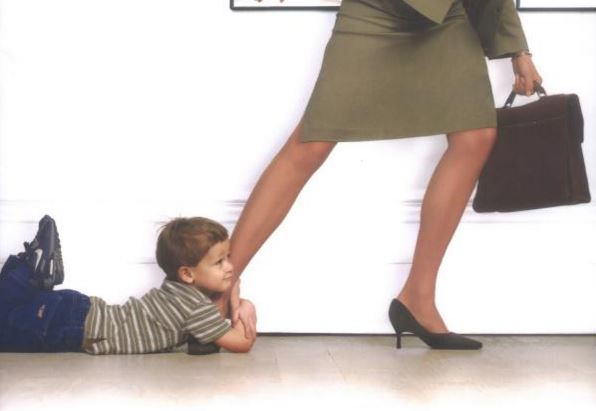
Child grabs for his mom, who is leaving for work

Here’s a report on a new study from the UK Daily Mail.

Excerpt:

When females were the main breadwinner in the family, they were discovered to report more symptoms of depression.

However, the opposite effect was found in men: Their psychological well-being was highest when they were the primary wage-earners.

Researchers at the University of Illinois examined data on nearly 1,500 men and 1,800 women, aged between 52 and 60. Their well-being was evaluated through surveys.

The researchers first found that men’s well-being decreased once they had exited the workforce to become home-makers.

Meanwhile, the inverse was not so for women: Women’s psychological well-being was not affected by leaving their jobs to become stay-at-home mothers.

‘We observed a statistically significant and substantial difference in depressive symptoms between men and women in our study,’ says lead researcher Karen Kramer.

‘The results supported the overarching hypothesis: well-being was lower for mothers and fathers who violated gendered expectations about the division of paid labor, and higher for parents who conformed to these expectations.’

If you don’t like the UK Daily Mail, CNN reported on a similar study back in 2014.

Indeed. The trouble is this: who can afford to provide for a stay-at-home wife on one salary, in a country where 30% of your income is taxed, and many things (e.g. – health care, college tuition, etc.) are way more expensive because of socialist welfare state policies? We have a $20 trillion dollar debt, and taxes are only going to go higher, making it that much harder for a working man to provide for a family – no matter how diligent he is about getting STEM degree(s) and working full time, non-stop. Marriages where the woman stays home with the children are happiest for everyone, but thanks to the voting patterns of radical feminists, husbands have been replaced by government programs, and those cost taxpayer money. You can either have a big government welfare state or you can have a stay-at-home wife. You can’t have both.

I got a snarky comment on a post I wrote last week about how marriages where the husband does not work full-time are more likely to fail.

Here is the comment:

Well done.
I’ll now await your follow-up article on the divorce rate for couples where the wife works full-time outside of the home and how men should choose a woman who has demonstrated an ability to do marriage tasks – like taking care of the household full time, raising and nuturing children, being loving and supportive of a husband when times are tough (especially if, God forbid, he should ever find himself unemployed and thus no longer a provider, in which case most wives’ base and visceral impulse is to abandon him), not wanting “a career,” and not insisting that her husband waste all his earnings on fun and thrills for her.

Well, I’m blogging about it again today, but if the commenter were very clever, then he would have found this post from June of 2013 entitled “STUDY SHOWS THAT FEMALE-BREADWINNER MARRIAGES ARE LESS HAPPY AND LESS STABLE”.

Excerpt:

Given these findings, it isn’t surprising that when a wife earns more than her husband, the risk of divorce rises, too. To study this, the authors used a survey conducted in two waves, 1987-88 and 1992-93. (There were no more recent data available for this particular test.) Then they investigated the likelihood of a divorce in the five-year interval. For this sample, some 12 percent of all couples were divorced during this period — a sobering fact about the stability of marriages in general. But the divorce rate rose by half, to about 18 percent, for couples in which the wife earned more than the husband.

When I was a high school student, I can remember trying to decide between being an English teacher, being a prosecuting attorney, or being a software engineer. It was my Dad who pointed me towards software engineering. As an avid stock picker, my Dad was seeing tech stocks exploding in value, and he knew that I would be able to find work even if I was laid off during tough times. I am glad that I listened to his advice, although my career still has not been easy, which is why I saved money for the two times where I was laid off (both times my subsidiary was folded by the parent company!). My reason for going into a field where I could earn more money was because I wanted to get married, have 4 children, and “heal” the experience of being neglected by my mother (who stuck me in day care after 6 weeks and worked full-time until she retired) by watching her parent my kids as a stay-at-home mom. I knew enough to know that marriage works better when the man provides and the woman focuses on the children – at least until they are 6 years old. Since then, I’ve discovered homeschooling, and I would definitely have done that. It’s not that I am opposed to women working, it’s that I am opposed to children not being raised by their mother.

As I explained in my lengthy reply to the snarky commenter, it’s gotten much harder for men to be the sole provider, and have a stay at home wife and homeschooling mom:

Regarding tough times, I think that the situation for men right now is horrible with respect to marriage and children. $20 trillion debt and a generation of unskilled snowflake millenials voting for socialism in droves. I also think that co-ed schools where teachers and administrators are 80% females produce lousy outcomes for boys (read Christina Hoff Sommers’ “The War on Boys”, 2nd edition). Affirmative action in higher education and in the workplace for women doesn’t help men become providers, either. Men also pay the same premiums for health care as women, and yet they use far less health care: more tilting the field against men. And so on, don’t even get me started on divorce courts and child custody.

If you want to do things the old-fashioned way, you definitely need to plan for it. You probably won’t be able to get the outcome you want just by following your heart.

This isn’t the first time that I’ve blogged on studies about male and female roles in marriage. If you want to get good results from your marriage, you definitely want to follow the studies below.

Related posts

Survey of scientific literature finds that children need their mom for first 3 years

Child grabs for his mom, who is leaving for work

Recently, an article published in the Wall Street Journal reported on research survey done why a far-left Democrat psychotherapist based in far-left New York City. Surprisingly, her book caused an uproar among the author’s left-wing allies. How come?

Excerpt:

Motherhood used to be as American as apple pie. Nowadays it can be as antagonistic as American politics. Ask Erica Komisar.

Ms. Komisar, 53, is a Jewish psychoanalyst who lives and practices on the Upper West Side of Manhattan. If that biographical thumbnail leads you to stereotype her as a political liberal, you’re right. But she tells me she has become “a bit of a pariah” on the left because of the book she published this year, “Being There: Why Prioritizing Motherhood in the First Three Years Matters.”

[…]The premise of Ms. Komisar’s book—backed by research in psychology, neuroscience and epigenetics—is that “mothers are biologically necessary for babies,” and not only for the obvious reasons of pregnancy and birth. “Babies are much more neurologically fragile than we’ve ever understood,” Ms. Komisar says. She cites the view of one neuroscientist, Nim Tottenham of Columbia University, “that babies are born without a central nervous system” and “mothers are the central nervous system to babies,” especially for the first nine months after birth.

What does that mean? “Every time a mother comforts a baby in distress, she’s actually regulating that baby’s emotions from the outside in. After three years, the baby internalizes that ability to regulate their emotions, but not until then.” For that reason, mothers “need to be there as much as possible, both physically and emotionally, for children in the first 1,000 days.”

What’s interesting about this is how the left responds to the science. You might have heard that the left is very fond of science, but veterans of debates about God’s existence know that people on the left tend to be hostile to science that goes against their view: the Big Bang cosmology, cosmic fine-tuning, biological information, irreducible complexity, molecular machines, habitability, etc. And early childhood education is no exception.

More:

Christian radio stations “interviewed me and loved me,” she says. She went on “Fox & Friends,” and “the host was like, your book is the best thing since the invention of the refrigerator.” But “I couldn’t get on NPR,” and “I was rejected wholesale—particularly in New York—by the liberal press.” She did appear on ABC’s “Good Morning America,” but seconds before the camera went live, she says, the interviewer told her: “I don’t believe in the premise of your book at all. I don’t like your book.”

[…]Ms. Komisar tells of hosting a charity gathering for millennials at her apartment. One young woman “asked me what my book was about. I told her, and she got so angry. She almost had fire coming out of her eyes, she was so angry at my message. She said, ‘You are going to set women back 50 years.’ I said, ‘Gosh, I wouldn’t want to do that.’ ”

[…]The needs of children get lost in all this—and Ms. Komisar hears repeatedly that the hostility to her message is born of guilt. When she was shopping for a literary agent, she tells me, “a number of the agents said, ‘No, we couldn’t touch that. That would make women feel guilty.’ ” Another time she was rejected for a speaking gig at a health conference. She quotes the head of the host institution as telling her: “You are going to make women feel badly. How dare you?”

[…]“The thing I dislike the most is day care,” she says. “It’s really not appropriate for children under the age of 3,” because it is “overstimulating” given their neurological undevelopment. She cites the “Strange Situation experiments,” devised in 1969 by developmental psychologist Mary Ainsworth, a pioneer of attachment theory: “A mother and the baby are on the floor playing. The mother gets up and leaves the baby in the room alone. The baby has a separation-anxiety response. A stranger walks in; the baby has a stressed reaction to the stranger.”

[…]Researchers sample the infant’s saliva and test it for cortisol, a hormone associated with stress (and inversely correlated with oxytocin). In a series of such experiments in which Ms. Komisar herself participated, “the levels were so high in the babies that the anticipation was that it would . . . in the end, cause disorders and problems.” In a more recent variant of the experiment, scientists use functional magnetic resonance imaging to look directly at the brain of an infant reacting to photos of the mother and of a stranger.

I spoke to a millennial co-worker in my office who is very proud of his strong feminist views. His wife just had a baby, and they stuck the baby in daycare after 3 months so that she could go back to work. I did speak to him about what the research says (daycare and public school studies are a hobby of mine!), but I try to only disagree with him on one thing at a time, and right now, we’re disagreeing about cohabitation and marital stability. It’s amazing how confident millennials are about taking positions on things like daycare, cohabitation, public schools, etc. without ever having consulted the relevant peer-reviewed science.

Let’s look at one of the studies, to see some evidence.

Brain scans of 3-year old children: normal vs neglected

The UK Telegraph reported on a recent study that measured the brain development of 3-year-old children.

Excerpt:

Take a careful look at the image of two brains on this page. The picture is of the brains of two three-year-old children. It’s obvious that the brain on the left is much bigger than the one on the right. The image on the left also has fewer spots, and far fewer dark “fuzzy” areas.

To neurologists who study the brain, and who have worked out how to interpret the images, the difference between these two brains is both remarkable and shocking. The brain on the right lacks some of the most fundamental areas present in the image on the left. Those deficits make it impossible for that child to develop capacities that the child on the left will have: the child on the right will grow into an adult who is less intelligent, less able to empathise with others, more likely to become addicted to drugs and involved in violent crime than the child on the left. The child on the right is much more likely to be unemployed and to be dependent on welfare, and to develop mental and other serious health problems.

[…]The primary cause of the extraordinary difference between the brains of these two three-year-old children is the way they were treated by their mothers. The child with the much more fully developed brain was cherished by its mother, who was constantly and fully responsive to her baby.

The child with the shrivelled brain was neglected and abused. That difference in treatment explains why one child’s brain develops fully, and the other’s does not.

[…]Professor Allan Schore, of UCLA, who has surveyed the scientific literature and has made significant contributions to it, stresses that the growth of brain cells is a “consequence of an infant’s interaction with the main caregiver [usually the mother]”.

The growth of the baby’s brain “literally requires positive interaction between mother and infant. The development of cerebral circuits depends on it.”

Prof Schore points out that if a baby is not treated properly in the first two years of life, the genes for various aspects of brain function, including intelligence, cannot operate, and may not even come into existence. Nature and nurture cannot be disentangled: the genes a baby has will be profoundly affected by the way it is treated.

I always like to consult the findings of science to find out the right way to achieve a goal. This puts off some prospective mates, who want to avoid planning and preparation so they can ride a roller-coaster of emotions and just do whatever they want to be happy in the moment. But in every other area of life, I’ve found that doing things the right way always involves studying and planning, then careful execution of a plan. Nobody passes an exam by going clubbing when they should be studying. Going clubbing is more fun “in the moment”, but studying always gets better results.

In this case, it’s very clear that keeping a mother at home for the first three years of each child would require some earning and saving by me, since men are the principal providers. And I expect that women who are looking for husbands to raise their children with will look for men who have made preparations to give the young children what they need. Not everything a man does is about looks and fun – there are real requirements here. It’s very important for young people to prepare for marriage and raising children by working backward from what the science says about children’s needs.

The more you read about the science, the less wiggle-room there is for feelings. Doing the right thing (saving money for a stay-at-home mom) is hard because it feels bad. But when you inform yourself with science, it makes it easier to override your bad feelings, because you know you’re doing the right thing to achieve a result. If you can’t bring yourself to prepare now to do things right later, then you should read more science, and that might make it easier to do the right thing.

What happens if young people stop caring about truth?

Do young women understand how to get to a stable marriage?

I noticed that young people are often unwilling to accept anything as true, especially when it interferes with their desire to seek happiness through an anything-goes sexuality. Often, opposition to abortion and/or homosexuality is an immediate deal-breaker. Nothing can be true if it contradicts the Sexual Revolution, including abortion and homosexuality.

Sean McDowell interviewed Abdu Murray about this problem.

Excerpt:

SEAN MCDOWELL: Why did you write a book called “Saving Truth”? What makes you think truth needs saving?

ABDU MURRAY: Thanks for the opportunity to share about the book, Sean. The title is meant to be a double-entendre. In and of itself, truth doesn’t need saving but it does need to be saved in the sense that we’ve lost our emphasis on it as a culture. We’re in a “post-truth” society, which elevates personal preferences and feelings over facts and truth. We don’t deny that truth exists, we just subordinate it to our preferences. We think that this will lead to freedom and human dignity and flourishing. But it won’t. It will lead to chaos because truth no longer serves as the standard by which to judge human preferences and opinions. That’s why we’re seeing such vilification of “them.” Whoever disagrees with our preferences is automatically a villain, even if the truth is on their side. We need to recover our love of the truth and its primacy if we’re to escape the chaos that so laces our cultural climate. When we see that truth is the lens through which we should shape and express our preferences, we’ll see the truth that we are made in God’s image and that Jesus redeemed that image at the cross. We no longer see “us” vs. “them.” Instead, we see each other as people in need of redemption. That’s when we come to a knowledge of the saving truth – the truth that saves.

In my 20s and early 30s, I spent a lot of time reading about marriage, specifically studies on what decisions and factors were more likely to avoid divorce. This is because I wanted my future marriage to last and to have an impact. So, I would read studies on how delaying sexual activity makes the relationship more stable. And how cohabitation undermines the stability of any future marriage. And how regular church attendance improves marriage stability. I was interested in the truth. And whenever my desires for something right now (e.g. – premarital sex) conflicted with the truth in the studies, I just went along with the truth. What we’re seeing today is that people don’t care about truth when they are making decisions, especially when it comes to relationship quality and stability. Happiness is number one, and character means nothing. Somehow, things are just supposed to “work out” if you find the “right person”. Good luck getting anyone to care what the Bible says about love and marriage, if it conflicts with sexual autonomy.

Here’s a quote from agnostic Aldous Huxley that illustrates the point:

I had motives for not wanting the world to have a meaning; consequently assumed that it had none, and was able without any difficulty to find satisfying reasons for this assumption. The philosopher who finds no meaning in the world is not concerned exclusively with a problem in metaphysics, he is also concerned to prove that there is no valid reason why he personally should not do as he wants to do, or why his friends should not seize political power and govern in the way that they find most advantageous to themselves… For myself, the philosophy of meaningless was essentially an instrument of liberation, sexual and political.”
Aldous Huxley in “Ends and Means“, 1937

Before I saw this interview, I tweeted another interview with Abdu Murray posted on Bible Gateway.

Excerpt:

What do you mean that “autonomy is confused for freedom”?

Abdu Murray: The seed for the post-truth mindset is the human desire for autonomy. We’ve confused autonomy with freedom, thinking they’re synonymous when they’re not.

Autonomy is the state of being a law unto one’s self (“autos” meaning self and “nomos” meaning law). Someone who’s autonomous is a law unto themselves and so he has no restraints whatsoever. An autonomous person can do or be whatever he wants, whenever he wants, however he wants. That ultimately leads to total chaos because if I’m a law unto myself and another person’s “law unto themselves” conflicts with my law, who will decide who’s right? It won’t be truth, it’ll be chaos (see Judges 17:6; 21:5: “In those days there was no king in Israel. Everyone did what was right in his own eyes”).

But true freedom is different. It requires boundaries; specifically the boundaries of truth and facts. As Chesterton pointed out, we don’t have the freedom to draw a giraffe with a short neck. Freedom entails limits. True freedom is not the unfettered ability to do, say, or be whatever we want in any way we want. True freedom is the ability to do what we want, in accordance with what we should, based on what we are. What we are is children of the Most High. That’s exactly why Jesus says that when we know the truth, the truth will set us free.

Abdu has written a book about how to deal with this. I’m not sure right now what his approach is. It’s probably important to make some sort of defense of truth to young people, so that they understand why the boundaries help them. If they think they can break all the moral laws and that it will not close off some good outcomes to them later, then we need to correct that. We need to use evidence to show them that some decisions will increase or decrease their ability to get the best outcomes. Moreover, we somehow have to get them to accept that God, if he exists, might have something to say about their moral choices. And if God exists then they ought to care what he thinks they should be doing.

One of my best friends is a Christian woman who had an abortion after living with an atheist when she was younger. Looking back on her life, she did not have good guidance about what to look for in a man. Her mother married (and re-married) poorly, and so there was never a good role model around for her. She would often complain to me about how she was lied to by the culture. About what men to prefer. About how far to go with a man. About delaying marriage. About delaying children. About how much abortion would hurt her. About guarding her heart from men who had not demonstrated ability at husbands and father skills. When I met her, I wasn’t very impressed with her education (English! Yucky!) and her career. But she had this hatred of lies, and a desperate desire to know how the world really worked.

More than almost any of my friends, she was utterly devoted to pursuing truth. I remember finding books that I had bought for her by really advanced writers like Stephen C. Meyer absolutely covered in underlining from cover to cover. Basically, she didn’t trust her ability to make decisions because she felt she had been lied to. She wanted a true worldview, so that when she took some action X, she knew that it was likely to lead her to result Y. That’s the love of truth that we need to teach the young people. Without a true worldview, (a Christian worldview, since Christianity is true), they will always be attempting to get to outcomes that have been closed off by their own poor decision-making and rebellion against God. I wish all of you could meet someone who had been raised without good leadership and good role models, and see how much some people at least really thirst for the truth and are anxious to make good decisions that honor what is true.