

Is the presupposition of naturalism in science good for the pursuit of truth?

I have a key that will unlock a puzzling mystery

This topic came up recently in a discussion, and I wanted to be sure that all my readers were aware of how to think about the work that the presupposition of naturalism does in supporting naturalistic views of science. When I was little, way back in the 1990s, Phillip E. Johnson’s work on the definitions of science, evolution and creation were very important stuff. He was everywhere, doing lectures on university campuses and debates on the radio with Eugenie Scott. I was able to get a bunch of this audio from Access Research Network on AUDIO CASSETTES, but now that’s all obsolete.

Thankfully, I was able to find an old column written by Johnson in the Wall Street Journal, and preserved by Access Research Network.

Excerpt:

A Chinese paleontologist lectures around the world saying that recent fossil finds in his country are inconsistent with the Darwinian theory of evolution. His reason: The major animal groups appear abruptly in the rocks over a relatively short time, rather than evolving gradually from a common ancestor as Darwin’s theory predicts. When this conclusion upsets American scientists, he wryly comments: “In China we can criticize Darwin but not the government. In America you can criticize the government but not Darwin.”

That point was illustrated last week by the media firestorm that followed the Kansas Board of Education’s vote to omit macro-evolution from the list of science topics which all students are expected to master. Frantic scientists and educators warned that Kansas students would no longer be able to succeed in college or graduate school, and that the future of science itself was in danger. The New York Times called for a vigorous counteroffensive, and the lawyers prepared their lawsuits. Obviously, the cognitive elites are worried about something a lot more important to themselves than the career prospects of Kansas high school graduates.

The root of the problem is that “science” has two distinct definitions in our culture. On the one hand, science refers to a method of investigation involving things like careful measurements, repeatable experiments, and especially a skeptical, open-minded attitude that insists that all claims be carefully tested. Science also has become identified with a philosophy known as materialism or scientific naturalism. This philosophy insists that nature is all there is, or at least the only thing about which we can have any knowledge. It follows that nature had to do its own creating, and that the means of creation must not have included any role for God. Students are not supposed to approach this philosophy with open-minded skepticism, but to believe it on faith.

[…]All the most prominent Darwinists proclaim naturalistic philosophy when they think it safe to do so. Carl Sagan had nothing but contempt for those who deny that humans and all other species “arose by blind physical and chemical forces over eons from slime.” Richard Dawkins exults that Darwin “made it possible to be an intellectually fulfilled atheist,” and Richard Lewontin has written that scientists must stick to philosophical materialism regardless of the evidence, because “we cannot allow a Divine Foot in the door.”

So, if you’re having a discussion with a person who believes in naturalism – that everything in nature can be explained by material forces alone – then they will give you a stock response to all of your evidence for something outside of nature.

  • Origin of the universe? That’s not science
  • Cosmic fine-tuning? That’s not science
  • Origin of life? That’s not science
  • Cambrian explosion? That’s not science
  • Habitability-discoverability? That’s not science

It’s not that the people who did the science around these discoveries invoked God, and that’s why it’s not science. On the contrary, the mainstream scientists who made these discoveries scrupulously left God out of their microscopes and telescopes. These discoveries – which have only gotten worse for the naturalists as more details emerge – do not have easy naturalistic explanations. If you ask the naturalist for an explanation, they will resort to various sorts of speculations:

  • future science will undermine all our current knowledge
  • we are in an unobservable multiverse that exists eternally
  • aliens seeded the Earth with life, and THEY evolved
  • there are lots of fossils we haven’t discovered yet
  • there are lots of stars and planets we haven’t discovered yet

What’s the answer to this arguing from ignorance?

I think ridicule is best. You need to start by telling the full story about how these discoveries were made. Name the scientists, state the dates. Tell the whole story of how the science was done. Do this for each discovery. Then, at the end, ask them which of these scientific discoveries they deny. Ask them for naturalistic explanations of the ones they accept. Pretend to be confused, then concerned about their sanity. Finally, you should be as condescending as possible, and just explain that we can’t believe in fairies and unicorns. Explain things to them as if they were a child: we have to base our worldview on what science has revealed. We can’t hold out for Santa Claus to come down the chimney with new science that undermines all we have discovered. We have to go with the science we have today, and the science we have today says Creator and Designer. That is the best explanation of the what we know right now. And the trend is that these discoveries are becoming even MORE difficult for naturalism to account for. I guarantee you that the average rank-and-file atheist knows more about Star Wars and Star Trek lore than they do about actual scientific discoveries that threaten their beloved religion of naturalism.

Try to make your face look like Tucker Carlson:
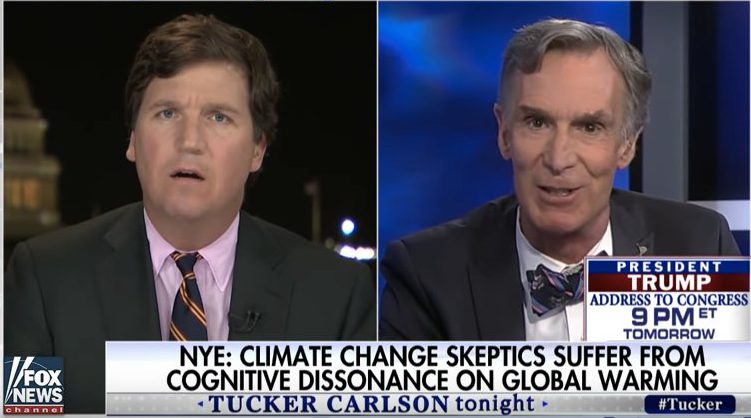
When dealing with a naturalist fundamentalist, make the Tucker Carlson face
The Tucker Carlson face conveys a mix of confusion, disappointment and horror

For God’s sake, even Richard Dawkins admitted in his debate with John Lennox that a good case can be made for a deistic God from the science we have now. If Dawkins can admit this, then you need to be extremely harsh to the village atheists.

If the word “naturalism” is all new to you, you should probably read the whole article and this longer article as well. The longer article really explains the different definitions of the words that are used in these debates. Johnson’s an excellent writer, and you will learn a lot.

Why did Dan Barker leave Christianity for atheism?

A conflict of worldviews

Unbelievable’s  radio show featured a discussion with former Christian Dan Barker, the founder and co-President of the Freedom From Religion Foundation.

The MP3 file is here. (60 minutes)

I thought that I would make some general comments about why I think that many people leave the Christian faith, and what you should be careful of in order to avoid following in Dan Barker’s footsteps, specifically.

Basically, there are four major reasons why people leave Christianity.

  1. They want to do something immoral with impunity. This type of person wants to do something immoral that is forbidden by Christianity, like pre-marital sex or getting drunk in clubs with friends. They dump Christianity in order to have freedom to seek happiness in this life.
  2. They want to make decisions based on their emotions, rather than wisdom. This type of person thinks that God’s job is to save them when they act irresponsibly. When God disappoints them by not make their recklessness “work out”, they leave the faith.
  3. They want to be loved by people, not by God. This type of person thinks that Christianity is a tool that they can use to become popular. When they first try to articulate the gospel in public, they find that people don’t like them as much, and they feel bad about offending people with exclusive truth claims that they cannot back up using logic and evidence. So, they water down Christianity to get along with non-Christians. Finally, they jettison Christianity completely. This happens to a lot of young Christians the moment they hit college / university.
  4. They don’t want to learn to defend their faith. This type of person is asked questions by skeptics that they cannot answer. Usually this happens when people go to university after growing up in the shelter of the Church. The questions and peer pressure make them feel stupid. Rather than investigate Christianity to see if it’s true, they drop it, so they can be thought of as part of the “smart” crowd.

Now listen to the discussion and see if you can identify some of these factors from Barker’s own carefully-prepared words. He is trying very hard to make himself look honest and moderate, because he wants Christians to be sympathetic with his story and his motives for leaving Christianity. But I think that there is enough in his statements to construct a different hypothesis of why he left Christianity.

I’ve grouped the data by risk factor. Some of this is my interpretation of his real motivations, based on my experience dealing with former-Christians.

Non-rational, emotional approach to Christianity

  • he was raised in a devout Christian family where he probably wouldn’t have faced skeptical questions
  • he converted to Christianity at age 15 as a result of a religious experience, not a serious investigation
  • his idea of God was probably idealized and uninformed, e.g. – a loving God who wants us to be happy
  • he wandered around from church to church preaching, with no fixed address or source of income
  • he earned money by collecting “love offerings” from churches where he performed his music
  • he wrote Christian songs and Christian musicals, but nothing substantive on apologetics and theology
  • he worked in three churches known for being anti-intellectual and fundamentalist
  • there’s no evidence that of any deep study of philosophy, science and history during this time

Desire to gain acceptance from non-Christians

  • he began to notice that some people were uncomfortable with sin and Hell
  • he began to avoid preaching about sin and Hell in order to make these people comfortable
  • he watered-down the gospel to focus on helping people to be happy in this life
  • his manic approach to Christian ministry was challenged by the “real life” needs of his growing family
  • he met liberal pastors while performing his music in their churches
  • he found it difficult to disagree with them because they seemed to be “good” people
  • he watered down his message further in order to appeal to people across the theological spectrum

Ignorance of Christian apologetics

  • he began to think that if there are many different views of religion, then no view can be correct
  • he was not intellectually capable of using logic and evidence to test these competing claims to see which was true
  • he decided to instead re-interpret Christian truth claims as non-rational opinions, so they could all be “valid”
  • he became a theological liberal, abandoning theism for an impersonal “ground of being”
  • he embraced religious pluralism, the view that all religions are non-rational and make no testable truth claims
  • he began to see God as a “metaphor” whose purpose is to make people have a sense of meaning and purpose
  • he jettisoned God completely and focused more on helping people find meaning and morality apart from God
  • seems to think that religion is about having a “great life”, and felt that you can have a “great life” without religion
  • seems to think that religion is about being “good”, and felt that you can be “good” without religion
  • religion makes people feel bad by telling them what to do instead of letting them do anything they want
  • religion makes people feel bad by telling them what is true, instead of letting them believe whatever they want
  • religion makes people feel bad by telling them that God will hold them accountable for their beliefs and actions

So what do I think happened?

Barker was generating an income from donations from churches where he entertained them. Gradually, his family grew to the point where conservative churches were not enough to support him. He had to change his message to appeal to liberal churches in order to cast a wider net.

He seems to have thought that Christianity is about having his needs met and being liked by others. I think he wanted to feel good and to make people feel good with his preaching and singing. But Christianity is not a feel-good religion. It’s not a tool to make people like you. He seems to have become aware that the exclusive claims of Christianity made other people feel offended, so he cut them out. Christian apologists learn how to provide evidence for claims that non-Christians find offensive or hard to believe, but Dan hadn’t studied philosophy, science or history so he couldn’t defend it. It’s hard to speak unpopular truths when you have nothing to back it up except your music composing. Eventually, Dan just quit making the truth claims entirely.

I also think money was a factor. It seems to me that it would have hurt his career and reduced his invitations from liberal churches if he had kept up teaching biblical Christianity. In order to appeal to a wider audience, (like many Christian singers do – e.g. – Amy Grant, Jars of Clay, etc.), he would have felt pressured to water down the unpleasant parts of his preaching and singing. Lacking apologetics skill, he instead abandoned his message. He needed to account for his family’s needs and “real life”, and exclusive truth claims and Hell-talk would have reduced his ability to do that. It seems to me that he should have scaled back his extreme schedule of preaching and singing, and instead gotten a steady job so that he could afford “real life” and a family without being pressured into altering his message. The Christian life requires a certain amount of wisdom that Dan did not have.

Life isn’t a fairy tale. God isn’t there to reward risky behavior. We need to be more shrewd about financial matters so that we have the ability to not care about what people think of us. Look at this blog. I work all day as a senior software engineer with two degrees in computer science, so that I don’t have to rely on donations. Additionally, I save most of what I make in case a tragedy strikes. Since I am financially secure, I can say what I think, and disregard anyone who wants me to change my message because they are offended. Becoming a Christian isn’t a license to behave irrationally and immaturely with money. For some people, (like William Lane Craig), stepping out in faith works. But if it doesn’t work, it’s better to retreat and re-trench, rather than to compromise your message for money.

I actually met someone like Dan Barker recently. She grew up in an anti-intellectual hippy Christian home. Her mother came from a good family, and decided on a whim to marry a non-Christian. Like Barker, the family exalted feelings and irrational expectations of miracles from God for “fearless” acts. She got herself into trouble with alcohol and promiscuity in her 20s, by making emotional decisions and mixing with the wrong crowd. Her way of fixing this was to fly off on a one-year missions trip, wrecking her resume and finances. Now, she is in her late 30s, unmarried, and literally blaming Jesus for putting too many demands on her that she doesn’t have time for, e.g – morning quiet time. This causes her to feel guilty, and make her want to reject Christianity. She had no intellectual conception of basic core doctrines like God’s existence or Jesus’ resurrection, which might have acted as a bulwark against her emotions. When I explained to her how I had structured my education and career so that I could have an influence without testing God, she seemed bored and said that I was too “fearful”.

This is apparently widespread, especially among anti-intellectual denominations. Another ex-Pentecostal atheist woman I heard about from people who knew her when she was young decided to drop out of college to travel around North America doing pro-life work. When she found herself penniless, unmarried and without children in her mid-30s, she decided to have a baby out of wedlock. The government will pay for it, she said. Rather than trying to justify this decision as a Christian, she blamed God for not making her madness “work out”. She is now an atheist, because God did not reward her decision to live fearlessly for him with a husband and children. It was all God’s fault. There is a whole subculture within Christianity, where the pursuit of fun and thrills can be masked with pious language, and all talk of prudence and restraint is seen as cowardice and lack of faith.

The Christian life requires a certain level of intelligence, a certain level of practical wisdom, and a certain level of self-control and discipline. Make sure that you don’t walk away from God because of your own bad choices.

Documented cases of discrimination against religious people skyrocketing

Discrimination against religious people

Consider this story from the Daily Signal, and keep in mind that these are only the documented cases.

Excerpt:

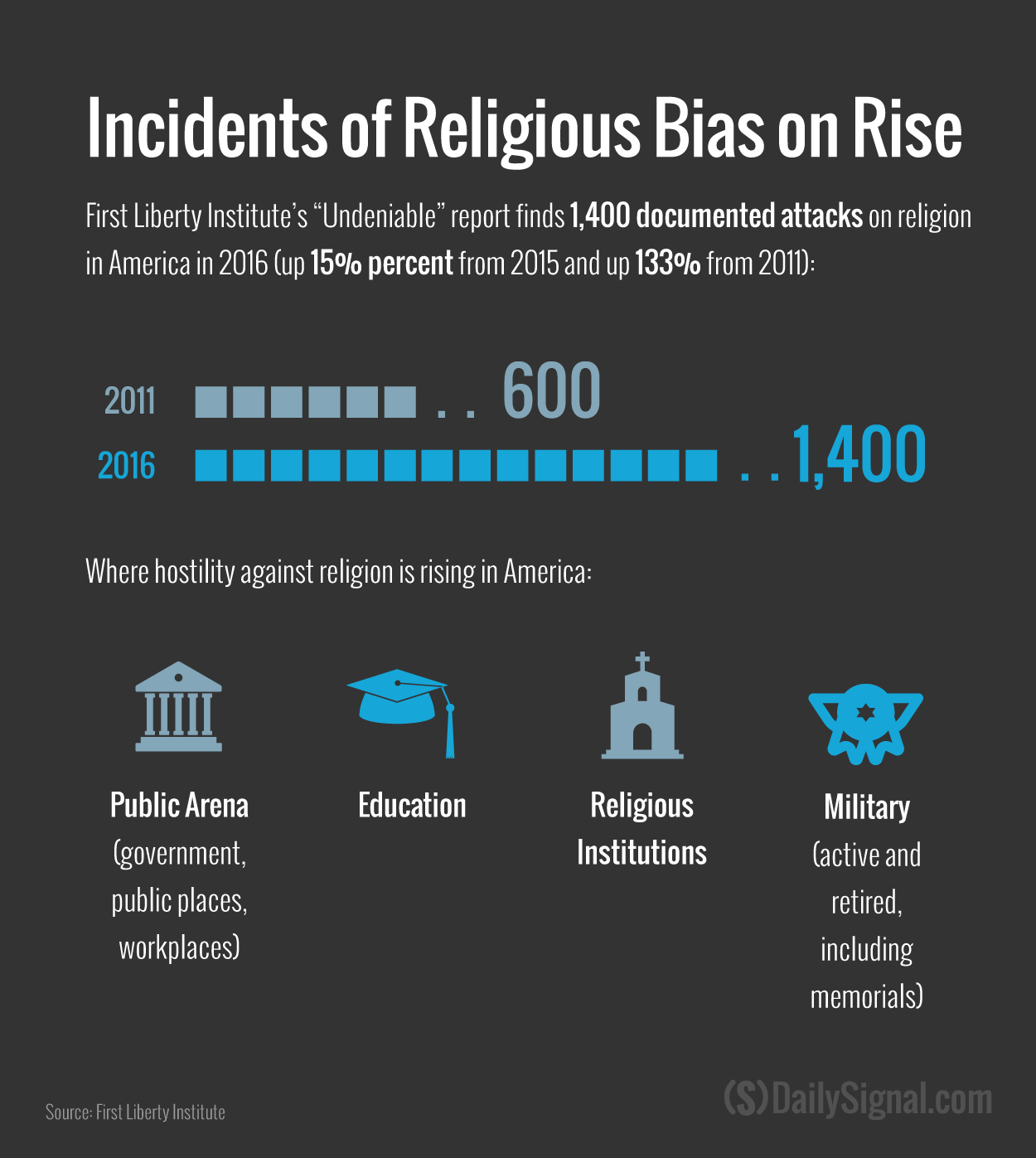
Freedom of religion isn’t as protected as some Americans may think. In fact, reported attacks on religion are increasing in the U.S. and, according to First Liberty Institute, the evidence is undeniable.

The 2017 edition of a First Liberty report called “Undeniable” shows threats to Americans’ First Amendment rights spanning the past five years.

The number of documented incidents of religious discrimination grew 15 percent in 2016 compared with 2015. The number of incidents increased by 133 percent, from 600 to more than 1,400, between 2011 and 2016.

“We’re in a battle right now for religious freedom in the future of our country,” First Liberty President Kelly Shackelford said in a Facebook Live video Sept. 12.

Justin Butterfield, editor-in-chief of the study, said in an interview with The Daily Signal that much of the data comes from court filings from across the country.

The research team also collects reports from news outlets and other organizations, including the Freedom From Religion Foundation, an atheist group.

Butterfield, who has a law degree from Harvard, said researchers specifically looked for instances where someone was illegally restricted from, or prosecuted for, practicing his or her faith.

Some people like to think that gay rights are a wonderful thing, but you can’t expect people who are involved in a sin to treat those who disagree with them with respect. Sin causes people to want to coerce and silence those who disagree.

Here is a story from Alliance Defending Freedom about a case in Washington state – a very, very godless state:

Alliance Defending Freedom attorneys filed a brief Monday with the Washington Supreme Court asking it to take up the case of Barronelle Stutzman, a floral artist whom the state and the American Civil Liberties Union sued for acting consistently with her faith.

ADF filed notices of appeal in April on behalf of Stutzman, owner of Arlene’s Flowers in Richland, after a lower state court ruled that she must pay penalties and attorneys’ fees for declining to use her artistic abilities to design custom floral arrangements for a long-time customer’s same-sex ceremony. Rather than participate in the ceremony, Stutzman referred the customer, whom she considers a friend and had served for nearly 10 years, to several other florists in the area who would provide high-quality arrangements and wedding support.

[…]“Government is supposed to protect freedom, not intimidate citizens into acting contrary to their faith and conscience,” added ADF Senior Legal Counsel Jeremy Tedesco. “The two lawsuits have the potential to financially devastate Barronelle’s business and personal assets – including taking this 70-year old grandmother’s retirement and personal savings – simply for acting in accordance with her faith. We hope the Washington Supreme Court will review this case not only because of the important legal and constitutional implications, but also because of the devastating impact the lower court’s ruling has on Barronelle.”

Barronelle just asked to not be forced to celebrate something that she didn’t believe in, and the attorney general of Washington thought that an appropriate response to her refusal to celebrate gay marriage was to take everything she owned, and block her from earning a living in the state of Washington.

It’s very important to people who are behaving immorally that they not be judged or shamed by religious people for their immoral choices. How far would social liberals go to stop religious people from judging them? Well, in America, they resort to lawsuits, censorship, coercion, vandalism and even violence. You’ll recall the attack by domestic terrorist Floyd Lee Corkins against the Family Research Council building. Corkins was, of course, a social progressive and in favor of legalizing gay marriage, and opposed to religious liberty.