Can prayer, Bible reading, church-singing and charismatic preaching stop Katy Perry’s apostasy?

I received an e-mail from a woman who was telling me to drop my list of 10 worldview questions and just look for a wife who reads the Bible and has feelings about Jesus.

She wrote:

My suggestion to you is to consider a top-down approach.  Just pray for God to send you your wife and pray that you recognize her immediately.  You don’t seem like you really want to remain single…and your children are missing out on having you as their dad.  Marriage is for children, remember?  I know several young ladies who know their Scripture and who love Jesus but who, I don’t think, would pass your test because, in my perception, they aren’t cerebral enough.

I get this e-mail a lot, especially from women who have married non-Christians or who are divorced. Now the whole point of the list of 10 questions is to detect women who are not going to help me to produce effective, influential Christian children. If I am going to spend north of $100,000 per child + tuition, then I expect to get some sort of return on that investment for God. That money doesn’t earn itself, and it needs to be well-spent serving God.

It’s my wife’s job to help me to do that. My goal in choosing a wife is to find a helper to make the relationship serve God. Otherwise, it’s better for God if I give that money that I worked very hard to earn directly to effective Christian scholars. I don’t have money to burn “playing house” with someone who is guided by her feelings. I can just give the money to Reasonable Faith or Discovery Institute instead.

Let’s take a look at two parents who aimed at nothing and hit it with their daughter. The two parents run a ministry that is based around passionate preaching, prayer and Bible verses.

Excerpt:

The Lord spoke to Arise International Conference host Mary Hudson to encourage women to reach their full destiny in Jesus Christ. He wants women to rise up as trailblazers, to think outside the box and be bold in Him, of course putting God first, your husband second and then your family!

Mary’s ministry of Arise! International holds annual women’s empowerment and leadership conferences in Hawaii, Belgium, Colombia, France, Switzerland, Denmark and the USA. The river of glory is rising and we must flow with it.

2012 promises to be a break-through year to Arise! in who you are in Christ. Lean on Him for direction, don’t look to man. Knowing the signs of the times and hearing the voice of the Holy Spirit will be vital to being at the right place at the right time to reap the harvest of souls coming into the Kingdom.

Pray about being a part of Arise! this coming year. It just may be the meeting that propels you into the next level for your life. Remember, you are equipped with everything you need to fulfill your purpose. God’s assignments reveal your abilities and your capabilities, and He will provide both the potential and the provision to meet every assignment.

We call you blessed and highly favored!

I noticed that their “book store” offers nonsense books like this:

Keith Hudson “Looking and Seeing”:

Like this disciplined athlete, you need to learn how to look beyond your present situation and keep your eye on His Presence. God is ready to display His glory in your life as well in these last days, but it is going to take boldness for you to take the mask off and look at people and situations the way God sees them, not how man looks at them. What may stand in front of you may look too big for you to grasp; that what you see now is the way it’s always going to be. Or you look at the dream God has given you and think, “there is no way I can ever accomplish this with my resources at my age…” That is the moment you have to flip the switch from looking to seeing.

Mary Hudson “Smart Bombs”:

Smart Bombs is a book which will show you practically and with true life examples how to take God’s Word and let it explode strongholds in your life. When you read the Bible, He quickens particular passages or verses to your heart. You know it is God talking to you about your situation. Or when you receive a prophetic word, you sense in your heart this is speaking to you. But what do you do with these words when they bear witness with you? Let them fade away and disappear off of your memory? No, Smart Bombs shows you how to go on the offense with the anointed word of God, how to demolish strongholds and take back everything the enemy has stolen from you.

This easy read is a must for anyone who is looking for clarity on their destiny.

Keith Hudson “The Cry”:

The Cry will reignite you with new fire. Christians lose their passion when they let go of their zeal for God. We come into prayer meetings and we are so polished and perfected. But the Lord wants to hear the cry of your heart. The church has lost its cry: God is about to restore it. Why did the thirty people gathered for the Azusa Street revival have such a move of the spirit of God in their day? Because they had a cry in their hearts and in their prayers. The Cry will release a desperate longing in you for Gods intervention in your life. It goes way beyond your natural thinking into a spiritual hunger from your innermost being. When everything else has failed, a desperate cry touches the heart of God.

Now do you think that someone who reads books like that will produce the same kind of children as parents who read William Lane Craig, Stephen C. Meyer, Jay Richards, and Michael Licona? Of course not. Because the Hudson books are fluff and the books by real Christian scholars are not fluff.

Now let’s read an article from Christian Post about what sort of child the fluff approach produces. (H/T Mysterious Chris S.)

Excerpt:

Katy Perry, the 29-year-old singer and songwriter, is revealing that while she prays she no longer identifies with Christianity.

“I don’t believe in a heaven or a hell, or an old man sitting on a throne. I believe in a higher power bigger than me because that keeps me accountable,” she told Marie Claire magazine recently. “Accountability is rare to find, especially with people like myself, because nobody wants to tell you something you don’t want to hear.”

Perry, who took the Billboard charts by storm with her hit song “I Kissed a Girl” in 2008, told Marie Claire that she no longer considers herself a Christian despite being raised by Christian ministers.

“I’m not Buddhist, I’m not Hindu, I’m not Christian, but I still feel like I have a deep connection with God. I pray all the time – for self-control, for humility,” she told Marie Claire. “There’s a lot of gratitude in it. Just saying ‘thank you’ sometimes is better than asking for things.”

Despite her decision to perform music that may seem controversial to the Christian community, the chart-topping singer has never shied away from crediting the Christian church for giving her a start as a performer.

“The atmosphere I grew up in was 100 percent Christian,” Perry said her “Part of Me: 3D” movie which was released last year. “I started singing in the church, I never really had another plan.”

Their daughter is writing songs to promote homosexuality to young people. That’s their legacy. The legacy of spiritual gifts, God opening doors of mysticism and charismatic anti-intellectualism. That’s what they are going to present to God as their spiritual legacy. I noticed that Mary Hudson is now calling her daughter’s celebrity divorce after one year of marriage a “gift from God”. Her daughter married a heroin-addicted leftist non-Christian – but he was hawt. Tall, dark, handsome and a famous comedian, too.

The list of questions I use when courting helps me to avoid marrying a woman like Katy Perry’s mother. She could not answer any of my questions. None of them. And what’s more, she doesn’t want to answer them. She wants to live her whole life without learning how to answer them. She wants to stick with her Bible, her singing, her feelings, her passionate oratory and her crowds of gullible people. I will not marry a woman like that. It produces disaster and failure. It produces anti-Christian children.

In fact, you can’t succeed at anything worthwhile in life using the Keith and Mary Hudson approach to parenting. You can’t do a thing with that approach. Not writing software, not fixing cars, not making investments, not sending a rocket to the moon, not even evangelizing an apostate daughter. You do not want to be a Christian man who pumps 30 years of hard labor into a family that produces apostate children. If you are going to spend the money, then make sure you get the results.
Why is it so hard for young people to find a job?

Young people have a sense of entitlement

Bloomberg News discusses the “Professionalism in the Workplace” survey of human resources specialists from York College of Pennsylvania.

Forty-nine percent of [those surveyed] stated that less than half of new employees “exhibit professionalism in their first year.” More than half (53 percent) have noticed “a sense of entitlement” rising among younger workers; almost 45 percent have seen a “worsening of the work ethic,” including “too casual of an attitude toward work” and “not understanding what hard work is.”

Younger workers believe they can multitask and remain productive, the human-resources people told the York researchers. Thirty-eight percent of respondents blamed multitasking for the lack of “focus” among younger workers. The authors of the study explained that the younger generation “believes that it is possible to multi-task effectively” and that using social media, for example, is an efficient way to communicate. In interviews, the applicants check their phones for texts and calls, dress inappropriately and overrate their talents.

“The sad fact is some of these persons probably do not understand what is wrong with this,” the authors note.

Older workers have always complained about younger workers, of course, but there’s a difference: This time they attribute the youthful flaws not to ignorance or waywardness, but to a “sense of entitlement.”

We might forgive 18-year-olds fresh out of high school for lacking employability skills (the manufacturing sector hires many workers lacking undergraduate degrees). But when he or she reaches 23 and has four years of college, employers expect a white-collar worker to recognize basic norms of dress and deportment.

What happened in college, then? The survey by York College’s Center for Professional Excellence assigns colleges part of the blame, observing that letting students miss deadlines without penalty and assigning good grades for middling work only make them form the wrong expectations.

Meanwhile, the UK Daily Mail had the results from a 2013 survey:

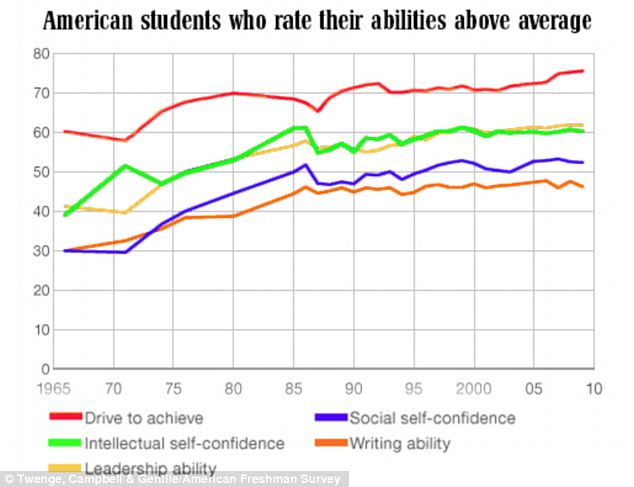
Young people’s unprecedented level of self-infatuation was revealed in a new analysis of the American Freshman Survey, which has been asking students to rate themselves compared to their peers since 1966.

Roughly 9 million young people have taken the survey over the last 47 years.

Psychologist Jean Twenge and her colleagues compiled the data and found that over the last four decades there’s been a dramatic rise in the number of students who describe themselves as being ‘above average’ in the areas of academic ability, drive to achieve, mathematical ability, and self-confidence.

But in appraising the traits that are considered less invidualistic – co-operativeness, understanding others, and spirituality – the numbers either stayed at slightly decreased over the same period.

Researchers also found a disconnect between the student’s opinions of themselves and actual ability.

While students are much more likely to call themselves gifted in writing abilities, objective test scores actually show that their writing abilities are far less than those of their 1960s counterparts.

Also on the decline is the amount of time spent studying, with little more than a third of students saying they study for six or more hours a week compared to almost half of all students claiming the same in the late 1980s.

Though they may work less, the number that said they had a drive to succeed rose sharply.

[…]Twenge is the author of a separate study showing a 30 per cent increase towards narcissism in students since 1979.

‘Our culture used to encourage modesty and humility and not bragging about yourself,’ Twenge told BBC News. ‘It was considered a bad thing to be seen as conceited or full of yourself.’

Just because someone has high self-esteem doesn’t mean they’re a narcissist. Positive self-assessments can not only be harmless but completely true.

However, one in four recent students responded to a questionnaire called the Narcissistic Personality Inventory with results pointing towards narcissistic self-assessments.

Narcissism is defined as excessive self-love or vanity; self-admiration, or being self-centered.

Twenge said that’s a trait that is often negative and destructive, and blames its boom on several trends – including parenting styles, celebrity culture, social media, and easy credit – for allowing people to seem more successful than they really are.

I think what I am seeing is that not only do they work less, but they work at things they “like”, rather than at things that will allow them to provide value to others. So, you’re not going to find a lot of computer programmers or petroleum engineers among young Americans, but you will find a lot of people gravitating to jobs that are easy that make them feel good about themselves, and look good to other people, too.

Obviously, there are policy reasons for youth unemployment being so high, but I think this attitude that young people have is definitely part of it.

Why is college so expensive? Why does university tuition cost so much?

The correct answer appeared in the radically leftist New York Times, of all places.

This is by Paul F. Campos, law professor at the radically leftist UC Boulder.

He writes:

[P]ublic investment in higher education in America is vastly larger today, in inflation-adjusted dollars, than it was during the supposed golden age of public funding in the 1960s. Such spending has increased at a much faster rate than government spending in general. For example, the military’s budget is about 1.8 times higher today than it was in 1960, while legislative appropriations to higher education are more than 10 times higher.

In other words, far from being caused by funding cuts, the astonishing rise in college tuition correlates closely with a huge increase in public subsidies for higher education. If over the past three decades car prices had gone up as fast as tuition, the average new car would cost more than $80,000.

Some of this increased spending in education has been driven by a sharp rise in the percentage of Americans who go to college. While the college-age population has not increased since the tail end of the baby boom, the percentage of the population enrolled in college has risen significantly, especially in the last 20 years. Enrollment in undergraduate, graduate and professional programs has increased by almost 50 percent since 1995. As a consequence, while state legislative appropriations for higher education have risen much faster than inflation, total state appropriations per student are somewhat lower than they were at their peak in 1990. (Appropriations per student are much higher now than they were in the 1960s and 1970s, when tuition was a small fraction of what it is today.)

As the baby boomers reached college age, state appropriations to higher education skyrocketed, increasing more than fourfold in today’s dollars, from $11.1 billion in 1960 to $48.2 billion in 1975. By 1980, state funding for higher education had increased a mind-boggling 390 percent in real terms over the previous 20 years. This tsunami of public money did not reduce tuition: quite the contrary.

[…]State appropriations reached a record inflation-adjusted high of $86.6 billion in 2009. They declined as a consequence of the Great Recession, but have since risen to $81 billion. And these totals do not include the enormous expansion of the federal Pell Grant program, which has grown, in today’s dollars, to $34.3 billion per year from $10.3 billion in 2000.

The more money that is attached to students, the more money universities charge – simple.

But where is the money going? Is it mostly going to research? To the classroom? To hire more and better professors?

No:

Interestingly, increased spending has not been going into the pockets of the typical professor. Salaries of full-time faculty members are, on average, barely higher than they were in 1970. Moreover, while 45 years ago 78 percent of college and university professors were full time, today half of postsecondary faculty members are lower-paid part-time employees, meaning that the average salaries of the people who do the teaching in American higher education are actually quite a bit lower than they were in 1970.

By contrast, a major factor driving increasing costs is the constant expansion of university administration. According to the Department of Education data, administrative positions at colleges and universities grew by 60 percent between 1993 and 2009, which Bloomberg reported was 10 times the rate of growth of tenured faculty positions.

Even more strikingly, an analysis by a professor at California Polytechnic University, Pomona, found that, while the total number of full-time faculty members in the C.S.U. system grew from 11,614 to 12,019 between 1975 and 2008, the total number of administrators grew from 3,800 to 12,183 — a 221 percent increase.

If you’re going to college or trade school, go to a low-cost school. Do a STEM degree or do a trade that pays well. Try to get tuition assistance even if it means going to a less prestigious school. And work at every opportunity you get in the most serious job you can find. Don’t spend your money – save it. Especially don’t spend your money on fun, vacations and alcohol. As soon as you grow up, you’re going to wish you could have it all back.