
Americans using student loans to pay for living expenses

Student Loan Bubble
Student Loan Bubble

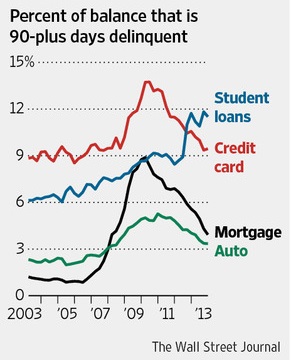
The Wall Street Journal reports on the $1.1 trillion of student loan debt.

Excerpt:

Some Americans caught in the weak job market are lining up for federal student aid, not for education that boosts their employment prospects but for the chance to take out low-cost loans, sometimes with little intention of getting a degree.

[…]A number of factors are behind the growth in student debt. The soft jobs recovery and the emphasis on education have driven people to attain more schooling. But borrowing thousands in low-rate student loans—which cover tuition, textbooks and a vague category known as living expenses, a figure determined by each individual school—also can be easier than getting a bank loan. The government performs no credit checks for most student loans.

College officials and federal watchdogs can’t say exactly how much of the U.S.’s swelling $1.1 trillion in student-loan debt has gone to living expenses. But data and government reports indicate the phenomenon is real. The Education Department’s inspector general warned last month that the rise of online education has led more students to borrow excessively for personal expenses. Its report said that among online programs at eight universities and colleges, non-education expenses such as rent, transportation and “miscellaneous” items made up more than half the costs covered by student aid.

The report also found the schools disbursed an average of $5,285 in loans each to more than 42,000 students who didn’t log any credits at the time. The report pointed to possible factors such as fraud in addition to cases of people enrolling without serious intentions of getting a degree.

Capella Education Co., which runs online schools, examined student costs and debt at institutions— public and private —in Minnesota and concluded that between a quarter and three-quarters of loans taken out by students were for non-education expenses. At one of Capella’s master’s programs, the typical graduate left with about $30,200 in student debt even though tuition, fees and book costs totaled roughly $18,800. Borrowers are prohibited under federal law, except in rare instances, from discharging student debt through bankruptcy.

The share of student borrowers taking out the maximum amount of loans—$12,500 a year for undergraduates—has risen since the recession. In the 2011-12 academic year, federal Education Department data show, 68% of all undergraduate borrowers hit the annual loan ceiling, up from 60% in 2008.

Research suggests a fair chunk of that is going to non-education expenses. In 2011-12, about a quarter of student borrowers took out loans that exceeded their tuition, after grants, by $2,500, according to research by Mark Kantrowitz, a higher-education analyst and publisher of the education site Edvisors.com.

Some students say they intend to get a degree but must borrow as much as possible because they can’t find decent-paying jobs to cover day-to-day expenses.

Here are some examples of how this is working out:

Tommie Matherne, a 32-year-old married father of five in Billings, Mont., has been going to school since 2010, when he realized the $10 an hour he was making as a mall security guard wasn’t covering his family’s expenses. He uses roughly $2,000 in student loans each year to stock his fridge and catch up on bills. His wife is a stay-at-home mother who also gets loans to take online courses.

“We’ve been taking whatever we can for student loans every year, taking whatever we have left over and using it to stock up the freezer just so we have a couple extra months where we don’t have to worry about food,” says Mr. Matherne, who owes $51,600 in federal loans.

Some students end up going deeper into debt. Early last year, when Denna Merritt lost her long-term unemployment benefits, the 49-year-old Indianapolis woman enrolled part-time at the Art Institute of Pittsburgh’s online program, aiming for a degree in graphic design. She took out $15,000 in federal loans, $2,800 of which went to catch up on unpaid bills, including utilities, health-insurance premiums and cable.

Mr. Selent, of Fort Lauderdale, knows he is getting himself deeper in a hole but prefers that to the alternative of making minimum wage. In his 20s, he earned a bachelor’s degree in communications from a local for-profit school but couldn’t find a job in the field after graduating and began falling behind on his student-loan bills. He is now taking courses for a degree in theater so he can become an actor.

Meanwhile, federal loans allow him to cover any needs that arise during the semester. Says Mr. Selent: “It keeps me from falling apart.”

Wow. Communications and Theatre. Do you think a private bank would have given him money to do a degree in theater? I don’t think so. A private banker might give a loan to someone trying to get a STEM degree, like computer science or nursing, but not for theater. So how did the theater major get the loan, then, if no sane private sector banker would give it to him?

This article from the Heritage Foundation think tank explains how he got the money.

Excerpt:

The Obama Administration’s overreach into the student loan industry has been wide-sweeping. In what The Wall Street Journal deemed “that other government takeover,” a provision buried deep in Obamacare effectively nationalized the student loan industry by ending government subsidies to private lenders and putting the federal government in charge of originating and servicing federally backed student loans.

The Obamacare provision came in addition to the Administration’s decision in 2011—made through executive order—to forgive student loan debt after 20 years. And it comes in addition to the Administration’s gainful employment regulations restricting access to student loans for students attending for-profit institutions.

But the current debate’s origins are in separate legislation passed in 2007 whereby the federal government set interest rates on student loans artificially low, cutting the rates in half temporarily for four years. Now that the interest rates are set to increase, President Obama is pressing Congress to keep rates low.

So the Democrats are repeating the mortgage lending recession they caused in 2008 by again transferring risk away from private banks and onto the backs of the taxpayers. Anybody can get a loan for anything, whether it be basket-weaving or women’s studies or… theater.

It’s just more vote-buying from the Democrat party

The government is giving away these loans to students, no questions asked, in order to buy their votes. These are the students who cheered when Obama promised that they could stay on their parents’ insurance plans until they were 26. The Democrats get the moocher vote, and the students get their loans forgiven in 20 years. Everybody wins – except that the next generation of Americans gets stuck with the bill for this vote buying scheme.

Global warming alert: Washington, D.C. breaks 141-year-old cold record

The leftist Washington Post reports.

Excerpt:

Baltimore-Washington International Thurgood Marshall Airport broke a 141-year-old record low temperature, reaching 4 degrees. The National Weather Service said the low reached early Tuesday broke a 5-degree record set on the day in 1873. It was also a record low for the month of March. Dulles International Airport – also outside Washington – tied a 1993 record for the month at -1 degree.

Both airports broke record lows two days in a row.

Schools and government offices along the East Coast were closed Tuesday or delayed opening. Virginia State Police said slickened roads were factors in three traffic deaths. And authorities in Maryland’s Prince George’s County said a 60-year-old woman died after shoveling snow there.

Global warming is to blame for these record cold temperatures. But wait, Washington wasn’t the only one victimized by the global warming monster.

On Monday, leftist Reuters reports that the cold was all up and down the East coast.

Excerpt:

A deadly winter storm hit the U.S. East Coast on Monday with freezing rain, snow and near-record cold, cancelling about 2,700 flights, shutting down Washington and closing schools and local governments.

The latest in a series of weather systems to pummel the winter-weary eastern United States, the storm dumped about 4 inches on the U.S. capital by early afternoon as it swept from the Mississippi Valley to the Atlantic coast, the National Weather Service said.

Brian Hurley, a weather service meteorologist, said temperatures would be about 30 degrees Fahrenheit (15 degrees Celsius) below normal as a cold front settled in from Great Plains to the Atlantic coast.

“It’s really, really cold, temperatures dropping into the teens (Fahrenheit, minus-7 to minus-10 Celsius) and the normal highs are around 50 (10C) at this point,” he said.

At least four weather-related traffic deaths in Texas, Oklahoma and Tennessee were blamed on the wide-ranging storm over the weekend.

And on Tuesday, leftist Reuters reported that the cold had spread westward.

Excerpt:

The eastern and central United States were plunged into a deep freeze on Tuesday, with record low temperatures in the wake of a deadly storm expected to moderate in coming days.

The late-winter storm left behind frigid temperatures after pushing freezing rain, sleet and snow from the Mississippi Valley to the Atlantic and Gulf coasts.

Temperatures this week will be “below average east of the Rockies, as it has been for a good part of the winter,” said Bob Oravec, a National Weather Service meteorologist in College Park, Maryland.

The icy front sent the mercury plunging to minus 1F (minus 18C) at Washington Dulles International Airport, tying a monthly record, the weather service said.

Baltimore; Scranton, Pennsylvania; Morgantown, West Virginia; Zanesville, Ohio; and Flint, Michigan all set or tied record lows.

The latest in a series of arctic weather systems to grip the winter-weary eastern United States, the cold front stretched from the Canadian border to southern Texas, where freezing rain was forecast.

[…]The storm was blamed for at least six deaths, most of them from traffic accidents on slippery roads. A woman in Bowie, Maryland, died on Monday from a likely heart attack after shoveling snow, a spokesman for the Prince George’s County fire department said.

About 730 U.S. flights were canceled and about 2,700 delayed on Tuesday in the wake of the bad weather, according to airline tracking site FlightAware.com. About 8,000 flights were canceled or delayed on Monday.

Those people were not killed by record cold temperatures, they were killed by the global warming monster!!1! They were caught up in a fiery explosion caused by cowboy capitalism and insufficient government spending on science education. We need more grant money for a study to find out why you believe your own eyes, rather than the dire warnings of greedy scientists and their power-hungry socialist masters in government.

William Lane Craig: Christians are idling in intellectual neutral

The video is 40 minutes long.

The full transcript is available here on the Reasonable Faith web site. (H/T Think Apologetics)

Excerpt:

No one has issued a more forceful challenge to Christians to become intellectually engaged than did Charles Malik, former Lebanese ambassador to the United States, in his address at the dedication of the Billy Graham Center in Wheaton, Illinois. Malik emphasized that as Christians we face two tasks in our evangelism: saving the soul and saving the mind, that is to say, not only converting people spiritually, but converting them intellectually as well. And the Church is lagging dangerously behind with regard to this second task. Our churches are filled with people who are spiritually born again, but who still think like non-Christians. Mark his words well:

I must be frank with you: the greatest danger confronting American evangelical Christianity is the danger of anti-intellectualism. The mind in its greatest and deepest reaches is not cared for enough. But intellectual nurture cannot take place apart from profound immersion for a period of years in the history of thought and the spirit. People who are in a hurry to get out of the university and start earning money or serving the church or preaching the gospel have no idea of the infinite value of spending years of leisure conversing with the greatest minds and souls of the past, ripening and sharpening and enlarging their powers of thinking. The result is that the arena of creative thinking is vacated and abdicated to the enemy.

Malik went on to say:

It will take a different spirit altogether to overcome this great danger of anti-intellectualism. For example, I say this different spirit, so far as philosophy alone—the most important domain for thought and intellect—is concerned, must see the tremendous value of spending an entire year doing nothing but poring intensely over the Republic or the Sophist of Plato, or two years over the Metaphysics or the Ethics of Aristotle, or three years over the City of God of Augustine. But if a start is made now on a crash program in this and other domains, it will take at least a century to catch up with the Harvards and Tübingens and the Sorbonnes—and by then where will these universities be?

What Malik clearly saw is the strategic position occupied by the university in shaping Western thought and culture. Indeed, the single most important institution shaping Western society is the university. It is at the university that our future political leaders, our journalists, our lawyers, our teachers, our scientists, our business executives, our artists, will be trained. It is at the university that they will formulate or, more likely, simply absorb the worldview that will shape their lives. And since these are the opinion-makers and leaders who shape our culture, the worldview that they imbibe at the university will be the one that shapes our culture.

And:

The great Princeton theologian J. Gresham Machen warned on the eve of the Fundamentalist Controversy that if the Church loses the intellectual battle in one generation, then evangelism would become immeasurably more difficult in the next:

False ideas are the greatest obstacles to the reception of the gospel. We may preach with all the fervor of a reformer and yet succeed only in winning a straggler here and there, if we permit the whole collective thought of the nation or of the world to be controlled by ideas which, by the resistless force of logic, prevent Christianity from being regarded as anything more than a harmless delusion. Under such circumstances, what God desires us to do is to destroy the obstacle at its root.

The root of the obstacle is to be found in the university, and it is there that it must be attacked. Unfortunately, Machen’s warning went unheeded, and biblical Christianity retreated into the intellectual closets of Fundamentalism, from which it has only recently begun to re-emerge. The war is not yet lost, and it is one which we must not lose: souls of men and women hang in the balance.

This lecture is an excellent opportunity for us all to ask ourselves: what are we doing to influence the university? Do you have a plan?

Many of the strongest people who are now opposed to Christianity raised in two-parent Christian homes, and went to church for a decade before going off to the university. I’m thinking especially of people like Tim Gill, in Colorado. At university (and even increasingly in high school) they turned away from Christianity. All their peers and the adults could not answer their questions. As adults, they were able to get money, power and influence. Many of them are using it against Christ and his kingdom – kicking away the ladder that they climbed to success on. Why is this? Unfortunately, many of us are not willing to do what works – pick up the Lee Strobel books and read them. Especially “The Case for a Creator”.