
Walter Bradley: three scientific phenomena that point to a designed universe

Dr. Walter L. Bradley

Dr. Walter L. Bradley (C.V. here) is the Distinguished Professor of Engineering at Baylor.

Here’s a bio:

Walter Bradley (B.S., Ph.D. University of Texas at Austin) is Distinguished Professor of Engineering at Baylor. He comes to Baylor from Texas A&M University where he helped develop a nationally recognized program in polymeric composite materials. At Texas A&M, he served as director of the Polymer Technology Center for 10 years and as Department Head of Mechanical Engineering, a department of 67 professors that was ranked as high as 12th nationally during his tenure. Bradley has authored over 150 refereed research publications including book chapters, articles in archival journals such as the Journal of Material Science, Journal of Reinforced Plastics and Composites, Mechanics of Time-Dependent Materials, Journal of Composites Technology and Research, Composite Science and Technology, Journal of Metals, Polymer Engineering and Science, and Journal of Materials Science, and refereed conference proceedings.

Dr. Bradley has secured over $5.0 million in research funding from NSF grants (15 yrs.), AFOSR (10 years), NASA grants (10 years), and DOE (3 years). He has also received research grants or contracts from many Fortune 500 companies, including Alcoa, Dow Chemical, DuPont, 3M, Shell, Exxon, Boeing, and Phillips.

He co-authored The Mystery of Life Origin: Reassessing Current Theories and has written 10 book chapters dealing with various faith science issues, a topic on which he speaks widely.

He has received 5 research awards at Texas A&M University and 1 national research award. He has also received two teaching awards. He is an Elected Fellow of the American Society for Materials and the American Scientific Affiliation (ASA), the largest organization of Christians in Science and Technology in the world. He is President elect of the ASA and will serve his term in 2008.

You can read more about his recent research in this article from Science Daily.

Below, I analyze a lecture entitled “Is There Scientific Evidence for an Intelligent Designer?”. Dr. Bradley explains how the progress of science has made the idea of a Creator and Designer of the universe more acceptable than ever before.

The MP3 file is here.

Evidence #1: The design of the universe

1. The correspondence of natural phenomena to mathematical law

  • All observations of physical phenomena in the universe, such as throwing a ball up in the air, are described by a few simple, elegant mathematical equations.

2. The fine-tuning of physical constants and rations between constants in order to provide a life-permitting universe

  • Life has certain minimal requirements; long-term stable source of energy, a large number of different chemical elements, an element that can serve as a hub for joining together other elements into compounds, etc.
  • In order to meet these minimal requirements, the physical constants, (such as the gravitational constant), and the ratios between physical constants, need to be withing a narrow range of values in order to support the minimal requirements for life of any kind.
  • Slight changes to any of the physical constants, or to the rations between the constants, will result in a universe inhospitable to life.
  • The range of possible ranges over 70 orders of magnitude.
  • Although each individual selection of constants and ratios is as unlikely as any other selection, the vast majority of these possibilities do not support the minimal requirements of life of any kind. (In the same way as any hand of 5 cards that is dealt is as likely as any other, but you are overwhelmingly likely NOT to get a royal flush. In our case, a royal flush is a life-permitting universe).

Examples of finely-tuned constants and ratios: (there are more examples in the lecture)

a) The strong force: (the force that binds nucleons (= protons and neutrons) together in nucleus, by means of meson exchange)

  • if the strong force constant were 2% stronger, there would be no stable hydrogen, no long-lived stars, no hydrogen containing compounds. This is because the single proton in hydrogen would want to stick to something else so badly that there would be no hydrogen left!
  • if the strong force constant were 5% weaker, there would be no stable stars, few (if any) elements besides hydrogen. This is because you would be able to build up the nuclei of the heavier elements, which contain more than 1 proton.
  • So, whether you adjust the strong force up or down, you lose stars than can serve as long-term sources of stable energy, or you lose chemical diversity, which is necessary to make beings that can perform the minimal requirements of living beings. (see below)

b) The conversion of beryllium to carbon, and carbon to oxygen

  • Life requires carbon in order to serve as the hub for complex molecules, but it also requires oxygen in order to create water.
  • Carbon is like the hub wheel in a tinker toy set: you can bind other elements together to more complicated molecules (e.g. – “carbon-based life), but the bonds are not so tight that they can’t be broken down again later to make something else.
  • The carbon resonance level is determined by two constants: the strong force and electromagnetic force.
  • If you mess with these forces even slightly, you either lose the carbon or the oxygen.

3. Fine-tuning to allow a habitable planet

  • A number of factors must be fine-tuned in order to have a planet that supports life
  • Initial estimates predicted abundant life in the universe, but revised estimates now predict that life is almost certainly unique in the galaxy, and probably unique in the universe.
  • Even though there are lots of stars in the universe, the odds are against any of them supporting complex life.
  • Here are just a few of the minimal requirements for habitability: must be a single star solar system, in order to support stable planetary orbits, the planet must be the right distance from the sun in order to have liquid water at the surface, the planet must sufficient mass in order to retain an atmosphere, etc.

The best non-theistic response to this argument is to postulate a multiverse, but that is very speculative and there is no experimental evidence that supports it.

Evidence #2: The origin of the universe

1. The progress of science has shown that the entire physical universe came into being out of nothing (= “the big bang”). It also shows that the cause of this creation event is non-physical and non-temporal. The cause is supernatural.

  • Atheism prefers an eternal universe, to get around the problem of a Creator having to create the universe.
  • Discovery #1: Observations of galaxies moving away from one another confirms that the universe expanded from a single point.
  • Discovery #2: Measurements of the cosmic background radiation confirms that the universe exploding into being.
  • Discovery #3: Predictions of elemental abundances prove that the universe is not eternal.
  • Discovery #4:The atheism-friendly steady-state model and oscillating model were both falsified by the evidence.
  • And there were other discoveries as well, mentioned in the lecture.

The best non-theistic response to this argument is to postulate a hyper-universe outside of ours, but that is very speculative and there is no experimental evidence that supports it.

Evidence #3: The origin of life

1. The progress of science has shown that the simplest living organism contains huge amounts of biological information, similar to the Java code I write all day at work. This is a problem for atheists, because the sequence of instructions in a living system has to come together all at once, it cannot have evolved by mutation and selection – because there was no replication in place prior to the formation of that first living system!

  • Living systems must support certain minimum life functions: processing energy, storing information, and replicating.
  • There needs to be a certain amount of complexity in the living system that can perform these minimum functions.
  • But on atheism, the living system needs to be simple enough to form by accident in a pre-biotic soup, and in a reasonable amount of time.
  • The minimal functionality in a living system is a achieved by DNA, RNA and enzymes. DNA and RNA are composed of sequences of proteins, which are in turn composed of sequences of amino acids.

Consider the problems of building a chain of 100 amino acids

  • The amino acids must be left-handed only, but left and right kinds are equally abundant in nature. How do you sort out the right-handed ones?
  • The amino acids must be bound together using peptide bonds. How do you prevent other types of bonds?
  • Each link of the amino acid chain needs to be carefully chosen such that the completed chain with fold up into a protein. How do you choose the correct amino acid for each link from the pool of 20 different kinds found in living systems?
  • In every case, a human or other intelligence could solve these problems by doing what intelligent agents do best: making choices.
  • But who is there to make the choices on atheism?

The best current non-theistic response to this is to speculate that aliens may have seeded the Earth with life at some point in the past.

The problem of the origin of life is not a problem of chemistry, it is a problem of engineering. Every part of car functionality can be understood and described using the laws of physics and chemistry. But an intelligence is still needed in order to assemble the components into a system that has the minimal requirements for a functioning vehicle.
RINO Mitt Romney deploys another RINO John Sununu to attack Newt Gingrich

Richard Miniter posted this Washington Post article on Facebook.

Excerpt:

In an effort to bring down surging front-runner Newt Gingrich, the Romney campaign has deployed a very strange choice of attack dog: former White House chief of staff John Sununu.

Sununu is everywhere these days. On a campaign conference call with reporters last week, he accused Gingrich of “a pattern of anti-principled actions that really irritated his own leadership and produced 88 percent of the Republicans in Congress voting for his reprimand.” On Sunday, the Romney campaign put him up against former Pennsylvania congressman Bob Walker on CNN’s “State of the Union,” where Sununu hit Gingrich for his “$500,000 outstanding bill at Tiffany’s” and warned, “The conservatives that he has turned his back on should recognize the fact that he’s not a conservative.” And this week, Sununu has begun hitting the airwaves on conservative talk radio, telling host Scott Hennen that Gingrich is “not stable.”

All of this raises a question: Has the Romney campaign lost its mind?

No doubt Sununu’s support is important for Romney in New Hampshire, where he was a popular governor in the 1980s and served as chairman of the state Republican Party from 2009-2011. But Sununu is a discredited figure among conservatives. To deploy him on the national stage — in an effort to convince conservatives that Gingrich is not one of them — is, quite simply, insanity.

The New Hampshire newspaper the Union Leader reports that Sununu said in an interview last week, “Then-House Minority Whip Gingrich reneged after telling then-President George H.W. Bush (41) that he approved of the 1990 budget agreement with Democrats that included tax increases.” This is supposed to show that Gingrich is an unreliable leader. Gingrich denies ever supporting the deal, but even so: Gingrich ended up on the right side — opposing the Bush tax increase, which is still reviled by conservatives to this day. So the Romney campaign is attacking Gingrich for opposing a massive tax increase — and is doing so by using the White House chief of staff who brokered the deal in which Bush broke his “no new taxes” pledge.

How on earth does trotting out the mastermind of Bush’s still-hated “read my lips” tax flip-flop to attack Gingrich help Romney? This is not territory where Team Romney should want to tread. Conservatives’ biggest worry is that Romney will flip-flop the way “41” did on his tax pledge. Sending out a man responsible for that reversal as a national spokesman only helps Gingrich and raises questions about Romney’s judgment.

[…]As White House chief of staff, Sununu spent hundreds of thousands of taxpayer dollars flying on military jets to ski lodges, golf resorts, and even his dentist in Boston, as well as taking a government limousine to New York to attend a Christie’s stamp auction. He was investigated by the White House counsel’s office and forced to repay the government. A few months later, he was forced to resign. The New York Times reported “The uproar over the 1990 budget deal, in which Mr. Sununu was seen by many Republican lawmakers as a malevolent influence, exacerbated Mr. Sununu’s troubles. In the same fashion, he was badly wounded by disclosures of his extensive use of military aircraft for personal and political trips.”

But it’s worse than that. John Sununu is the one responsible for recommending David Souter to then-President George H.W. Bush for a Supreme Court appointment.

The New York Times explains everything you need to now about John Sununu, (and, consequently, about Mitt Romney).

Excerpt:

John H. Sununu, the White House chief of staff, said today that he had assured President Bush that David H. Souter would uphold conservative values on the Supreme Court. He also said he had given ”strong personal support” to Judge Souter at a key moment in the President’s decision-making.

As Governor of New Hampshire, Mr. Sununu named Judge Souter an Associate Justice of its Supreme Court.

”I was looking for someone who would be a strict constructionist, consistent with basic conservative attitudes, and that’s what I got,” the chief of staff said in an interview. ”I was able to tell the President that I was sure he would do the same thing when he encountered Federal questions.

”What he says and does is what he is. No pretense, no surprises.” Their Kind of Man?

The chief of staff’s comments were designed to advance the overall White House strategy of seeking to convince conservatives that Judge Souter was their kind of man, who could be trusted to vote ”right” on the big issues, without getting him involved in fierce debates about abortion or flag burning or other contentious specifics.

[…]Mr. Sununu said that President Bush had had two candidates under consideration when he retired to his office on Monday with a yellow legal pad to make his decision – the two he had just spoken with, Judge Souter and Judge Edith H. Jones, 41, who sits on the Court of Appeals for the Fifth Circuit, in Houston.

Let me tell you something. I am a strong conservative on fiscal issues, foreign policy and social issues. My candidates for President in 2012 are Michele Bachmann, followed by Rick Santorum, followed by Rick Perry. And if I had a choice to nominate anyone to be on the Supreme Court of the United States, the last person in the world that I would choose is David Souter, and the first person in the world I would choose is Edith H. Jones. She is my absolute favorite for the Supreme Court, followed closely by Janice Rogers Brown.

I recommended Jones and Brown in this old post from May 2009, and nothing has changed since then – they are my favorites. But John Sununu passed on Edith Jones and recommended David Souter – a staunchly liberal activist judge. Sununu is not a conservative.

If you would like to see some videos of Mitt Romney explaining his liberal views on everything from abortion to gun control to global warming, then click here.

New York Times profiles philosopher Alvin Plantinga and discusses his new book

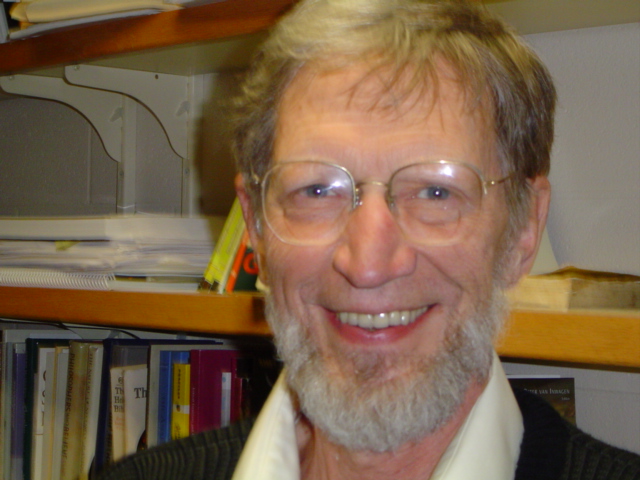
Christian philosopher Alvin Plantinga

Alvin Plantinga is widely regarded as the top Christian philosopher in the world, and a former head of the largest professional association of philosophers – the American Philosophical Association (APA).

 Mary sent me this article from the New York Times about Alvin Plantinga and his new book, published by Oxford University Press – the top academic press in the world.

Excerpt:

From Calvin [College], and later from the University of Notre Dame, Mr. Plantinga has led a movement of unapologetically Christian philosophers who, if they haven’t succeeded in persuading their still overwhelmingly unbelieving colleagues, have at least made theism philosophically respectable.

“There are vastly more Christian philosophers and vastly more visible or assertive Christian philosophy now than when I left graduate school,” Mr. Plantinga said in a recent telephone interview from his home in Grand Rapids, adding, with characteristic modesty, “I have no idea how it happened.”

Mr. Plantinga retired from full-time teaching last year, with more than a dozen books and a past presidency of the American Philosophical Association to his name. But he’s hardly resting on those laurels. Having made philosophy safe for theism, he’s now turning to a harder task: making theism safe for science.

For too long, Mr. Plantinga contends in a new book, theists have been on the defensive, merely rebutting the charge that their beliefs are irrational. It’s time for believers in the old-fashioned creator God of the Bible to go on the offensive, he argues, and he has some sports metaphors at the ready. (Not for nothing did he spend two decades at Notre Dame.)

In “Where the Conflict Really Lies: Science, Religion and Naturalism,” published last week by Oxford University Press, he unleashes a blitz of densely reasoned argument against “the touchdown twins of current academic atheism,” the zoologist Richard Dawkins and the philosopher Daniel C. Dennett, spiced up with some trash talk of his own.

[…] Longtime readers of Mr. Plantinga, who was raised as a Presbyterian and who embraced the Calvinism of the Christian Reformed Church as a young man, are used to such invocations of theological concepts. And even philosophers who reject his theism say his arguments for the basic rationality of belief, laid out in books like “Warranted Christian Belief” and “God and Other Minds,” constitute an important contribution that every student of epistemology would be expected to know.

But Mr. Plantinga’s steadfast defense of the biochemist and intelligent-design advocate Michael Behe, the subject of a long chapter in the new book, is apparently another matter.

“I think deep down inside he really isn’t a friend of science,” Michael Ruse, a philosopher of science at Florida State University, said of Mr. Plantinga. “I’m not objecting to him wanting to defend theism. But I think he gets his victory at the level of gelding or significantly altering modern science in unacceptable ways.”

Mr. Dennett was even harsher, calling Mr. Plantinga “Exhibit A of how religious beliefs can damage or hinder or disable a philosopher,” not to mention a poor student of biology. Evolution is a random, unguided process, he said, and Mr. Plantinga’s effort to leave room for divine intervention is simply wishful thinking.

“It’s just become more and more transparent that he’s an apologist more than a serious, straight-ahead philosopher,” Mr. Dennett said.

When Mr. Plantinga and Mr. Dennett (who said he has not read Mr. Plantinga’s new book) faced off over these questions before a standing-room-only crowd at a 2009 meeting of the American Philosophical Association, the event prompted ardent online debate over who had landed better punches, or simply been more condescending. (A transcript of the proceedings was published last year as “Science and Religion: Are They Compatible?”)

Mr. Plantinga, who recalled the event as “polite but not cordial,” allowed that he didn’t think much of Mr. Dennett’s line of reasoning. “He didn’t want to argue,” Mr. Plantinga said. “It was more like he wanted to make assertions and tell stories.”

Would you like to know how well Daniel Dennett can debate the naturalism/theism dispute? First of all, Plantinga has debated Dennett, and you can find the audio for it at Apologetics 315.

William Lane Craig also presented several arguments against naturalism to Daniel Dennett in 2007, and Dennett responded by calling it a “first-rate piece of philosophical reasoning”. I link to the exchange and complain about Dennett’s weak response to Craig’s arguments in a previous post.

You may also find this recent interview with Alvin Plantinga, conducted by Brian Auten, informative.

The resurgence of Christian theism in analytical philosophy

Now let’s move from the specific to the aggregate. What is going on with these Christian philosophers?

Well, you can read an excellent article about the resurgence of Christian theism in philosophy departments in the peer-reviewed philosophy journal Philo, which, in my opinion, is the best journal for atheists and agnostic philosophers. The article is authored by the well-known atheist Quentin Smith.

He writes:

THE DESECULARIZATION OF ACADEMIA THAT EVOLVED IN PHILOSOPHY DEPARTMENTS SINCE THE LATE 1960s

By the second half of the twentieth century, universities and colleges had been become in the main secularized. The standard (if not exceptionless) position in each field, from physics to psychology, assumed or involved arguments for a naturalist world-view; departments of theology or religion aimed to understand the meaning and origins of religious writings, not to develop arguments against naturalism. Analytic philosophers (in the mainstream of analytic philosophy) treated theism as an antirealist or non-cognitivist world-view, requiring the reality, not of a deity, but merely of emotive expressions or certain “forms of life” (of course there were a few exceptions, e.g., Ewing, Ross, Hartshorne, etc., but I am discussing the mainstream view).

[…]The secularization of mainstream academia began to quickly unravel upon the publication of Plantinga’s influential book on realist theism, God and Other Minds, in 1967. It became apparent to the philosophical profession that this book displayed that realist theists were not outmatched by naturalists in terms of the most valued standards of analytic philosophy: conceptual precision, rigor of argumentation, technical erudition, and an in-depth defense of an original world-view. This book, followed seven years later by Plantinga’s even more impressive book, The Nature of Necessity, made it manifest that a realist theist was writing at the highest qualitative level of analytic philosophy, on the same playing field as Carnap, Russell, Moore, Grünbaum, and other naturalists. Realist theists, whom hitherto had segregated their academic lives from their private lives, increasingly came to believe (and came to be increasingly accepted or respected for believing) that arguing for realist theism in scholarly publications could no longer be justifiably regarded as engaging in an “academically unrespectable” scholarly pursuit.

Naturalists passively watched as realist versions of theism, most influenced by Plantinga’s writings, began to sweep through the philosophical community, until today perhaps one-quarter or one-third of philosophy professors are theists, with most being orthodox Christians. Although many theists do not work in the area of the philosophy of religion, so many of them do work in this area that there are now over five philosophy journals devoted to theism or the philosophy of religion, such as Faith and Philosophy, Religious Studies, International Journal of the Philosophy of Religion, Sophia, Philosophia Christi, etc. Philosophia Christi began in the late 1990s and already is overflowing with submissions from leading philosophers. Can you imagine a sizeable portion of the articles in contemporary physics journals suddenly presenting arguments that space and time are God’s sensorium (Newton’s view) or biology journals becoming filled with theories defending élan vital or a guiding intelligence? Of course, some professors in these other, non-philosophical, fields are theists; for example, a recent study indicated that seven percent of the top scientists are theists.1 However, theists in other fields tend to compartmentalize their theistic beliefs from their scholarly work; they rarely assume and never argue for theism in their scholarly work. If they did, they would be committing academic suicide or, more exactly, their articles would quickly be rejected, requiring them to write secular articles if they wanted to be published. If a scientist did argue for theism in professional academic journals, such as Michael Behe in biology, the arguments are not published in scholarly journals in his field (e.g., biology), but in philosophy journals (e.g., Philosophy of Science and Philo, in Behe’s case). But in philosophy, it became, almost overnight, “academically respectable” to argue for theism, making philosophy a favored field of entry for the most intelligent and talented theists entering academia today. A count would show that in Oxford University Press’ 2000–2001 catalogue, there are 96 recently published books on the philosophy of religion (94 advancing theism and 2 presenting “both sides”). By contrast, there are 28 books in this catalogue on the philosophy of language, 23 on epistemology (including religious epistemology, such as Plantinga’s Warranted Christian Belief), 14 on metaphysics, 61 books on the philosophy of mind, and 51 books on the philosophy of science.

And how have naturalist philosophers reacted to what some committed naturalists might consider as “the embarrassment” of belonging to the only academic field that has allowed itself to lose the secularization it once had? Some naturalists wish to leave the field, considering themselves as no longer doing “philosophy of mind,” for example, but instead “cognitive science.” But the great majority of naturalist philosophers react by publicly ignoring the increasing desecularizing of philosophy (while privately disparaging theism, without really knowing anything about contemporary analytic philosophy of religion) and proceeding to work in their own area of specialization as if theism, the view of approximately one-quarter or one-third of their field, did not exist. (The numbers “one-quarter” and “one-third” are not the result of any poll, but rather are the exceptionless, educated guesses of every atheist and theist philosophy professor I have asked [the answers varied between “one-quarter” and “one-third”]). Quickly, naturalists found themselves a mere bare majority, with many of the leading thinkers in the various disciplines of philosophy, ranging from philosophy of science (e.g., Van Fraassen) to epistemology (e.g., Moser), being theists. The predicament of naturalist philosophers is not just due to the influx of talented theists, but is due to the lack of counter-activity of naturalist philosophers themselves. God is not “dead” in academia; he returned to life in the late 1960s and is now alive and well in his last academic stronghold, philosophy departments.

Quentin Smith is a good friend of William Lane Craig, who is a philosopher/theologian and the top Christian defender in the world, and probably of all time. Smith is the co-author, with William Lane Craig, of the book “Theism, Atheism, and Big Bang Cosmology“, also published by Oxford University Press. Craig and Smith debated at Harvard University in 2003, and I transcribed the debate for posterity. If some of you are looking for a way to help promote Christian apologetics, you should pick a debate that hasn’t been transcribed and transcribe it. A lot of people read these debate transcripts. I had them printed out in my binder when I was an undergraduate student, in case my professors got boring! I like a good fight.

On a lighter note, my office plant is named Alvin Plantinga. It was grown in water and then given to me by an atheist with whom I work. We discuss these interesting topics over lunch every few months. And so should you. Why not send the New York Times article and the Philo article to an atheist in your office and get the conversation started? There’s enough in this post alone to help you sound like Alvin Plantinga!