
Tag Archives: Youth

In California, students protest the results of their own liberal voting

Victor Davis Hanson writes about it National Review.

Excerpt:

Here in California, students just marched on Sacramento in outrage that state-subsidized tuition at the UC and CSU campuses keeps climbing. It is true that per-unit tuition costs are rising, despite even greater exploitation of poorly paid part-time teachers and graduate-student TAs. But the protests are sort of surreal. The California legislature is overwhelmingly Democratic. The governor is a Democrat. The faculties and administrative classes are largely Democratic. Who then, in the students’ minds, have established these supposedly unfair budget priorities?

Sales, income, and gas taxes are still among the highest in the nation (and are proposed to rise even higher) — prompting one of the largest out-of-state exoduses of upper-income brackets in the nation. The state budget is pretty much entirely committed to K–12 education (whose state-by-state comparative test scores in math and science hover between 45th and 49th in the nation), prisons, social services, and public-employee salaries and pensions. Whom, then, can the students be angry at?

Are students angry at public-union salaries and pensions that are among the highest in the nation? Do they think the many highly compensated retired Highway patrol officers have shorted students at UC Davis? Are they mad at the 50,000 illegal aliens in the California prison system that might have siphoned off scholarship funds from CSU Monterey Bay? Or is the rub the influx of hundreds of thousands of children of illegal aliens who require all sorts of language remediation and extra instruction in the public schools, and so might in theory divert library funds from UC Santa Cruz?

Perhaps the students don’t want billions to be committed to high-speed rail that might rob Berkeley of needed funding, or environmental efforts to introduce salmon into the San Joaquin River, in which the $70 million spent so far in studies and surveys might have come from nearby CSU Fresno? Are they mad at state social services, whose medical expenses have skyrocketed to address the health-care needs of millions of illegal aliens, and thus in theory could curb the choice of classes at CSU Stanislaus? Are they angry that some $10–15 billion a year probably leaves the state as remittances to Mexico?

If one cannot blame the wealthy for “not paying their fair share” (the top 1 percent of Californians now pay about 37 percent of all income-tax revenue — and their numbers have decreased by one-third in recent years, as the state has come to rely on the income tax for half its revenue), or Republican majorities in government, who, then, is left to blame?

Not only are their tuition costs going UP but their likely salary is going DOWN.
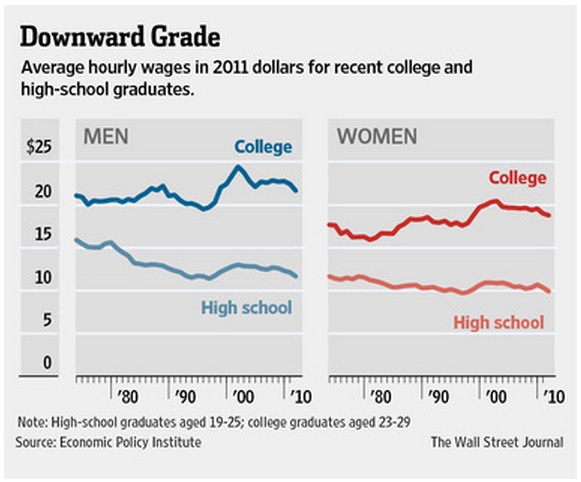
Students majoring in booze and hook-up sex
How's that hopey-changey stuff workin' for ya?

I got that image from a post at the American Enterprise Institute.

Excerpt:

  • Only 35 percent of students starting a four-year degree program will graduate within four years, and less than 60 percent will graduate within six years.
  • The U.S. college dropout rate is about 40 percent, the highest college dropout rate in the industrialized world.
  • Over the past 25 years, the total number of students in college has increased by about 50 percent. But the number of students graduating with degrees in STEM subjects has remained more or less constant.
  • In 2009, the United States graduated 37,994 students with bachelor’s degrees in computer and information science. That’s not bad, but we graduated more students with computer-science degrees 25 years ago!
  • Few disciplines have changed as much in recent years as microbiology, but in 2009 we graduated just 2,480 students with bachelor’s degrees in microbiology—about the same number as 25 years ago. Who will solve the problem of antibiotic resistance?
  • If students aren’t studying science, technology, engineering, and math, what are they studying?
  • In 2009, the United States graduated 89,140 students in the visual and performing arts, more than in computer science, math, and chemical engineering combined and more than double the number of visual-and-performing-arts graduates in 1985.
  • Moreover, more than half of all humanities graduates end up in jobs that don’t require college degrees, and those graduates don’t get a big income boost from having gone to college.

I think this is interesting. What exactly are these students paying for?

If there is one thing I learned from my love of Shakespeare, it’s that it is tragic to be the cause of your own downfall because of your own tragic flaw. Right now, there are a bunch of young people who have been totally brainwashed by the unionized public school teachers and professors to have views on economics that are completely opposite to what works in the real world. They keep voting for bigger and bigger government, which creates more and more debt in order to provide their parents with bigger and bigger benefits. They have lots of self-esteem, but very few marketable skills. Eventually, the bill for all the government spending on “helping the poor”, (e.g. – food stamps for millionaires and bailouts for bankrupt green energy firms), comes due, and it’s the students who will be paying the bill. I wonder if they will look as favorably on socialism and global warming alarmism then?

UPDATE: I noticed that in Quebec, the most liberal province in Canada, students are doing the same thing.

Europe’s socialist debt crisis: who suffers most? Can bailouts fix it?

This is the most popular article on Investors Business Daily right now.

Excerpt:

Rational or not, Greece’s street riots and emigration rates signify one thing: Socialism offers very little to the young. So why is the EU’s $172 billion bailout geared toward saving so much of the failed socialist system?

As Europe prepares to deliver a historic $172 billion bailout to Greece in a deal announced Monday, it’s pretty much a given that the austerity conditions required, in the absence of a true free market, will hit youth hardest. Athens will be trashed by another youth rampage, as many youths blame the pain on something other than Greece’s deeply rooted socialism.

A bigger effect will come from Greeks who do recognize reality. They won’t riot. They’ll leave, voting with their feet just as Eastern Europe’s youth once did.

The young in both cases are victims of socialism, which claims to make people equal but, in reality, penalizes the young. For Greece, a country already gutted by a below-replacement birth rate and an aging population, that’s a disaster.

It’s not just Greece, but also every EU state with institutionalized socialism — where high government spending seeks to create a warm blanket insulating everyone from risk, but instead has led to bankruptcy.

[…]One out of five jobs in Greece is held by a bureaucrat, which is why unemployment among the under-24s runs at 42%. A 2010 poll shows that seven out of 10 Greek college graduates seek to leave.

Some 9% of Greek college graduates and at least 51% of Greece’s Ph.D.s are already gone, according to University of Macedonia demographer Lois Lambrianidis.

What jobs there are come from the bottom of a two-tier labor system that shields older workers in Greece’s rigid labor market. Young Greeks earn a 500-and-change euro monthly minimum wage as older workers doing the same work make 700.

In contrast, immigrant-magnet Australia holds packed job fairs at its Athens embassy. In 2011, it took in 249,000 immigrants. In 2012, a 20% rise is expected.

[…]Meanwhile, Spain’s EFE News reports that the Spanish Embassy in Santiago, Chile, has seen a 10% rise in registered nationals to 48,000, while Chile reports a 25% rise in work permits issued to Spanish citizens.

It’s not just jobs that are penalizing Europe’s young. Housing is stacked against youth, too. Eurostat reports that in 2008, 46% of young European adults ages 18-34 lived with their parents — 51 million people.

The two-tier job market, which leans heavily toward unstable contract employment, affects housing choices for the young. Other socialist measures designed to protect current owners against the market also shut out the young.

Perhaps most hostile of all to youth are the EU’s outdated state pension systems — which force the young to pay the pensions of the old as the population shrinks.

In Italy, 14% of all economic output goes to pensions. It’s no coincidence that states attracting Europe’s young, like Chile and Australia, have privatized their social security systems that give youth a real shot at building personal wealth and a credible pension through their own efforts, instead of political favoritism.

This is the direction that the United States is also headed in. What I find mystifying is why young people in the United States are voting for these policies. Young people here have a higher rate of unemployment, and they ought to know that all of these entitlement programs won’t be there for them when they retire. What possible reason could they have for voting for more and more government control?

Why are youth rioting in the UK’s socialist welfare state?

If the UK is so secular and socialist, then why are young people rioting? Don’t young people like secularism and socialism? I thought that the enlightened Labour Party would have fixed all the problems of society with their progressive fiscal and social policies over the last decade.

This National Post article explains what the rioting youth said of their exploits.

Excerpt:

It is the joy on display that is so unsettling.

People who are protesting are by nature angry, or at least solemn. They have upraised fists and homemade signs.

But young Britons haven’t even bothered to come up with a slogan or a decent chant. They are blissfully happy as they destroy other people’s property. They are without guilt.

It can be seen in the images of giddy youths hauling flat-screen televisions out of plundered shops. It can be read in the reports where, as one witness described, a young woman looted so many sweaters from a high-end London store she tottered under their weight.

And it can be heard, starkly, in the conversation between a BBC Radio reporter and two women in Croydon who were, at 9: 30 a.m. Tuesday, drinking from a bottle of stolen rosé and talking about their night of adventure.

“Everyone was chucking things, chucking bottles, breaking into stuff,” one said.

“It was good, though; it was madness,” her friend chimed in, giggling about the craziness of it all. The first girl agreed, it was “good fun.”

The reporter asked if they had been drinking all night. “Free alcohol,” one said. Then she caught herself. “It’s the government’s fault, though. The Conservatives. It’s not even a riot. It’s showing the police we can do what we want.”

The reporter gamely tried to crack through the cognitive dissonance she was hearing. These are local people whose shops are being torched, she said. “Why are you targeting your own people?”

“It’s the rich people,” came the explanation. “It’s the people who have all got businesses. That’s why all this is happening, because of the rich people.”

Tell that to the kid, captured on video, who was sitting on the ground with a bleeding nose when someone came to his aid. He was helped up, then had his backpack emptied.

Tell that to the shop owners whose only asset was their inventory and who have lost it all to self-centred, marauding thugs. If only they had known they were “rich,” they might have taken time to enjoy their vast wealth. Instead of, you know, working.

[…]They have convinced themselves someone else is to blame, even if they identify a different culprit in consecutive breaths, and therefore they are off to pillage, loot and burn. If homes are lost to the fires? Blame the rich. Or the police. They started it all, you see.

Does that view sound familiar? Why yes – it’s the view of mainstream Democrats, including Obama and his allies in the news media.

And here’s an article that Mary and Dina sent to me explaining where these amoral children came from.

Excerpt:

An underclass has existed throughout history, which once endured appalling privation. Its spasmodic outbreaks of violence, especially in the early 19th century, frightened the ruling classes.

Its frustrations and passions were kept at bay by force and draconian legal sanctions, foremost among them capital punishment and transportation to the colonies.

Today, those at the bottom of society behave no better than their forebears, but the welfare state has relieved them from hunger and real want.

When social surveys speak of “deprivation” and “poverty”, this is entirely relative. Meanwhile, sanctions for wrongdoing have largely vanished.

[…]But it will not do for a moment to claim the rioters’ behaviour reflects deprived circumstances or police persecution.

Of course it is true that few have jobs, learn anything useful at school, live in decent homes, eat meals at regular hours or feel loyalty to anything beyond their local gang.

This is not, however, because they are victims of mistreatment or neglect.

It is because it is fantastically hard to help such people, young or old, without imposing a measure of compulsion which modern society finds unacceptable. These kids are what they are because nobody makes them be anything different or better.

A key factor in delinquency is lack of effective sanctions to deter it. From an early stage, feral children discover that they can bully fellow pupils at school, shout abuse at people in the streets, urinate outside pubs, hurl litter from car windows, play car radios at deafening volumes, and, indeed, commit casual assaults with only a negligible prospect of facing rebuke, far less retribution.

Anyone who reproaches a child, far less an adult, for discarding rubbish, making a racket, committing vandalism or driving unsociably will receive in return a torrent of obscenities, if not violence.

So who is to blame? The breakdown of families, the pernicious promotion of single motherhood as a desirable state, the decline of domestic life so that even shared meals are a rarity, have all contributed importantly to the condition of the young underclass.

The social engineering industry unites to claim that the conventional template of family life is no longer valid.

[…]This has ultimately been sanctioned by Parliament, which refuses to accept, for instance, that children are more likely to prosper with two parents than with one, and that the dependency culture is a tragedy for those who receive something for nothing.

The judiciary colludes with social services and infinitely ingenious lawyers to assert the primacy of the rights of the criminal and aggressor over those of law-abiding citizens, especially if a young offender is involved.

The police, in recent years, have developed a reputation for ignoring yobbery and bullying, or even for taking the yobs’ side against complainants.

“The problem,” said Bill Pitt, the former head of Manchester’s Nuisance Strategy Unit, “is that the law appears to be there to protect the rights of the perpetrator, and does not support the victim.”

Police regularly arrest householders who are deemed to have taken “disproportionate” action to protect themselves and their property from burglars or intruders. The message goes out that criminals have little to fear from “the feds”.

Figures published earlier this month show that a majority of “lesser” crimes – which include burglary and car theft, and which cause acute distress to their victims – are never investigated, because forces think it so unlikely they will catch the perpetrators.

[…]A teacher, Francis Gilbert, wrote five years ago in his book Yob Nation: “The public feels it no longer has the right to interfere.”

Discussing the difficulties of imposing sanctions for misbehaviour or idleness at school, he described the case of a girl pupil he scolded for missing all her homework deadlines.

The youngster’s mother, a social worker, telephoned him and said: “Threatening to throw my daughter off the A-level course because she hasn’t done some work is tantamount to psychological abuse, and there is legislation which prevents these sorts of threats.

“I believe you are trying to harm my child’s mental well-being, and may well take steps… if you are not careful.”

That story rings horribly true. It reflects a society in which teachers have been deprived of their traditional right to arbitrate pupils’ behaviour. Denied power, most find it hard to sustain respect, never mind control.

I think that last example explains the root of the problem.

Here’s the chain of causation. First, people get annoyed with the talk of moral values and moral duties that comes from religious people. They don’t want anyone telling them to set boundaries on their pursuit of pleasure.

Agnostic evolutionist Aldous Huxley explains:

I had motive for not wanting the world to have a meaning; consequently I assumed that it had none, and was able without any difficulty to find satisfying reasons for this assumption. The philosopher who finds no meaning in the world is not concerned exclusively with a problem in pure metaphysics, he is also concerned to prove that there is no valid reason why he personally should not do as he wants to do, or why his friends should not seize political power and govern in the way that they find most advantageous to themselves … For myself, the philosophy of meaninglessness was essentially an instrument of liberation, sexual and political.

The secular left government is only too happy to push this philosophy of meaninglessness in the public schools. It makes the secular left elites feel good when they undermine the moral standard that religious people use when making judgments. Judgments are bad because they make bad people feel bad about behaving badly. Judgments have to go. And if religion is the ground for moral judgments, then religion has to go. And the public schools can be used to make sure that it does go.

This new view of morality is called “moral relativism”, and it is the official view of the secular left. Basically, if there is no designer of the universe, then there is no way we ought to be. If there is no way we ought to be, then no one has a right to tell anyone how they ought to be. This is the view that the Labour Party enshrined into law, using all the power of the public schools and the state-run media. The position of the secular left is that making people feel bad by judging them is the only real evil left in the world. Just let people do whatever they want, they say – we can always tax the rich and the corporations more to make everyone come out equal in the end.

You may have noticed that my post about Theodore Dalrymple’s book “Life at the Bottom” is back in the top 10 popular posts today. Check out the post – it has links to all the chapters of a free book that explains exactly what the rioters believe, and why. The thesis of the book is that the secular left elites deliberately cause the poor to avoid taking responsibility for their actions, and to prevent anyone from holding them accountable for their own choices. It’s a must-read.