Tag Archives: Young People

1 in 2 new graduates are jobless or underemployed

From CNS News.

Excerpt:

 The college class of 2012 is in for a rude welcome to the world of work.

A weak labor market already has left half of young college graduates either jobless or underemployed in positions that don’t fully use their skills and knowledge.

Young adults with bachelor’s degrees are increasingly scraping by in lower-wage jobs — waiter or waitress, bartender, retail clerk or receptionist, for example — and that’s confounding their hopes a degree would pay off despite higher tuition and mounting student loans.

An analysis of government data conducted for The Associated Press lays bare the highly uneven prospects for holders of bachelor’s degrees.

Opportunities for college graduates vary widely.

While there’s strong demand in science, education and health fields, arts and humanities flounder. Median wages for those with bachelor’s degrees are down from 2000, hit by technological changes that are eliminating midlevel jobs such as bank tellers. Most future job openings are projected to be in lower-skilled positions such as home health aides, who can provide personalized attention as the U.S. population ages.

Taking underemployment into consideration, the job prospects for bachelor’s degree holders fell last year to the lowest level in more than a decade.

[…]You can make more money on average if you go to college, but it’s not true for everybody,” says Harvard economist Richard Freeman, noting the growing risk of a debt bubble with total U.S. student loan debt surpassing $1 trillion. “If you’re not sure what you’re going to be doing, it probably bodes well to take some job, if you can get one, and get a sense first of what you want from college.”

Andrew Sum, director of the Center for Labor Market Studies at Northeastern University who analyzed the numbers, said many people with a bachelor’s degree face a double whammy of rising tuition and poor job outcomes. “Simply put, we’re failing kids coming out of college,” he said, emphasizing that when it comes to jobs, a college major can make all the difference. “We’re going to need a lot better job growth and connections to the labor market, otherwise college debt will grow.”

That bit about getting a job so you know what you need to study. It’s important to get a job – any job – so that you understand what you are supposed to be learning in high school and college – what employers want! The next most important thing is to have a career mentor – someone to steer you away from subjects like English and ballet and into engineering and science. A trade school is another good choice: nursing or electrical wiring or something like that. Something valuable that employers need – that should be the deciding factor – what employers want you to do for them. Here’s a page listing degrees and expected incomes. Engineering, medicine and computer science are the three best fields.

I am still trying to puzzle out why young people vote for Democrats so much. I think that they have been brainwashed to think that making moral judgments is wrong, so they keep voting against Republicans who pro-life, pro-marriage, pro-family and pro-personal responsibility. That’s what teachers tell them in school – don’t have any moral standards, don’t make any moral judgments, let the government spend your money for you to be more “fair”, etc. So young people vote for Democrats. But voting for Democrats doesn’t just weaken the social fabric, it also wrecks the economy. Who do young people expect to work for when they keep voting to bash corporations all the time? Corporations hire young people. It seems stupid to vote against the people who want to pay you to do work.

Now that I think about it, it might be a good idea for social conservatives to be ready to make a case for free market capitalism and limited government, using evidence like this that shows how socialism fails to create economic growth and jobs. Even if people vote for conservatism based on fiscal concerns or foreign policy concerns, it’s still going to be helpful to social conservatives. We need to be like Paul and be able to speak intelligently to any audience on a wider variety of topics. Also, I think it helps social conservatives to be seen as competent in areas outside of social conservatism – it’s important to have a well-rounded worldview in order to not be perceived as being narrow-minded and ideologically motivated.
How Obama’s plan to raise the minimum wage will hurt young black men

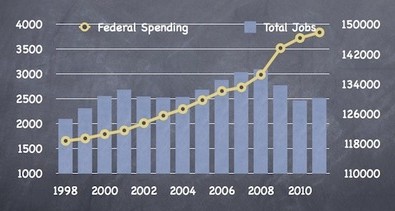
Government Spending Vs Jobs

From Investors Business Daily.

Excerpt:

How amusing to watch Democrats wring their hands over what they can do to get businesses to create jobs, when one of the biggest job killers is the minimum wage they keep hiking.

Recall that it was Democrats who raised the federal wage floor a whopping $2.10 an hour in the middle of the recession. The record 41% increase has led to record unemployment among young people, especially black teens.

Congress started ratcheting up the minimum wage from $5.15 an hour in mid-2007, arguing it would help abate poverty. But retailers looking to slash costs eliminated low-skilled, entry-level jobs rather than pay the mandated increases.

Now 1.5 million fewer teens are working. Last year’s unemployment rate for workers ages 16 to 19 shot up to 26% from 2007’s 15%.

As for black teens, their joblessness soared to a record 43% after the final raise to $7.25 took effect in mid-2009. It helped put more than half of young black men out of work — a first.

The president proposes cranking the minimum wage even higher to $9.50. Then he wants to raise it every year thereafter as a “living wage” indexed to inflation.

Yes, this is the problem that happens when you elect someone who knows nothing whatsoever about economics. And when I say nothing, I mean he is in disagreement with virtually all economists across the ideological spectrum.

Moderate economist Gregory Mankiw of Harvard University lists the policies that are accepted by virtually all economists.

Here’s Greg’s list, together with the percentage of economists who agree:

  1. A ceiling on rents reduces the quantity and quality of housing available. (93%)
  2. Tariffs and import quotas usually reduce general economic welfare. (93%)
  3. Flexible and floating exchange rates offer an effective international monetary arrangement. (90%)
  4. Fiscal policy (e.g., tax cut and/or government expenditure increase) has a significant stimulative impact on a less than fully employed economy. (90%)
  5. The United States should not restrict employers from outsourcing work to foreign countries. (90%)
  6. The United States should eliminate agricultural subsidies. (85%)
  7. Local and state governments should eliminate subsidies to professional sports franchises. (85%)
  8. If the federal budget is to be balanced, it should be done over the business cycle rather than yearly. (85%)
  9. The gap between Social Security funds and expenditures will become unsustainably large within the next fifty years if current policies remain unchanged. (85%)
  10. Cash payments increase the welfare of recipients to a greater degree than do transfers-in-kind of equal cash value. (84%)
  11. A large federal budget deficit has an adverse effect on the economy. (83%)
  12. A minimum wage increases unemployment among young and unskilled workers. (79%)
  13. The government should restructure the welfare system along the lines of a “negative income tax.” (79%)
  14. Effluent taxes and marketable pollution permits represent a better approach to pollution control than imposition of pollution ceilings. (78%)

From CNBC, we get this article showing that any increase in the minimum wage will raise the unemployment rate for young people.

Excerpt:

A quarter of teenagers were jobless in March, representing a surprising increase from February, even as the unemployment rate for the rest of the population decreased.

This figure may only get worse if budget-strapped states raise the minimum wage, and it could also be a sign of greater structural damage underlying our economy, analysts said.

The unemployment rate for 16- to 19-year olds jumped back up to 24.5 percent in March, up from 23.9 percent the prior month, according to the latest jobs data from the Labor Department.

[…]“Even when comprehending that teen employment is volatile in nature, the data that exists serves up some shock and awe,” said Brian Sozzi, a retail research analyst with Wall Street Strategies, in a note Wednesday. “If these (wage) increases do go through, the prospect for teen employment will remain grim as employers search for workers with advanced skills to fill positions.”

Twelve states, including Illinois and Pennsylvania, are considering a hike in the minimum wage. While this has been the subject of a long-running debate, many economists and analysts say raising this pay bar may cause more teen layoffs, even as it helps teens who manage to stay employed make more.

“Minimum wage increases over the past few years has definitely made it worse,” said Peter Boockvar, chief equities strategist at Miller Tabak. “In fact, there should be zero minimum wage for teenagers, or at most, something much less than the current rate.”

Teens typically are the first to be fired and the last to be hired back in a normal economic cycle, so this rate can be considered a kind of leading indicator of employment.

A new study shows that only 25% of teens will be able to find jobs this summer. And Obama thinks that this number is apparently too high. He wants to lower it by raising the price that must be paid by employers who would like to hire younger workers.

You can find out more about how raising the minimum wage increases unemployment from this comprehensive, 50-year, government study.

Excerpt:

Summary of Research on the Minimum Wage

* The minimum wage reduces employment.

Currie and Fallick (1993), Gallasch (1975), Gardner (1981), Peterson (1957), Peterson and Stewart (1969).

* The minimum wage reduces employment more among teenagers than adults.

Adie (1973); Brown, Gilroy and Kohen (1981a, 1981b); Fleisher (1981); Hammermesh (1982); Meyer and Wise (1981, 1983a); Minimum Wage Study Commission (1981); Neumark and Wascher (1992); Ragan (1977); Vandenbrink (1987); Welch (1974, 1978); Welch and Cunningham (1978).

* The minimum wage reduces employment most among black teenage males.

Al-Salam, Quester, and Welch (1981), Iden (1980), Mincer (1976), Moore (1971), Ragan (1977), Williams (1977a, 1977b).

* The minimum wage helped South African whites at the expense of blacks.

Bauer (1959).

* The minimum wage hurts blacks generally.

Behrman, Sickles and Taubman (1983); Linneman (1982).

* The minimum wage hurts the unskilled.

Krumm (1981).

* The minimum wage hurts low wage workers.

Brozen (1962), Cox and Oaxaca (1986), Gordon (1981).

* The minimum wage hurts low wage workers particularly during cyclical downturns.

Kosters and Welch (1972), Welch (1974).

* The minimum wage reduces average earnings of young workers.Meyer and Wise (1983b).

* The minimum wage reduces employment in low-wage industries, such as retailing.Cotterman (1981), Douty (1960), Fleisher (1981), Hammermesh (1981), Peterson (1981).

* The minimum wage causes employers to cut back on training.Hashimoto (1981, 1982), Leighton and Mincer (1981), Ragan (1981).

* The minimum wage encourages employers to install labor-saving devices.Trapani and Moroney (1981).

* The minimum wage increases the number of people on welfare.Brandon (1995), Leffler (1978).

* The minimum wage hurts the poor generally.

Stigler (1946).

* The minimum wage does little to reduce poverty.

Bonilla (1992), Brown (1988), Johnson and Browning (1983), Kohen and Gilroy (1981), Parsons (1980), Smith and Vavrichek (1987).

* The minimum wage helps unions.Linneman (1982), Cox and Oaxaca (1982).

* The minimum wage increases teenage crime rates.Hashimoto (1987), Phillips (1981).

* The minimum wage encourages employers to hire illegal aliens.

Beranek (1982).

* Few workers are permanently stuck at the minimum wage.

Brozen (1969), Smith and Vavrichek (1992).

* The minimum wage has reduced employment in foreign countries.Canada: Forrest (1982); Chile: Corbo (1981); Costa Rica: Gregory (1981); France: Rosa (1981).

This is why it is important for voters to understand economics. When you raise the price of labor, fewer employers will purchase labor. Supply and demand.

New study finds that young people value marriage and hope to marry

From the National Post. (H/T Andrew)

Excerpt:

Young adults still tend to view marriage as an important life commitment to which they aspire, results of a new U.S. study suggest.

The findings appear to contradict public and academic anxiety over the state of marriage, and surprised even the researchers.

“What was so striking about what the young people said is that no one really described rejecting marriage,” said lead author Maria Kefalas, a sociology professor at Saint Joseph’s University in Philadelphia. “I had a category all written -marriage rejector -and we couldn’t find any. There was no one who said, ‘Marriage is meaningless and I don’t want to get married.’ ”

The researchers uncovered a divide between rural and urban young adults after examining interviews with 424 people aged 21 to 38 who lived in New York, San Diego and Minneapolis/St. Paul or rural Iowa.

Young adults in small towns and rural areas -dubbed “marriage naturalists” -generally have a 1950s view toward marriage, they found, seeing it as the inevitable “next step” in a long-term relationship.

“It was like a time capsule,” Ms. Kefalas said. “Marriage was expected. It wasn’t fretted about, there was very little hand-wringing about it. A lot of the pressure for marriage was external in terms of social expectation that that’s what you do.”

In contrast, urban young adults -dubbed “marriage planners” by the researchers -had high standards for potential marriage partners and a strong sense that marriage was something they had to be “ready for.”

[…]Ms. Kefalas said she believes declining marriage rates in Canada and the United States are due to a shifting economic landscape that makes it more difficult for young adults in the Millennial cohort born in the 1980s and 1990s to get the education, career, housing and general stability they feel they need before saying “I do” -not a lack of interest in the institution itself.

“One of the great myths has been that young people, in particular millennials, are saying, ‘We don’t want to get mar-ried and marriage is irrelevant to us,’ and that’s not true,” Ms. Kefalas said.

The paper is to be published in the Journal of Family Issues.

I think the problem I see, and this is something for Christians to research, and for churches to get serious about – is that we need to help young people to translate these aspirations to marry into a solid plan for how to get married well. That means telling them how to prepare themselves to be married, how to find and evaluate another person for marriage, and how to court another person in a way that will result in a stable, loving marriage. Young people need to understand things that social scientists know – like the fact that chastity is good for marital stability, and that cohabitation is bad for marital stability. We need to study these factors and then inform the young people in winsome ways.