The glasses don’t make you any smarter, Tim T-Bonehead
UPDATE: Report from TMZ says they never dated, but that Tebow did “show interest” in her, and so this post still works somewhat.
Everyone likes to pick on me because they say that I always blame women for their poor choices, when everything is really the fault of men. Well, that’s not true. I love to blame men when it really is the man’s fault. And we have a case now where it really IS the man’s fault, and you’ll never guess how all the Christian feminists are responding to me blaming the man.
Let’s see the story, first, which is very important. It’s from the UK Daily Mail.
It says:
Tim Tebow has made a vow to stay chaste until marriage.
But it seems as if Olivia Culpo just couldn’t wait.
The 23-year-old former Miss Universe has broken up with the hunky 28-year-old former professional American footballer due to his choice to stay abstinent according to a recent report.
Two points about this.
First, it’s very improbable (but not impossible) that a Miss Universe is going to have Christian character enough to step into the roles of Christian wife and Christian mother. If her entire life is spent traveling around, putting on make-up and prancing up and down a stage, that’s not going break her narcissistic, emotional spirit enough for her to orient herself in a Christian direction. Newsflash, T-Bonehead: just because a woman claims to be a Christian doesn’t make her a Christian.
Second, if you want to marry a real Christian women, I recommend looking for women whose lives show a consistent, multi-year record of studying apologetics and engaging for conservative causes in the public square. And again, it’s just safer to prefer women with STEM degrees. Women with STEM degrees have the emotivism and narcissism drummed out of them. STEM graduates know that no amount of intuition and wishing will make a program compile and run and generate correct output.
The general point here is that men are stupid – especially when they are young and don’t realize how important it is for them to choose wisely, when it comes to a bride. They imagine that because a woman is good looking, that must mean that she has a good Christian worldview – a worldview that includes a commitment to studying apologetics, and integrating Christianity with economics, politics, etc. Guess what, stupid men? Unless she has read people like Lee Strobel and J. Warner Wallace, she doesn’t know whether her Christian faith is true or not. Unless she has read people like Thomas Sowell and Jay Richards, she has no idea how her Christian faith integrates with economics or politics. Unless she has read people like Scott Klusendorf and Ryan Anderson, she isn’t really pro-life or pro-marriage – not beyond the level of feelings, she is not.You can’t sing your way to a Christian worldview, Te-Beau. Somebody needs to hand T-Bonehead my list of courting questions. I can guarantee you that Miss Universe would not be able to answer any of them.
Pretty girls are always used to getting attention from men for free, they never have to do anything they don’t feel like doing – and that is the exact opposite of what you need in a wife and mother of your children. Women who are less focused on their appearance actually have to care about helping and supporting a man in his plan to change the world with his marriage and family. So, they busy themselves before marriage getting STEM degrees, staying chaste, working with kids to practice, stay out of debt, building up a nest egg, and trying to make the society as Christian-friendly as possible through apologetics, activism, charity and political activism. She wants the world to be a safe place for a man to marry and raise a family in, and she wants to communicate to him through her serious decision-making that she will be a help to him, and not a loose cannon on deck.
Now I was going to tell you what all my good female friends on Facebook said, and here it is: all but one of them split the blame between Tebow and his girlfriend. They actually thought she was to blame in part!!!! That’s ridiculous. Only one of them thought that he was entirely to blame and she is probably the smartest one. It goes without saying that she is studying computer science.
There is no shortcut to an effective Christian woman who takes the Bible seriously when making decisions about things like chastity. A marriage-minded man has to check her worldview and past actions, just like you check an job applicant’s education and resume. Nobody hires a candidate to do a job based on attractiveness – not if the job is important. The job of a woman is not to make you feel good or to impress your friends with her looks. The job of a woman is wife and mother, and that is just as dependent on education and resume as any other job. If a man is serious about getting a partner who will help help to actually accomplish something for God, he needs to do his thinking with his mind, not with his eyes.
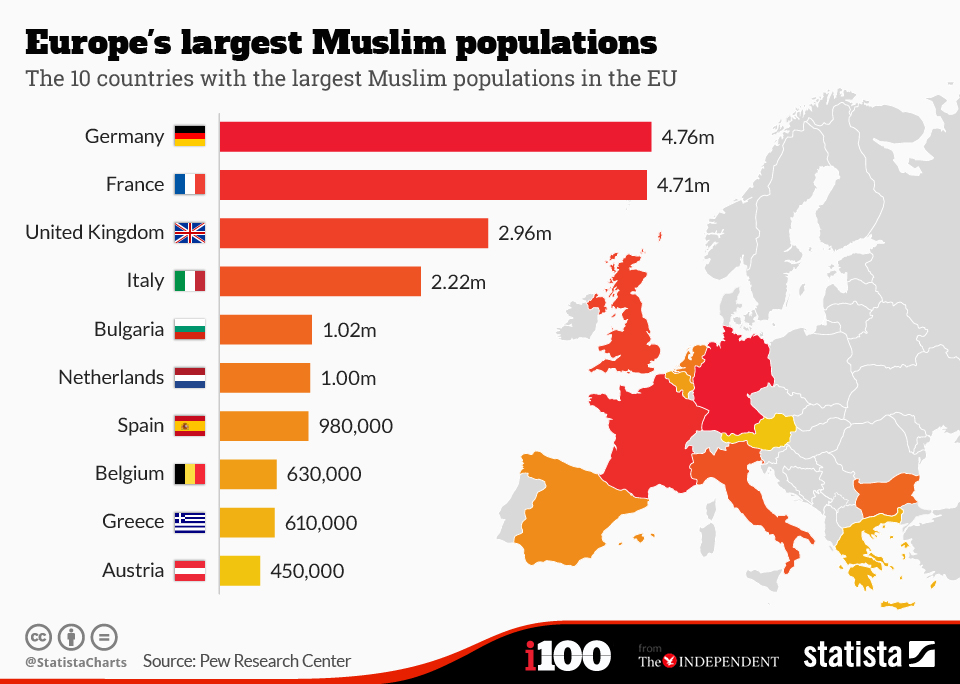
Normally, when people ask me about this question, I go straight to the 2013 Pew Research survey which I blogged about before. But now I have something even better.
Here’s a post from Ben Shapiro at Breitbart News which looks at several polls from several different countries.
Shapiro writes: (links to polls removed)
So, here is the evidence that the enemy we face is not a “tiny minority” of Muslims, let alone a rootless philosophy unconnected to Islam entirely. It’s not just the thousands of westerners now attempting to join ISIS. It’s millions of Muslims who support their general goals, even if they don’t support the group itself.
France. A new, widely-covered poll shows that a full 16% of French people have positive attitudes toward ISIS. That includes 27% of French between the ages of 18-24. Anne-Elizabeth Moutet of Newsweek wrote, “This is the ideology of young French Muslims from immigrant backgrounds…these are the same people who torch synagogues.”
Britain. In 2006, a poll for the Sunday Telegraph found that 40% of British Muslims wanted shariah law in the United Kingdom, and that 20% backed the 7/7 bombers.Another poll from that year showed that 45% of British Muslims said that 9/11 was an American/Israeli conspiracy; that poll showed that one-quarter of British Muslims believed that the 7/7 bombings were justified.
Palestinian Areas. A poll in 2011 showed that 32% of Palestinians supported the brutal murder of five Israeli family members, including a three-month-old baby. In 2009, a poll showed that 78% of Palestinians had positive or mixed feelings about Osama Bin Laden. A 2013 poll showed 40% of Palestinians supporting suicide bombings and attacks against civilians. 89% favored sharia law. Currently, 89% of Palestinians support terror attacks on Israel.
Pakistan. After the killing of Osama Bin Laden, the Gilani Foundation did a poll of Pakistanis and found that 51% of them grieved for the terrorist mastermind, with 44% of them stating that he was a martyr. In 2009, 26% of Pakistanis approved of attacks on US troops in Iraq. That number was 29% for troops in Afghanistan. Overall, 76% of Pakistanis wanted strict shariah law in every Islamic country.
Morocco. A 2009 poll showed that 68% of Moroccans approved of terrorist attacks on US troops in Iraq; 61% backed attacks on American troops in Afghanistan as of 2006. 76% said they wanted strict sharia law in every Islamic country.
Jordan. 72% of Jordanians backed terror attacks against US troops in Iraq as of 2009. In 2010, the terrorist group Hezbollah had a 55% approval rating; Hamas had a 60% approval rating.
Indonesia: In 2009, a poll demonstrated that 26% of Indonesians approved of attacks on US troops in Iraq; 22% backed attacks on American troops in Afghanistan. 65% said they agreed with Al Qaeda on pushing US troops out of the Middle East. 49% said they supported strict sharia law in every Islamic country. 70% of Indonesians blamed 9/11 on the United States, Israel, someone else, or didn’t know. Just 30% said Al Qaeda was responsible.
Egypt. As of 2009, 87% of Egyptians said they agreed with the goals of Al Qaeda in forcing the US to withdraw forces from the Middle East. 65% said they wanted strict sharia law in every Islamic country. As of that same date, 69% of Egyptians said they had either positive or mixed feelings about Osama Bin Laden. In 2010, 95% of Egyptians said it was good that Islam is playing a major role in politics.
United States. A 2013 poll from Pew showed that 13% of American Muslims said that violence against civilians is often, sometimes or rarely justified to defend Islam. A 2011 poll from Pew showed that 21 percent of Muslims are concerned about extremism among Muslim Americans. 19 percent of American Muslims as of 2011 said they were either favorable toward Al Qaeda or didn’t know.
In short, tens of millions of Muslims all over the world sympathize with the goals or tactics of terrorist groups – or both. That support is stronger outside the West, but it is present even in the West. Islamist extremism is not a passing or fading phenomenon – it is shockingly consistent over time. And the West’s attempts to brush off the ideology of fanaticism has been an overwhelming failure.
A more recent poll says that 13% of Syrian refugees support Islamic State:
A first-of-its-kind survey of the hordes of Syrian refugees entering Europe found 13% support the Islamic State. The poll should raise alarms about the risks posed by the resettlement of 10,000 refugees in the U.S.
The poll of 900 Syrian refugees by the Arab Center for Research and Policy Studies also found that another 10% of the displaced Syrians have a lukewarm, but not entirely negative, view of the terror group. That means 23% — or almost 1 in 4 — could be susceptible to ISIS recruitment.
It also means as many 2,500 of the 10,000 Syrian refugees that the Obama administration is resettling inside American cities are potential terrorist threats.
Now contrast those facts with the views of Barack Obama and his allies in the mainstream media.
President Obama told CNN’s Fareed Zakaria that 99.9 percent of Muslims reject radical Islam. He made the comments in response to a question about the White House avoiding using the phrase “Islamic terrorists.”
“You know, I think that the way to understand this is there is an element growing out of Muslim communities in certain parts of the world that have perverted the religion, have embraced a nihilistic, violent, almost medieval interpretation of Islam, and they’re doing damage in a lot of countries around the world,” said Obama.
“But it is absolutely true that I reject a notion that somehow that creates a religious war because the overwhelming majority of Muslims reject that interpretation of Islam. They don’t even recognize it as being Islam, and I think that for us to be successful in fighting this scourge, it’s very important for us to align ourselves with the 99.9 percent of Muslims who are looking for the same thing we’re looking for–order, peace, prosperity.”
So Obama denies all of these surveys, and instead invents a view of the world that is consistent with his feelings. A true man of the secular left.
This gap between belief and reality explains why he is now bringing 200,000 Syrian Muslim refugees into America, keeping Syrian Christian refugees out of America, and generally underestimating Islamic State (ISIS / ISIL) because he cannot believe that radical Islam is anything for us to be concerned about.
Is the government capable of vetting Syrian refugees to find threats?
The administration argues that it’s conducting interviews with Syrians at camps in Turkey, Jordan and Lebanon. But without security forces on the ground in Syria who can verify details, there is no way to back-check a refugee’s story to see if he is telling the truth and is, in fact, not a security threat.
Even when we had people on the ground in Iraq to screen refugees, terrorists got through the safety net.
In 2011, for instance, two Kentucky immigrants who had been resettled as Iraqi refugees were busted for trying to buy stinger missiles for al-Qaida.
It turned out that their fingerprints matched those linked to roadside bombs in Iraq. It was a major red flag that should have barred their entry, but U.S. screeners failed to take note. And the terrorists slipped into the U.S.
The administration’s vetting process for the massive influx of Syrian refugees is completely unreliable, admits the FBI official in charge of such security background checks.
“It’s not even close to being under control,” warned assistant FBI director Michael Steinbach.
We should not be believing the man who promised us that we could keep our doctor, keep our health plans, and that our health insurance premiums would go down $2,500. He is either lying, or he likes to speak on matters where he is not competent to know the truth of the matter.
Note: I am re-posting a series of five Bible studies this week that I wrote last year. Every 2 PM post Monday to Friday this week will be a Bible study.
1 Paul and Timothy, bond-servants of Christ Jesus, To all the saints in Christ Jesus who are in Philippi, including the overseers and deacons:
2 Grace to you and peace from God our Father and the Lord Jesus Christ.
3 I thank my God in all my remembrance of you,
4 always offering prayer with joy in my every prayer for you all,
5 in view of your participation in the gospel from the first day until now.
6 For I am confident of this very thing, that He who began a good work in you will perfect it until the day of Christ Jesus.
7 For it is only right for me to feel this way about you all, because I have you in my heart, since both in my imprisonment and in the defense and confirmation of the gospel, you all are partakers of grace with me.
8 For God is my witness, how I long for you all with the affection of Christ Jesus.
9 And this I pray, that your love may abound still more and more in real knowledge and all discernment,
10 so that you may approve the things that are excellent, in order to be sincere and blameless until the day of Christ;
11 having been filled with the fruit of righteousness which comes through Jesus Christ, to the glory and praise of God.
Now just read that and reflect on how passionate, and even unstable and emotional Paul sounds about this love he has for this church. Ask yourself this: what is the basis for these feelings? Read it again, and write your answer down. I’ll tell you mine in a minute.
Now here is D. A. Carson.
He writes:
As often in his letters, Paul begins with a warm expression of thanks to God for something in the lives of his readers. Here the grounds of his thanksgiving to God are three in number, though all three are tied to the same theme.
The first is their faithful memory of him. The NIV reads, “I thank my God every time I remember you” (1: 3). But others suggest “I thank my God every time you remember me,” or something similar. The original is ambiguous. For reasons I shall not go into, I think Paul is referring to their remembrance of him. Later on he will thank the Philippians for remembering him so warmly that they sent funds to support him in his ministry. But here the vision is broader: he perceives that their interest in him is a reflection of their continued commitment to the gospel, and that is why he thanks God for them.
The point becomes explicit in the second cause of his thanksgiving: “In all my prayers for all of you, I always pray with joy because of your partnership in the gospel from the first day until now . . .” (1: 4– 5). Their “partnership in the gospel” injects joy into Paul’s prayers of thanksgiving: “I always pray with joy,” he writes. The word rendered “partnership” is more commonly translated “fellowship” in the New Testament. What precisely does the word mean? In common use “fellowship” has become somewhat debased. If you invite a pagan neighbor to your home for a cup of tea, it is friendship; if you invite a Christian neighbor, it is fellowship. If you attend a meeting at church and leave as soon as it is over, you have participated in a service; if you stay for coffee afterward, you have enjoyed some fellowship. In modern use, then, fellowship has come to mean something like warm friendship with believers.
In the first century, however, the word commonly had commercial overtones. If John and Harry buy a boat and start a fishing business, they have entered into a fellowship, a partnership. Intriguingly, even in the New Testament the word is often tied to financial matters. Thus, when the Macedonian Christians send money to help the poor Christians in Jerusalem, they are entering into fellowship with them (Rom. 15: 26).
The heart of true fellowship is self-sacrificing conformity to a shared vision. Both John and Harry put their savings into the fishing boat. Now they share the vision that will put the fledgling company on its feet. Christian fellowship, then, is self-sacrificing conformity to the gospel. There may be overtones of warmth and intimacy, but the heart of the matter is this shared vision of what is of transcendent importance, a vision that calls forth our commitment. So when Paul gives thanks, with joy, because of the Philippians’ “partnership in the gospel” or “fellowship in the gospel,” he is thanking God that these brothers and sisters in Christ— from the moment of their conversion (“ from the first day until now,” Paul writes)— rolled up their sleeves and got involved in the advance of the gospel. They continued their witness in Philippi, they persevered in their prayers for Paul, they sent money to support him in his ministry— all testifying to their shared vision of the importance and priority of the gospel. That is more than enough reason for thanking God.
[..]Implicitly, such an apostolic stance asks us what gives us our greatest joy. Is it personal success? Some victory for our children? Acquisition of material things? “I have no greater joy,” John writes, “than to hear that my children are walking in the truth.” Paul reflects exactly the same attitude. Paul adds, “It is right for me to feel this way about all of you, since I have you in my heart . . .” (Phil. 1: 7). Probably this was written against the background of Stoic influence that was cautious about whole-life commitments, especially if they involved the “passions.” Be cool; do not be vulnerable; do not get hurt. But that was not Paul’s way. “It is right for me to feel this way about all of you,” Paul insists, regardless of what the contemporary culture says. “I have you in my heart”: my whole life and thought are bound up with you.
More:
So strongly does he want the Philippians to recognize his devotion to them that Paul puts himself under an oath: “God can testify how I long for all of you with the affection of Christ Jesus” (1: 8). The significance of the oath is not that without it he might lie. Rather, he puts himself under an oath so that the Philippians might feel the passion of his truthfulness, in exactly the same way that God puts himself under an oath in the Epistle to the Hebrews. There the point is not that otherwise God might lie, but that God wants to be believed (Heb. 7: 20– 25). So Paul: God is my witness “how I long for all of you with the affection of Christ Jesus.”
Here is no mere professionalism. Nor is this an act, a bit of showmanship to “turn them on” to the apostle. Rather, it is something that repeatedly bubbles through Paul’s arguments. It recurs, for example, in chapter 4: “Therefore, my brothers, you whom I love and long for, my joy and crown, that is how you should stand firm in the Lord, dear friends!” (4: 1).
Both from Paul’s example and from that of the Philippians, then, we must learn this first point: the fellowship of the gospel, the partnership of the gospel, must be put at the center of our relationships with other believers. That is the burden of these opening verses. Paul does not commend them for the fine times they had shared watching games in the arena. He doesn’t mention their literature discussion groups or the excellent meals they had, although undoubtedly they had enjoyed some fine times together. What lies at the center of all his ties with them, doubtless including meals and discussion, is this passion for the gospel, this partnership in the gospel.
What ties us together? What do we talk about when we meet, even after a church service? Mere civilities? The weather? Sports? Our careers and our children? Our aches and pains? None of these topics should be excluded from the conversation of Christians, of course. In sharing all of life, these things will inevitably come up. But what must tie us together as Christians is this passion for the gospel, this fellowship in the gospel. On the face of it, nothing else is strong enough to hold together the extraordinary diversity of people who constitute many churches: men and women, young and old, blue collar and white, healthy and ill, fit and flabby, different races, different incomes, different levels of education, different personalities. What holds us together? It is the gospel, the good news that in Jesus, God himself has reconciled us to himself. This brings about a precious God-centeredness that we share with other believers.
Does what Carson writes make you think of the Lord of the Rings book 1? (“The Fellowship of the Ring”) It sounds like Christians are supposed to band together in common purpose in order to complete a quest. They are not supposed to just be hanging out to pass the time. There is planning. There is cooperation. There is danger. There is achievement. There is adventure. I think that he loves the church in Philippi because they have entered into this fellowship of the gospel with him.
More:
Already in verse 4 Paul has insisted that whenever he prays for the Philippians, he does so with joy and thanksgiving. Now he gives us the content of his prayers for them: “And this is my prayer: that your love may abound more and more in knowledge and depth of insight, so that you may be able to discern what is best and may be pure and blameless until the day of Christ, filled with the fruit of righteousness that comes through Jesus Christ— to the glory and praise of God” (1: 9– 11).
[…]Second, what Paul has in mind is not mere sentimentalism or the rush of pleasure spawned, for example, by a large conference. “I pray,” Paul writes, “that your love may abound more and more in knowledge and depth of insight.” The kind of love that Paul has in mind is the love that becomes more knowledgeable. Of course, Paul is not thinking of just any kind of knowledge. He is not hoping they will learn more and more about nuclear physics or sea turtles. He has in mind the knowledge of God; he wants them to enjoy insight into God’s words and ways, and thus to know how to live in light of them.
[…]Third, for Paul this prayer has a further end in view. He lifts these petitions to God, he tells the Philippians, “so that you may be able to discern what is best and may be pure and blameless until the day of Christ” (1: 10). Clearly, Paul does not want the Philippian believers to be satisfied with mediocrity. He cannot be satisfied, in a fallen world, with the status quo. He wants these believers to move on, to become more and more discerning, proving in their own experience “what is best.” He wants them to pursue what is best in the knowledge of God, what is best in their relationships with other believers, what is best in joyful obedience. For ultimately what he wants from them is perfection: he prays that they “may be pure and blameless until the day of Christ.”
Now for my thoughts.
I want all of you reading this to do one thing for me. I want you to completely abandon the criteria you are currently using for who you will be friends with and adopt Paul’s criteria. I want you to put your gospel-related activities at the center of your life. Do not neglect your other practical duties like making money and saving money and so on, but when it comes to your passion, where you take risks, where your long-term goals are – I want you to put the gospel at the center. And I do not mean mere proclamation of simple statements, I mean apologetics and Christian worldview – including politics, economics, etc.
Now, that’s not my main point. My main point is that I further want you to stop choosing who you will associate with based on worldly criteria. I want you to think about the people around you who are the most willing to put the gospel first and I want you to take up those people as friends. I want you to talk to them, to share with them, to encourage them, to confide in them, to listen to their confessions and to generally love them in the traditional ways that Christians love, e.g. – 1 Corinthians 13:1-13. You need to fellowship with them – invest in their enterprises, and let them invest in yours, too. This is real love according to the Bible.
We need to stop looking at other people on the surface level – age, skin color, wealth, clothes, etc. – and start to dig deeper underneath to find out where each person stands with respect to the gospel of Jesus Christ. Our criteria should not be present ability. We should choose those with desire, intensity, and willingness to learn hard things. The first person you should invest in is the person who wants to learn to defend their faith to non-Christians using the best available evidence. If that person can demonstrate their desire to do grow in knowledge and depth of insight, you should be spending your time, money and effort with that person first.


 WINTERY KNIGHT