
Tag Archives: Work

Harvard economist says stimulus was designed to reward Democrat constituencies

EVERYONE  PLEASE GO VOTE TODAY! (NOVEMBER 2nd, 2010)

Hans Bader at the Competitive Enterprise Institute comments on a new published paper by Harvard economist Jeffrey Miron, which explains why the stimulus failed to stimulate the economy and to create more jobs.

The paper is here. (PDF)

Excerpt:

Harvard economist Jeffrey Miron explains why the $800 billion stimulus package failed in a recent article.

What’s interesting about Dr. Miron’s critique is that he shows how the stimulus was a failure even if you take for granted liberal assumptions about economic policy (such as Keynesian economic theory), since it was so badly designed and executed that it failed to achieve its goals, spending wastefully while failing to revive the economy.  Indeed, the stimulus was so poorly tailored to the economy (and the goal of reducing unemployment) that Miron concludes that it was designed to reward politically connected “constituencies” and special-interest groups, like public-employee unions, rather than being focused on ”economic stimulus.”

Other Harvard economics professors like Robert Barro have also criticized the stimulus package. Barro called it “the worst bill that has been put forward since the 1930s.”  Former Obama economic advisor Martin Feldstein, a Harvard professor who is a big believer in stimulus packages in principle, said that the stimulus designed by Obama and congressional Democrats was “poorly done

Much stimulus money has been wasted.  It has gone to prisoners and dead people, wasteful welfare spending, abandoned bridges to nowhere, and unnecessary government buildings.  The stimulus subsidized foreign green jobs and wiped out jobs in America’s export sector.

The “’stimulus’ is not the road to economic recovery. It’s the problem, not the solution, writes Nobel Prize winning economist Vernon L. Smith.” Other Nobel Laureates like Gary Becker have also criticized the stimulus package.  200 economists signed a statement publicly opposing the stimulus package in an ad published in the Washington Post and New York Times.

So the stimulus bill was a failure because it was not designed to grow the economy or create jobs.

What was the real purpose of the stimulus bill?

George Mason University professor Veronique de Rugy looked at recovery.org and found that Democrat districts got more stimulus money than Republican districts.

Here’s the first chart:
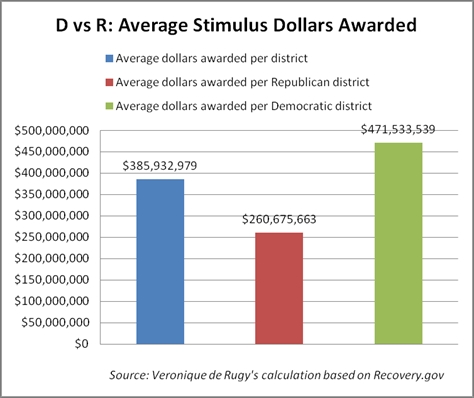
Stimulus spending by voting district affiliation

She writes:

…based on my new analysis of the Recovery.org data, Democratic districts are getting 1.8 times more money on average than Republican districts. Using Recovery.gov data, and cleaning it up seriously to be able to use it, we find that Republican districts are getting on average $260.6 million in stimulus awards while democratic districts are getting on average $471.5 million. The average is award per district is $385.9 million.

Interestingly, my data also confirms that the stimulus funds are not allocated based on unemployment rates or even variations in unemployment rates. So basically,  if the administration believes that government spending can create jobs, the allocation of the funds doesn’t show it.

And here’s the second chart showing which government departments got stimulus money.

Stimulus spending by government department
Stimulus spending by government agency

She writes:

Based on the Recovery.gov data, more than two third of the 594,754.3 jobs “created or saved” with the stimulus funds were “created or saved” in the Department of Education (see chart).  Basically, what the administration meant by shovel ready projects was funding for your next door teacher.

[…]A third of all union jobs are in Education

33 percent of the education industry is unionized

The union boss, Andy Stern, was appointed to be on the president’s debt commission.

The stimulus bill was never about stimulating the economy. It was about rewarding Democrat special interest groups. Remember, people who disagree with Obama are his “enemies”. And that means he isn’t there to govern for all the people equally. He’s there to reward his people. With Your Money.

Mary Eberstadt’s book “Home Alone America”

I thought I would write quickly about Mary Eberstadt’s book “Home Alone America”, which I read a few years back.

Here’s an article from National Review by Stanley Kurtz.

Excerpt:

Up until now, public discussion of issues like day care has been dominated by feminist journalists and academics who take their own career decisions for granted and call on society to make their lives easier: How can I be equal to a man if society won’t give me better day care? Eberstadt strides into this situation and asks a totally different series of questions: Are children any happier in day care than they are with their mothers? If not, should that effect a woman’s career decisions? Are unhappy children who bite and get aggressive or ill in day care growing tougher, stronger, and more ruggedly individualist, or is it we adults who are being coarsened to needs of our children?

[…]Increasingly, we’re medicating children for mental illnesses that barely existed in the past. Take “separation anxiety disorder” (SAD), defined as “developmentally inappropriate and excessive anxiety concerning separation from home or from those to whom the individual is attached.” This syndrome is now said to affect about 10 percent of the nation’s children. One of its symptoms is “refusal to attend classes or difficulty remaining in school for an entire day” — in other words, what used to be called “truancy.”

Are 10 percent of the nation’s children really in need of treatment for SAD, or are most of these children actually behaving more normally than mothers who have little trouble parting from their children for most of the day? Is it surprising that children get SAD in the absence of their parents? As Eberstadt suggests, maybe we need to define a whole new range of disorders: “There is no mental disorder…called, say, preoccupied parent disorder, to pathologize a mother or father too distracted to read Winnie the Pooh for the fourth time or to stay up on Saturday night waiting for a teenager to come home from the movies. Nor will one find divorced second-family father disorder, even though the latter might explain what we could call the ‘developmentally inappropriate’ behaviors of certain fathers, such as failure to pay child support or to show up for certain important events. There is also nothing…like separation non-anxiety disorder to pathologize parents who can separate for long stretches from their children without a pang.”

And here’s an article from National Review by Rich Lowry.

Excerpt:

Eberstadt writes: “Of reported cases of chlamydia in 2000, 74 percent occurred in persons age 15 to 24, and that number is judged to be ‘a substantial underestimate of the true incidence of chlamydia among young people,’ in the words of The Alan Guttmacher Institute. An estimated 11 percent of people age 15 to 24 are infected with genital herpes, and 33 percent of females in the same age group are thought to be infected with human papillomavirus (HPV). This age group is also thought to account for 60 percent of gonorrhea cases. … Of the 18.9 million new STD cases in the United States in 2000, about 9.1 million, or half, were found in people between the ages of 15 and 24.”

[…]Where are many of these kids having sex? In empty homes. A study in the journal Pediatrics of public-school kids found that 91 percent were having sex in a home setting — usually after school, when parents aren’t around. Absent parents are practically an invitation to early sexual initiation. According to Pediatrics, “Youths who were unsupervised for 30 or more hours per week were more likely to be sexually active compared with those who were unsupervised for 5 hours a week or less.”

[…]This is just the beginning of Eberstadt’s distressing catalog:

There has been a dramatic increase in ear infections, technically known as otitis media, in children. Eberstadt quotes a specialist: “Virtually every study ever done on the increase in otitis media has shown that day care is the most important difference.”

According to Eberstadt, “Practically every index of juvenile mental and emotional problems is rising.” Many of these maladies are linked to absent parents. A Department of Health and Human Services report found that “children in single-parent families are two to three times as likely as children in two-parent families to have emotional and behavioral problems.”

And so on.

A sample chapter is here.

If you’ve never thought about the effects of day care and parent-child separation, you should take a look. I thought that there were places in the book where the argumentation was a bit loose, and evidence was suspect or absent, but it is a good thing to get a different point of view on these issues. My concern is that parents will be all too ready to blame the suffering of the children on “mental problems” caused by “genetics” or “brain chemistry”, rather than give up their two-parents-working lifestyle, and the economic perks that it brings. Frankly, children are a pain, and some parents will prefer to have to deal with grown-ups at work instead of screaming babies at home. Somehow, they feel ashamed for having to take care of children – as if raising children is somehow useless work because the government doesn’t get any tax revenue from it. And the government might encourage parents to keep working even if the children are showing symptoms of anxiety, depression, etc.

Imagine how this works out in a single-payer system, e.g. – Canada. The government wants women to work, so they can get more tax money for taking over more of private businesses and redistributing wealth in more areas to make everyone “equal”. They raise taxes, and now more women must work instead of staying home. Children go into government-run day care centers funded by the government via tax money from working mothers. The day cares educate the children instead of the parents. What happens when the children develop mental problems or behavioral problems? Can the state-run medical system blame the government for forcing women to work? Of course not – the child is somehow to blame, and will have to be medicated. The parents believe this because they do not want to believe that their drive for more material possessions has caused their child any harm. It must be the brain chemicals that are to blame – not the intrusion of government and not the selfishness of the parents.

MUST-READ: Dr. Leon Kass on the end of courtship

This essay has 3 parts, and it was sent to me by ECM.

Part 1 of 3.

Excerpt:

The change most immediately devastating for wooing is probably the sexual revolution. For why would a man court a woman for marriage when she may be sexually enjoyed, and regularly, without it? Contrary to what the youth of the sixties believed, they were not the first to feel the power of sexual desire. Many, perhaps even most, men in earlier times avidly sought sexual pleasure prior to and outside of marriage. But they usually distinguished, as did the culture generally, between women one fooled around with and women one married, between a woman of easy virtue and a woman of virtue simply. Only respectable women were respected; one no more wanted a loose woman for one’s partner than for one’s mother.

The supreme virtue of the virtuous woman was modesty, a form of sexual self-control, manifested not only in chastity but in decorous dress and manner, speech and deed, and in reticence in the display of her well-banked affections. A virtue, as it were, made for courtship, it served simultaneously as a source of attraction and a spur to manly ardor, a guard against a woman’s own desires, as well as a defense against unworthy suitors. A fine woman understood that giving her body (in earlier times, even her kiss) meant giving her heart, which was too precious to be bestowed on anyone who would not prove himself worthy, at the very least by pledging himself in marriage to be her defender and lover forever.

Once female modesty became a first casualty of the sexual revolution, even women eager for marriage lost their greatest power to hold and to discipline their prospective mates. For it is a woman’s refusal of sexual importunings, coupled with hints or promises of later gratification, that is generally a necessary condition of transforming a man’s lust into love. Women also lost the capacity to discover their own genuine longings and best interests. For only by holding herself in reserve does a woman gain the distance and self-command needed to discern what and whom she truly wants and to insist that the ardent suitor measure up. While there has always been sex without love, easy and early sexual satisfaction makes love and real intimacy less, not more, likely — for both men and women. Everyone’s prospects for marriage were — are — sacrificed on the altar of pleasure now.

Part 2 of 3.

Excerpt:

The ubiquitous experience of divorce is also deadly for courtship and marriage. Some people try to argue, wishfully against the empirical evidence, that children of divorce will marry better than their parents because they know how important it is to choose well. But the deck is stacked against them. Not only are many of them frightened of marriage, in whose likely permanence they simply do not believe, but they are often maimed for love and intimacy. They have had no successful models to imitate; worse, their capacity for trust and love has been severely crippled by the betrayal of the primal trust all children naturally repose in their parents, to provide that durable, reliable, and absolutely trustworthy haven of permanent and unconditional love in an otherwise often unloving and undependable world. Countless students at the University of Chicago have told me and my wife that the divorce of their parents has been the most devastating and life-shaping event of their lives. They are conscious of the fact that they enter into relationships guardedly and tentatively; for good reason, they believe that they must always be looking out for number one. Accordingly, they feel little sense of devotion to another and, their own needs unmet, they are not generally eager for or partial to children. They are not good bets for promise keeping, and they haven’t enough margin for generous service. And many of the fatherless men are themselves unmanned for fatherhood, except in the purely biological sense. Even where they dream of meeting a true love, these children of divorce have a hard time finding, winning, and committing themselves to the right one.

[…]That the cause of courtship has been severely damaged by feminist ideology and attitudes goes almost without saying. Even leaving aside the radical attacks on traditional sex roles, on the worth of motherhood or the vanishing art of homemaking, and sometimes even on the whole male race, the reconception of all relations between the sexes as relations based on power is simply deadly for love. Anyone who has ever loved or been loved knows the difference between love and the will to power, no matter what the cynics say. But the cynical new theories, and the resulting push toward androgyny, surely inhibit the growth of love.

On the one side, there is a rise in female assertiveness and efforts at empowerment, with a consequent need to deny all womanly dependence and the kind of vulnerability that calls for the protection of strong and loving men, protection such men were once — and would still be — willing to provide. On the other side, we see the enfeeblement of men, who, contrary to the dominant ideology, are not likely to become better lovers, husbands, or fathers if they too become feminists or fellow-travelers. On the contrary, many men now cynically exploit women’s demands for equal power by letting them look after themselves — pay their own way, hold their own doors, fight their own battles, travel after dark by themselves. These ever so sensitive males will defend not a woman’s honor but her right to learn the manly art of self-defense. In the present climate, those increasingly rare men who are still inclined to be gentlemen must dissemble their generosity as submissiveness….

The problem is not woman’s desire for meaningful work. It is rather the ordering of one’s loves. Many women have managed to combine work and family; the difficulty is finally not work but careers, or, rather, careerism. Careerism, now an equal opportunity affliction, is surely no friend to love or marriage; and the careerist character of higher education is greater than ever. Women are under special pressures to prove they can be as dedicated to their work as men. Likewise, in the work place, they must do man’s work like a man, and for man’s pay and perquisites. Consequently, they are compelled to regard private life, and especially marriage, homemaking, and family, as lesser goods, to be pursued only by those lesser women who can aspire no higher than “baking cookies.” Besides, many women in such circumstances have nothing left to give, “no time to get involved.” And marriage, should it come for careerist women, is often compromised from the start, what with the difficulty of finding two worthy jobs in the same city, or commuter marriage, or the need to negotiate or get hired help for every domestic and familial task.

Besides these greater conflicts of time and energy, the economic independence of women, however welcome on other grounds, is itself not an asset for marital stability, as both the woman and the man can more readily contemplate leaving a marriage. Indeed, a woman’s earning power can become her own worst enemy when the children are born. Many professional women who would like to stay home with their new babies nonetheless work full-time. Tragically, some cling to their economic independence because they worry that their husbands will leave them for another woman before the children are grown. What are these women looking for in prospective husbands? Do their own career preoccupations obscure their own prospective maternal wishes and needs? Indeed, what understanding of marriage informed their decision to marry in the first place?

[…]This brings me to what is probably the deepest and most intractable obstacle to courtship and marriage: a set of cultural attitudes and sensibilities that obscure and even deny the fundamental difference between youth and adulthood. Marriage, especially when seen as the institution designed to provide for the next generation, is most definitely the business of adults, by which I mean, people who are serious about life, people who aspire to go outward and forward to embrace and to assume responsibility for the future. To be sure, most college graduates do go out, find jobs, and become self-supporting (though, astonishingly, a great many do return to live at home). But, though out of the nest, they don’t have a course to fly. They do not experience their lives as a trajectory, with an inner meaning partly given by the life cycle itself. The carefreeness and independence of youth they do not see as a stage on the way to maturity, in which they then take responsibility for the world and especially, as parents, for the new lives that will replace them. The necessities of aging and mortality are out of sight; few feel the call to serve a higher goal or some transcendent purpose.

The view of life as play has often characterized the young. But, remarkably, today this is not something regrettable, to be outgrown as soon as possible; for their narcissistic absorption in themselves and in immediate pleasures and present experiences, the young are not condemned but are even envied by many of their elders.

Part 3 of 3.

Kass used to be on the President’s bio-ethics council when Bush was the President and they had pro-lifers on the council.