
Tag Archives: William Lane Craig

The kalam cosmological argument defended in a peer-reviewed science journal

Christianity and the progress of science

Here’s the peer-reviewed article. It appears in a scientific journal focused on astrophysics.

Here’s the abstract:

Both cosmology and philosophy trace their roots to the wonder felt by the ancient Greeks as they contemplated the universe. The ultimate question remains why the universe exists rather than nothing. This question led Leibniz to postulate the existence of a metaphysically necessary being, which he identified as God. Leibniz’s critics, however, disputed this identification, claiming that the space-time universe itself may be the metaphysically necessary being. The discovery during this century that the universe began to exist, however, calls into question the universe’s status as metaphysically necessary, since any necessary being must be eternal in its existence. Although various cosmogonic models claiming to avert the beginning of the universe predicted by the standard model have been and continue to be offered, no model involving an eternal universe has proved as plausible as the standard model. Unless we are to assert that the universe simply sprang into being uncaused out of nothing, we are thus led to Leibniz’s conclusion. Several objections to inferring a supernatural cause of the origin of the universe are considered and found to be unsound.

The whole text of the article is posted online here.

Here’s an excerpt in which the author, Dr. William Lane Craig, explains the Big Bang cosmology:

The monumental significance of the Friedman-Lemaitre model lay in its historization of the universe. As one commentator has remarked, up to this time the idea of the expansion of the universe “was absolutely beyond comprehension. Throughout all of human history the universe was regarded as fixed and immutable and the idea that it might actually be changing was inconceivable.”{8} But if the Friedman-Lemaitre model were correct, the universe could no longer be adequately treated as a static entity existing, in effect, timelessly. Rather the universe has a history, and time will not be matter of indifference for our investigation of the cosmos. In 1929 Edwin Hubble’s measurements of the red-shift in the optical spectra of light from distant galaxies,{9} which was taken to indicate a universal recessional motion of the light sources in the line of sight, provided a dramatic verification of the Friedman-Lemaitre model. Incredibly, what Hubble had discovered was the isotropic expansion of the universe predicted by Friedman and Lemaitre. It marked a veritable turning point in the history of science. “Of all the great predictions that science has ever made over the centuries,” exclaims John Wheeler, “was there ever one greater than this, to predict, and predict correctly, and predict against all expectation a phenomenon so fantastic as the expansion of the universe?”{10}

As a GTR-based theory, the Friedman-Lemaitre model does not describe the expansion of the material content of the universe into a pre-existing, empty, Newtonian space, but rather the expansion of space itself. This has the astonishing implication that as one reverses the expansion and extrapolates back in time, space-time curvature becomes progressively greater until one finally arrives at a singular state at which space-time curvature becomes infinite. This state therefore constitutes an edge or boundary to space-time itself. P. C. W. Davies comments,

An initial cosmological singularity . . . forms a past temporal extremity to the universe. We cannot continue physical reasoning, or even the concept of spacetime, through such an extremity. . . . On this view the big bang represents the creation event; the creation not only of all the matter and energy in the universe, but also of spacetime itself.{11}

The popular expression “Big Bang,” originally a derisive term coined by Fred Hoyle to characterize the beginning of the universe predicted by the Friedman-Lemaitre model, is thus potentially misleading, since the expansion cannot be visualized from the outside (there being no “outside,” just as there is no “before” with respect to the Big Bang).{12}

The standard Big Bang model thus describes a universe which is not eternal in the past, but which came into being a finite time ago. Moreover,–and this deserves underscoring–the origin it posits is an absolute origin ex nihilo. For not only all matter and energy, but space and time themselves come into being at the initial cosmological singularity. As Barrow and Tipler emphasize, “At this singularity, space and time came into existence; literally nothing existed before the singularity, so, if the Universe originated at such a singularity, we would truly have a creation ex nihilo.“{13}

[…]On such a model the universe originates ex nihilo in the sense that at the initial singularity it is true that There is no earlier space-time point or it is false that Something existed prior to the singularity.

Every theist should be able to understand and defend this argument. It is a scientific refutation of materialism, and it is supported by six lines of scientific evidence – all of which emerged as science has progressed.

Scientific evidence:

  1. Einstein’s theory of general relativity (GTR)
  2. the red-shifting of light from distant galaxies implies an expanding universe
  3. the cosmic background radiation (which also disproves the oscillating model of the universe)
  4. the second law of thermodynamics applied to star formation theory
  5. hydrogen-helium abundance predictions
  6. radioactive element abundance predictions

Those are the scientific discoveries that have led us to the beginning of the universe, which support’s Dr. Craig’s argument.

This is the kind of evidence I expect all Christian theists to be using when discussing the question of whether God exists. Scientific evidence. When talking to non-Christians, we first need to show that we understand science, because science is a reliable and respected way of getting knowledge about the universe. Non-Christians do not accept the Bible, but they do accept science, so we begin evangelism with science. Science (experimental, testable, repeatable science) should set limits on what anyone can believe – including non-Christians, who might otherwise not be inclined to listen to Bible verses and theology. Important: it’s not a good idea to discuss the resurrection of Jesus with a person who does not accept the scientific evidence for a Creator of the universe.

A helpful short video:

The Big Bang is not compatible with atheism

According to the Secular Humanist Manifesto, atheism is committed to an eternally existing universe, (See the first item: “Religious humanists regard the universe as self-existing and not created.”). If something non-material brought all existing matter into being, that would be a supernatural cause, and atheists deny that anything supernatural exists. The standard Big Bang theory requires that all the matter in the universe come into being out of nothing. This falsifies eternal models of the universe, which are required by the atheistic worldview.
William Lane Craig’s secret weapon is his amazing wife Jan

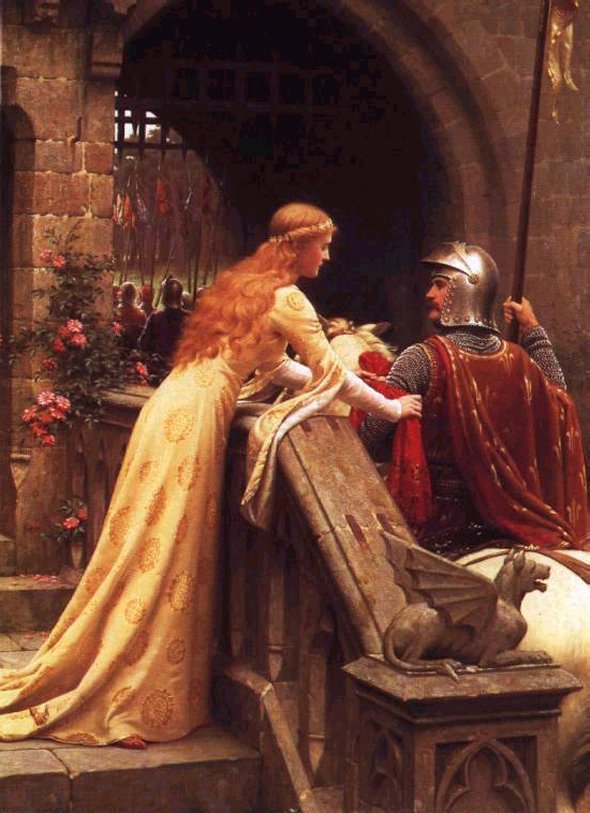
My favorite painting: "Godspeed" by Edmund Blair Leighton, 1900
My favorite painting: “Godspeed” by Edmund Blair Leighton, 1900

I’m re-posting this classic post because it was mentioned in the latest episode of the Reasonable Faith podcast.

I want to draw your attention to a talk on “Vision in Life” given by Dr. William Lane Craig. Dr. Craig is the ablest defender of the Christian faith operating today. He has done formal academic debates with all of the best known atheists on major university campuses in front of thousands of university students.

It turns out that he owes a lot of his success to his amazing wife Jan.

The MP3 file is here. (32 minutes)

This talk was Dr. Craig’s chapel address to Biola University students.

About 11 minutes into the talk, Bill describes what happened after he finished his Bachelor’s degree at Wheaton:

And so I joined the staff of Campus Crusade for Christ for 2 years, and was assigned to Northern Illinois University. And that was where I met my wife Jan. She was a graduate of the University of North Dakota where she had come to faith in Christ. And she had a similar vision for her life of evangelism and discipleship.

And as we worked at NIU together, she with gals and I with the guys, leading students to Christ and discipling them to walk with the Lord, we fell in love. And we decided that we would be more effective if we joined forces and became a team.

So their reason for getting together was because they thought that they would be more effective in evangelism and discipleship if they worked as a team.

It is at this point in the talk where Bill begins to explain just how Jan molded him into the lean, mean debating machine that travels the world striking terror into the hearts of atheists.

Bill’s first story about Jan occurs early after their marriage while he is working on his first Masters degree at Trinity:

And it was also at that time that I began to see what an invaluable asset the Lord had given me in Jan. I remember I came home from classes one day, and found her at the kitchen table with all the catalogs and schedules and papers spread out in front of her and she said, “look! I’ve figured out how you can get two Masters degrees at the same time that it would normally take to get one! All you have to do is take overloads every semester, go to all full-time summer school and do all these other things, and you can do two MAs in the time it takes to do one!”

And I thought, whoa! Are you sure you really want to make the commitment it takes to do this kind of thing? And she said, “Yeah! Go for it!” And it was then I began to see that God had given me a very special woman who was my supporter – my cheerleader – and who really believed in me. And as long as she believed in me, that gave me the confidence to dream bigger dreams, and to take on challenges that I had never thought of before.

In an article on his web site, he talks about how Jan encouraged him to do his first Ph.D:

As graduation from Trinity neared, Jan and I were sitting one evening at the supper table in our little campus apartment, talking about what to do after graduation. Neither of us had any clear leading or inclination of what we should do next.

So Jan said to me, “Well, if money were no object, what would you really like to do next?”

I replied, “If money were no object, what I’d really like to do is go to England and do a doctorate under John Hick.”

“Who’s he?” she asked.

“Oh, he’s this famous British philosopher who’s written extensively on arguments for the existence of God,” I explained. “If I could study with him, I could develop a cosmological argument for God’s existence.”

But it hardly seemed a realistic idea.

The next evening at supper Jan handed me a slip of paper with John Hick’s address on it. “I went to the library today and found out that he’s at the University of Birmingham in England,” she said. “Why don’t you write him a letter and ask him if you can do a doctoral thesis under him on the cosmological argument?”

What a woman! So I did, and to our amazement and delight Professor Hick wrote back saying he’d be very pleased to supervise my doctoral work on that subject. So it was an open door!

And in the same article, he explains how Jan encouraged him to get his second Ph.D:

As Jan and I neared the completion of my doctoral studies in Birmingham, our future path was again unclear to us. I had sent out a number of applications for teaching positions in philosophy at American universities but had received no bites. We didn’t know what to do.

I remember it like yesterday. We were sitting at the supper table in our little house outside Birmingham, and Jan suddenly said to me, “Well, if money were no object, what would you really like to do next?”

I laughed because I remembered how the Lord had used her question to guide us in the past. I had no trouble answering the question. “If money were no object, what I’d really like to do is go to Germany and study under Wolfhart Pannenberg.”

“Who’s he?”

“Oh, he’s this famous German theologian who’s defended the resurrection of Christ historically,” I explained. “If I could study with him, I could develop a historical apologetic for the resurrection of Jesus.”

Our conversation drifted to other subjects, but Jan later told me that my remark had just lit a fire under her. The next day while I was at the university, she slipped away to the library and began to research grants-in-aid for study at German universities. Most of the leads proved to be defunct or otherwise inapplicable to our situation. But there were two grants she found that were possibilities. You can imagine how surprised I was when she sprung them on me!

Both of these Ph.D experiences are also described in the talk. And the talk concludes as follows:

I am so thankful to be married to a woman who is tremendously resourceful, tremendously talented and energetic, who could have pursued an independent career in any number of areas, but instead, she has chose to wed her aspirations to mine, and to make it her goal to make me the most effective person I can be, for Christ. And she has been like my right arm in ministry over these many years. And it is a tremendous privilege to be a team with a person like that.

And you young men, I would encourage you, if you marry, to find a gal who shares your vision, not some independent vision, but who is interested in aligning herself with you, and pursuing together a common vision and goal that will draw you [together], so that you will avoid the growing separateness that so often creeps into marriages.

And now you know the rest of Bill’s story. The person you marry will have an enormous influence on the impact you will have for Christ and his Kingdom. It is up to you to decide whether that influence is going to be positive or negative, by deciding if you will marry, and if you do marry, by deciding whom you will marry.

You may also be interested in this talk given by William Lane Craig, entitled “Healthy Relationships” (National Faculty Leadership Conf. 2008) (audio here) In that talk, he offers advice to Christians who want to have a marriage that is consistent with their Christian faith.

William Lane Craig lectures on the moral argument at Georgia Tech

Making sense of the meaning of atheism

This video has 3 parts, as well as questions and answers in individual clips.

For those who cannot watch the video, you can read this essay by Dr. Craig which covers exactly the same ground as the video. The essay is for Christians already familiar with basic apologetics.

Part 1 of 3:

Part 2 of 3:

Part 2 of 3:

Here’s a quick couple of quotes from the essay for those who cannot watch:

If there is no God, then any ground for regarding the herd morality evolved by homo sapiens as objectively true seems to have been removed. After all, what is so special about human beings? They are just accidental by-products of nature which have evolved relatively recently on an infinitesimal speck of dust lost somewhere in a hostile and mindless universe and which are doomed to perish individually and collectively in a relatively short time. Some action, say, incest, may not be biologically or socially advantageous and so in the course of human evolution has become taboo; but there is on the atheistic view nothing really wrong about committing incest. If, as Kurtz states, “The moral principles that govern our behavior are rooted in habit and custom, feeling and fashion,”5 then the non-conformist who chooses to flout the herd morality is doing nothing more serious than acting unfashionably.

The objective worthlessness of human beings on a naturalistic world view is underscored by two implications of that world view: materialism and determinism. Naturalists are typically materialists or physicalists, who regard man as a purely animal organism. But if man has no immaterial aspect to his being (call it soul or mind or what have you), then he is not qualitatively different from other animal species. For him to regard human morality as objective is to fall into the trap of specie-ism. On a materialistic anthropology there is no reason to think that human beings are objectively more valuable than rats. Secondly, if there is no mind distinct from the brain, then everything we think and do is determined by the input of our five senses and our genetic make-up. There is no personal agent who freely decides to do something. But without freedom, none of our choices is morally significant. They are like the jerks of a puppet’s limbs, controlled by the strings of sensory input and physical constitution. And what moral value does a puppet or its movements have?

[…]Moreover, if atheism is true, there is no moral accountability for one’s actions. Even if there were objective moral values and duties under naturalism, they are irrelevant because there is no moral accountability. If life ends at the grave, it makes no difference whether one lives as a Stalin or as a saint. As the Russian writer Fyodor Dostoyevsky rightly said: “If there is no immortality, then all things are permitted.”

If you want a much shorter, slicker version of this argument to share, Reasonable Faith has produced this nice 5-minute video that you can tweet or share on your Facebook page or whatever:

The moral argument is the easiest argument in the world to discuss with non-Christians, as everyone has to have an answer to questions like “what makes humans valuable?” and “why should I do the right thing when it goes against my self-interest?” and “will evildoers who escape justice in this life be punished when they die?” and “do humans have free will to make moral choices?” These are interesting questions, and people can just give their opinion and then think about it as they discuss it.

You can read a debate transcript where Dr. Craig puts his ideas to the test, against Dr. Richard Taylor. I found this debate very helpful for answering the question that everyone should be able to answer: “why should I be moral?”
