
Tag Archives: Welfare

What working at Wal-Mart taught a young conservative woman about the poor

My friend Jose sent me this wonderful article from The College Conservative.

Excerpt:

During the 2010 and 2011 summers, I was a cashier at Wal-Mart #1788 in Scarborough, Maine. I spent hours upon hours toiling away at a register, scanning, bagging, and dealing with questionable clientele. These were all expected parts of the job, and I was okay with it. What I didn’t expect to be part of my job at Wal-Mart was to witness massive amounts of welfare fraud and abuse.

I understand that sometimes, people are destitute. They need help, and they accept help from the state in order to feed their families. This is fine. It happens. I’m not against temporary aid helping those who truly need it. What I saw at Wal-Mart, however, was not temporary aid. I witnessed generations of families all relying on the state to buy food and other items.  I literally witnessed mothers of small children asking their mothers if they could borrow their EBT cards. I once had a man show me his welfare card for an ID to buy alcohol. The man was from Massachusetts. Governor Michael Dukakis’ signature was on his welfare card. Dukakis’ last gubernatorial term ended in January of 1991. I was born in June of 1991. The man had been on welfare my entire life. That’s not how welfare was intended, but sadly, it is what it has become.

Here are just two short anecdotes:

a) People ignoring me on their iPhones while the state paid for their food. (For those of you keeping score at home, an iPhone is at least $200, and requires a data package of at least $25 a month. If a person can spend $25+ a month so they can watch YouTube 24/7, I don’t see why they can’t spend that money on food.)

d) A man who ran a hotdog stand on the pier in Portland, Maine used to come through my line. He would always discuss his hotdog stand and encourage me to “come visit him for lunch some day.” What would he buy? Hotdogs, buns, mustard, ketchup, etc. How would he pay for it? Food stamps. Either that man really likes hotdogs, or the state is paying for his business. Not okay.

I urge you with every fiber of my body to click through and read the true story of Welfare Queen #1 and Welfare Queen #2. Read them, and weep. Just because someone is poor, it doesn’t mean that they are automatically a good person. Maybe they are poor because they are irresponsible and selfish. Had you ever considered that? In any case, it’s not the government’s job to hand out money without knowing anything about the person who is getting the money. Government should leave the money in the hands of people who earn it, and let us decide who deserves to receive charity. (At the most, they should give us a tax deduction for charity up to 10% of our gross income to encourage more private charity)

But wait! There’s more!

From Human Events, toll workers being paid over $100,000 a year by the government.

Excerpt:

Ladies and gentlemen, meet Princesella Smith, who raked in $89,599 for operating the toll lanes at the George Washington Bridge in 2011.

Smith isn’t alone.  An investigation by the New York Post revealed that another toll booth operator pulled in a whopping $102,670 in 2011, $40K of that money coming in overtime.  In total, as the Post notes, there are at least 24 New York and New Jersey workers who have raked in more than $80,000 as “public” workers at a job that requires us to hand them even more of our money.

[…]Besides excessive wages to people whose only skill requirement is to sit on a stool and count and collect dollar bills, tax dollars reserved for transportation uses have gone to a panoply of nonessential programs.  As Ronald Utt of The Heritage Foundation points out, the “highway trust fund” has been raided to pay for Indian reservations, historic preservation sites, Appalachian and Mississippi Delta development, roadside beautification, bicycles, hiking paths, university research, and—the granddaddy of all expenses—feeding the $425 million beast that is the Department of Transportation.

The Port Authority (PA), for instance, employees a gardener for $94,000 and a blacksmith for $146,000 a year.  Heck, there are even retired PA employees who are making around that amount by cashing in on unused vacation and comp time.  (Here’s an idea:  As we’re facing budget deficits well into our future, how about requiring public employees to use their vaca time … or lose it.  No cashing in allowed.)

The larger problem highlighted with transportation spending, as Ronald Utt underscores, is the concept of public ownership.  A paltry 65% of highway taxes collected actually go to making driving a more pleasant experience for commuters.  The rest is squandered on whatever fancies a politician’s spending appetite at a given moment.  As the number of people driving has increased on the nation’s roads and highways (up 71% since 1970), lawmakers in Washington, D.C., and around the country have funneled money to stupid bike lines and high-speed rail debacles.

If I were President, I would immediately cancel all pensions for retired public sector workers and outlaw public sector unions.  What a colossal waste of money.

UPDATE: John Hawkins just posted a column entitled “The Five Things You Can Learn From Wal-Mart“.
Should Christians support social justice? Is wealth redistribution good for the poor?

Discovery Institute fellow Jonathan Witt pens this article in the American Spectator on the Gospel, business and social justice.

Excerpt:

The third term, social justice, is unlike the other two in its having a justifiable raison d’être. It stretches back to 19th century Catholic social thought and was used in the context of nuanced explorations of law, ethics, and justice. Unfortunately, this nuance and precision usually falls away in popular usage, and the term has been co-opted by the left to imply that ordinary justice is a mere tool of the ruling elite, with the real deal being “social justice.”

This impoverished meaning needs to be addressed. If a society extends justice to the rich and well-connected but allows the poor to be bullied and swindled by corrupt players inside and outside of the government, the problem isn’t unsocial justice but a lack of justice. If the poor in many developing nations can’t get access to credit or the courts because they can’t register their businesses, and they can’t register their businesses because they don’t have the bribe money and connections to navigate a byzantine regulatory maze, the problem is injustice, plain and simple. Such a society doesn’t need a social brand of justice any more than a poor neighborhood without stores needs a social grocery store. The neighborhood needs an ordinary grocery store, and the unjust society needs basic justice. Grocery stores and justice are already intrinsically social.

More than accurate semantics is at stake here. Often the popular call for “social justice” boils down to an ill-conceived call for coercive wealth transfers — for instance, getting rich countries to transfer more of their tax revenues to the governments of poor countries as foreign aid. It’d be nice if this approach actually helped the poor, since we’ve been using it for the past 60 years. Unfortunately, the statistical and narrative testimony on this strategy hovers between mixed and scandalous.

The reasons for this are complex but not so complex as to excuse the status quo. Much of the aid money gets quietly funneled into the pockets of corrupt politicians. In other cases the aid money reaches its intended target but, since the aid money is fungible, it still supports bad actors. It does so by freeing a regime of the political necessity of paying for the schools, road projects and emergency relief already covered by the foreign assistance. This, in turn, allows the regimes to spend more of their tax revenues for enhancing their own wealth and power.

Worse, the small fraction of aid money that actually reaches its intended destination often puts indigenous producers out of business, since it’s difficult to compete against free goods from abroad. Haiti’s rice farmers, for instance, once exported rice, but today their livelihoods have been all but wiped out by subsidized U.S. rice dumped on the country as foreign aid.

Add to all of this international “social justice” the devastating cultural effects of America’s welfare state. The neighborhoods flooded with 50 years of this domestic “social justice” now face far higher levels of criminal injustice and anti-social behavior than before the justice arrived.

Much of the problem stems from welfare’s effect on the institution of the family. The percentage of children being raised by both of their biological parents in America’s poorest neighborhoods used to be low and fairly comparable to what was found in middle and upper class neighborhoods, but the Great Society programs of the 1960s changed that.

As George Gilder put it in Wealth and Poverty, the underclass husband and father was “cuckolded by the compassionate state,” a violation which has incited “that very combination of resignation and rage, escapism and violence, short horizons and promiscuous sexuality that characterizes everywhere the life of the poor.”

Yale University sociologist Elijah Anderson put it almost as bluntly in a 1989 journal article: “It has become increasingly socially acceptable for a young woman to have children out of wedlock — significantly, with the help of a regular welfare check.”

The plain testimony of history is that the left’s strategy for saving the poor has been a tragic failure. It has stifled development in poor countries, bred a fatherless underclass in the United States, and all but bankrupted the European Union. Cloaking all of this in the guise of “social justice” serves only to perpetuate the tragedy.

It turns out that the very people who cry the loudest about wanting to help the poor – by redistributing wealth from those who produce to those who don’t – are the ones who incentivize people to make decisions that will make them poorer and expose them to more violence. Sure, there is a certain amount of uncertainty in life, but when you reward failure and punish success, you get more takers and fewer makers. The alternative to taxation and redistribution is to leave wealth in the hands of the individuals and businesses and trust them to make the decision about sharing. When businesses pay less in taxes, they expand – and more people start up new businesses, because they are attracted by the chance to make higher profits. Although letting individuals and business keep their own money is frowned on by the secular left, that’s because they themselves project their tendency not to give to charity and create jobs onto everyone else. They don’t understand charity and entrepreneurialism, that’s why they take money away from people who work and who create wealth.

I do want to say one other thing. I find it troubling when Christians present themselves to me as being social conservative, and fiscally liberal. There is no such thing as a social conservative and a fiscal liberal. If a person demands that the state provide cheese sandwiches to the children of single mothers in public schools, then  it creates more of an incentive to become a single mother, and less of an incentive to marry. That redistribution lowers the cost of single motherhood and raises the cost of marriage. It has been shown that single motherhood is the leading cause of child poverty – so why would we put into place incentives that encourage people to not make good decisions about sex? Why subsidize people who refuse to exercise self-control in sexual matters? Why make it encourage people to inflict fatherlessness on their own innocent children? Marriage is correlated with increased safety for women and children. Lowering the moral standards and paying people to make mistakes isn’t good for them. And it’s not good for their children.

The more you tax those who produce, the fewer of them you get. And the more you subsidize those who collect, the more of them you get. When men see themselves as slaves of the state – working only to be plundered – they stop working and they stop marrying. Why would a man work to feed the children of someone who could not even bother to get married before having babies? Why would a man get married knowing that half of what he earns will go to the state? Let families keep more of their own money, so that families are empowered – and not government. Let families keep their own money so they decide how to spend it, instead of depending on government. Let single mothers have to face the cost of their decisions. Let them ask charities for help, not the government. When people have to ask their neighbors for help, they know that they have done wrong, and that the money they get came from someone who worked for it. That is not there when government taxes and writes them a no-guilt check. Then it’s an entitlement, and they don’t learn their lesson.

Instead, let individuals and businesses make the decision to help those who they think are truly willing to try to improve their lot in life. Those are the ones who need support. When you leave wealth distribution to the government, no one is there to make those moral judgments. And it’s worse than that. When government takes over industries like health care, they are often supported by naive pro-lifers who think that wealth redistribution is compassion. But a secular government has no interest in women who stay home to raise their children – they want women to get out into the work force and pay income taxes. A single-payer health care system is always going to be pro-abortion for that reason. And any pro-lifer who votes “with their heart” for single-payer health care is a fool. They are, in effect, pro-abortion. Think before you vote.

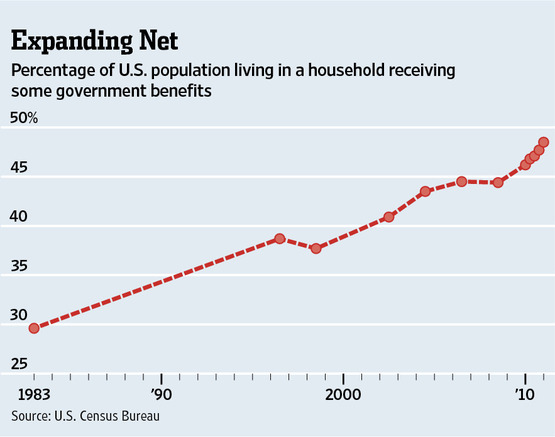
Nearly half of U.S. households are receiving some government benefits

Percentage of households receiving some government benefits

(Click for larger image)

This is the top story on the Wall Street Journal at the time I am writing this (Thursday at midnight).

Excerpt:

Families were more dependent on government programs than ever last year.

Nearly half, 48.5%, of the population lived in a household that received some type of government benefit in the first quarter of 2010, according to Census data. Those numbers have risen since the middle of the recession when 44.4% lived households receiving benefits in the third quarter of 2008.

The share of people relying on government benefits has reached a historic high, in large part from the deep recession and meager recovery, but also because of the expansion of government programs over the years. (See a timeline on the history of government benefits programs here.)

Means-tested programs, designed to help the needy, accounted for the largest share of recipients last year. Some 34.2% of Americans lived in a household that received benefits such as food stamps, subsidized housing, cash welfare or Medicaid (the federal-state health care program for the poor).

Another 14.5% lived in homes where someone was on Medicare (the health care program for the elderly). Nearly 16% lived in households receiving Social Security.

High unemployment and increased reliance on government programs has also shrunk the nation’s share of taxpayers. Some 46.4% of households will pay no federal income tax this year, according to the nonpartisan Tax Policy Center. That’s up from 39.9% in 2007, the year the recession began.

A plan like Herman Cain’s 9-9-9 plan would make sure that everybody is paying their fair share of taxes, and maybe then people who collect these benefits without paying their fair share would have a reason to want to cut government spending.