Tag Archives: Welfare

Conservative MP Iain Duncan Smith proposes reforms to the UK welfare state

Dina sent me this exciting article from the UK Daily Mail about our favorite conservative MP.

Excerpt:

Jobless couples with more than two children should have benefit payments limited, Iain Duncan Smith suggested yesterday.

The Work and Pensions Secretary said there were ‘large numbers’ of couples on welfare having big families – unlike middle-income parents who had to weigh up if they could afford to have another child.

Mr Duncan Smith condemned the ‘madness’ of the state subsidising large workless families – saying it would be fairer to the ‘vast majority’ of responsible taxpayers if benefits were limited to the first two children in future.

He has agreed to find another £10billion in welfare savings by 2016, having already slashed £18billion from a vast budget that grew by 60 per cent under Labour.

As well as cuts to child benefit and tax credits for large workless families, he suggested housing benefit could be stripped for those who expected to go straight from school on to welfare and a state-subsidised house.

[…]He [insisted] the real cruelty was leaving people languishing on welfare for years. ‘We have accepted for far too long in this country that it is possible for people to just stay on benefits,’ he said. ‘It is all about saying, we will give you massive support to find work… But also, we have an expectation, as the taxpayer pays for these bills, that you try your hardest to find work.’

Most controversially, Mr Duncan Smith suggested the present system encouraged poorer families to have large numbers of children without worrying about the cost.

‘When you look at families across the board, at all incomes, you find the vast, vast majority make decisions about the kind of numbers of children they have, the families they want, based on what they think they can afford,’ he said.

‘Where you see the clustering of the large families is really down at the very lowest incomes, those on significant levels of welfare, and those on the very top incomes. In other words, the problem for those who are paying the taxes, paying the bills – they make the decisions about their lives, even if they sometimes would like to maybe have extra children, they make decisions.

‘People who are having support through welfare are often free from that decision. We want to support people if they have children when they are out of work, of course.

‘But can there not be a limit to the fact that really you need to remember you need to cut your cloth in accordance with what capabilities and what finances you have?’

The UK Telegraph added:

Official figures show that 120,000 of the most troubled and difficult families cost the taxpayer about £9 billion a year. Every household is now spending the equivalent of £3,000 a year in tax for welfare payments.

There are about one in five households where no one works and 1.5 million children are growing up with a parent addicted to drugs or alcohol.

[…]Mr Duncan Smith will say that the poor use of government money in recent times has led to people being “written off”.

“Our failure to make each pound count has cost us again and again over the years, Not only in terms of a financial cost – higher taxes, inflated welfare bills and lower productivity, as people sit on benefits long term. But also the social cost of a fundamentally divided Britain – one in which a section of society has been left behind. We must no longer allow ourselves to accept that some people are written off.”

[…]The Liberal Democrats are threatening to block further cuts in benefits unless the Coalition also introduces new taxes on the rich.

The article notes that members of the British socialist party (the Labor Party) British communist party (the Liberal Democrats) oppose the cuts to welfare. Of course! That’s how they get their votes – by redistributing money from working people to many more people who don’t work.

New report: welfare spending hits record $1 trillion, up 32% in Obama’s first term

Democrats control the House and Senate in 2007

Dad sent me this excellent article from the Daily Caller.

Excerpt:

The government spent approximately $1.03 trillion on 83 means-tested federal welfare programs in fiscal year 2011 alone — a price tag that makes welfare that year the government’s largest expenditure, according to new data released by the Republican side of the Senate Budget Committee.

The total sum taxpayers spent on federal welfare programs was derived from a new Congressional Research Service (CRS) report on federal welfare spending — which topped out at $745.84 billion for fiscal year 2011 — combined with an analysis from the Republican Senate Budget Committee staff of state spending on federal welfare programs (based on “The Oxford Handbook of State and Local Government Finance”), which reached $282.7 billion in fiscal year 2011.

[…]According to the CRS report, which focused solely on federal spending for federal welfare programs, spending on federal welfare programs increased $563.413 billion in fiscal year 2008 to $745.84 billion in fiscal year 2011 — a 32 percent increase.

[…]The total federal spending on federal welfare programs vastly outpaced fiscal year 2011 spending on such federal expenditures as non-war defense ($540 billion), Social Security ($725 billion), Medicare ($480 billion), and departments such as Justice ($30.5 billion), Transportation ($77.3 billion) and Education ($65.486 billion) — a fact that alarmed the ranking member of the Senate Budget Committee, Alabama Sen. Jeff Sessions, who requested the report from CRS.

“These astounding figures demonstrate that the United States spends more on federal welfare than any other program in the federal budget,” Sessions wrote The Daily Caller in an email. “It is time to restore — not retreat from — the moral principles of the 1996 welfare reform. Such reforms, combined with measures to promote growth, will help both the recipient and the Treasury.”

When state spending on federal welfare programs — specifically Medicaid and the Children’s Health Insurance Program — was thrown into the mix, the amount spent on federal welfare increased 28 percent, from $798.813 billion in fiscal year 2008 to $1.028.54 trillion in fiscal year 2011.

“No longer should we measure compassion by how much money the government spends, but by how many people we help to rise out of poverty,” Sessions continued. “Welfare assistance should be seen as temporary whenever possible, and the goal must be to help more of our fellow citizens attain gainful employment and financial independence. This is about more than rescuing our finances. It’s about creating a more optimistic future for millions of struggling Americans.”

With food assistance spending increasing the most out of every category, Sessions, who has been sounding the alarm on the expanding food stamp rolls, noted that the Obama administration has allowed for the food stamp increase through misleading promotion and a disregard for self-reliance.

“The administration ludicrously argues that every five dollars in food stamp spending results in nearly 10 dollars in economic benefit. They insist that communities ‘lose out’ when more people don’t sign up for benefits,” Sessions noted. “[The United States Department of Agriculture] even awarded a recruitment worker for overcoming people’s ‘mountain pride.’ Is this a hopeful vision for the future? Do these priorities make our country stronger and our economy more secure?”

Do these numbers surprise you, because of what you hear from Obama and his allies in the media? Well, Democrats are always lying about how the Bush tax cuts caused the deficits. The truth is that revenues went up after the tax cuts because more wealthy invested their savings since they stood to keep more of the gains if their risks panned out. People invest more when they are allowed to keep more of the profit, if they get a profit. That’s how investing works – when you stand to gain more for the same risk, you risk more. And risking money in a business venture means MORE JOBS, since people get hired to take the risk, and do the work.

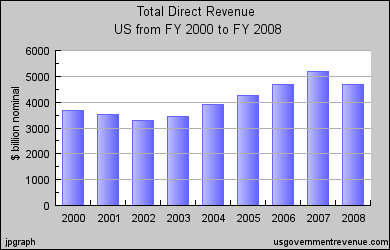
Bush’s tax cuts were passed in 2001 and 2003, and look what happened to revenues:

Did the Bush tax cuts make revenues decrease? No!

Not only that, but the unemployment rate went down to just over 4% after the tax cuts. The two wars cost about $550 billion, and we actually got national security out of it. What do we get for paying people not to work? Is it government’s job to pay people not to work? I think that charity is best done by individuals, businesses and especially churches, where we can expect some moral accountability from the recipient – some improved decision-making and personal responsibility. That’s simply lacking when government mails out checks paid for by working families and their employers.

Not every Republican is good on cutting spending, but Jeff Sessions is one of the Republican majority who opposes spending. We just just need to keep getting rid of the RINOs and Democrats, and this problem will get solved. We are never going to turn this economy around when people who think that more dependency and fewer jobs cause economic growth. They are wrong about the facts and they need to go in November.

Who pays the bill for handing out $2.2 trillion of entitlements per year?

This article by Nicholas Eberstadt is the most popular article on the Wall Street Journal right now. I found it through Doug Ross’ links.

First, a quick review of the entitlement situation:

What is monumentally new about the American state today is the vast empire of entitlement payments that it protects, manages and finances. Within living memory, the federal government has become an entitlements machine. As a day-to-day operation, it devotes more attention and resources to the public transfer of money, goods and services to individual citizens than to any other objective, spending more than for all other ends combined.

The growth of entitlement payments over the past half-century has been breathtaking. In 1960, U.S. government transfers to individuals totaled about $24 billion in current dollars, according to the Bureau of Economic Analysis. By 2010 that total was almost 100 times as large. Even after adjusting for inflation and population growth, entitlement transfers to individuals have grown 727% over the past half-century, rising at an average rate of about 4% a year.

In 2010 alone, government at all levels oversaw a transfer of over $2.2 trillion in money, goods and services. The burden of these entitlements came to slightly more than $7,200 for every person in America. Scaled against a notional family of four, the average entitlements burden for that year alone approached $29,000.

Government’s job used to be to handle responsibilities like roads and bridges or like defending us at home and to defending our national interests abroad. But now government seems to be more interested in redistributing money taken from job creating businesses and their workers to those don’t create jobs and those who don’t work. What happens when you punish people for trying to succeed and reward people who don’t even try?

This is the result of wealth redistribution:

The proud self-reliance that struck Alexis de Tocqueville in his visit to the U.S. in the early 1830s extended to personal finances. The American “individualism” about which he wrote did not exclude social cooperation—the young nation was a hotbed of civic associations and voluntary organizations. But in an environment bursting with opportunity, American men and women viewed themselves as accountable for their own situation through their own achievements—a novel outlook at that time, markedly different from the prevailing attitudes of the Old World (or at least the Continent).

The corollaries of this American ethos were, on the one hand, an affinity for personal enterprise and industry and, on the other, a horror of dependency and contempt for anything that smacked of a mendicant mentality. Although many Americans in earlier times were poor, even people in fairly desperate circumstances were known to refuse help or handouts as an affront to their dignity and independence. People who subsisted on public resources were known as “paupers,” and provision for them was a local undertaking. Neither beneficiaries nor recipients held the condition of pauperism in high regard.

Overcoming America’s historic cultural resistance to government entitlements has been a long and formidable endeavor. But as we know today, this resistance did not ultimately prove an insurmountable obstacle to establishing mass public entitlements and normalizing the entitlement lifestyle. The U.S. is now on the verge of a symbolic threshold: the point at which more than half of all American households receive and accept transfer benefits from the government. From cradle to grave, a treasure chest of government-supplied benefits is there for the taking for every American citizen—and exercising one’s legal rights to these many blandishments is now part of the American way of life.

As Americans opt to reward themselves ever more lavishly with entitlement benefits, the question of how to pay for these government transfers inescapably comes to the fore. Citizens have become ever more broad-minded about the propriety of tapping new sources of finance for supporting their appetite for more entitlements. The taker mentality has thus ineluctably gravitated toward taking from a pool of citizens who can offer no resistance to such schemes: the unborn descendants of today’s entitlement-seeking population.

We used to want to earn our own success. Now we want to live on the backs of children not yet born. Slavery is a horrible crime, no matter where it is practiced. Isn’t it a kind of slavery to live it up now and then pass the bill for it on to generations not even born yet? It strikes me as a kind of slavery – taking an unfair portion of the income of others so that we can live at a higher standard than what we can afford through our own choices and labor.