Tag Archives: Welfare State

Bank run in socialist Europe begins

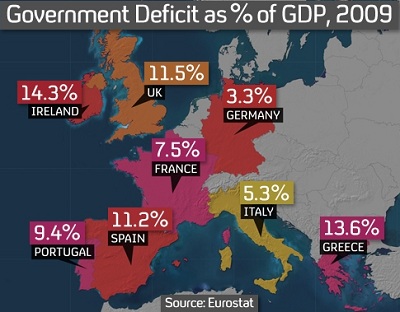
Europe: Annual Budget Deficit as % of GDP

From CNBC.

Excerpt:

Money-market funds in the United States have quite dramatically slammed shut their lending windows to European banks. According to the Economist, Fitch estimates U.S. money market funds have withdrawn 42 percent of their money from European banks in general.

And for France that number is even higher — 69 percent. European money-market funds are also getting in on the act.

Bond issuance by banks has seized up because buyers have gone on strike.

From the Economist’s Free Exchange Blog:

In the third quarter bonds issues by European banks only reached 15 percent of the amount they raised over the same period in the past two years, reckon analysts at Citi Group. It is unlikely that European banks have sold many more bonds since.

Corporate depositors are also pulling their cash.

Free Exchange:

“We are starting to witness signs that corporates are withdrawing deposits from banks in Spain, Italy, France and Belgium,” an analyst at Citi Group wrote in a recent report. “This is a worrying development.”

And there are troubling signs that banks are even running out of collateral to back their borrowings from the European Central Bank .

So far the liquidity of the European Central Bank (ECB) has kept the system alive. Only one large European bank, Dexia, has collapsed because of a funding shortage. Yet what happens if banks run out of collateral to borrow against?

And from the leftist New York Times.

Excerpt:

The flight from European sovereign debt and banks has spanned the globe. European institutions like the Royal Bank of Scotland and pension funds in the Netherlands have been heavy sellers in recent days. And earlier this month, Kokusai Asset Management in Japan unloaded nearly $1 billion in Italian debt.

At the same time, American institutions are pulling back on loans to even the sturdiest banks in Europe. When a $300 million certificate of deposit held by Vanguard’s $114 billion Prime Money Market Fund from Rabobank in the Netherlands came due on Nov. 9, Vanguard decided to let the loan expire and move the money out of Europe. Rabobank enjoys a AAA-credit rating and is considered one of the strongest banks in the world.

American money market funds, long a key supplier of dollars to European banks through short-term loans, have also become nervous. Fund managers have cut their holdings of notes issued by euro zone banks by $261 billion from around its peak in May, a 54 percent drop, according to JPMorgan Chase research.

This is really disturbing. I wonder if any of my economics-minded commenters can explain to me what happens when there is a run on banks. I am guessing that there will be some rioting over benefits as austerity measures are imposed, and interest rates will go up.

Induced abortions, drinking and use of contraceptives all increase breast cancer risk

Here’s the latest study from the Journal of the American Medical Association (JAMA), showing that excessive consumption of alcohol is a rish factor for breast cancer.

Excerpt:

Consumption of 3 to 6 alcoholic drinks per week is associated with a small increase in the risk of breast cancer, and consumption in both earlier and later adult life is also associated with an increased risk, according to a study in the November 2 issue of JAMA.

“In many studies, higher consumption of alcohol has been associated with an increased risk of breast cancer. However, the effect of low levels of drinking as is common in the United States has not been well quantified,” according to background information in the article. “In addition, the role of drinking patterns (i.e., frequency of drinking and ‘binge’ drinking) and consumption at different times of adult life are not well understood.”

Wendy Y. Chen, M.D., M.P.H., of Brigham and Women’s Hospital and Harvard Medical School, Boston, and colleagues examined the association of breast cancer with alcohol consumption during adult life, including quantity, frequency, and age at consumption. The study included 105,986 women enrolled in the Nurses’ Health Study who were followed up from 1980 until 2008 with an early adult alcohol assessment and 8 updated alcohol assessments. The primary outcome the researchers measured was the risk of developing invasive breast cancer.

During the follow-up period, there were 7,690 cases of invasive breast cancer diagnosed among the study participants. Analyses of data indicated that a low level of alcohol consumption (5.0 to 9.9 grams per day, equivalent to 3-6 glasses of wine per week) was modestly but statistically significantly associated with a 15 percent increased risk of breast cancer. In addition, women who consumed at least 30 grams of alcohol daily on average (at least 2 drinks per day) had a 51 percent increased risk of breast cancer compared with women who never consumed alcohol.

The researchers also found that when examined separately, alcohol consumption levels at ages 18 to 40 years and after age 40 years were both strongly associated with breast cancer risk. The association with drinking in early adult life still persisted even after controlling for alcohol intake after age 40 years.

Binge drinking, but not frequency of drinking, was also associated with breast cancer risk after controlling for cumulative alcohol intake.

Now let’s take a look at some other factors that raise the risk of breast cancer.

Abortion and breast cancer

Many studies show a link between abortion and breast cancer.

Study 1: (September 2010)

Based on the expression of estrogen receptor (ER), progesterone receptor (PR) and HER2/neu (HER2), breast cancer is classified into several subtypes: luminal A (ER+ and/or PR+, HER2-), luminal B (ER+ and/or PR+, HER2+), HER2-overexpressing (ER-, PR-, and HER2+) and triple-negative (ER-, PR-, and HER2-). The aim of this case-control study is to determine reproductive factors associated with breast cancer subtypes in Chinese women. A total of 1,417 patients diagnosed with breast cancer in the First Affiliated Hospital, China Medical University, Shenyang, China between 2001 and 2009 and 1,587 matched controls without a prior breast cancer were enrolled.

[…]Postmenopause and spontaneous abortion were inversely associated with the risk of luminal tumors. By contrast, multiparity, family history of breast cancer and induced abortion increased the risk of breast cancer.

Study 2: (March 2010)

OBJECTIVE: To explore the risk factors of breast cancer for better control and prevention of the malignancy.

METHODS: The clinical data of 232 patients with pathologically established breast cancer were investigated in this 1:1 case-control study to identify the risk factors of breast cancer.

RESULTS: The history of benign breast diseases, family history of carcinoma and multiple abortions were the statistically significant risk factors of breast cancer, while breast feeding was the protective factor.

CONCLUSION: A history of benign breast diseases, family history of carcinoma and multiple abortions are all risk factors of breast cancer.

But wait, there’s more.

Birth control pills

Many studies showed that taking birth control pills caused an increased risk of breast cancer.

Study 1: (March 2003)

RESULTS: Among the youngest age group (<35 years, n = 545), significant predictors of risk included African-American race (RR = 2.66: 95% CI 1.4-4.9) and recent use of oral contraceptives (RR = 2.26; 95% CI 1.4-3.6). Although these relationships were strongest for estrogen receptor-negative (ER-) tumors (RRs of 3.30 for race and 3.56 for recent oral contraceptive use), these associations were also apparent for young women with ER+ tumors. Delayed childbearing was a risk factor for ER+ tumors among the older premenopausal women (Ptrend < 0.01), but not for women <35 years in whom early childbearing was associated with an increased risk, reflecting a short-term increase in risk immediately following a birth.

Study 2: (October 2008)

Oral contraceptive use ≥1 year was associated with a 2.5-fold increased risk for triple-negative breast cancer (95% confidence interval, 1.4-4.3) and no significantly increased risk for non-triple-negative breast cancer (Pheterogeneity = 0.008). Furthermore, the risk among oral contraceptive users conferred by longer oral contraceptive duration and by more recent use was significantly greater for triple-negative breast cancer than non-triple-negative breast cancer (Pheterogeneity = 0.02 and 0.01, respectively).

Why are these risk factors so prevalent today?

Now let’s put it all together by looking at this New York Times article by Nancy Bauer.

Excerpt:

If there’s anything that feminism has bequeathed to young women of means, it’s that power is their birthright.  Visit an American college campus on a Monday morning and you’ll find any number of amazingly ambitious and talented young women wielding their brain power, determined not to let anything — including a relationship with some needy, dependent man — get in their way.  Come back on a party night, and you’ll find many of these same girls (they stopped calling themselves “women” years ago) wielding their sexual power, dressed as provocatively as they dare, matching the guys drink for drink — and then hook-up for hook-up.

The article was written by:

Nancy Bauer is associate professor and chair of philosophy at Tufts University. She is the author of “Simone de Beauvoir, Philosophy, and Feminism,” and is currently completing a new book, “How to Do Things With Pornography.”

Her comments cause me to ask some questions. Where did women ever get the idea that they had to drink as much as men drink? Where did women ever get the idea that using contraceptives to enable hook-up sex was healthy and normal? Where did women ever get the idea that aborting their own unborn children was healthy and normal? Is there one unifying worldview that stipulates all of these beliefs? Why has this worldview become so popular that so many young women who now believe in it, rather than believing in traditional Judeo-Christian values?

Who is paying for all of this increased health care spending?

The total cost for breast cancer treatment, which raises medical insurance premiums (private health care) or taxes (single-payer health care), has been estimated to be between $1.8 billion and $3.8 billion dollars. In addition, the government spends billions of dollars each year on breast cancer research. All of this spending is costing taxpayers a lot of money, as people demand more and more government funding of breast cancer research and breast cancer treatment (with either private or single-payer health care).

If you defend your home from armed intruders in the UK, you get arrested

Story here in the UK Telegraph.

Excerpt:

Officers were called to Vincent Cooke’s house in the affluent Stockport suburb of Bramhall, just before 8pm on Saturday following reports of a break-in.

Mr Cooke, 39, a married father of one who has run a number of small courier and logistics companies, was relaxing alone in the detached interwar property when the two intruders struck, Greater Manchester Police said.

His wife Karen, 34, and 12-year-old son returned home during the incident but escaped unharmed. Police said that during the break-in Mr Cooke was threatened and one of the intruders, Raymond Jacob, 37, of was stabbed.

Mr Cooke, who is one of five children, was being questioned on suspicion of murder on Sunday night.

I thought the response of the police was interesting – self-defense is murder:

“Clearly this is a serious incident in which a man has lost his life and at this time we believe the dead man was one of two men who were attempting to carry out a burglary at the house.”

The other suspected intruder fled in a small white Citroen van. Police last night confirmed a second man had been arrested in connection with the incident.

On Sunday afternoon relatives of Mr Jacob, of Northern Moor, Greater Manchester, laid flowers outside Mr Cooke’s home.

One read: “To my baby boy who will always be my baby boy. I will miss you, but never stop loving you. Mum.”

Last night friends and relatives also left tributes for Mr Jacob social networking websites.

“Still doesnt feel real, cant believe your gone we will all miss you,” said Danielle Leach on Facebook.

Just to be clear about the facts, here’s the UK Sun.

Excerpt:

Two knife-wielding intruders burst into the home of company director Vincent Cooke, 39.

Burglar Raymond Jacob, 37, is believed to have been stabbed with his own knife.

Mr Cooke was later arrested in Bramhall, Cheshire. His wife and son fled the house unhurt.

Isn’t the mother’s reaction interesting? It’s not unexpected coming from the feminized UK, though, where no one is responsible for anything they do. In fact, the one who judges and refuses to bail others out is the bad one. How mean! Defending your home from armed intruders! Just let them kill you! After all, the government already takes your money, so why not not ban self-defense so they take your life as well?

This is not unusual in the new Harriet Harman-onized UK. It happens all the time.

Consider this story from the UK Telegraph.

Excerpt:

Miss Klass, a model for Marks & Spencer and a former singer with the pop group Hear’Say, was in her kitchen in the early hours of Friday when she saw two teenagers behaving suspiciously in her garden.

The youths approached the kitchen window, before attempting to break into her garden shed, prompting Miss Klass to wave a kitchen knife to scare them away.

Miss Klass, 31, who was alone in her house in Potters Bar, Herts, with her two-year-old daughter, Ava, called the police. When they arrived at her house they informed her that she should not have used a knife to scare off the youths because carrying an “offensive weapon” – even in her own home – was illegal.

Jonathan Shalit, Miss Klass’s agent, said that had been “shaken and utterly terrified” by the incident and was stepping up security at the house she shares with her fiancé, Graham Quinn, who was away on business at the time.

He said: “Myleene was aghast when she was told that the law did not allow her to defend herself in her own home. All she did was scream loudly and wave the knife to try and frighten them off.

You can read more about how the 1997 ban on handguns in the UK doubled violent crime in the four years after the ban at Reason magazine. Similarly, in the United states, legalizing the concealed carrying of firearms resulted in dramatic declines in violent crime. But that is just common sense. The more people who own guns and can defend themselves, the less crime there will be. But I think that the feminized state is just hostile to men acting in their traditional role as protectors, and they don’t like the idea that anyone is judged for doing evil things – like criminals.

The left, feminism and “equality”

And I can tell you what’s behind this. The secular left believes in equality. So if one person has money, and another doesn’t, it doesn’t matter what their personal decisions were. The poorer person should be allowed to take things from the richer person, and without getting hampered by laws and “self-defense”. That’s their view. That’s why they are soft on crime and release criminals early instead of punishing them. And this doesn’t just apply to criminals – this attitude goes right into the education system (“we need to make sure that families have no choice except the public schools, that way all the children will be equal”) the day care system (“we need to nationalize day care so that all the children are raised equally instead of by their own mothers”) the health care system (“we need to nationalize health care so that chaste men who are saving for their future marriage and children can pay for the abortions, sex changes, breast implants, contraceptives and IVF”), and so on.

I think Christians need to be especially careful with this compassionate impulse for “equality”, and consider whether equality might not make achieving Christian goals like liberty, marriage, and family more difficult. I don’t think it’s good for families to vote for higher taxes and bigger social programs that make men unnecessary as providers, protectors and leaders. All the responsibilities of the man to provide, protect and lead morally and spiritually are being handed off to the government, via police, schools, etc. That’s wrong.

Replacing men with government is bad for children – you don’t want to make it easier for women to not prepare to be mothers and wives, to not be careful about choosing the right men for marriage and parenting, and to not perform as wives and mothers once they are married in order to support men in their male roles. And that’s not my opinion – single motherhood by choice is known to increase child poverty and child abuse. And I don’t think that replacing men with government helps God any, either, since fathers are important for passing religion on to kids. You don’t serve God by undercutting his goals just because it feels good to you. You serve God by delivering results. His goal is not for you to feel good, but to do good. I recommend that anyone who votes based on feelings read more economics to find out what really works, and what strengthens marriage and family.

Related posts