Tag Archives: War

Should Christians expect to know God’s will by means of feelings and intuitions?

I have a key that will unlock a puzzling mystery

There are two views on the topic of decision making and the will of God. The view you learn in the church is called “the traditional view”. I call this view the feelings/intuition view. This view that elevates feelings / intuitions to the level of divine communications from God. The more practical view is called “the wisdom view”. I call this view the battlefield commander view. I am a proponent of the wisdom / commander view.

Let’s learn about the two different views:

[The traditional view is] that God has a plan for our lives and that we receive guidance through methods such as “open and closed doors”, “feeling led” and “the still, small, voice”.

[The wisdom view] holds that God does not have an “individual will” for our lives, but rather that all of God’s will can be summed up within two categories, God’s sovereign will and God’s moral will. Basically God’s sovereign will is all the things that god decrees will happen. It is hidden (mostly) from us, and does not play an active part in our decision, although some of it is revealed in the bible. God’s moral will is the part that we must concern ourselves with in making decisions. It is fully revealed in the bible and our decisions must be made within it. We may use wisdom in applying god’s moral will to our lives, or we may be in an area not covered by god’s moral will. We must finally submit in advance to God’s sovereign will, being prepared for him to sovereignty intervene and redirect us through whatever means he wills (see James).

Here’s a bit more from someone else:

Regarding the view that God has a personal will for us individually that we have to discern and find, J.I. Packer says, “The first thing to say is that the idea of guidance is actually a novelty among orthodox evangelicals. It does not go back farther than the last century. Second, it has led people to so much foolish action on the one hand, and so much foolish inaction on the other, as well as puzzlement and heartbreak when the ‘hotline’ to God seems to go silent, that it has to be discredited. Third, it must be said that Scripture gives us no more warrant constantly to expect personal ‘hotline,’ ‘voice-from-the-control-tower’ guidance than to expect new authoritative revelations to come our way for the guidance of the whole church.” (Hot Tub Religion, page 118).

As to the point of the question, how do I make decisions, I attempt to make decisions in light of three factors: God’s moral will, wisdom, and my personal desires. If something is opposed to God’s moral will, then I should obviously flee from it. If it’s not opposed, then I consider the wisdom of the choices. For example, would it be wise for me to marry a woman who loves Jesus, though we have nothing else in common? Probably not. If the options pass the criteria of wisdom, then I’m free to choose how I wish. If I’m offered two jobs, and both are honoring to God, and both would be wise to take, then I’m free to choose the job I would like more. I don’t need to put out a fleece or await some other confirmation from God. If it’s moral and wise, then the only question as to whether or not it will honor Him is my attitude.

Some examples of this model used in the Bible (in theological circles referred to as the Wisdom Model) are in Paul’s planning of a mission to Rome in Romans 1:9-15, 15:22-24, the Jerusalem Council (Acts 15:1-29), and Paul’s instructions for legal disputes (1 Cor 6:3-6).

The best book on this topic is Garry Friesen’s “Decision Making and the Will of God”. In it, you’ll find a full assessment about what the Bible teaches on this topic.

When I am trying to decide what will be effective, I look at Christian scholars, at their papers, books, and public debates. That’s effectiveness because it is addressed to a non-Christian audience in public with the force of reason and evidence. It is persuasion and it is addressed to rational minds. I want to change the minds of people who have a large influence on society on the whole. I don’t think that offering Christianity as life-enhancement or self-help is really “having an influence”. I think that offering Christianity as truth, with support, is “having an influence”.

So let me be clear about what I believe:

  • I don’t think that God normally talks to people directly
  • I don’t believe that life is an Easter egg hunt, filled with clues accessible only to emotion and intuition
  • I don’t believe that God expects people to discover a specific will for their lives using non-rational means
  • I think that people make up their own life plan that is consistent with the Bible
  • The goal of the life plan is to be effective, and there are no other considerations
  • I think that there are many good things a person can do, but that some are more effective than others
  • I think that with respect to the goal of serving God effectively, my happiness is expendable
  • I don’t think that the purpose of doing something for the Lord is to feel good about ourselves
  • I don’t think that people should choose ineffective things to do just because they like them
  • I don’t think that people should choose ineffective things to do just because they are good at them
  • I think people should do hard things that they don’t like – as long as it’s more effective
  • I don’t think that any course of action is as effective as any other – some plans accomplish more
  • I don’t think that life is totally unpredictable and irrational and subjective
  • I think that we can know what is or is not effective by studying and learning about the world
  • I think life is like a battlefield that must be surveyed, understood and acted upon deliberately

I think that every person is the commanding officer of his or her own life, and each person must study everything they can, make a plan that is consistent with the Bible’s moral prescriptions, execute the plan and achieve whatever they can achieve for the Lord. And the goal is not comfort or happy feelings, but real achievements. Not for the purpose of being saved, of course, because salvation is a free gift of God because of what Jesus did on the cross. Life is more like a battle than a vacation resort or a buffet or a shopping center. God’s will for us is not have happy feelings, but that we freely choose to sacrifice ourselves out of obedience and service to him. In my case, that means studying hard things, making money, saving money, and giving money away to good scholars, sponsoring good events and being persuasive to non-Christians. None of this necessarily makes me happy, but it does work to bring glory to God. I cried when I had to learn calculus, because it was so hard. But who cares? The main thing is that I have money now to sponsor Christian speakers or to give books to Christians to read, and God is happy with that.

I think that it is very important to realize that God is not impressed by our not being smart and not being effective. If we have the ability to be smart, then we should be smart, whether it makes us happy or not. If we have the ability to make money, then we should make money, whether it makes us happy or not. If we have the ability have a great influence, then we should have a great influence, whether it makes us happy or not. There will be plenty of time for happiness after we’re dead. But this life is a time of serving, and we should try to serve effectively, whether it makes us happy or not. With respect to God’s purposes in the world, my happiness is expendable.

Whenever someone questions my goals and plans by saying that I am asserting my will over God’s will, the first question I want to ask that person is this: “how do you know what God’s will is?” and “what is your basis for thinking that my plan to serve will not be effective?”. I want to know if I have misunderstood something about the way the world is, or miscalculated in some way. I want someone to look at my calculations and show where they are going to produce a less optimal result for the Lord. That’s the only concern I have – effectiveness for the Lord. Usually what I have found is that the other person wants to make the purpose of life their own happiness, and it makes them happier to choose what to do moment by moment, without having to study anything or make plans. It’s not that they have better goals (for God) or better plans (for God). It’s that they want their goals to be above God, and they don’t want to make plans other than to do whatever makes them happy.

This article by Greg Koukl may be helpful.

And I also found this summary of the Friesen book useful:

In nine parts.
Veteran’s Day re-post: Navy SEAL Michael Murphy awarded Medal of Honor

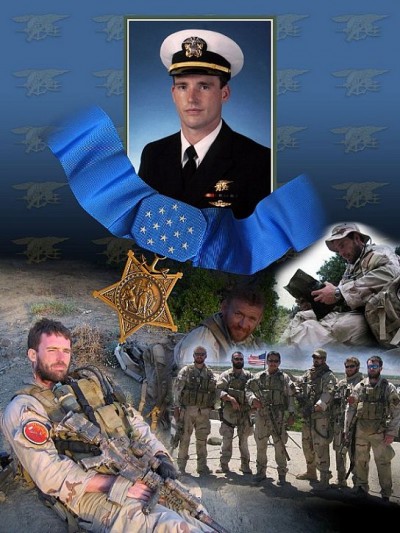
Navy SEAL Michael Murphy wins Medal of Honor

For Veteran’s Day, I am re-posting one of my favorite Medal of Honor stories.

Here is the story of a brave Navy SEAL named Michael Murphy.

Excerpt:

Engaged in a frenzied firefight and outnumbered by the Taliban, Navy Lt. Michael Murphy made a desperate decision as he and three fellow SEALs fought for their lives on a rocky mountainside in Afghanistan’s Kunar Province in 2005.

In a last-ditch effort to save his team, Murphy pulled out his satellite phone, walked into a clearing to get reception and called for reinforcements as a fusillade of bullets ricocheted around him. One of the bullets hit him, but he finished the call and even signed off, “Thank you.”

Then he continued the battle.

Dan Murphy, the sailor’s father, said it didn’t surprise him that his slain son nicknamed “The Protector” put himself in harm’s way. Nor was he surprised that in the heat of combat his son was courteous.

“That was Michael. He was cool under fire. He had the ability to process information, even under the most difficult of circumstances. That’s what made him such a good SEAL officer,” Murphy said.

A warship bearing the name of the Medal of Honor recipient will be christened Saturday — on what would have been Murphy’s 35th birthday — at Bath Iron Works, where the destroyer is being built.

Murphy, who was 29 when he died, graduated from Pennsylvania State University and was accepted to multiple law schools, but decided he could do more for his country as one of the Navy’s elite SEALS — special forces trained to fight on sea, air and land — the same forces that killed Osama bin Laden this week in Pakistan.

[…]Murphy, of Patchogue, N.Y., earned his nickname after getting suspended in elementary school for fighting with bullies who tried to stuff a special-needs child into a locker and for intervening when some youths were picking on a homeless man, said Dan Murphy, a lawyer, former prosecutor and Army veteran who served in Vietnam.

Maureen Murphy said he thought he was too young to take a desk job as a lawyer. Instead, he went to officer candidate school, the first step on his journey to become a SEAL officer. He was in training during the Sept. 11 attacks, which shaped his views.

His view was that there are “bullies in the world and people who’re oppressed in the world. And he said, ‘Sometimes they have to be taken care of,'” she said.

On June 28, 2005, the day he was killed, Murphy was leading a SEAL team in northeastern Afghanistan looking for the commander of a group of insurgents known as the Mountain Tigers.

What happened to Murphy?

The Operation Red Wings reconnaissance team rappelled down from a helicopter at night and climbed through rain to a spot 10,000 feet high overlooking a village to keep a lookout. But the mission was compromised the following morning when three local goat herders happened upon their hiding spot.

High in the Hindu Kush mountains, Murphy and Petty Officers Marcus Luttrell of Huntsville, Texas; Matthew Axelson of Cupertino, Calif.; and Danny Dietz of Littleton, Colo.; held a tense discussion of the rules of engagement and the fate of the three goat herders, who were being held at gunpoint.

If they were Taliban sympathizers, then letting the herders go would allow them to alert the Taliban forces lurking in the area; killing them might ensure the team’s safety, but there were issues of possible military charges and a media backlash, according to Luttrell, the lone survivor.

Murphy, who favored letting the goat herders go, guided a discussion of military, political, safety and moral implications. A majority agreed with him.

An hour after the herders were released, more than 100 Taliban armed with AK-47 assault rifles and rocket-propelled grenades opened fire, attacking from higher elevation, and maneuvering to outflank the SEALs, said Gary Williams, author of “Seal of Honor,” a biography of Murphy.

[…]As the only survivor, Luttrell has pangs of regret for voting to go along with Murphy, his best friend; he now believes the team could’ve survived if the goat herders were killed.

He wasn’t willing to kill unarmed civilians. That’s the difference between the United States and the Muslim terrorists. It’s a moral difference. Michael Murphy was a good man. He used guns and violence to protect others, and he was not willing to kill unarmed civilians.

Here are the requirements for the Army version of the Medal of Honor:

The Medal of Honor is awarded by the President in the name of Congress to a person who, while a member of the Army, distinguishes himself or herself conspicuously by gallantry and intrepidity at the risk of his or her life above and beyond the call of duty while engaged in an action against an enemy of the United States; while engaged in military operations involving conflict with an opposing foreign force; or while serving with friendly foreign forces engaged in an armed conflict against an opposing armed force in which the United States is not a belligerent party. The deed performed must have been one of personal bravery or self-sacrifice so conspicuous as to clearly distinguish the individual above his comrades and must have involved risk of life. Incontestable proof of the performance of the service will be exacted and each recommendation for the award of this decoration will be considered on the standard of extraordinary merit.

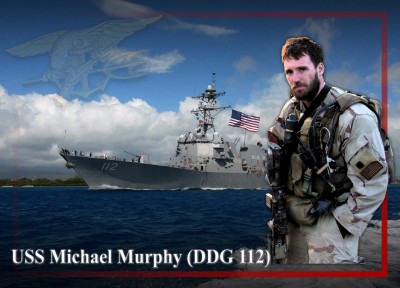
The Navy decided to honor Murphy’s sacrifice by naming a ship after him. What kind of ship do you think would suit Michael Murphy?

 USS Michael Murphy DDG 112 Arleigh Burke
USS Michael Murphy DDG 112 Arleigh Burke

Michael Murphy is getting a brand new Arleigh Burke guided missile destroyer! Arleigh Burke vessels have the AEGIS missile defense system and their role is to protect carrier strike groups from incoming SSMs and ASMs.

Excerpt:

The Arleigh Burke Class destroyers are equipped with the Aegis combat system which integrates the ship’s sensors and weapons systems to engage anti-ship missile threats.

The Aegis system has a federated architecture with four subsystems – AN/SPY-1 multifunction radar, command and decision system (CDS), Aegis display system (ADS) and the weapon control system (WCS). The CDS receives data from ship and external sensors via satellite communications and provides command, control and threat assessment. The WCS receives engagement instruction from the CDS, selects weapons and interfaces with the weapon fire control systems.

[…]Lockheed Martin is developing the Aegis ballistic missile defence (BMD) capability for the Aegis combat system to engage ballistic missiles with the SM-3 missile. 15 Arleigh Burke destroyers have been fitted with the Aegis BMD system, which provides the capability for long-range surveillance, tracking and engagement of short and medium-range ballistic missiles. The system received US Navy certification for full deployment in September 2006. Work was completed on the 15 destroyers at the end of 2008 and the vessels, with three Ticonderoga cruisers, form the Aegis BMD fleet. On 30 July 2009 the Aegis BMD system was successfully tested by the US Navy on the USS Hopper (DDG 70).Aegis BMD is the main sea-based component of the US ballistic missile defence system.

The weapons control systems include a SWG-1A for Harpoon, SWG-3 for Tomahawk, mk99 mod 3 missile fire control system, GWS34 mod 0 gun fire control system and mk116 mod 7 fire control system for anti-submarine systems.

Only two classes of warships that I know of have the AEGIS system. The DDG Arleigh Burke and the CG Ticonderoga.

Michael Murphy was a real hero. It makes me sad that he is gone. But his spirit will live on in the new warship that bears his name.

Public school punishes student for punching bully

According Wikipedia, “Huntington Beach High School (HBHS) is a public high school in Huntington Beach, California. Built in 1906, it is part of the Huntington Beach Union High School District. HBHS is a California Distinguished School. Huntington Beach High School is also the home of the Academy for the Performing Arts.”

Consider this article from the UK Daily Mail.

It says:

A California teenager has been hailed as a hero after he rushed to help a blind classmate being beaten up by a bully.

Shocking footage of the attack, filmed by a bystander, shows the ‘visually impaired’ student being repeatedly hit round the head during lunch break at Huntington Beach High School, California on Wednesday.

The assault only ends when the high school intervenes by knocking the bully to the ground with a single punch.

A California teenager has been hailed as a hero after he rushed to help a blind classmate being beaten up by a bully.

Shocking footage of the attack, filmed by a bystander, shows the ‘visually impaired’ student being repeatedly hit round the head during lunch break at Huntington Beach High School, California on Wednesday.

The assault only ends when the high school intervenes by knocking the bully to the ground with a single punch.

Now why is this happening? Why is it that the use of force to resolve conflicts between good and evil are frowned upon in public schools?

I think there are two reasons. One, schools tend to frown on objective morality, and try to teach kids that everyone constructs their own moral view is as valid as anyone else’s. In practice this means that might makes right, since there is no objective morality to appeal to in a relativistic system. The school doesn’t want to step in and take a side here, because they don’t believe that anyone is right or wrong. Second, there is a war against boys in the public schools. Teachers and administrators teach that the natural inclinations of boys to punish evil with force are bad. And they escalate that from the stomp-the-bully level to the anti-police level to the anti-war level. There is no good use of force ever, ever, ever, if you ask these teachers and administrators.

Why is there this emphasis on compassion over moral standards, and this war against male nature in the schools?

ABC News reports that there is a huge disparity between the numbers of male and female teachers.

Excerpt:

For the past 20 years, the numbers of male teachers in elementary and middle school grades have stagnated at about 16 to 18 percent, according to MenTeach, an organization whose mission is to increase the number of males working with young children.

There were no statistics for grades K-3, but in 2011, the most recent year for which there are data, only slightly more than 2 percent of kindergarten and preschool teachers were male.

“The gap and discrepancy between girls’ performance and boys’ performance is growing ever more marked,” said Massachusetts psychologist Michael Thompson, co-author of the groundbreaking 2000 book “Raising Cain,” which argues that society shortchanges boys.

“There are lots of explanations for it,” he said. “One is the nature of the elementary classroom. It’s more feminized and it does turn boys off, perhaps because they are in trouble more or because the teaching style is more geared to girls’ brains.

Some students go through public schools and never see a male teacher.

Men and women are different when it comes to moral judgments, and the use of force against evil, either in self-defense or in war. Men are traditionally more likely to see the use of force against evil as morally praiseworthy. Since there are few male teachers in the schools, naturally this sort of broad condemnation of all violence and all war as wrong is much more accepted – and taught to children. Either in the classroom, or through suspensions and other punishments. And the suspensions and other punishments are for things as small as drawing anything military, or chewing your sandwich into the shape of a gun, or… punching a bully who is attacking a blind kid.

When we as a nation wonder why people walk past others in distress instead of doing something, we should not underestimate the messages that children receive in public schools. The moral courage to oppose evil is beaten out of children in public schools, because they are being taught by those who see no moral value to self-defense against evil or any kind of use of force against evil. My advice is to not send your kids to public schools, especially boys.

An excellent resource to read about discrimination against boys and traditional boy behaviors is “The War Against Boys”, 2nd edition, by moderate feminist Christina Hoff Sommers.