
Tag Archives: Wages

Democrat lawmakers flee state to avoid voting on spending cuts

Video from Gateway Pundit.

Story from the Wall Street Journal.

Excerpt:

Democratic lawmakers fled the state in an effort to torpedo a closely watched vote on what would be the nation’s first major overhaul of union laws in years, as government workers flooded the statehouse for a third day seeking to block passage of the bill.

Surrounded by thousands of tightly packed protesters, including teachers who had been encouraged by union leaders to show up in force, state senators gathered around 11 a.m. to vote on Republican Gov. Scott Walker’s proposal to limit collective-bargaining rights for most state employees.

The governor’s proposal, part of a bill aimed at overcoming a $137 million deficit in the current budget and a projected $3.6 billion hole in the next two years, would allow collective bargaining on wages, but not pensions and health care. Workers would be required to pay more for both.

But a roll call revealed that the 14 Senate Democrats were absent, leaving the chamber short of the 20 votes needed to conduct business.

[…]Late Thursday, Gov. Walker, who could hear chanting every time he opened his office door, blasted the Democrats’ move as a “stunt” and urged them to return to vote on what he called as a “bold political move but a modest, modest proposal” that would preserve benefits for public employees that remained “better than what most people are getting across the state.”

The extraordinary scene was being followed in statehouses across the country, as a test case of both union clout and the political will of newly elected legislators. Wisconsin was at the front edge of voter discontent in 2010, with voters agitated about public spending electing Gov. Walker to succeed Democrat Jim Doyle and handing both houses of the legislature to the GOP.

[…]If the governor’s efforts succeed, other states are expected to try to follow, as governors grapple with deepening deficits. Many new governors in both parties have blamed the states’ fiscal crisis in part on what they say are overly generous benefits and pension obligations granted over many years to organized government workers.

Proposals similar to Gov. Walker’s have been made in New Jersey and Ohio. In Columbus, Ohio, thousands gathered Thursday to protest a Republican proposal that would eliminate collective-bargaining rights for many of that state’s 400,000 public-sector workers.

[…]Gov. Walker first introduced his “budget repair” bill just a week ago, setting off the firestorm that has swept the Capitol. Besides limiting collective-bargaining right for most workers—excepting police, firefighters and others involved in public safety—it would require government workers, who currently contribute little or nothing to their pensions, to contribute 5.8% of their pay to pensions, and pay at least 12.6% of health-care premiums, up from an average of 6%.

In exchange, Gov. Walker has pledged no layoffs or furloughs for the state’s 170,000 public employees. He has said 5,500 state jobs and 5,000 local jobs would be saved under his plan, which would save $30 million in the current budget and $300 million in the two-year budget that begins July 1.

The lawmakers are required by law to report to their posts to vote on all legislation, which is why the police were dispatched to locate them.

Here’s what the fuss is about:
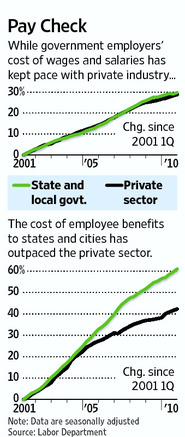
Public Sector Benefits

And Gov. Walker is not the only one trying to stop the massive transfers of wealth from the productive private sector to non-productive public sector.

Excerpt:

Lawmakers around the country are looking at new ways to prevent budget disasters by changing the rules for overburdened state employee pension funds. But they are meeting stiff resistance from public employee unions.

Two Arizona state lawmakers this week, including the speaker of the House, introduced their plan to salvage the state’s budget by significantly changing the public retirement system.

Following the lead of Gov. Chris Christie, R-N.J., a pair of New Jersey assemblymen on Monday put forth their legislative solution to make solvent a fund that’s $54 billion in the red.

Also on Monday, in his first budget address as governor, Florida’s Rick Scott announced his effort to “stabilize and secure” government employee pensions.

The moves are part of a larger battle over pension reform between conservative budget hawks and government worker unions.

The national debt is currently over 14 trillion, and scheduled to be at 26 trillion by 2021.

Michelle Malkin has a breakdown of teacher salaries and benefits here.

Obama’s reversal of the Bush tax cuts would cut your take-home pay

Investors Business Daily explains what would happen if Obama allows the Bush tax cuts to expire. (H/T Ponder With Us)

Excerpt:

Professor Michael Graetz of Columbia University recently estimated in the Wall Street Journal that letting the tax cuts expire will cost the U.S. economy $10 billion a month in added withholding from paychecks.

Goldman Sachs economist Alec Phillips estimates letting the Bush cuts expire could slash “nearly 10 percentage points” from disposable income growth in the first quarter of next year, and nearly two percentage points from GDP in the first half.

With GDP now at a tad above $14 trillion, the impact could be $280 billion or more in the first six months alone.

In short, the higher taxes could very well push us back into recession — at a time when the economy is struggling under 9.6% unemployment with little if any private-sector job growth.

What’s most worrisome is what it will do to the working taxpayer. His or her take-home pay is about to fall, leaving noticeably less to spend and save.

A married couple without children and an annual income of $80,000 would have an added $221 taken from their paycheck every two weeks, the Bloomberg report says, quoting the H&R Block Tax Institute. That jumps to $558 for couples bringing in $240,000.

Data from the Tax Policy Center show even those with modest family incomes would take a hit. For example, a couple with income of $60,000 and four children can expect to pay $130 more every two weeks to Uncle Sam. It doesn’t get much better for those who make just $40,000. They’ll find about $108 more withheld every other week.

Obama likes to spread the wealth around. You don’t mind, do you? He knows so much better than you do how to spread your money around.

Fiscal and social conservatives unite in new free e-book “Indivisible”

There’s a new book that just came out from the Heritage Foundation, my favorite think tank.

Here’s an excerpt from the introduction by Jay Richards:

To listen to media and political strategists is to get the impression that American public life is a checklist of issues. Some are known as “social” issues (marriage, family) and some are known as “economic” (international trade, wages). There may be some good reasons for this distinction, but when we itemize and divide these topics into two separate categories, we fail to convey the underlying unity of the principles behind the American Experiment in ordered liberty. In reality, the two groups of issues are interdependent. For instance, a free economy cannot long exist in a culture that is hostile to it. The success of free market economic policies depends on important cultural and moral factors such as thrift, delayed gratification, hard work, and respect for the property of others. A virtuous and responsible populace derives, in turn, from strong families, churches, and other civil institutions.

Conversely, economic issues have a strong influence on culture and the institutions of civil society. High taxes, for example, put pressure on families and force parents to spend more time in the workforce, leaving less time to devote to their spouses and children. When government expands spending and control in education, it crowds out parental responsibility; when it expands its role in providing social welfare services, it tends to erode a sense of responsibility among churches and other groups doing good work to help neighbors in need.

The connections are such that the individual issues rarely fit neatly and exclusively into one set or the other. An “economic” issue is rarely exclusively about economics. For instance, poverty in America is often as much a moral and cultural problem as an economic problem. Reducing such poverty depends on civil institutions that inculcate virtue and responsibility as well as policies that promote economic freedom and discourage dependency. Most poverty among children in America is not caused by a lack of jobs but rather by factors such as family breakdown, negligent or absentee parents, substance abuse, or other social pathologies. To consider American poverty in strictly economic terms is to fail to see the full scale of issues involved in this problem.

[…]The following essays are intended as a concise exploration of the link between liberty and human dignity and of the policy issues that tend to cluster around these two themes in American life. This collection brings together a number of well-known social and economic conservatives. To encourage cross-fertilization of their ideas, those known as social conservatives have written on themes normally identified with economic conservatives, and vice versa. The authors highlight economic arguments for issues typically categorized as “social” and social/moral arguments for “economic” issues. Each author focuses on a single topic, briefly summarized below, that is associated with either social or economic conservatives or, in some cases, both.

That’s also one of the main purposes of my blog, to show how fiscal conservatives and social conservatives depend on each other.

Here are the essays and authors:

  • Civil Society: Moral Arguments for Limiting Government – Joseph G. Lehman
  • Rule of Law: Economic Prosperity Requires the Rule of Law – J. Kenneth Blackwell
  • Life: The Cause of Life Can’t be Severed from the Cause of Freedom – Representative Paul Ryan
  • Free Exchange: Morality and Economic Freedom – Jim Daly with Glenn T. Stanton
  • Marriage: The Limited-Government Case for Marriage – Jennifer Roback Morse, Ph.D.
  • Profit: Prophets and Profit – Marvin Olasky, Ph.D.
  • Family: Washington’s War on the Family and Free Enterprise – Stephen Moore
  • Wages: The Value of Wages – Bishop Harry R. Jackson, Jr.
  • Religion:  Why Faith Is a Good Investment – Arthur Brooks, Ph.D., and Robin Currie
  • International Trade: Why Trade Works for Family, Community, and Sovereignty – Ramesh Ponnuru
  • Culture: A Culture of Responsibility – Edwin J. Feulner, Ph.D.
  • Property: Property and the Pursuit of Happiness – Representative Michele Bachmann
  • Environment: Conserving Creation – Tony Perkins
  • Education: A Unified Vision for Education Choice – Randy Hicks

Seeing the names of people paired with these topics just blows my mind. It would be as though William Lane Craig were suddenly to write a book defending free market capitalism or the war on Islamic terrorism. It’s just WEIRD. And you’ll notice that many of the Wintery Knight’s favorite people are in there; Paul Ryan, Michele Bachmann, Jennifer Roback Morse.  I also like Stephen Moore’s writing a lot.

The entire book is available for free as a PDF download, or you can order it from the Heritage Foundation. I ordered 10 copies of everything at the store, because I wanted a bunch to give away to all my friends. I think this is the perfect gift to give someone who doesn’t see the relevance of public policy to Christianity, marriage and parenting. There is no such thing as an informed Christian who is fiscally liberally or socially liberal.

Oh, and by the way: Ryan/Bachmann 2012 for the win!