Tag Archives: University

College professors donate to Democrats over Republicans 95 to 1

Where do college professors send their political donations?

Why is it that college students, including Christian college students, are becoming so progressive? It’s because their professors are all progressive. This isn’t just my opinion. You can look at the breakdown of political donations made by college professors to see how many of them donate to Republicans vs Democrats.

Here is the latest from Campus Reform:

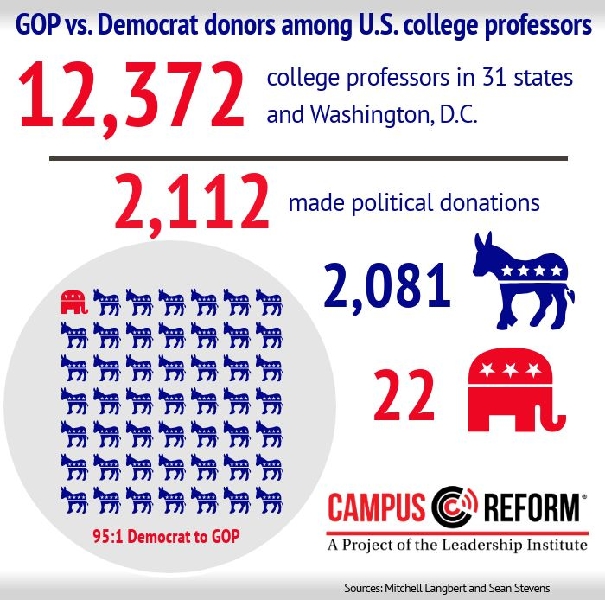
A recent study found that U.S. college professors donate exclusively to Democrats over Republicans by a 95:1 ratio.

Two researchers, Heterodox Academy Director of Research Sean Stevens and Brooklyn College Professor Mitchell Langbert conducted the study, published by the National Association of Scholars. They looked at the political donations of 12,372 college professors at universities in 31 states and the District of Columbia during the past two election cycles in 2015-16 and 2017-18.

Stevens and Langbert conducted their study by looking at political donation data available from the Federal Election Commission.

Of those professors, 2,112 made political donations, 2,081 of which were donated to Democrats. Just 22 of those 2,112 professors donated to Republicans. Nine professors donated to both Republicans and Democrats, according to the study.

The findings indicate that professors donated to Democrats more than Republicans by a 95:1 ratio. In addition to the number of professors who donated to Democrats versus Republicans, the study also revealed how many professors are registered to vote as Democrats compared with professors who are registered as Republicans. Nearly half of the 12,372 professors — 48.5 percent — are registered Democrats while just 5.7 percent are registered Republicans.

Given that, it’s not hard to see why Democrats like Elizabeth Warren want to provide those college professors with $1.3 trillion of taxpayer money – which is what the student loan bailout does.

What explains all of this?

Consider this essay by secular libertarian professor Robert Nozick who explains why university professors are liberal.

Excerpt:

What factor produced feelings of superior value on the part of intellectuals? I want to focus on one institution in particular: schools. As book knowledge became increasingly important, schooling–the education together in classes of young people in reading and book knowledge–spread. Schools became the major institution outside of the family to shape the attitudes of young people, and almost all those who later became intellectuals went through schools. There they were successful. They were judged against others and deemed superior. They were praised and rewarded, the teacher’s favorites. How could they fail to see themselves as superior? Daily, they experienced differences in facility with ideas, in quick-wittedness. The schools told them, and showed them, they were better.

The schools, too, exhibited and thereby taught the principle of reward in accordance with (intellectual) merit. To the intellectually meritorious went the praise, the teacher’s smiles, and the highest grades. In the currency the schools had to offer, the smartest constituted the upper class. Though not part of the official curricula, in the schools the intellectuals learned the lessons of their own greater value in comparison with the others, and of how this greater value entitled them to greater rewards.

The wider market society, however, taught a different lesson. There the greatest rewards did not go to the verbally brightest. There the intellectual skills were not most highly valued. Schooled in the lesson that they were most valuable, the most deserving of reward, the most entitled to reward, how could the intellectuals, by and large, fail to resent the capitalist society which deprived them of the just deserts to which their superiority “entitled” them? Is it surprising that what the schooled intellectuals felt for capitalist society was a deep and sullen animus that, although clothed with various publicly appropriate reasons, continued even when those particular reasons were shown to be inadequate?

It’s very important to understand what is motivating university professors, especially ones who are in departments divorced from reality, like English and victim studies of various sorts. They are literally teaching classes in topic that have no accountability to reality. It’s just indoctrination in what the professor believes. These professors think they are smart, but they don’t earn anything like productive people in the private sector, e.g. – software engineers. It creates a deep sense of inferiority that makes them hostile to the capitalist system. Their only hope is a powerful government that redirects money from those who serve customers (private sector companies) to “wordsmiths” like themselves.

Jennifer Roback Morse lectures on sex and sexuality at Harvard University

Dr. Jennifer Roback Morse

Dr. Morse delivers a talk based on her book “Smart Sex” at Harvard University.

The MP3 file is here. (21 Mb) (Link in case that doesn’t work)

Topics:

  • the hook-up culture and its effects on men and women
  • cohabitation and its effect on marriage stability
  • balancing marriage, family and career
  • single motherhood by choice and IVF
  • donor-conceived children
  • modern sex: a sterile, recreation activity
  • the real purposes of sex: procreation and spousal unity
  • the hormone oxytocin: when it is secreted and what it does
  • the hormone vassopressin: when it is secreted and what it does
  • the sexual revolution and the commoditization of sex
  • the consumer view of sex vs the organic view of sex
  • fatherlessness and multi-partner fertility
  • how the “sex-without-relationship” view harms children

52 minutes of lecture, 33 minutes of Q&A from the Harvard students. The Q&A is worth listening to – the first question is from a gay student, and Dr. Morse pulls a William Lane Craig to defeat her objection. It was awesome! I never get tired of listening to her talk, and especially on the topics of marriage and family.

New study: outstanding student loans reduce a woman’s odds of marrying

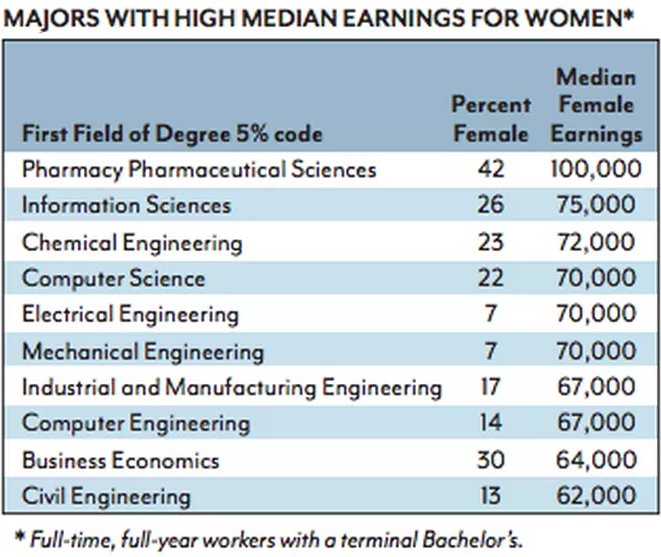
The best majors for women to avoid student loan debt
Top 10 majors with the highest median earnings for women

First, the study, which was published in Demographic Research.

Abstract:

BACKGROUND

With increasing levels of student loan debt, the path to economic stability may be less smooth than it was for earlier generations of college graduates. This paper explores this emerging trend by assessing whether or not student loan debt influences family formation.

OBJECTIVE

The objective of this study is to examine whether student loan debt delays marriage in young adulthood, whether or not the relationship between student loan debt and marriage differs for women and for men, and if this relationship attenuates during the years immediately after college graduation.

METHODS We estimate a series of discrete-time hazard regression models predicting the odds of first marriage as a function of time-varying student loan debt balance, using a nationally representative sample of bachelor’s degree recipients from the 1993 Baccalaureate and Beyond Longitudinal Study (N = 9,410).

RESULTS We find that the dynamics of loan repayment are related to marriage timing for women, but not for men. Specifically, an increase of $1,000 in student loan debt is associated with a reduction in the odds of first marriage by 2 percent a month among female bachelor degree recipients during the first four years after college graduation. This relationship attenuates over time.

CONCLUSION Our study lends support to the proposition that the financial weight of monthly loan repayments impedes family formation in the years immediately following college graduation – however, only for women. This finding questions traditional models of gender specialization in family formation that emphasize the economic resources of men.

I think that a woman who is serious about studying something that will allow her to get a job related to her field so she can quickly pay off her loans in the first few years is a very good sign of RESPECT for a man, and for his role as primary/sole provider. Men choose tough majors / trades for a reason, and they do tough jobs for a reason. When a woman chooses something hard to study and then chooses a hard job to do to pay off her loans, it’s showing to her man that she respects what he is doing to provide for the family. I think this is something that parents need to encourage young women to do, but so often parents focus too much on spiritual / emotional concerns instead of practical wisdom when leading their kids.

When a woman asks a man to work to pay for the marriage – with all the costs of home, furniture, diapers, tuition, etc. – she is asking him for a commitment to work until he is 65. That is a lot to ask, and it is very hard to accept this from a woman who doesn’t understand the difficulty of earning and saving money.

So what do I recommend to a woman? I recommend she do a STEM degree, pay off her debts, guard her chastity, marry young when she is fertile, have a few years of work to pay off student loans and get used to the workplace, demonstrate ability in apologetics and mentoring others, etc. A wife needs to have a lot more skills than just being pretty and young. There are things she has to do in the marriage – things that take preparation. The more accustomed she is to hard work and self-sacrifice, the easier she will take to her role in the marriage. Women who are used to having to do hard things that they don’t feel like doing make the best wives and mothers. It’s something that a woman can grow into, if she lets herself be challenged to grow.

My friend Amy is fond of telling me that people usually adapt to their friends. So if all your friends are very spiritual and impractical, and they don’t have jobs or savings, then chances are you’ll be like them, too. To get out of debt, don’t take financial advice from people who, in their own lives, show no evidence of knowing what to study, how to find a job, how to save money, and so on. Instead of pushing away the people who “rain on your parade” with wisdom, grab them and keep them close. Watch what they do. Talk to them about your finances. Rely on them to hold you accountable for choosing a good major, updating your resume, and continuously growing your salary, through annual raises or job changes. That’s how you get better.

I don’t say these things in order to make women feel bad, or limit their freedom unnecessarily. I tell women to make good decisions to prepare for marriage, to practice self-denial and self-sacrifice, to choose the right men, to not be scared away by strong providers and men with moral and religious convictions. Although on one level, women can be scared off by men who have firm and definite convictions, they need to understand that these men are the most reliable men to marry. Men who don’t make demands on women usually don’t respond well to demands that women make on them. A strict moral and theological framework can seem scary to a woman – she might feel scared that she could be rejected. But it’s exactly these convictions that ground a man’s ability to keep loving her, to stick with her, and to encourage and support her as she grows.

Instead of being frightened by men who ask her to do good things, she should view it as an asset, not a liability. And the more she listens to his leading and grows, the more independent and capable she will be. She will feel better about doing hard things and playing a role. Better than she would feel about always choosing the easy way and then finding herself without accomplishments. Demanding men can be bad, but not if the demands they make are to build the woman up. The demand that a woman be serious about paying her debts with a real plan might seem scary to some women, but the study shows that this is good advice for her to be more attractive – to any man who might want to marry her.