Tag Archives: United Kingdom

What UK Prime Minister David Cameron will do, and an extra thing that he should do

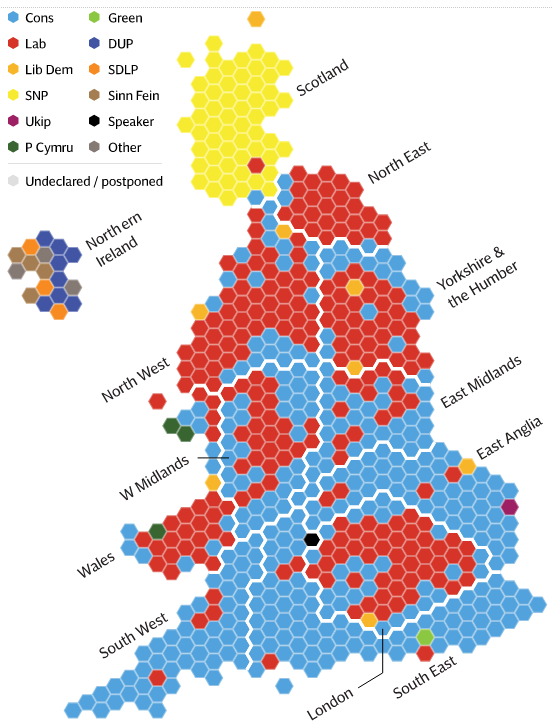
CON = 331 (+24), LAB = 232 (-26), SNP = 56 (+50), LIB = 8 (-47), UKP = 1 (+1), OTH = 22

Here’s an article from the radically leftist UK Independent, which is furious with the Conservative Party victory in Thursday’s national elections.

In it, they explain what Cameron intends to do:

David Cameron will use the Conservative Party’s first majority in the House of Commons for nearly 20 years to “deliver” on a radical agenda to cut welfare, shrink the size of the state and re-define Britain’s relationship with Europe.

Conservative insiders said Mr Cameron would move to the right to consolidate support among his backbench MPs after five years of compromise with the Liberal Democrats.

Among Mr Cameron’s first legislative priorities will be to enshrine an EU referendum into law, bring in the so-called ‘snoopers charter’ to give police greater powers to monitor internet communications and give English MPs a veto over legislation only affecting England.  The Tories also intend to publish plans to scrap the Human Rights Act within their first 100 days. All proposals had been previously blocked by the Lib Dems.

I always think of the UK as the biggest dupes when it comes to global warming, especially after the Climategate e-mails came out showing that that there was a concerted effort to falsify data and persecute global warming skeptics. But, like Canada’s Conservative Party, the UK Conservative Party is taking a stand against the pseudo-science.

Look:

As well as deep welfare cuts The Independent understands that the Department of Business and the Department of Energy and Climate Change, previously run by the Lib Dems, will be among the biggest casualties in terms of spending reductions.

Oliver Letwin, the Tories’ policy chief, has spent the campaign in Whitehall drawing up proposals to merge quangos and slash Government regulation. These are likely to form a key part of the spending review. The review has been made more difficult by Mr Cameron’s late and unexpected election pledge to find an extra £8bn for the NHS. This has yet to be funded and if the Tories stick to their other tax and spending commitments could require further cuts. Most senior Tories had expected to be negotiating another coalition agreement with the Liberal Democrats, giving them the flexibility to raise taxes to fund their additional spending commitments. As it is they are now bound to implement legislation binding the Government not to increase income tax, national insurance or VAT rates for the next five years.

Quangos are “quasi-autonomous non-governmental organisations”. Abolishing or merging these will put a serious dent in government over-spending – and overreach.

The Democratic Unionist Party factor

Cameron would do well to add the Democratic Unionist Party (DUP) members to his coalition. Conservative MEP Daniel Hannan says that “On immigration, on constitutional reform, on defence, on Europe, on rural issues, on education, on law and order, the DUP is, well, conservative.”The Conservatives need 323 seats to govern. They have 331 by themselves, and 8 more would help them in case there are any rebellions from within their own ranks. If he can get the lone UKIP member on board, that would help too, giving him a majority of 340.

More about the DUP:

The DUP bills itself as “right-wing in the sense of being strong on the constitution”, but “to the left on social policy”. The party’s members show a strong leaning towards the Conservatives, Professor Jonathan Tonge notes, backing them by a ratio of seven to one over Labour. The DUP also back the Conservatives on areas like Europe, with Nigel Dodds insisting that any coalition they are involved in would need to offer an EU referendum.

[…]The DUP, which has close links to the Dr Paisley’s Free Presbyterian Church, has frequently sparked controversy for how it discusses homosexuality. This has led to David Cameron facing tough questions earlier this month during a Q&A when one audience member wanted him to vow not to go into coalition with the DUP because of its views on LGBT rights, something he refused to rule out.

[…]The DUP also oppose the right of women to an abortion, with Jim Wells saying it should be ruled out for rape victims. The party has also called for a parliamentary debate on resinstating the death penalty.

It sounds like they are even further right than Cameron, which is good, because Cameron is what Americans would call a RINO.

Give Scotland enough rope to hang itself

But the most important thing for Cameron to do is to give Scotland full fiscal autonomy.

This is even something that the SNP leader wants:

Nicola Sturgeon was forced to admit in the second Scottish leaders’ debate that her MPs would be prepared to vote next year for full fiscal autonomy, which according to experts would make Scotland £7.6 billion worse off.

[…]In March, she suggested it might not happen straightaway as she faced claims it would cost almost 140,000 jobs and leave Scotland with a higher deficit than Spain.

[…]It would mean Scotland opting out of the Barnett Formula which currently sets Scotland’s public spending block grant, and gives Scots around £1,200 extra per head.

[…]In March, Ms Sturgeon dismissed warnings from the impartial Institute for Fiscal Studies (IFS) that her general election demand for full fiscal autonomy would create a multi-billion pound financial black hole in Scotland’s finances.

Daniel Hannan thinks this would be a great idea:

Commentators struggle to explain the rise of the SNP: why, seven months after rejecting separation, should Scots turn to the separatist party? Those commentators miss the point. The SNP knows fine well (as Scots say) that opinion has not moved on the independence issue. Nicola Sturgeon had to keep promising that there’d be no re-run of the vote.

No, the SNP is better understood as Scotland’s version of Greece’s Syriza or Spain’s Podemos – a far-Left, populist insurgency. Like those parties, it has a touching belief in its ability to conjure wealth through alchemy.

[…]There is a very weak link in Scotland between taxation, representation and expenditure. Because of the Barnett Formula, Scottish politicians get to spend money that has been raised through taxation elsewhere. This incentivises their constituents to vote for high-spending parties. Over time, that tendency has become self-reinforcing to the extent that the very act of calling for fiscal restraint is seen as alien, un-Scottish.

Not all Scots are on the Left, obviously. There are some free-marketeers in the land of Adam Smith. But the prevailing assumption among Holyrood politicians and pundits is that higher spending is a defining national characteristic. They don’t use those words, of course. They say, “We’re a compassionate, fair-minded people”. But it’s what they mean.

What can be done about it? Well, the SNP demands full fiscal autonomy, and David Cameron should hurry to meet that demand. Partly because linking taxation to expenditure north of the border might allow a revival, over time, of Right-of-Centre politics in Scotland. Partly because the measure will also be popular with English taxpayers. Partly, too, because, without such a reform, separatism will revive. And partly because greater autonomy for Scotland could bring about a new, devolved settlement for the entire United Kingdom, something that is long overdue. Mainly, though, because most Scots say they want it, and the SNP has won an unarguable mandate. What are we waiting for?

The Scottish electorate – by and large – make Greek socialists like Tsipras / Syriza appear fiscally prudent. They need to find out how economics works the hard way. Let them make their own decisions, and maybe when they are picking leaves off of trees to feed themselves in a few years, they will come to their senses and be ready to deal. It’s very important for people who are led by their feelings and who pursue dreams against reality to crash and burn, so that they understand the value of practical people who have worked hard, saved and played by the rules.

The Scots are voting for slogans like “stop austerity” without any idea of how difficult working and saving really is for taxpayers, of which there are precious few in Scotland. Let them face the consequences of their own folly, and then come back to the negotiating table with a weaker hand, just as Greece is doing now. Maybe if Cameron does this in the UK, it will inspire Harper to do the same with Quebec in Canada. Just give Quebec full fiscal autonomy and then cut off the equalization payments that allow them to live far beyond their means. Make them grow up.

One thing is for sure. The UK electorate (aside from Scotland and Wales) has impressed me. This is the beginning of a period of liberty, prosperity and security for the UK, and I for one am envious that they are getting a head start on it, while we have to wait another year and a half before we join them by electing a Republican president, and holding the House and Senate.

Friday night movie: Sink the Bismarck! (1960)

Here’s tonight’s movie:

IMDB mean rating: [7.2/10]

Description:

In 1939, the Nazi Germany’s largest and most powerful battleship, Bismarck, is launched in a ceremony at Hamburg with Adolf Hitler attending. The launching of the hull is seen as the beginning of an era of German sea power. Two years later, in 1941,British convoys are being ravaged by U-boats and surface raider attacks which cut off supplies which Britain needs to continue the war. In May, British intelligence discovers the Bismarck and the heavy cruiser Prinz Eugen are about to break into theNorth Atlantic to attack convoys.

The man assigned to coordinate the hunt is the Admiralty’s chief of operations, Captain Jonathan Shepard (Kenneth More), who has been distraught over the death of his wife in an air raid and the sinking of his ship by German ships commanded by Admiral Günther Lütjens (Karel Štěpánek). Upon receiving his new post, Shepard discovers Lütjens is the fleet commander on the Bismarck. Shepard’s experience of conflict with the German Navy and his understanding of Lütjens allow him to predict theBismarck‘s movements. Shepard is aggressive to his staff but comes increasingly to rely on the coolness and skill of his assistant, WREN Second Officer Anne Davis (Dana Wynter).

Below are the combatants.

The German battleship Bismarck:

The Bismarck (click for larger image)

The aircraft carrier HMS Ark Royal:

HMS Ark Royal (click for larger image)

I think this battle signaled the end of battleships as the best naval unit.

So why did battleships become extinct? Well, you can get a lot more range and striking power out of several squadrons of bombers and torpedo bombers than you can out of 16 or even 18 inch guns. In fact, you’ll see the torpedo bombers of the HMS Ark Royal face off against the Bismarck in the movie. Today, naval warfare is conducted with surface-to-surface missiles like the Tomahawk and the SS-N-27 Sizzler, etc. as well as air-to-surface missiles fired from land and carrier based strike aircraft. The range of these missiles is far greater than the range of the deck guns on any battleship. However, there is work being done on rail guns which may force a return to conventional deck guns, especially for operations like shore bombardments where you want to use cheaper munitions!

Happy Friday!

UK Supreme Court rules against Christian B&B couple’s conscience rights

Dina sent me this article from the UK Telegraph about a recent Supreme Court decision from the UK.

Excerpt:

The devoutly Christian owners of a Cornish hotel who refused to allow two gay men to take a double room have lost their final appeal to the Supreme Court. It ruled that Peter and Hazelmary Bull had discriminated against the couple, even though they had long operated a rule that unmarried guests had to sleep apart. One of the judges, Lady Hale, said such a case would have been unthinkable less than two decades ago, and it is a measure of how both the law and societal norms have changed that the Bulls should have found themselves in such a predicament.

It is also a pity this matter was not settled amicably when the Bulls made an offer of redress; but campaigners were intent on making an example of them. The aggrieved men, Martyn Hall and Steven Preddy, who were in a civil partnership, were supported by the Equalities and Human Rights Commission (EHRC). The Bulls were perplexed as to why the EHRC should act against them, since their right to exercise their religious beliefs was being set against that of the men not to be discriminated against on the grounds of their sexual orientation.

Dina also sent me this article from the pro-gay Spiked Online.

Excerpt:

[A]s the systematic unequal treatment of gays has ended, so another problem has grown. One pernicious social force has been replaced by another: the willingness of the state to outlaw minority or eccentric views and behaviours. State-backed oppression has yielded to state-backed intolerance.

The Bulls have been hauled before the courts and told they can no longer practise what they preach. To deny a couple the right to make a living in a manner consistent with their Christian values is draconian. The Bulls’ fate is similar to that of Lillian Ladele, an Islington marriage registrar, and Gary McFarlane, a Relate counsellor, who were both sacked after declining to provide their professional services to lesbians and gays. Equality laws did for them all.

The problem here is not, as it appears, merely a slap in the face to Christians. It is a slap in the face to the right of all individuals to act free of state control absent a compelling reason for intervention. As John Stuart Mill put it in On Liberty (1859): ‘The only purpose for which power can be rightfully exercised over any member of a civilised community, against his will, is to prevent harm to others.’

As if to satisfy Mill’s harm principle, the Supreme Court went in search of Preddy and Hall’s ‘harm’. What they found was that when the Bulls’ house rules were explained to Preddy and Hall, they found it ‘upsetting’ and ‘very hurtful’. Even in the touchy-feely twenty-first century, where self-esteem is seen as so important and so fragile, this is pretty lame.

The Supreme Court judge, Lady Hale, may have been aware that this ‘affront to their dignity’, as she put it, was not the sort of harm, in the Mill sense, that should justify the state’s coercive power. She bolstered her argument by linking Preddy and Hall’s hurt feelings to a bigger historical picture. ‘We should not underestimate’, she said, ‘the continuing legacy of those centuries of discrimination, persecution even, which is still going on in many parts of the world’.

Fascism happens when the normal desire for compassion is taken out of the family context and becomes the policy of a powerful feminist welfare state. And that’s when it becomes a threat to the right of individuals to make moral judgments and to exercise religious liberty.

The EHRC, you’ll remember, was a project of the Labour Party of the UK, which is the socialist party in the UK. There is also a communist party called the Liberal Democrats. The striking thing is that many church-attending Christians not only vote for the Labour Party, but they also vote for the Liberal Democrats, which are even more liberal. A lot of this is because British Christians are so far to the left on economic issues that they sort of go along with the assault on their own religious liberty out of ignorance. They vote for bigger and bigger government, and then they are surprised when they actually get it.

The same thing happened in Canada with the Liberal Party and their introduction of Human Rights Commissions and Human Rights Tribunals, which criminalize offending people with free speech. The very Christians that voted for expanding government to reduce poverty were the ones who were then persecuted by the same big government they voted to create. This goes to show why we need to have better economics knowledge among Christians, because many of us are voting for left-wing parties because we think that private, voluntary charity can be replaced with government-controlled redistribution of wealth. Not only does that not work to reduce poverty, but in the end, we lose our liberties, too.

In the UK, you’ll find a lot of Christians who think that rent control is a good thing, that price controls are a good thing, that raising minimum wage is a good thing, that tariffs on imported goods are a good thing – positions which are generally viewed as incorrect by academic economists across the ideological spectrum. That’s why churches need to teach the Christian worldview, including economics. The UK church should be training Christians to undo this ignorant, patriotic confidence that UK Christians have in their welfare state. We all have a lot of work to do to educate ourselves on how the Bible applies to the real world (e.g. – economics), or else we will end up undermining our own liberties.

Additionally, I find it very frustrating that so many churches are so focused on providing emotional comfort and a sense of community to the people in the pews that they neglect to talk about these religious liberty issues. Pastors don’t want to alert ordinary Christians about how dangerous it’s becoming to take unpopular stands on issues like gay rights in public – it’s scary and divisive and drives people away from church. You’re not going to hear them trying to apply the Bible to moral issues or economic issues, etc. from the pulpit, because that spoils the “experience” and “the show” – the comfort and entertainment that people expect from church. We need to do better at helping Christians to be aware of threats to our liberties. They need to be trained to connect their faith to specific laws and policies in the real world.