
Tag Archives: Tolerance

Why do some Christians say “all sins are equally bad” and “everyone is equally guilty”?

Young women very supportive of premarital sex

We were having a discussion about whether the Bible teaches that sex before marriage is morally wrong, and someone said “impure thoughts counts as adultery… there isn’t a virgin among us”.

Regarding her point that lust is equal to adultery, and so no one is really a virgin, here’s Ligonier Ministries:

In demonstrating that the seventh commandment was given also to prohibit lust, Jesus is not somehow saying that an unconsummated lustful intent is sinful to the same degree as an actual extramarital affair (though both sins merit punishment). The latter is a more blatant violation of the statute against adultery, and it has greater consequences in the form of divorce and the loss of one’s reputation as a trustworthy person.

Any serious student of the Bible is aware of Jesus’ tendency to exaggerate / use hyperbole.

Also, 1 Corinthians 7 says that wives are not supposed to make a habit of denying their husbands sex. Sex withholding is more of an epidemic today than pornography, and it should also be on the adultery spectrum. It isn’t as bad as adultery, but it definitely breaks the marital covenant.

So why would someone say that lust is the same as adultery, and that there is no such thing as a virgin?

Dr. Michael Krueger recently blogged about this “all sins are equal” view.

Krueger says this:

First, to say all sins are the same is to confuse the effect of sin with the heinousness of sin. While all sins are equal in their effect (they separate us from God), they are not all equally heinous.

Second, the Bible differentiates between sins. Some sins are more severe in terms of impact (1 Cor 6:18), in terms of culpability (Rom 1:21-32), and in terms of the judgment warranted (2 Pet 2:17; Mark 9:42; James 3:1).

Krueger explains the motivation behind the slogans:

[S]ome Christians… use this phrase as way to “flatten out” all sins so that they are not distinguishable from each other. Or, to put it another way, this phrase is used to portray all human beings as precisely the same. If all sins are equal, and all people sin, then no one is more holy than anyone else.

In a world fascinated with “equality,” this usage of the phrase is particularly attractive to folks. It allows everyone to be lumped together into a single undifferentiated mass.

Such a move is also useful as a way to prevent particular behaviors from being condemned. If all sins are equal, and everyone is a sinner, then you are not allowed to highlight any particular sin (or sinner).

Needless to say, this usage of the phrase has featured largely in the recent cultural debates over issues like homosexuality. Yes, homosexuality is a sin, some Christians reluctantly concede. But, they argue, all sins are equal in God’s sight and therefore it is no different than anything else. Therefore, Christians ought to stop talking about homosexuality unless they are also willing to talk about impatience, anger, gluttony, and so on.

Krueger also posted this fascinating follow up post, where he looks at how the phrase is being used by people on Twitter.

Look at these tweets:

  • All sins are equal. People tend to forget that. There is no bigger or smaller sin. Being gay and lying, very equal.

  • all sins are equal in God’s eyes. whatever you’re doing, is no better than what someone else is doing.

  • If you have sex before marriage please don’t come on social media preaching about the wrongs of homosexuality. All sins are equal

  • Need people to realize that all sins are equal… don’t try to look down on me or question my faith just cuz you sin differently than I do.

  • Don’t understand why you’re so quick to judge me, when all sins are equal. So much for family..

  • if you think being gay is a sin, let me ask you something, have you not done anything wrong in your life? all sins are equal. we’re sinners

  • Nope no difference at all. All sins are equal no matter what you’re running for. The bible says do not judge lest ye be judged

  • A huge problem I have with religion is the notion that all sins are equal. Like pre-martial sex and murder are the same amount t of bad.

  • people do bad things because they believe that all sins are equal and ~god~ loves y’all equally so he’s going to forgive you naman ha ha ha

  • It a sin to condemn another sinner and their actions. All sins are equal. So what makes you better than the person you’re condemning?

  • I think so b/c having sex before marriage doesn’t make you less of a women then if you waited until marriage.. all sins are equal soo

  • friendly reminder, all sins are equal in gods eyes so you’re not better than I am in any way. please worry about your own sins before mine.

  • People don’t like when I suggest abortion as an option. This is a free country and all sins are equal so mind your business!!!

  • What I do is no worse than wat you do… all sins are equal no matter what it is… a sin is a sin

  • to god all sins are equal so you have no right to compare your sins to someone else’s bc in the end it doesn’t matter

The first thing that I noticed is that premarital sex and homosexuality are the most popular sins. I would think that divorce and abortion would be up there in the rankings, as well.

People want to be free to follow their hearts when seeking pleasure, then quote the Bible (badly) afterwards, to attack anyone who says that anything they’ve done is morally wrong. They would rather escape the judgment of their peers than admit fault and try to fix the mistake, and do better next time. And they would rather tell people who are hurting themselves by breaking the rules that there are no rules. It makes them feel good to “not judge” – they feel as if they are being kind. Their compassion looks good to non-Christians. And they’re promoting moral relativism which, when it becomes widespread, prevents anyone from judging them.

It’s so bad now, that the people who have morals and who make moral judgments are seen as the real bad people. The immoral people are on the offense, and even trying to ban people from being able to disagree with them.
Tad Hopp accumulated $100,000 of college debt, now he wants a taxpayer bailout

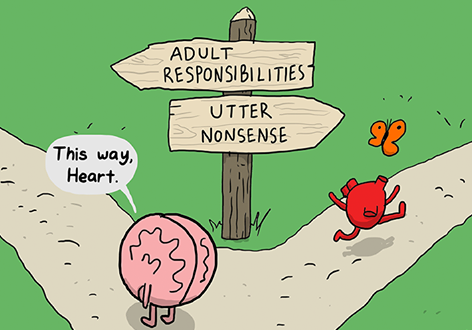
Brain vs Heart, from: theawkwardyeti.com

Here’s an interesting editorial from a “Christian” left blog. (H/T Acton Institute)

The author, Tad Hopp is graduating a PCUSA seminary – an extremely liberal, left-wing denomination.

He writes:

I graduated college in 2007.

[…] I majored in English, not exactly what most people consider a ‘marketable’ or ‘practical’ degree…

[…]I went to a somewhat expensive private school…

[…]I did what many students in their last year of high school do: I went to the school where I felt I was being called…

[…]I do not regret my four years at my undergraduate institution one bit.

[….]When I graduated college, I owed nearly $50,000 in student loan debt and was unemployed for almost six months before I finally found a low-paying office job.

[…]“Can’t find a job? Well, you should have majored in something more ‘practical’, like economics or business or medicine.” Yeah, that would be great…if those were the subjects where my skills and passions lie. They’re not.

[…]I felt called to go to seminary.

[…]I will graduate seminary with close to six figures worth of student loan debt.

Let’s take stock of what he’s said so far:

  • he studied English, a language that he already spoke, which has one of the lowest employment rates
  • he was warned by people who knew something about earning and saving money not to study English
  • he went to a school he couldn’t afford to go to, and he graduated with $50,000 in debt
  • he went to seminary, another subject that doesn’t pay, and added another $50,000 or so of debt
  • he says that he doesn’t have to study subjects that lead to a career because he isn’t “passionate” about them
  • he “followed his heart” by going to the school that he had mystical, emotional, intuitions about = “calling”

My advice to Tad at this point would be for him to take the Bible seriously when it says this:

2 Thessalonians 3:10:

10 For even when we were with you, we used to give you this order: if anyone is not willing to work, then he is not to eat, either.

And 1 Timothy 5:8:

8 But if anyone does not provide for his own, and especially for those of his household, he has denied the faith and is worse than an unbeliever.

The Bible is giving us the goal of working. So what should we do to be able to reach that goal? Why should anyone hire us? What is working really about? It’s those kinds of questions that should guide what we study in school, and what jobs we pursue.

We know what careers have the highest starting salaries and mid-career salaries:

Starting and Mid-Career salaries by profession (click for larger image)

(Source)

Why do some people get paid more than others? The answer is supply and demand. Prices are a way of determining what is most valued by your fellow man. Business owners pay more to people who offer their customers more value. If you really want to serve your neighbor, you have to learn something they really want, but can’t easily obtain. And then you will be paid more. You can’t do what makes you happy. You have to do what makes customers happy. That’s how the free market works – you make money when you provide something of value to others. You make money when you serve others. This is something that is very hard for self-centered, feelings-driven young progressives to grasp. But it’s something older Americans all know.

More Tad:

Is the PCUSA doing anything to address this crisis?

[…]What has our government done to address this issue?

[…]I, like so many in my generation, voted for Obama…

[…]It seems to me that we’ve bought into the lie that student loan debt is brought on by the individual person…

[…]You know what I think might stimulate the economy? Automatically cancelling every single outstanding student loan!

He insists that the results of his own choices aren’t his fault. But didn’t he make the choices about what to study? Didn’t he make the choice to follow his heart? Didn’t he disregard the advice of people who urged him to be practical? Who is to blame, if not he, himself?

Tad needs to push away all his friends who told him to “follow his heart” and stick close by his friends who told him to focus on providing value to others. Don’t look for advice from dreamers, look for advice from doers. Dreamers talk. But doers have demonstrated the ability to create plans that work to achieve results.

By the way, some of you might be wondering how serious this person was about his Christianity. Well, in another post, he comes out as gay. So clearly the Bible is being interpreted in a way where feelings are overturning the plain meanings of words. People who read the Bible closely never come away with the message that they should follow their hearts.

J.P. Moreland asks: does truth matter when choosing a religion?

Christian Apologist March Madness Tournament
Please help me in the Christian Apologist March Madness Tournament

Since I’m facing off against J. P. Moreland in the Apologetics March Madness tournament (click here), I thought I’d re-post one of my favorite J. P. Moreland posts. I’m asking for your vote, although right now, he is leading 75-25 and it doesn’t look good. The poll runs to the end of Friday.

This lecture contains Moreland’s famous “Wonmug” illustration. If you don’t know who Wonmug is, you can find out in this lecture.

The MP3 file is here.

Topics:

  • Is it intolerant to think that one religion is true?
  • Is it more important to be loving and accepting of people regardless of worldview?
  • How should Christians approach the question of religious pluralism?
  • How does a person choose a religion anyway?
  • Who is Wonmug, and would you like to be like Wonmug?
  • Is it enough that a belief “works for you”, or do you want to believe the truth?
  • Can all the religions in the world be true?
  • Is it wise to pick and choose what you like from all the different religions?
  • Is it possible to investigate which religion is true? How?
  • Which religions are testable for being true or false?
  • How you can test Christianity historically (very brief)

I’m posting this, because I’ve noticed that there’s an awful lot of cultural Christianity in red states. Basically, if you ask someone if they are a Christian, and they say yes, they don’t usually mean that they think it’s true and that they’ve investigated whether it’s true. They usually just mean that they like it, or it makes them feel good, or that’s how they were raised, etc. My worry about this is that if Christianity isn’t adopted because it’s true, then no one is going to do any work or self-sacrifice for it. And I think that Christianity won’t survive the challenges of the secular culture if parents and pastors don’t understand that Christianity will require work, if it’s going to be presented to people as TRUE in a persuasive way.

Why is truth important? People are willing to invest in projects self-sacrificially if they think that they are involved in something true. So, you might enroll in a chemistry program in college because you expect to come out with true beliefs about chemistry. You’ll do the work and solve the problems because you think that chemistry is real. But if you think that chemistry is just made up nonsense with no use at all, you’re probably not going to work at it and sacrifice for it. You’ll probably just find something else to do with your life that’s easier and more fun. That’s why the truth question is really important.