Tag Archives: Tolerance

Are Campus Crusade and IVCF still Christian? Or are they just leftists?

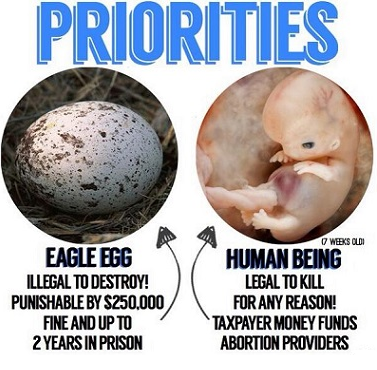
Eagle eggs are protected, unborn babies are not

The latest news is about IVCF’s rejection of the pro-life cause.

Here is an article from Touchstone magazine.

It says:

Happy New Year, Everyone! Urbana 2015 ended on January 1, 2016. Urbana is a triennial major Christian (mostly Evangelical) student missions conference in St. Louis, Missouri, sponsored by InterVarsity Christian Fellowship (“InterVarsity”), primarily for college and graduate students.

[…][O]ne of the speakers prominently featured at Urbana was the “Rev.” Michelle Higgins. “Rev.” Higgins is the director of Faith for Justice, an advocacy group in St. Louis (she also serves as worship director at South City Church). Ms. Higgins is active in the #BlackLivesMatter movement in the St. Louis area.

[…]“Rev.” Higgins… described the pro-life movement as merely “a big spectacle.” In her remarks, she said:

We could end the adoption crisis tomorrow. But we’re too busy arguing to have abortion banned. We’re too busy arguing to defund Planned Parenthood. We are too busy withholding mercy from the living so that we might display a big spectacle of how much we want mercy to be shown to the unborn. Where is your mercy? What is your goal and only doing activism that is comfortable?

[…]Government statistics estimate that more than 16 million black babies have been murdered in the womb since the Supreme Court’s Roe v. Wade decision of 1973, a number quite a bit larger than the number of unarmed black men killed by police.

Not to mention the racist origins of Planned Parenthood, which was born out of the eugenics movement. Keep in mind that Christians are supposed to speak out against premarital sex, and for taking in unwanted children – that’s what the early church did. But at IVCF, we have women telling us that Planned Parenthood’s views on premarital sex and abortion are not to be challenged. The Bible is wrong, and Planned Parenthood is right. Because feelings.

Its often the case that the pro-abortion activists like to slander pro-lifers for not caring about women and not caring about children after they are born. But it’s not true of course, and you can read the reasons why in this Public Discourse post.

Campus Crusade, too

Previously, I wrote about how conservative professor Mike Adams is annoyed with Campus Crusade, let’s see why.

He wrote his first article to complain that campus clubs like Crusade don’t take stands on obvious moral issues like abortion.

He wrote:

Several years ago, a good friend of mine named Dave Sterrett gave a pro-life speech to a Campus Crusade chapter at a state university in North Texas. He was invited to speak by a student. During the middle of his speech, he was arguing that the unborn are fully human and have souls by quoting from the Gospel of Luke. His talk was clearly Biblical and not political in nature.

Nonetheless, when the Campus Crusade director arrived, he rudely shut the speech down.

The Campus Crusade director told Dave to come out in the hall after he shut down his talk. The Crusade leader then began to yell at Dave and told him, “I don’t know what your deal is talking about this issue. Get your books and get out of here.” He went even further calling the headquarters of Crusade, which then demanded an apology from Sterrett.

Shortly after I wrote about the incident, several members of Campus Crusade contacted me – but not to apologize for their mistreatment of Dave. They emailed to admonish me for writing about the incident – even though I did not call out the university or the chapter director by name. The fallout from the incident was revealing. It shows how far some campus ministries will go to avoid controversy – and that they often consider themselves to be above reproach.

The original incident was also revealing. The censored speech was not political so the problem cannot be that Campus Crusade is not a “politically-based” organization. The speech was morally and Biblically based. Does the rejection of the speech mean that Campus Crusade is not a “morally-based” organization? Or does it mean they are not a “Biblically-based” organization?

Of course it doesn’t. The incident merely shows that Campus Crusade has become a “comfort-based” organization. In other words, an over-riding priority is avoiding topics that might make people feel uncomfortable.

Here is the second article. He writes about how Crusade made a deal to remove Christian elements from a gathering in order to get government funding, then writes about this lady who stood up for free speech:

Subsequently, at the very school where Campus Crusade traded its religious freedom for student government funding, there was a lawsuit over a campus speech code. One of the plaintiffs was a fine Christian woman who fought to overturn a speech code that was being used to suppress conservative speech and which also posed a grave threat to religious organizations.

After she sued, homosexual groups erupted in anger – falsely claiming that she was defending “hate speech” by opposing the speech code. They defamed her, physically threatened her, and verbally abused her –all in the name of tolerance and diversity.

This time, Campus Crusade did not remain neutral. They weighed in. But, unbelievably, they weighed in against the Christian woman and in favor of those defending the speech codes.

This is the part I really think is important:

Right after these unfortunate events unfolded I became embroiled in my own First Amendment lawsuit. In part, because I stood in unity with Christians and defended them against illegal policies, I was denied a promotion at my school.

With the support of numerous Christian organizations, I eventually won the seven-year legal battle. Two Christian legal firms paid my legal bills and countless other Christian ministry and policy groups publicly backed me. But one Christian organization remained conspicuously silent. Of course, I am speaking of… the Crusade formerly named after Christ.

For seven long years I heard not a single word of public support from a single member of Campus Crusade. When I won the case, I was deluged with calls and emails and handwritten letters from Christian leaders all across America.

But I heard not a word from Campus Crusade for months in the wake of the verdict.

Then, in mid-July, the final terms of my settlement were reached. It was reported in the local news that I would get a raise and a check for back pay while may attorneys would get a sum of $615,000. On August 1, 2014, I received the check from the State of North Carolina. On August 2, just 24 hours later, one of the local directors for Campus Crusade wrote me the following:

“Hey Mike. I hope your summer is going well. Would you be interested in having coffee with me next week so I could talk to you about joining my ministry support team?”

After I received that audacious email, I searched through my archives and read every single email correspondence I had received from that director over the course of seven years. There was no offer of prayer support in any of those emails. Nor was there any mention of the legal ordeal I was going through. He simply ignored the suit until the terms of the settlement became public.

In other words, your ministry and its leaders were never interested in unity. They never offered support in public or even in private. They only sought to profit financially from those who win battles Campus Crusade chooses to avoid.

The reason I am linking to this is because I experienced this kind of behavior from IVCF and Campus Crusade as an undergraduate and later as a graduate student. They opposed the introduction of apologetics at every point, and they were both anxious to embrace the secular left, especially radical feminism, global warming alarmism, gay rights and socialism. It was depressing. If I were a student today, I’d head straight for the College Republicans and Ratio Christi if I wanted to get anything useful done. In fact, I started this blog partly as a way of discussing issues from a Christian point of view because I could not get anything done in IVCF and Campus Crusade.

I would not give money to IVCF or Crusade or any Christian missionary / relief organization  right now. I would only give to individual chapters of Ratio Christi, and then only for specific lectures or debates. You have to watch your money like a hawk, because a lot of these leftist Christian do-gooder organizations have no Christian worldview based in the Bible.


Pro-gay web site tells real story of the Matthew Shepard murder

I have a key that will unlock a puzzling mystery

A fascinating article from the pro-gay The Advocate.

Excerpt:

What if nearly everything you thought you knew about Matthew Shepard’s murder was wrong? What if our most fiercely held convictions about the circumstances of that fatal night of October 6, 1998, have obscured other, more critical, aspects of the case? How do people sold on one version of history react to being told that facts are slippery — that thinking of Shepard’s murder as a hate crime does not mean it was a hate crime? And how does it color our understanding of such a crime if the perpetrator and victim not only knew each other but also had sex together, bought drugs from one another, and partied together?

None of this is idle speculation; it’s the fruit of years of dogged investigation by journalist Stephen Jimenez, himself gay. In the course of his reporting, Jimenez interviewed over 100 subjects, including friends of Shepard and of his convicted killers, Aaron McKinney and Russell Henderson, as well as the killers themselves (though by the book’s end you may have more questions than answers about the extent of Henderson’s complicity).  In the process, he amassed enough anecdotal evidence to build a persuasive case that Shepard’s sexuality was, if not incidental, certainly less central than popular consensus has lead us to believe.

And here are the details:

But in what circumstances does someone slam a seven-inch gun barrel into their victim’s head so violently as to crush his brain stem? That’s not just flipping out, that’s psychotic — literally psychotic, to anyone familiar with the long-term effects of methamphetamine. In court, both the prosecutor and the plaintiffs had compelling reasons to ignore this thread, but for Jimenez it is the central context for understanding not only the brutality of the crime but the milieu in which both Shepard and McKinney lived and operated.

By several accounts, McKinney had been on a meth bender for five days prior to the murder, and spent much of October 6 trying to find more drugs. By the evening he was so wound up that he attacked three other men in addition to Shepard. Even Cal Rerucha, the prosecutor who had pushed for the death sentence for McKinney and Henderson, would later concede on ABC’s 20/20 that “it was a murder that was driven by drugs.”
No one was talking much about meth abuse in 1998, though it was rapidly establishing itself in small-town America, as well as in metropolitan gay clubs, where it would leave a catastrophic legacy. In Wyoming in the late 1990s, eighth graders were using meth at a higher rate than 12th graders nationwide. It’s hardly surprising to learn from Jimenez that Shepard was also a routine drug user, and — according to some of his friends — an experienced dealer. (Although there is no real evidence for supposing that Shepard was using drugs himself on the night of his murder).

Despite the many interviews, Jimenez does not entirely resolve the true nature of McKinney’s relationship to Shepard, partly because of his unreliable chief witness. McKinney presents himself as a “straight hustler” turning tricks for money or drugs, but others characterize him as bisexual. A former lover of Shepard’s confirms that Shepard and McKinney had sex while doing drugs in the back of a limo owned by a shady Laramie figure, Doc O’Connor. Another subject, Elaine Baker, tells Jimenez that Shepard and McKinney were friends who had been in sexual threesome with O’Connor. A manager of a gay bar in Denver recalls seeing photos of McKinney and Henderson in the papers and recognizing them as patrons of his bar. He recounts his shock at realizing “these guys who killed that kid came from inside our own community.”

Not everyone is interested in hearing these alternative theories. When 20/20 engaged Jimenez to work on a segment revisiting the case in 2004, GLAAD bridled at what the organization saw as an attempt to undermine the notion that anti-gay bias was a factor; Moises Kaufman, the director and co-writer of The Laramie Project, denounced it as “terrible journalism,” though the segment went on to win an award from the Writers Guild of America for best news analysis of the year.

There are valuable reasons for telling certain stories in a certain way at pivotal times, but that doesn’t mean we have to hold on to them once they’ve outlived their usefulness. In his book, Flagrant Conduct, Dale Carpenter, a professor at the University of Minnesota Law School, similarly unpicks the notorious case of Lawrence v. Texas, in which the arrest of two men for having sex in their own bedroom became a vehicle for affirming the right of gay couples to have consensual sex in private. Except that the two men were not having sex, and were not even a couple. Yet this non-story, carefully edited and taken all the way to the Supreme Court, changed America.

In different ways, the Shepard story we’ve come to embrace was just as necessary for shaping the history of gay rights as Lawrence v. Texas; it galvanized a generation of LGBT youth and stung lawmakers into action. President Obama, who signed the Hate Crimes Prevention Act, named for Shepard and James Byrd Jr., into law on October 28, 2009, credited Judy Shepard for making him “passionate” about LGBT equality.

I think that it’s good that The Advocate posted this correction to the story. I admire them for being willing to tell the truth about the story. However, note that the author is not sorry that a fake version of the case was used to push the gay agenda forward. Now what if the same willingness to twist the truth was shared by the gay activists who are redefining the issues in the culture as a whole? What if the people who are pushing the gay agenda in schools, in the media, in the workplace, and elsewhere, had the same willingness to twist the truth in order to advance their cause?

It’s also helpful to understand the media bias angle of this story. Are they really interested in telling the truth? Or is there something else going on there? How much of a story was the attack on the Family Research Council building by a gun-wielding gay activist compared to the Matthew Shepard story? How much of a story is the persecution of Christians in the Middle East compared to the Matthew Shepard story? How much of a story is the loss of basic human rights like free speech and religious liberty here at home when compared to the Matthew Shepard story?

Breitbart has more about what really happened to Matthew Shepard.

Self-refuting statements defined and some common examples

A conflict of worldviews

A fine article by Aaron, who writes at Apologetics Junkie.

Excerpt:

A self-defeating (or self-refuting) statement is one that fails to meet its own standard. In other words, it is a statement that cannot live up to its own criteria. Imagine if I were to say,

I cannot speak a word in English.

You intuitively see a problem here. I told you in English that I cannot speak a word in English. This statement is self-refuting. It does not meet its own standard or criteria. It self-destructs.

The important thing to remember with self-defeating statements is that they are necessarily false. In other words, there is no possible way for them to be true. This is because they violate a very fundamental law of logic, the law of non-contradiction. This law states that A and non-A cannot both be true at the same time and in the same sense. For example, it is not possible for God to exist and not exist at the same time and in the same sense. This would violate the law of non-contradiction. So if I were to say, “God told me He doesn’t exist” you would see intuitively the obvious self-refuting nature of this statement.

Aaron goes on to explain how to deal with self-refuting statements in the article.

Here are 20 examples of self-refutation, just to encourage you to click through and read it:

1. There is no truth.

2. You can’t know truth.

3. No one has the truth.

4. All truth is relative.

5. It’s true for you but not for me.

6. There are no absolutes.

7. No one can know any truth about religion.

8. You can’t know anything for sure.

9. You should doubt everything.

10. Only science can give us truth.

11. You can only know truth through experience.

12. All truth depends on your perspective.

13. You shouldn’t judge.

14. You shouldn’t force your morality on people.

15. You should live and let live.

16. God doesn’t take sides.

17. You shouldn’t try to convert people.

18. That’s just your view.

19. You should be tolerant of all views.

20. It is arrogant to claim to have the truth.

Aaron explains how to respond to each of those! Read them all – it’s important to know, because you hear these all the time.

Add yours in the comments!