
Tag Archives: Theistic Evolution

William Dembski reviews a new book by two theistic evolutionists

From Patheos, an opening statement by William Dembski. This is the first part of a four-part debate with two scientists of the Biologos group, which advocates for theistic evolution. (And not to be confused with the Biologic Institute, which is supportive of intelligent design).

Excerpt:

Throughout their book, Giberson and Collins overconfidently proclaim that Darwinian evolution is a slam-dunk. Thus one reads, “There has been no scientific discovery since Darwin–not one–which has suggested that evolution is not the best explanation for the origin of species” (21-22). No theory is that good. Every theory admits anomalies. Every theory faces disconfirming evidence. Repeatedly readers are informed that mountains of overwhelming evidence support Darwin’s theory and that the authors are “unfamiliar with any premier scientists who reject evolution.” And just so there’s no doubt, in that same paragraph, they reiterate, “There are certainly a few scientists who reject evolution . . . But these are never premier scientists.”

Oh, you reject Darwinian evolution; you can’t be a premier scientist. What counterexample would convince Giberson and Collins to retract such a claim? How about Henry Schaefer’s signature on a “Dissent from Darwin” list? Schaefer heads the computational quantum chemistry lab at the University of Georgia, has published over a thousand peer-reviewed journal articles, and is one of the most widely cited chemists in the world. Then again, Giberson and Collins look askance at this list (according to them, it has too many emeriti professors and not enough biologists). But why engage in such posturing about scientific pecking order in the first place? The issue is not who’s doubting Darwinism, but what are the arguments for and against it and whether they have merit. Giberson and Collins’ constant drumming of mainstream and consensus science is beside the point–science progresses by diverging from the mainstream and by breaking with consensus.

Because Giberson and Collins assert that natural selection is such a powerful mechanism for driving evolution–and one that admits no reasoned dissent–it’s worth recounting here briefly why the intelligent design community is so skeptical of it. It’s not, as theistic evolutionists often suggest, that we have a desperate need to shore up faith and morality and are using ID as our instrument of choice to accomplish that end. Rather, it’s that natural selection is, in essence, a trial and error tinkering mechanism for which all evidence suggests that its power is quite limited. Trial and error works fine when you have something that’s functional and are trying to enhance it or adapt it to a new situation.

But for natural selection, as a trial and error mechanism, to traverse vast swatches of biological function space, we need to see an extended series of small gradual structural changes (under neo-Darwinism, these are genetic mutations leaving effects at the phenotypic level) that continually improve, or at least maintain, function, with evolving functions and evolving structures covarying and reinforcing each other. But we know of no detailed testable (macro-)evolutionary pathways like this in any field, whether in the evolution of living forms or in the evolution of language or in the evolution of technologies. In fact, when we can trace such evolutionary pathways, we find that significant change happens in creative leaps, not via trial and error tinkering.

Everyone who has read Dembski’s opening remarks in this four-part series is raving about the quality of what he’s written. I was hoping to wait for the response before publishing his opening salvo, so we could balance it, but no reply has appeared yet. For me, there is only one issue in the debate about the origin of life: if natural causes can create life from non-life with the time and resources available on the early Earth, then show me the mechanism. That’s all I want to see – the evidence that natural causes can do the creating that the naturalists say that it can do. I don’t want to hear about feelings, possibilities, what God could or couldn’t do, philosophy, what church you attend, your favorite hymn, the way you were raised, your religious experiences, etc. I just want to see you prove that nature can do all the creating that you say it can do.
Can intelligent design be front-loaded at the creation of the universe?

Structure of DNA
Structure of DNA

This video introduction to intelligent design packs a lot of information into a very small video. (H/T Brian Auten from Apologetics 315)

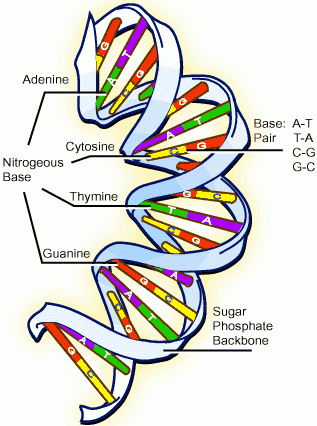
When it comes to the science of DNA, theistic evolutionists and atheists agree: matter, law and chance are sufficient to evolve DNA. No intelligence is needed to sequence the base pairs or the amino acids. That agreement that intelligent causes are not needed to explain DNA is why I call theistic evolution “functional atheism”.

Theistic evolutionists express subjective opinions about God that no one can investigate using science. These untestable opinions about God are similar to the opinions of little children about Santa Claus. And yet they insist that they be taken seriously alongside the people who actually think Christianity is objective knowledge, not subjective opinion.

To defuse a theistic evolutionist, simply ask them for  fully materialistic and naturalistic explanation for the first living organism – the origin of life. And then watch how they avoid answering the question. For even Richard Dawkins has no idea how life could begin, if only purely naturalistic, materialistic causes are allowed in the explanation.

Theistic evolutionists hate talking about evidence. They want to talk their private feelings and beliefs and experiences in order to reassure you that they are just like you. Don’t let them talk about religion – stick to what science can show. Demand evidence that the material processes can do the creating that the theistic evolutionists think that material processes can do.

Here’s an easy article that you can read that explains a bit more about what the video discussed. Here is one is a bit more difficult. These are mentoring articles for Christians.

If you want to read some serious research, then read this post and listen to this interview which are both about the work of Doug Axe.

Do leading evolutionists think that evolution is compatible with God?

Here is a post from Jerry Coyne’s blog: http://whyevolutionistrue.wordpress.com/2010/07/17/selective-creationists/. (H/T Retha from Christian Rethinker)

Coyne is a radical atheist and evolutionist. And he is also a very prominent biologist.

He writes:

Only a tad more than one in four teachers really accepts evolution as scientists conceive of it: a naturalistic process undirected by divine beings.  Nearly one in two teachers thinks that humans evolved but that God guided the process.

Can we count those 48% of “guided-by-Godders” 0n our side?  I agree with P. Z.: the answer is NO.  Yes, they do accept that our species changed genetically over time, but they see God as having pulled the strings.  That’s not the way evolution works.   The graph labels these 48% as believers in intelligent design, and that’s exactly what they are, for they see God as nudging human evolution toward some preconceived goal.  We’re designed.  These people are creationists: selective creationists.

To count them as allies means we make company with those who accept evolution in a superficial sense but reject it in the deepest sense.  After all, the big revolution in thought wrought by Darwin was the recognition that the appearance of design—thought for centuries to be proof of God—could stem from purely natural processes.   When we cede human evolution to God, then, we abandon that revolution.  That’s why I see selective creationists like Kenneth Miller, Karl Giberson and Francis Collins as parting company with modern biological thought.

Just to let you know, Ken Miller and Francis Collins do not think that science can perform experiments and detect that an intelligent cause is the best explanation for some effect in nature. They are committed to explaining every effect in nature as the result of natural processes, before they ever sit down in front of a microscope to look and see. That is their faith commitment – naturalism. I.e. – God didn’t do anything in nature that we can know about using objective measuring.

Theistic evolution versus atheism

Who was the foremost evangelical proponent of theistic evolution? Well, one of them was Howard Van Till of Calvin College. Why do I say “was”? Take a look at this event he did for a FREETHOUGHT group a while back.

Excerpt:

FROM CALVINISM TO FREETHOUGHT: The Road Less Traveled
by Howard J. Van Till

Professor of Physics and Astronomy, Emeritus
Calvin College
Presented 5/24/2006 for the Freethought Association of West Michigan
Lightly edited 5/26/2006

Precis: Born into a Calvinist family, shaped by a Calvinist catechism training, educated in the Calvinist private school system, and nurtured by a community that prized its Calvinist systematic theology, I was a Calvinist through and through. For 31 years my
teaching career was deeply rooted in the Calvinism I had inherited from my community.

During most of that time it was a fruitful and satisfying experience. Nonetheless, stimulated in part by the manner in which some members of that community responded to my efforts to practice what I had learned from my best teachers, I eventually felt the need to extend my intellectual exploration into philosophical territories far outside the one provided by Calvinism. Did I complete the lengthy journey from Calvinism to Freethought? The listener will be the judge.

Freethought is atheism, by the way.

I think that either God can interfere or he can’t. Theistic evolutionists and atheists think that he can’t intervene – at least not in a way that is independent of “faith” – by which they mean blind belief ungrounded by evidence. What theistic evolutionists are really saying is that God interferes where we can’t test in a lab (the resurrection), and he doesn’t interfere in the area that they can test in a lab (science). This allows them to appease their wives and churches with pronunciations of orthodox beliefs (of course I believe in miracles, honey), and also to appease their scientific colleagues (God didn’t do anything that we can know objectively). Well. Isn’t that convenient for them AND THEIR CAREERS as scientists?