

Tag Archives: Theism

William Lane Craig’s moral argument, and five objections to it

Which argument for God is the most accessible? To really sustain the cosmic beginning argument and the cosmic fine-tuning argument, you have to learn some scientific evidence. Same for the resurrection of Jesus – you have to learn some history. But what about the moral argument? All you need to make that argument is for your opponent to think that something is morally wrong.

First, let’s review the moral argument, from William Lane Craig.

He writes:

We are going to turn now to a discussion of the moral argument for the existence of God. So far we have been looking at philosophical and scientific arguments. This is an ethical argument. There are a wide variety of moral reasons for believing in God, but this is a particularly simple moral argument that I have used over and over again with university students and I find very effective. It really grabs people where they live. This is not just a matter of scientific evidence or philosophical issues that may not impact your life. This is an issue that is vitally important because everyday as you live you make moral choices. So everyday by your behavior you answer the question whether or not you believe that God exists. The argument consists basically of three simple steps:

1. If God does not exist, objective moral values do not exist.

2. Objective moral values do exist.

3. Therefore, God exist.

That is a very simple argument for the existence of God and is easy to memorize. It is just three steps. It is logically valid. If those two premises are true then the conclusion follows necessarily and logically. The only question is: are the two premises true?

But there are some objections to the moral argument. CrossExamined.org has posted a list of five objections to the moral argument from philosopher Paul Rezkalla.

Here are the 5 points:

  1. “But I’m a moral person and I don’t believe in God. Are you saying that atheists can’t be moral?”
  2. “But what if you needed to lie in order to save someone’s life? It seems that morality is not absolute as you say it is.”
  3. ‘Where’s your evidence for objective morality? I won’t believe in anything unless I have evidence for it.’
  4. ‘If morality is objective, then why do some cultures practice female genital mutilation, cannibalism, infanticide, and other atrocities which we, in the West, deem unacceptable?’
  5.  ‘But God carried out many atrocities in the Old Testament. He ordered the genocide of the Canaanites.’

That last one seems to be popular, so let’s double-check the details:

For starters, this isn’t really an objection to the moral argument. It does not attack either premise of the argument. It is irrelevant, but let’s entertain this objection for a second. By making a judgement on God’s actions and deeming them immoral, the objector is appealing to a standard of morality that holds true outside of him/herself and transcends barriers of culture, context, time period, and social norms. By doing this, he/she affirms the existence of objective morality! But if the skeptic wants to affirm objective morality after throwing God out the window, then there needs to be an alternate explanation for its basis. If not God, then what is it? The burden is now on the skeptic to provide a naturalistic explanation for the objective moral framework.

If you have heard any of these objections before when discussing the moral argument, click through and take a look.

And if you have a non-Christian in your life who likes to make moral statements, it’s a good conversation to have. Where does your standard come from? Is it from your own desires? Is it from cultural conventions, that vary by time and place? Is it from Darwinian evolution? Find out what the answer is, and then respond to it.
Study: galactic habitable zone depends on fine-tuning of cosmological constant

This is going to be old news to readers of this blog who are familiar with the Michael Strauss, Walter Bradley and Guillermo Gonzalez lectures on habitability and fine-tuning. But, it’s nice to see these ideas show up in one of the most prestigious peer-reviewed science journals in the world (if not the most prestigious).

Here’s the article from Science.

It says:

Scientists have known for several years now that stars, galaxies, and almost everything in the universe is moving away from us (and from everything else) at a faster and faster pace. Now, it turns out that the unknown forces behind the rate of this accelerating expansion—a mathematical value called the cosmological constant—may play a previously unexplored role in creating the right conditions for life.

That’s the conclusion of a group of physicists who studied the effects of massive cosmic explosions, called gamma ray bursts, on planets. They found that when it comes to growing life, it’s better to be far away from your neighbors—and the cosmological constant helps thin out the neighborhood.

“In dense environments, you have many explosions, and you’re too close to them,” says cosmologist and theoretical physicist Raul Jimenez of the University of Barcelona in Spain and an author on the new study. “It’s best to be in the outskirts, or in regions that have not been highly populated by small galaxies—and that’s exactly where the Milky Way is.”

Jimenez and his team had previously shown that gamma ray bursts could cause mass extinctions or make planets inhospitable to life by zapping them with radiation and destroying their ozone layer. The bursts channel the radiation into tight beams so powerful that one of them sweeping through a star system could wipe out planets in another galaxy. For their latest work, published this month in Physical Review Letters, they wanted to apply those findings on a broader scale and determine what type of universe would be most likely to support life.

The research is the latest investigation to touch on the so-called anthropic principle: the idea that in some sense the universe is tuned for the emergence of intelligent life. If the forces of nature were much stronger or weaker than physicists observe, proponents note, crucial building blocks of life—such fundamental particles, atoms, or the long-chain molecules needed for the chemistry of life—might not have formed, resulting in a sterile or even completely chaotic universe.

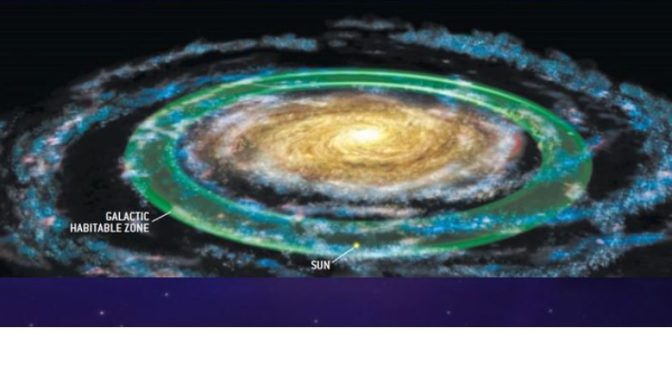
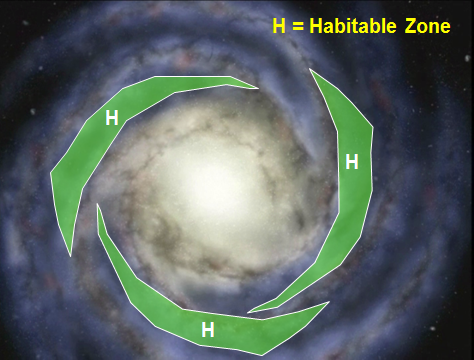
Basically, the best place for a galaxy that permits complex, embodied life to exist is one where you can pick up enough heavy elements from dying stars nearby, but not be in an area that is so crowded by stars that you will be wiped out by intense gamma radiation when they die. So, you want to be between the “arms” of a spiral galaxy, close enough to the areas with a lot of stars, and not too far away. But you can only get that pattern of stars if the universe is expanding at the right rate.

More:

As it turns out, our universe seems to get it just about right. The existing cosmological constant means the rate of expansion is large enough that it minimizes planets’ exposure to gamma ray bursts, but small enough to form lots of hydrogen-burning stars around which life can exist. (A faster expansion rate would make it hard for gas clouds to collapse into stars.)

Jimenez says the expansion of the universe played a bigger role in creating habitable worlds than he expected. “It was surprising to me that you do need the cosmological constant to clear out the region and make it more suburbanlike,” he says.

Remember, this is only one of many characteristics that must obtain in order for a have a location in the universe that can support complex, embodied life of any conceivable kind.

The galactic habitable zone (GHZ) is shown in green against a spiral galaxy

Let’s review the big picture

Time for me to list out some of the things that are required for a galaxy, solar system and planet to support complex embodied life. Not just life as we know it, but life of any conceivable kind given these laws of physics.

  • a solar system with a single massive Sun than can serve as a long-lived, stable source of energy
  • a terrestrial planet (non-gaseous)
  • the planet must be the right distance from the sun in order to preserve liquid water at the surface – if it’s too close, the water is burnt off in a runaway greenhouse effect, if it’s too far, the water is permanently frozen in a runaway glaciation
  • the solar system must be placed at the right place in the galaxy – not too near dangerous radiation, but close enough to other stars to be able to absorb heavy elements after neighboring stars die
  • a moon of sufficient mass to stabilize the tilt of the planet’s rotation
  • plate tectonics
  • an oxygen-rich atmosphere
  • a sweeper planet to deflect comets, etc.
  • planetary neighbors must have non-eccentric orbits

And remember, these requirements for a habitable planet are downstream from the cosmic fine-tuning of constants and quantities that occurs at the Big Bang. No point in talking about the need for plate tectonics if you only have hydrogen in your universe. The habitability requirements are a further problem that comes after the fine-tuning problem.

William Lane Craig debates Austin Dacey: Does God Exist?

Here is the video and summary of a debate between Christian theist William Lane Craig and Austin Dacey at Purdue University in 2004 about the existence of God.

The debaters:

The video: (2 hours)

The video shows the speakers and powerpoint slides of their arguments. Austin Dacey is one of the top atheist debaters, and I would put him second to Peter Millican alone, with Walter Sinnott-Armstrong in third place. This is the debate to show people who are new to apologetics. The debate with Peter Millican is better for advanced students, and that’s no surprise since he teaches at Oxford University and is familiar with all of Dr. Craig’s work. The Craig-Dacey debate is the one that I give to my co-workers.

By the way, you can get the DVDs and CDs for the first Craig-Dacey debate and the second Craig-Dacey debate and the second Craig-Sinnott-Armstrong debate. The Peter Millican debate is not available on DVD, but the link above (Peter Millican) has the video and my summary.

Dr. Dacey’s 5 arguments below are all good arguments that you find in the academic literature. He is also an effective and engaging speaker, This is a great debate to watch!

SUMMARY of the opening speeches:

Dr. Craig’s opening statement:

Dr. Craig will present six reasons why God exists:

  1. (Contingency argument) God is the best explanation of why something exists rather than nothing
  2. (Cosmological argument)  God’s existence is implied by the origin of the universe
  3. (Fine-tuning argument) The fine-tuning of the universe for intelligent life points to a designer of the cosmos
  4. (Moral argument) God is the best explanation for the existence of objective moral values and objective moral duties
  5. (Miracles argument) The historical facts surrounding the life, death and resurrection of Jesus
  6. (Religious experience) God’s existence is directly knowable even apart from arguments

Dr. Dacey’s opening argument:

There are two ways to disprove God’s existence, by showing that the concept of God is self-contradictory, or by showing that certain facts about ourselves and the world are incompatible with what we would expect to be true if God did exist. Dr. Dacey will focus on the second kind of argument.

  1. The hiddenness of God
  2. The success of science in explaining nature without needing a supernatural agency
  3. The dependence of mind on physical processes in the brain
  4. Naturalistic evolution
  5. The existence of gratuitous / pointless evil and suffering

One final point:

One thing that I have to point out is that Dr. Dacey quotes Brian Greene during the debate to counter Dr. Craig’s cosmological argument. Dr. Craig could not respond because he can’t see the context of the quote. However, Dr. Craig had a rematch with Dr. Dacey where was able to read the context of the quote and defuse Dr. Dacey’s objection. This is what he wrote in his August 2005 newsletter after the re-match:

The following week, I was off an another three-day trip, this time to California State University at Fresno. As part of a week of campus outreach the Veritas Forum scheduled a debate on the existence of God between me and Austin Dacey, whom I had debated last spring at Purdue University. In preparation for the rematch I adopted two strategies: (1) Since Dacey had come to the Purdue debate with prepared speeches, I decided to throw him for a loop by offering a different set of arguments for God, so that his canned objections wouldn’t apply. I chose to focus on the cosmological argument, giving four separate arguments for the beginning of the universe, and on the evidence for Jesus’ resurrection. (2) I reviewed our previous debate carefully, preparing critiques of his five atheistic arguments. In the process I found that he had seriously misunderstood or misrepresented a statement by a scientist on the Big Bang; so I brought along the book itself in case Dacey quoted this source again. I figured he might change his arguments just as I was doing; but I wanted to be ready in case he used his old arguments again.

[…]The auditorium was packed that night for the debate, and I later learned that there were overflow rooms, too. To my surprise Dr. Dacey gave the very same case he had presented at Purdue; so he really got clobbered on those arguments. Because he wasn’t prepared for my new arguments, he didn’t even respond to two of my arguments for the beginning of the universe, though he did a credible job responding to the others. I was pleased when he attacked the Big Bang by quoting the same scientist as before, because I then held up the book, specified the page number, and proceeded to quote the context to show what the scientist really meant.

Dr. Craig is always prepared!