From Breitbart. (Note the Youtube video is about 9 minutes long, so I don’t recommend sitting through the whole thing)
Excerpt:
A YouTube video uploaded on Monday afternoon apparently shows a schoolteacher from the Rowan-Salisbury school district in North Carolina informing a student that failing to be respectful of President Obama is a criminal offense. Breitbart News has uncovered that the student is a high school junior, and that the teacher is apparently one Tanya Dixon-Neely.
The video shows a classroom discussion about the Washington Post hit piece about Mitt Romney bullying a kid some five decades ago. One student says, “Didn’t Obama bully someone though?” The teacher says: “Not to my knowledge.” The student then cites the fact that Obama, in Dreams from My Father, admits to shoving a little girl. “Stop, no, because there is no comparison,” screams the teacher. Romney is “running for president. Obama is the president.”
The student responds that both are “just men.”
The teacher yells — literally yells — that Obama is “due the respect that every other president is due … Listen,” she continues, “let me tell you something, you will not disrespect the president of the United States in this classroom.” She yells over the student repeatedly, and yells at him that it’s disrespect for him to even debate about Romney and Obama.
The student says that he can say what he wants.
“Not about him, you won’t,” says the teacher.
The teacher then tells the student – wrongly – that it is a criminal offense to say bad things about a president. “Do you realize that people were arrested for saying things bad about Bush? Do you realize you are not supposed to slander the president?”
The student says that it would violate First Amendment rights to jail someone for such sentiments. “You would have to say some pretty f’d up crap about him to be arrested,” says the student. “They cannot take away your right to have your opinion … They can’t take that away unless you threaten the president.”
Clearly, the student should be teaching the class, and the teacher should be reading the Constitution more often.
This is why taxpayers need to support school choice. There are some teachers in public schools, especially in the STEM areas, who are qualified. But there are others who are not. Education degrees are universally regarded as very easy, and very useless. We really should not be forced to fund a public school system that does not work for parents and children. Abolishing the federal Department of Education would be an excellent first step to improving the quality of education in state-run schools. We need to get the politics out of the classroom and focus on basic useful skills and career training.
Governors of both parties have promoted education reform, but so far no one has delivered more than Louisiana’s Bobby Jindal. This week he’ll sign two bills that offer a national model for competition and parental choice.
Louisiana’s new laws will essentially give all parents an average of $8,500 to use for their child’s education as they see fit. They can keep their child in their local public school, but they can also try to get Johnny into a more demanding charter school, or a virtual school, or into special language or career-training courses, among other options.
Nearly 400,000 low-income children—a bit more than half of all students—will also be eligible for vouchers to attend private schools. State officials estimate that about 2,000 students will use vouchers this September given private-school capacity limits, but that tens of thousands will do so over time.
Louisiana is also making life easier for charter schools, with new authorizing boards, a fast-track for high-performing networks, and access to facilities equal to that of traditional public schools. The new laws seek to strengthen superintendents and principals over local school boards, which are bastions of bureaucratic and union intransigence.
Nearly as dramatic are reforms in teacher tenure. To earn tenure, teachers will now have to rate in the top 10% (measured in part by student performance) for five of six consecutive years, and any teacher who falls into the bottom 10% loses tenure. No teacher in the bottom 10% can get a raise, while layoffs will no longer hit the junior-most teachers first while ignoring performance.
Mr. Jindal made school reform a second-term priority after winning a landslide re-election last November. By then he had appointed or helped elect reformers to the state superintendent’s office and board of education.
Louisiana voters also had a preview of reform’s potential. Since Hurricane Katrina in 2005, New Orleans schools have become almost exclusively charters—with dramatic academic improvements—and the city has run a small and oversubscribed voucher program since 2008. As for tenure, the reforms attach consequences to a teacher-evaluation system enacted in 2010.
The result: the reforms attracted bipartisan legislative majorities of roughly 60%. Over four votes (two different bills, each having to pass the House and Senate), one-quarter to one-half of Democrats voted for reform, including many black representatives, especially those from New Orleans.
Teachers unions were predictably opposed and even heavier-handed than usual. Michael Walker Jones of the Louisiana Association of Educators dismissed choice on grounds that “If I’m a parent in poverty I have no clue because I’m trying to struggle and live day to day.” Unions pushed principals to cancel school—sometimes giving parents less than 24 hours notice—so teachers could protest at the state Capitol. It was a tired act.
Mr. Jindal joins Indiana’s Mitch Daniels in passing the most far-reaching school reforms, and now they’ll have to follow through to produce better student outcomes. Unions will seize on any troubles as a sign of failure, but success might catalyze similar reforms across the country that could finally improve the life prospects for all American children.
Now is a good time to compare and contrast those reforms with the record of the Obama administration:
“House and Senate Appropriators this week ignored the wishes of D.C.’s mayor, D.C.’s public schools chancellor, a majority of D.C.’s city council, and more than 70 percent of D.C. residents and have mandated the slow death of the D.C. Opportunity Scholarship Program. This successful school voucher program–for D.C.’s poorest families–has allowed more than 3,300 children to attend the best schools they have ever known.
The decision to end the program, a decision buried in a thousand-page spending bill and announced right before the holidays, destroys the hopes and dreams of thousands of D.C. families. Parents and children have rallied countless times over the past year in support of reauthorization and in favor of strengthening the OSP.
Yet, despite the clearly positive results and the proven success of this program, Sen. Dick Durbin, Rep. Jose Serrano, Del. Eleanor Holmes Norton, and Secretary Arne Duncan worked together to kill the OSP. Funding the program only for existing children shrinks the program each year, compromises the federal evaluation of the program, denies entry to the siblings of existing participants, and punishes those children waiting in line by sentencing them to failing and often unsafe schools.
What is incredibly disappointing to low-income families in Washington, D.C. has been the silence of President Barack Obama. The President, who benefited from K-12 scholarships himself, worked on behalf of low-income families in Chicago, and exercises school choice as a parent, has stood silently on the sidelines while his Secretary of Education belittled the importance of helping such a small number of children in the nation’s capital.”
Another Wall Street Journal article explains why voucher programs work for children. They don’t work for teacher unions, and that’s why Democrats oppose them.
Excerpt:
In a study published last year, Patrick Wolf of the University of Arkansas found that voucher recipients had graduation rates of 91%. That’s significantly higher than the D.C. public school average (56%) and the graduation rate for students who applied for a D.C. voucher but didn’t win the lottery (70%). In testimony before a Senate subcommittee in February, Mr. Wolf said that “we can be more than 99% confident that access to school choice through the Opportunity Scholarship Program, and not mere statistical noise, was the reason why OSP students graduated at these higher rates.”
The administration downplays these findings. But the students who attend D.C. public schools are overwhelmingly black and poor, and the achievement gap has a particularly devastating impact on their communities. High school dropouts are eight times more likely than someone with a diploma to wind up behind bars. Some 60% of black male high school dropouts in their 30s have prison records. And nearly one in four young black male dropouts is in jail or juvenile detention.
Mr. Obama says he wants to help all students—not just the lucky few who receive vouchers. But that’s an argument for offering more vouchers to those in need, not for reducing school choice. Policies ought to be weighed against available alternatives, not some unattainable ideal. The alternative to a voucher for families in D.C. ghettos and elsewhere is too often a substandard public school.
The positive effects of the D.C. voucher program are not unique. A recent study of Milwaukee’s older and larger voucher program found that 94% of students who stayed in the program throughout high school graduated, versus just 75% of students in Milwaukee’s traditional public schools. And contrary to the claim that vouchers hurt public schools, the report found that students at Milwaukee public schools “are performing at somewhat higher levels as a result of competitive pressure from the school voucher program.” Thus can vouchers benefit even the children that don’t receive them.
Research gathered by Greg Forster of the Foundation for Educational Choice also calls into question the White House assertion that vouchers are ineffective. In a paper released in March, he says that “every empirical study ever conducted in Milwaukee, Florida, Ohio, Texas, Maine and Vermont finds that voucher programs in those places improved public schools.” Mr. Forster surveyed 10 empirical studies that use “random assignment, the gold standard of social science,” to assure that the groups being compared are as similar as possible. “Nine [of the 10] studies find that vouchers improve student outcomes, six that all students benefit and three that some benefit and some are not affected,” he writes. “One study finds no visible impact. None of these studies finds a negative impact.”
Such results might influence the thinking of an objective observer primarily interested in doing right by the nation’s poor children. But they are unlikely to sway a politician focused on getting re-elected with the help of teachers unions.
There is a difference between Demcorats and Republicans, and the difference is that Republicans think that children do better when their parents can choose a school that works for their child. Republicans are the evidence-based party – they do what’s right. But Democrats do whatever it takes to please their special interest groups.
Shikha Dalmia, responds to Slate’s Dahlia Lithwick, who was so, “Shell shocked by the shellacking that the Solicitor General Donald Verrilli received at the hearing Tuesday, [that] she went into a deep sulk and threw the intellectual equivalent of a hissy fit.” Shikha observes:
In our current health care system, a mix of taxpayers; (rich) hospitals/providers and (even richer) private insurers are stuck with the tab for uncompensated care. There are many problems with this. But isn’t it at least more compassionate than ObamaCare that would force asset-poor young people – trying to pay off their college debt and hang on to some beer money – to subsidize the coverage of relatively wealthier prospective geezers? If maximizing compassion is the issue, shouldn’t we stick with what we’ve got?
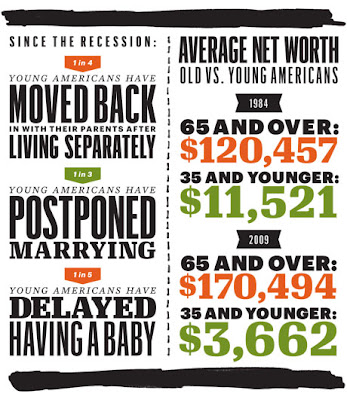
In other words, under Obamacare the young overpay for health insurance in order to subsidize the old, whose medical costs are magnitudes higher than those of the young. That is a key feature of the “individual mandate” that makes it mandatory to buy health insurance under Obamacare. I remember reading during the SCOTUS hearings that men and women younger than 30 (or so) average using about $1,800 of health insurance per year, but will have to pay $5,400.
It’s very important to understand that when government gets involved with spending money on handing out goodies, that it is tempting for them to buy the votes of those who are politically informed with the money taken from those who don’t know a thing about real life.
Youth unemployment now exceeds 50pc in both Spain and Greece as the number of people out of work in the eurozone as a whole hit a 15-year high of 17.2m.
The unemployment rate among Spain’s under-25s rose to 50.5pc in January, and to 50.4pc in Greece in December, according to the latest available data from Eurostat, the European Union’s statistics office. It compared with an average eurozone youth unemployment rate of 21.6pc. One of the lowest rates of youth unemployment is in Germany, where it remained at 8.2pc in February.
The rise in Spain and Greece reflects the deep financial woes of both countries, which are in the midst of far-reaching and highly unpopular austerity programmes, considered necessary by the broader EU to reduce huge deficits.
Spain’s unemployment rate now stands at 23.6pc, compared with a eurozone average of 10.8pc. The extent of Spain’s problems are further underlined by a housing market in crisis, with prices expected to fall the most on record this year. One-in-four homeowners in the country owes more than their property is worth.
I find it so sad that kids are brainwashed by unionized public school teachers to support nonsense like global warming, while despising free market capitalism. And then they go out and vote for more and more government, so that their “teachers” can be paid more and more. They will never fix their worldviews until they get out into the real world, and by then it they will have voted in many elections.

 WINTERY KNIGHT