
Tag Archives: Taxes

New study: what choices should women make in order to achieve happiness?

Marriage and family
Marriage and family

In preparation for this blog post, I read an article from a far-left source about the decline of women’s happiness.

Excerpt:

As women gain political, economic and social freedoms, one would expect that they should feel even more contented relative to men. But this isn’t so.

The “paradox of declining female happiness” was pointed out by economists Betsey Stevenson and Justin Wolfers, who also happen to share a house and kids. They analyzed the happiness trends of US citizens between 1970 and 2005 and found a surprising result.

Stevenson and Wolfers discovered that American women rated their overall life satisfaction higher than men in the 1970s. Thereafter, women’s happiness scores decreased while men’s scores stayed roughly stable. By the 1990s, women were less happy than men. This relative unhappiness softened after the turn of the century, but men continue to enjoy a higher sense of subjective wellbeing that is at least as high — if not higher — than women’s.

Those 35 years saw advances in American women’s rights and financial power.

Let’s take a look at a recent study that the Daily Wire reported on, to see what really makes women happy:

Despite the onslaught of propaganda telling young girls otherwise, a recent research paper distilling data from over 30 European countries concluded that mothers find homemaking preferable to working full-time.

Doc. PhDr. Dana Hamplová, Ph.D., a senior scientist at the Institute of Sociology, ASCR, and a current representative of the Czech Republic in the International Social Science Program, authored the paper. Addressing Betty Friedan’s narrative in the book The Feminine Mystique, which claims that women are happiest and most fulfilled at work, Hamplová “explores the link between employment and subjective well-being among mothers with children under 3 years of age,” reads the paper’s abstract.

“Analyzing multiple measures of subjective well-being, the paper shows that homemakers are generally happier than full-time workers,” the scientist found.

“Contrary to our expectations, homemaking was positively associated with happiness particularly among mothers who left higher quality employment for childcare. Though some variation across countries exists, it is not linked to the provision of formal childcare, duration of parental leave, or tax system,” Hamplová explains.

[…]”Thus, similarly to several other studies, the ESS [European Social Survey] data do not corroborate Betty Friedan’s idea that domesticity and housekeeping leaves women unhappy and unsatisfied,” she writes. “As all 12 measures of happiness/satisfaction point to the same direction, the conclusion that mothers with younger children tend to be better off if they are not engaged in paid employment seems to be robust.”

We’ve had lots of advancements in women’s power, often coming at the expense of men (i.e. – husband candidates). For example, anti-male schools staffed by feminist administrators and feminist teachers might be great for women, but they don’t produce high-earning men for women to marry. And when women vote to expand government, taxes must increase to pay for all the spending. This reduces even further the pool of men who can take on a wife and family shrinks even more because of the increased tax burden.

This article from the leftist The Atlantic explains:

In the view that has prevailed in American education over the past decade, boys are resented, both as the unfairly privileged sex and as obstacles on the path to gender justice for girls. This perspective is promoted in schools of education, and many a teacher now feels that girls need and deserve special indemnifying consideration.

[…]A review of the facts shows boys, not girls, on the weak side of an education gender gap. The typical boy is a year and a half behind the typical girl in reading and writing; he is less committed to school and less likely to go to college. In 1997 college full-time enrollments were 45 percent male and 55 percent female. The Department of Education predicts that the proportion of boys in college classes will continue to shrink.

Data from the U.S. Department of Education and from several recent university studies show that far from being shy and demoralized, today’s girls outshine boys. They get better grades. They have higher educational aspirations. They follow more-rigorous academic programs and participate in advanced-placement classes at higher rates. According to the National Center for Education Statistics, slightly more girls than boys enroll in high-level math and science courses. Girls, allegedly timorous and lacking in confidence, now outnumber boys in student government, in honor societies, on school newspapers, and in debating clubs. Only in sports are boys ahead, and women’s groups are targeting the sports gap with a vengeance. Girls read more books. They outperform boys on tests for artistic and musical ability. More girls than boys study abroad. More join the Peace Corps. At the same time, more boys than girls are suspended from school. More are held back and more drop out. Boys are three times as likely to receive a diagnosis of attention-deficit hyperactivity disorder. More boys than girls are involved in crime, alcohol, and drugs. Girls attempt suicide more often than boys, but it is boys who more often succeed. In 1997, a typical year, 4,483 young people aged five to twenty-four committed suicide: 701 females and 3,782 males.

It’s important to note that women are not victims here, they are actually the ones who created the shortage of men who could earn enough money to support a family, and allow them to stay home with their children. Their “advancements in power” came at a cost: they undermined the system that produced men who were capable of handling the financial demands of a family where the wife can raise her own children.

Look at this study of how women have voted to expand government and therefore raise taxes on working men for social programs that replace husbands:

This paper examines the growth of government during this century as a result of giving women the right to vote. Using cross‐sectional time‐series data for 1870–1940, we examine state government expenditures and revenue as well as voting by U.S. House and Senate state delegations and the passage of a wide range of different state laws. Suffrage coincided with immediate increases in state government expenditures and revenue and more liberal voting patterns for federal representatives, and these effects continued growing over time as more women took advantage of the franchise. Contrary to many recent suggestions, the gender gap is not something that has arisen since the 1970s, and it helps explain why American government started growing when it did.

Bigger government means higher taxes means men earn less money, after taxes. How are you supposed to keep your wife home to watch over the little ones when taxes are higher? You can’t.
New study: “Medicare For All” would cost $32.6 trillion, but it’s actually more

A Christian friend of mine who is divorced with children surprised me by telling me that she favored single payer health-care. I asked her if she realized that people would have to be taxed to pay for all this free health care, and she seemed to be aware of it. But even I didn’t realize how much it would really cost.

Investor’s Business Daily reports on a couple of recent studies – one from the left, and one from the far-left – that both agreed on the price tag for universal health care.

Excerpt:

Last year, 16 Senators, including three presidential hopefuls, co-sponsored Sanders’ “Medicare for all” bill. And earlier this month, more than 70 Democrats signed on to form a “Medicare for all” caucus. Support for the bill is now something of a litmus test for Democratic hopefuls.

Do they have any idea what they’re endorsing?

A new study out Monday from George Mason University’s Mercatus Center finds that Sanders plan would add to federal spending in its first 10 years, with costs steadily rising from there. That closely matches other studies — including one by the liberal Urban Institute — that looked at Sanders’ plan.

To put this in perspective, “Medicare for all” would the size of the already bloated federal government. Doubling corporate and individual income taxes wouldn’t cover the costs.

Even this is wildly optimistic. To get to this number, author Charles Blahous had to make several completely unrealistic assumptions about savings under Sanders’ hugely disruptive plan.

The first is a massive cut in payments to providers. Sanders wants to apply Medicare’s below-market rates across the board, which would amount to a roughly 40% cut in payments to doctors and hospitals. Blahous figures this will save hundreds of billions of dollars a year.

But cuts of that magnitude would drive doctors out of medicine and hospitals out of business, since the only way providers can afford Medicare’s cut-rate reimbursements today is by charging private payers more.

The study also assumes that shoving everyone into a government health care plan would cut administrative costs by $1.6 trillion over the next decade and prescription drug costs by $846 billion. Neither of those are likely, and wouldn’t make much of a difference in overall spending anyway. Private insurance overhead accounts for about 6% of national health spending, and drugs less than 10%.

There’s also the fact that every other federal health program has seen costs explode “unexpectedly” after they were enacted. The per-enrollee cost of ObamaCare’s Medicaid expansion, for example, is almost 49% higher than expected. Medicare itself cost nearly 10 times as much as projected in its first 25 years.

The author of the Mercatus study was nominated Barack Obama to be a member of the Board of Trustees of the Social Security Trust Funds. That might explain his questionable assumptions about costs. And the Urban Institute is even further to the left. There can be no doubt that the true cost of the Sanders health care plan would be much higher than what these two studies calculated it to be.

Now, you might think that we can just tax the people who earn the most money to pay for all this spending.

In 2012, John Stossel wrote this in Forbes:

If the IRS grabbed 100 percent of income over $1 million, the take would be just $616 billion.

In 2011, the Tax Foundation explained that even if you taxed ALL THE DISPOSABLE INCOME from all the people who make $200,000 or more, you would only raise $1.53 trillion dollars:

There’s simply not enough wealth in the community of the rich to erase this country’s problems by waving some magic tax wand.

[…]After everyone making more than $200,000/year has paid taxes, the IRS would need to take every single penny of disposable income they have left. Such an act would raise approximately $1.53 trillion. It may be economically ruinous, but at least this proposal would actually solve the problem.

Taxing the rich isn’t enough to pay for single payer health care. $32.6 trillion over 10 years works out to $3.26 trillion per year. We’re not going to pay that off even with $1.53 trillion a year of additional revenue. And this is assuming that the wealthy would just allow themselves to be made into slaves, and keep working even if the government takes all their money.

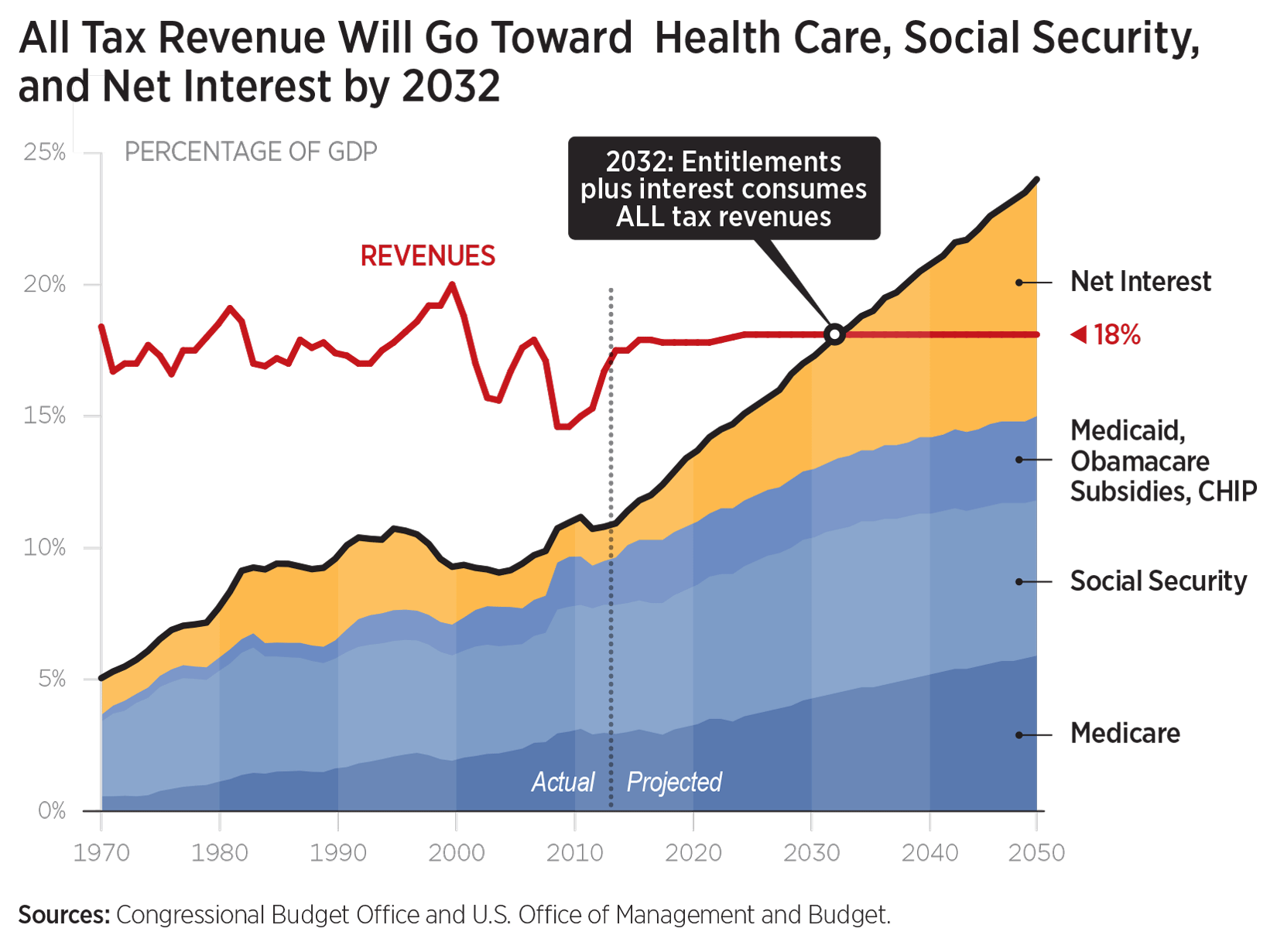
Pretty soon, our mandatory expenses will consume all of our tax revenues

Who is going to pay for all the spending we already have scheduled? As the graph above shows, things are going to get worse in the future as the big entitlement programs pay out more than current tax rates take in. I’m sure glad that I’m going to be retiring before 2032, and I’m not going to be stuck with the bill for this. It’s one thing for me to get out of bed every morning to be paid only 75% of what I earn. I certainly wouldn’t want to be working if the tax rates here were more like Europe, so that I’d be taking home less than half of what I earn. No thank you!

By the way, it might be a good idea to think about whether you want to have children or not before you vote. Children are expensive, and if we keep electing the big spenders like Obama, then there isn’t going to be any money left over to run a family and raise kids. Think about it before you vote with your feelings only.

New study: what lifestyle choices lead to happiness for women?

Marriage and family
Marriage and family

In preparation for this blog post, I read an article from a far-left source about the decline of women’s happiness.

Excerpt:

As women gain political, economic and social freedoms, one would expect that they should feel even more contented relative to men. But this isn’t so.

The “paradox of declining female happiness” was pointed out by economists Betsey Stevenson and Justin Wolfers, who also happen to share a house and kids. They analyzed the happiness trends of US citizens between 1970 and 2005 and found a surprising result.

Stevenson and Wolfers discovered that American women rated their overall life satisfaction higher than men in the 1970s. Thereafter, women’s happiness scores decreased while men’s scores stayed roughly stable. By the 1990s, women were less happy than men. This relative unhappiness softened after the turn of the century, but men continue to enjoy a higher sense of subjective wellbeing that is at least as high — if not higher — than women’s.

Those 35 years saw advances in American women’s rights and financial power.

Let’s take a look at a recent study that the Daily Wire reported on, to see what really makes women happy:

Despite the onslaught of propaganda telling young girls otherwise, a recent research paper distilling data from over 30 European countries concluded that mothers find homemaking preferable to working full-time.

Doc. PhDr. Dana Hamplová, Ph.D., a senior scientist at the Institute of Sociology, ASCR, and a current representative of the Czech Republic in the International Social Science Program, authored the paper. Addressing Betty Friedan’s narrative in the book The Feminine Mystique, which claims that women are happiest and most fulfilled at work, Hamplová “explores the link between employment and subjective well-being among mothers with children under 3 years of age,” reads the paper’s abstract.

“Analyzing multiple measures of subjective well-being, the paper shows that homemakers are generally happier than full-time workers,” the scientist found.

“Contrary to our expectations, homemaking was positively associated with happiness particularly among mothers who left higher quality employment for childcare. Though some variation across countries exists, it is not linked to the provision of formal childcare, duration of parental leave, or tax system,” Hamplová explains.

[…]”Thus, similarly to several other studies, the ESS [European Social Survey] data do not corroborate Betty Friedan’s idea that domesticity and housekeeping leaves women unhappy and unsatisfied,” she writes. “As all 12 measures of happiness/satisfaction point to the same direction, the conclusion that mothers with younger children tend to be better off if they are not engaged in paid employment seems to be robust.”

We’ve had lots of advancements in women’s power, often coming at the expense of men (i.e. – husband candidates). For example, anti-male schools staffed by feminist administrators and feminist teachers might be great for women, but they don’t produce high-earning men for women to marry. And when women vote to expand government, taxes must increase to pay for all the spending. This reduces even further the pool of men who can take on a wife and family shrinks even more because of the increased tax burden.

This article from the leftist The Atlantic explains:

In the view that has prevailed in American education over the past decade, boys are resented, both as the unfairly privileged sex and as obstacles on the path to gender justice for girls. This perspective is promoted in schools of education, and many a teacher now feels that girls need and deserve special indemnifying consideration.

[…]A review of the facts shows boys, not girls, on the weak side of an education gender gap. The typical boy is a year and a half behind the typical girl in reading and writing; he is less committed to school and less likely to go to college. In 1997 college full-time enrollments were 45 percent male and 55 percent female. The Department of Education predicts that the proportion of boys in college classes will continue to shrink.

Data from the U.S. Department of Education and from several recent university studies show that far from being shy and demoralized, today’s girls outshine boys. They get better grades. They have higher educational aspirations. They follow more-rigorous academic programs and participate in advanced-placement classes at higher rates. According to the National Center for Education Statistics, slightly more girls than boys enroll in high-level math and science courses. Girls, allegedly timorous and lacking in confidence, now outnumber boys in student government, in honor societies, on school newspapers, and in debating clubs. Only in sports are boys ahead, and women’s groups are targeting the sports gap with a vengeance. Girls read more books. They outperform boys on tests for artistic and musical ability. More girls than boys study abroad. More join the Peace Corps. At the same time, more boys than girls are suspended from school. More are held back and more drop out. Boys are three times as likely to receive a diagnosis of attention-deficit hyperactivity disorder. More boys than girls are involved in crime, alcohol, and drugs. Girls attempt suicide more often than boys, but it is boys who more often succeed. In 1997, a typical year, 4,483 young people aged five to twenty-four committed suicide: 701 females and 3,782 males.

It’s important to note that women are not victims here, they are actually the ones who created the shortage of men who could earn enough money to support a family, and allow them to stay home with their children. Their “advancements in power” came at a cost: they undermined the system that produced men who were capable of handling the financial demands of a family where the wife can raise her own children.

Look at this study of how women have voted to expand government and therefore raise taxes on working men for social programs that replace husbands:

This paper examines the growth of government during this century as a result of giving women the right to vote. Using cross‐sectional time‐series data for 1870–1940, we examine state government expenditures and revenue as well as voting by U.S. House and Senate state delegations and the passage of a wide range of different state laws. Suffrage coincided with immediate increases in state government expenditures and revenue and more liberal voting patterns for federal representatives, and these effects continued growing over time as more women took advantage of the franchise. Contrary to many recent suggestions, the gender gap is not something that has arisen since the 1970s, and it helps explain why American government started growing when it did.

Bigger government means higher taxes means men earn less money, after taxes. How are you supposed to keep your wife home to watch over the little ones when taxes are higher? You can’t.