
Tag Archives: Stem

Ideas for higher education reform from a disillusioned professor

We need to reform higher education

A friend of mine who is a full professor sent me this article from the radically leftist site Vox. I was so surprised to find that I agreed with the author – a university professor  – pretty much across the board. See what you think of some of his points about how higher education needs to be reformed, and then I’ll comment at the end.

He complains about the university bureacracy and the office politics, then says this:

I realized not even students were too invested. When my best friend visited my campus to give a talk, he observed one of my lectures. I’ve got many shortcomings as an academic, but lecturing isn’t one of them. I’ve been on TV, radio, podcasts — you name it. By professor standards, which admittedly aren’t that high, I could rock the mic. But while my friend sat there, semi-engrossed in the lecture, he found himself increasingly distracted by the student in front of him.  That student, who like all in-state students was paying $50 per lecture to hear me talk, was watching season one of Breaking Bad. In a class with no attendance grade, where the lectures were at least halfway decent, he was watching Breaking Bad.

Later during that same visit, my friend asked me, in total sincerity, “Why aren’t you doing something meaningful with your life?”

“This is important,” I insisted. But there was no passion behind my words. I was a priest who had lost his faith, performing the sacraments without any sense of their importance.

So why are there so many students who have no interest in university who nevertheless attend in order to get the credential? After all, university is very expensive.

Here is his explanation:

As recently as a year ago, I remained willing to work inside that fractured system of pay-to-play higher education. If students wanted to take out federal loans to buy degrees, who was I to stop them? Let the chips fall where they may; graduate them all and let the invisible hand sort them out.

But that system is unsustainable. Liberal arts programs, and the humanities in particular, have become a place to warehouse students seeking generic bachelor’s degrees not out of any particular interest in the field, but in order to receive raises at work or improve their position in a crowded job market.

Once upon a time, in a postwar America starved for middle managers who could file TPS reports, relying on the BA as an assurance of quality, proof of the ability to follow orders and complete tasks, made perfect sense. But in today’s world of service workers and coders and freelancers struggling to brand themselves, wasting four years sitting in classes like mine makes no economic sense for the country or for the students — particularly when they’re borrowing money to do so.

See, this is not going to make any sense to my readers who have STEM degrees or vocational training. When STEM or vocational training students are in class, we learn, because we expect to have to do the job shortly after. We were not preparing for easy “talking” jobs, we were preparing for “doing” jobs. We were there to learn how to do something for money, not to have fun. We were there to learn how to produce value for customers, not to be indoctrinated by liberal professors holding red marking pens. Many liberal arts students are not there to learn to do a job, they are there to get a credential. In fact, many of the graduates of liberal arts programs these days have to be retrained by their employers.

The author of the Vox article has a solution:

Our federally backed approach to subsidizing higher education through low-interest loans has created perverse incentives with disastrous consequences. This system must be reformed.

When I started out, I believed that government regulation could solve every problem with relatively simple intervention. But after four years of wading though this morass, I’m convinced these solutions should be reevaluated constantly. If they’re not achieving their objectives, or if they’re producing too much waste in the process, they ought to be scrapped. We can start with federal funding for higher education.

The quickest and most painful solution to the crisis would involve greatly reducing the amount of money that students can borrow to attend college. Such reductions could be phased in over a span of years to alleviate their harshness, but the goal would remain the same: to force underperforming private and public universities out of business. For-profit universities — notorious for their lack of anything resembling good academic intention — should be barred altogether from accessing these programs; let them charge only what consumers in a genuinely free market can afford to pay for their questionable services.

Without the carrot of easy access to student loans, enrollments would shrink. Universities would be forced to compete on a cost-per-student basis, and those students still paying to attend college would likely focus their studies on subjects with an immediate return on investment. Lower tuition costs, perhaps dramatically lower at some institutions, would still enable impoverished students eligible for Pell Grant assistance to attend college.  Vocational education programs, which would likely expand in the wake of such a massive adjustment, would offer inexpensive skills training for others. The liberal arts wouldn’t necessarily die out — they’d remain on the Ivy League prix-fixe menu, to be sure, and curious minds of all sorts would continue to seek them out — but they’d no longer serve as a final destination for unenthusiastic credential seekers.

I agree with this idea, in fact I blogged about it before. This is the right solution to the problem. The problem of higher education costing too much will be solved when we stop attaching taxpayer money to students and urging them to attend university. If they want to get a job, then they should be trained to do a job. Only the students who are really interested in liberal arts should be there, and they should have to weigh the costs against the benefits. Maybe we should be taking the student loan decisions out of the hands of the government, and back in the hands of bankers who actually expect the money to be paid back. Or maybe we should give a tax credit to private sector businesses who agree to stake a student through his education, in exchange for working for them for some period after graduation. Anything is better than the mess we have now.

New study: the majority (69%) of divorces are initiated by women

Is it OK to tell women they are wrong?
Is this “I’ll do what I want” attitude compatible with life-long married love?

This new report from Live Science gives us some numbers about who initiates divorces most frequently.

It says:

Women are more likely than men to initiate divorce in the United States, but they are no more likely than men to initiate breakups in a dating relationship, a new study finds.

“The breakups of nonmarital heterosexual relationships in the U.S. are quite gender-neutral and fairly egalitarian,” study author Michael Rosenfeld, an associate professor of sociology at Stanford University, said in a statement. “This was a surprise because the only prior research that had been done on who wanted the breakup was research on marital divorces.”

Previous research had found that women are more likely to initiate divorce, at least in the United States, Europe and Australia. In the new study, Rosenfeld compared divorces to nonmarital breakups, in an effort to understand the driving forces behind each type of breakup.

To investigate, he looked at data from the 2009 to 2015 waves of How Couples Meet and Stay Together, a nationally representative survey spearheaded by Rosenfeld and his colleagues. The new study includes 2,262 adults, ages 19 to 64, who reported having opposite-sex partners in 2009. By 2015, 371 of the participants had broken up or gotten divorced.

Women initiated 69 percent of the 92 divorces, Rosenfeld found. But there was no statistically significant difference between women and men when it came to nonmarital breakups, regardless of whether they were living together, he said.

So I am seeing a couple of problems in young, unmarried women that might explain this.

Feminism is bad

First, there is the feminism. Feminism was the driving force behind no-fault divorce. Today, young unmarried women are being taught to view marriage as stifling to their freedom. So if they do get married, they are often resolved that marriage should not affect their freedom in any way. That is just not the way marriage works, though – both spouses need to be equally ready to have their freedom infringed upon by things that HAVE TO GET DONE. Lots of things that have to get done will not be fun, thrilling or amusing – and that’s why it’s good to be prepared to do them before you marry.

My friend Dina says that she only knows one happily married couple from among her friends. The most frequent case she sees is wife is working in order to pay for big house, two cars, etc. and wife is denying husband sex, which makes him disengage from the marriage. A working wife tends to not be as responsive to the needs of husband and kids as a non-working wife, probably in part due to work stress. There is an epidemic of sex-withholding by women, and it causes men to disengage from marriage because they feel unloved. Although women tend to rebel against the idea that the man’s bad behavior is their fault, and that there is a “contractual” nature to marriage, that is how marriage works. You cannot stay married, women, by just doing whatever you feel like, and NOT doing whatever you DON’T feel like. Men will disengage when their needs are not supplied, and that’s no fault of theirs. It’s your fault. Denying relationship obligations causes men to underperform.

Feminism is often linked closely to “independence”. There is a lot of confusion over what the word independence means among young, unmarried women. A man uses that word to mean “lack of financial dependence on parents, the state, etc. because of good decisions in education, career and finances”. But a woman means “not having to care about the needs of a man and the leadership of a man, or the needs of children while still getting what I want from men and children”. That’s not compatible with life-long married love.

Emotions are bad

Second, emotions. In my experience, young, unmarried women are less likely to have reasoned out their own life plan in a practical step-by-step manner. (Although, all the women I advise have, but they are exceptional) Instead, they tend to do whatever makes them feel good moment-by-moment without any realistic plan. Peer-approval and culture play a large part in determining their goals and what they do day-to-day – and these day-to-day choices do not lead to achieving their goals. “Live in the moment”, they often tell me. If you try to talk to them about roles and responsibilities in a marriage, they will withdraw and rebel. But marriage is about each spouse doing his or her job, and feeling content about what the couple is building together. You can’t make life-long married love from emotional craziness and pursuing fun and thrills. You can’t make anything out of emotional craziness and pursuing fun and thrills.

How to pick a woman who won’t divorce you

Young men, I advise you to choose wives who have had to do things that they did not feel like doing. That can involve things like getting a STEM degree, getting a job in STEM, moving out of her parents’ house, getting a “boring” job that helps her pay off her debts, keeping commitments when she doesn’t feel like it, and caring for other people and even animals.

Basically, the more the woman has ground down any narcissism and hedonism she may have, by having to do nasty calculus and horrid lab work, the better. The more accustomed she is to constraints, responsibilities, expectations and obligations, the less likely it is that she’ll divorce you for unhappiness. And all of this goes for men, as well. STEM degree, STEM job, save money, serve others, give to charity.

Marriage is not the time for people to be carried away by their emotions. It’s an enterprise, and it works when both people are rational, practical, hard-working and self-controlled.

My editors

My friend Dina edited this post. She has a hilarious line she tells me whenever I ask her why some feminists think that I am so demanding. She says “You are demanding, but nothing you ask me to do is as bad as what I had to do at work today”. Her job is a billion  times harder than mine. She has a BS and MS in a STEM discipline, and has been working full-time since she was 18. She owns her own car, her own home, and has loads of investments. Whatever I want from her (e.g. – play Orcs Must Die! 2 with me) is pretty minor. She is a tough girl, and that’s what you want in a wife. Marriage is not happily ever after for the woman, it’s actually a lot of work for her. Hard work  before marriage prepares her for the responsibilities, expectations and obligations of marriage.

My friend Lindsay, who also has a STEM BS and MS and a resume, edited an early version of this post. She gave up her college teaching career to get married, have kids, and homeschool the kids. She sent me this story of a woman who abandoned her husband and 4 kids for a convicted rapist and serial killer. I think this story captures the radical feminism and emotional craziness that I am warning about in this post. Avoid women who run away from responsibilities and prefer men who meet their emotional needs without holding them accountable. Listen up, single women: you can’t choose a bad man because he makes you feel good (by not demanding anything from you) and then expect him to perform husband and father duties. That’s just causing your own divorce through your own poor choices.

Why is it so hard for young people to find a job?

Young people have a sense of entitlement

Bloomberg News discusses the “Professionalism in the Workplace” survey of human resources specialists from York College of Pennsylvania.

Forty-nine percent of [those surveyed] stated that less than half of new employees “exhibit professionalism in their first year.” More than half (53 percent) have noticed “a sense of entitlement” rising among younger workers; almost 45 percent have seen a “worsening of the work ethic,” including “too casual of an attitude toward work” and “not understanding what hard work is.”

Younger workers believe they can multitask and remain productive, the human-resources people told the York researchers. Thirty-eight percent of respondents blamed multitasking for the lack of “focus” among younger workers. The authors of the study explained that the younger generation “believes that it is possible to multi-task effectively” and that using social media, for example, is an efficient way to communicate. In interviews, the applicants check their phones for texts and calls, dress inappropriately and overrate their talents.

“The sad fact is some of these persons probably do not understand what is wrong with this,” the authors note.

Older workers have always complained about younger workers, of course, but there’s a difference: This time they attribute the youthful flaws not to ignorance or waywardness, but to a “sense of entitlement.”

We might forgive 18-year-olds fresh out of high school for lacking employability skills (the manufacturing sector hires many workers lacking undergraduate degrees). But when he or she reaches 23 and has four years of college, employers expect a white-collar worker to recognize basic norms of dress and deportment.

What happened in college, then? The survey by York College’s Center for Professional Excellence assigns colleges part of the blame, observing that letting students miss deadlines without penalty and assigning good grades for middling work only make them form the wrong expectations.

Meanwhile, the UK Daily Mail had the results from a 2013 survey:

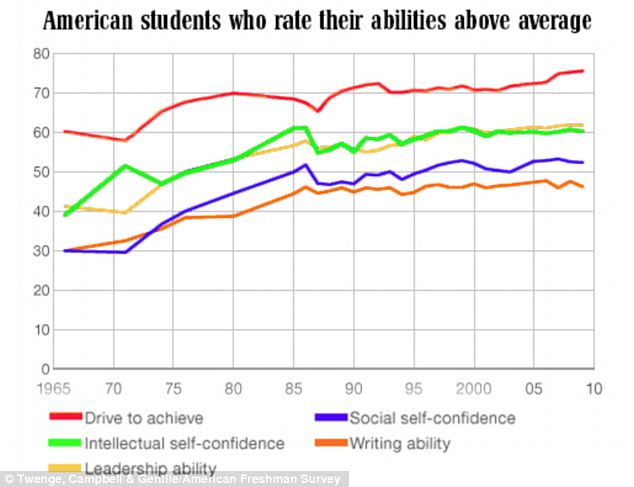
Young people’s unprecedented level of self-infatuation was revealed in a new analysis of the American Freshman Survey, which has been asking students to rate themselves compared to their peers since 1966.

Roughly 9 million young people have taken the survey over the last 47 years.

Psychologist Jean Twenge and her colleagues compiled the data and found that over the last four decades there’s been a dramatic rise in the number of students who describe themselves as being ‘above average’ in the areas of academic ability, drive to achieve, mathematical ability, and self-confidence.

But in appraising the traits that are considered less invidualistic – co-operativeness, understanding others, and spirituality – the numbers either stayed at slightly decreased over the same period.

Researchers also found a disconnect between the student’s opinions of themselves and actual ability.

While students are much more likely to call themselves gifted in writing abilities, objective test scores actually show that their writing abilities are far less than those of their 1960s counterparts.

Also on the decline is the amount of time spent studying, with little more than a third of students saying they study for six or more hours a week compared to almost half of all students claiming the same in the late 1980s.

Though they may work less, the number that said they had a drive to succeed rose sharply.

[…]Twenge is the author of a separate study showing a 30 per cent increase towards narcissism in students since 1979.

‘Our culture used to encourage modesty and humility and not bragging about yourself,’ Twenge told BBC News. ‘It was considered a bad thing to be seen as conceited or full of yourself.’

Just because someone has high self-esteem doesn’t mean they’re a narcissist. Positive self-assessments can not only be harmless but completely true.

However, one in four recent students responded to a questionnaire called the Narcissistic Personality Inventory with results pointing towards narcissistic self-assessments.

Narcissism is defined as excessive self-love or vanity; self-admiration, or being self-centered.

Twenge said that’s a trait that is often negative and destructive, and blames its boom on several trends – including parenting styles, celebrity culture, social media, and easy credit – for allowing people to seem more successful than they really are.

I think what I am seeing is that not only do they work less, but they work at things they “like”, rather than at things that will allow them to provide value to others. So, you’re not going to find a lot of computer programmers or petroleum engineers among young Americans, but you will find a lot of people gravitating to jobs that are easy that make them feel good about themselves, and look good to other people, too.

Obviously, there are policy reasons for youth unemployment being so high, but I think this attitude that young people have is definitely part of it.