
Tag Archives: Stay-At-Home Mom

New study: negative effects of day care on children not caused by quality of day care

Does government provide incentives for people to get married?
Mom is staying home because Dad can afford to let her: do kids benefit?

New study using National Institute of Child Health and Human Development data is discussed on the Family Studies web site.

First, let’s get the two views:

Parents, policymakers, and academics interested in how day care and preschool affect child development often embrace one of two competing—and exaggerated—claims about the childrearing circumstances that are now normative in America: that of non-family care being initiated early in a child’s first year of life on a full-time or near-full-time basis and continuing, in one form or another (e.g., family day care, center care, preschool), until the start of formal schooling.

Critics of such arrangements highlight the fact that developmental risks, like increased rates of insecure attachment and elevated levels of aggressive behavior, have been found to be associated with the extensive use of non-family care in America. Advocates, in contrast, stipulate, usually without qualification, that if the quality of care is good, then children benefit; and, indeed, that it is the limited quality of care available to too many parents in the USA that is responsible for any negative effects on children that emerge in the research literature.

All right, so the big-government, anti-family people say that day care as such isn’t bad for kids, the negative effects that are observed are not caused by too much day care, but by the low quality of the day care. The conservative, pro-family, limited-government crowd thinks that quality doesn’t matter as much as quantity – too much day care is bad for kids, regardless of quality.

The study details:

[…][T]he National Institute of Child Health and Human Development (NICHD) funded, to the tune of at least $150 million, the NICHD Study of Child Care and Youth Development. It recruited more than 1,000 children (along with their mothers) in 1991 from 10 different research sites, and followed them from the first month of life to age 15. Among other purposes, the NICHD Study was designed to investigate the claim that long hours of day care initiated very early in life posed risks to children’s social and emotional development; and, should this prove so, to evaluate the proposition that such negative effects would be due to the poor quality of care that children received, not the quantity of care they experienced across the first five years of life.

And the conclusion:

NICHD Study’s findings on the effects of day care proved more consistent than inconsistent with my “developmental risk” claim. And they provided virtually no support for the idea that it was poor quality care that accounted for the negative effects of “early, extensive, and continuous” care (initiated very early in life, for long hours, and continuing for many years).2 Specifically, our many research reports revealed that the more time children spent in any kind of non-familial child care, and sometimes specifically in centers, the more aggressive and disobedient they proved to be at two (but not three) and 4.5 years of age, as well as across their elementary school years; and the more impulsive they proved to be at age 15, at which age they also engaged in more “risky” behavior than children who experienced far less non-familial care across their first five years of life. Critically, despite spending millions to carefully measure the quality of care, using methods and measures developed by the proponents of the “it’s quality, stupid” view, the study never found that the quality of care accounted for these quantity-of-care effects. In other words, the problem behavior associated with early, extensive, and continuous care emerged irrespective of whether quality of care was good or bad.

Read the whole thing, and don’t feel guilty if you can’t do the best for your kids. I am sure that everyone reading this post is going to do the best they can for their kids. But for those who have not yet had kids, let this be a lesson to you about what you should be studying in school, where you should be working, how much you should borrow, how much you should spend. A stay-at-home mom is expensive. It cannot be finessed with feelings and following your heart to fun and thrills.

When it comes to children, money is important

I know there are lots of Christians around the world who read the Bible and understand that there are certain goals laid out in the Bible for Christian parents who are raising their kids. As far as I can tell, young Christians seem to think that these goals will sort themselves out all by themselves through God’s mysterious predestination, or some other such fideistic wishing. What it really boils down to is that young people want to do what they want to do, and they can sound pious about it by saying God will somehow make their crazy plan work out. Well, that’s not effective, and young Christians would never act so ineffectively in any other area of their lives – ignoring how things really work.

Look the Bible has information about the specification that God expects you to implement. Part of that spec involves requirements for your kids. If you decide that the Bible is not trying to give you a spec, you’ll fail to deliver. If you decide that you don’t need to read studies to know how the world works, you’ll fail to deliver. If you decide that following your heart is something that God rewards more than intelligent thought, you’ll fail to deliver. You cannot feelings your way out of this assignment, you’ve got to solve the problem, and that means reading the studies and making a plan that delivers results.

So, young people. If you want to do the best for your kids, you better stop doing what feels good, and start engaging in some serious self-denial and self-sacrifice. Fumbling around chasing happy philosophy bubbles to Europe through your teens, 20s and 30s is not the right way to prepare professionally and financially for kids. Your love for your future kids begins with your decision to grow up and do hard, boring things that need to be done. You won’t be able to fix the child care costs problem at the 11th hour if you follow your heart for the first 10 hours. Keep in mind what child care looks like in places like Ontario, and what your children would be learning, and who they would be learning it from. Make a plan now.
Do husbands and wives have specific responsibilities in a marriage?

Does government provide incentives for people to get married?
Marriage advice from someone who knows

I found another awesome post by Lindsay.

The post starts explaining how a woman supports a man in his role as spiritual leader of the home. I always talk about the responsibilities of a husband/father in the home being protecting, providing and leading on moral and spiritual issues. You’d be surprised how many Christian women are not OK with me claiming these roles. In fact, I am always getting criticism for buying too many gifts (providing), for being too concerned about the challenges of policies (protecting), and for being too rough on rebutting spiritual wolves – even after they admit they are wrong! (spiritual/moral leading). It is rare for me to find a Christian woman who accepts those male roles. Usually, I get attacked for all three of them. Women do not like to let me execute these tasks.

Lindsay is fine with men leading in all 3 of those roles, but this is the part of her post that I really liked:

Once children arrive, it becomes pretty much impossible for her to work outside the home and still fulfill her duties at home. The funny thing about children is that they need constant care. One cannot care for children and work outside the home too. The choice once children come along is whether to outsource the care of the children to someone else or to do it yourself. I firmly believe that God entrusts children to a husband and wife because he wants them to be the primary influences in their children’s lives. That doesn’t happen if the children spend a majority of their waking hours in the care of someone else.

Children don’t just need food and shelter provided to them, they need love, teaching, discipline, a sense of security, and examples of how they are to live. All of those things are best done when the child spends time primarily with his or her parents. Daycare workers, school teachers, and even grandparents simply cannot provide them in the same way parents can. No one loves a child like his own parents do. No one has such a vested interest in ensuring that he grows up with the proper spiritual and moral training. Even if others care about the child, the responsibility for the training of a child belongs to his parents. Daycare workers and teachers and grandparents won’t answer to God for the soul of that child. His parents will.

So, given the needs of children, I am convinced that women are called to be with their children, training and caring for them as their primary caregiver. Does that mean a mother can’t have any job outside the home? In theory, no. In practice, yes. A woman’s priority must be her own family. If she can have her children with her or leave them for only a short time each day, she may still be able to provide the necessary training and care they need from their mother and earn some income. But in doing that, she needs to be sure she is not neglecting her husband’s needs either. Theoretically, a woman can have it all – keeping a job and caring for her family too. The problem is that it is a very rare woman who has the energy to keep up with the constant needs of her children for care, training, discipline, and love and those of her husband for companionship, sex, and a partner in life as well as the logistics of running a household and still have something left for even a part-time job.

What usually happens when a woman has an outside job is that her family simply suffers the lack. Either her children spend a lot of time with other caregivers or teachers or her husband does without the companionship and marital intimacy he needs or some of the household chores descend on the husband, taking away some of his time and energy to train his children spiritually and impact the world for Christ. Often it’s a combination of these. A woman simply cannot meet all the needs of her family when she is spread that thin and, as a result, something important gets left undone.

I wish I could find women who had definite ideas about what they wanted to do with their children, but thinking back over previous relationships, what I usually hear is that they want to go on mission trips, do pro-life protests, have careers, etc. No one looks at these little kids with any sort of plan to grow them into anything. I just think it’s depressing that kids are not part of most women’s plans. If there is any plan at all it’s that there should be no plan, and the kids can just do anything they want. How depressing for the man to think about when he has to pay all the bills to raise kids who are aiming at nothing, and will surely hit it. What kind of man is excited about having children when his wife is not on board with making them into anything special? It’s depressing.

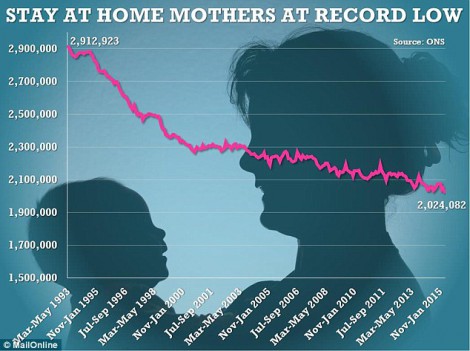
Stay-at-home motherhood falls to record low in the UK

Stay-at-home mothers at a record low in the UK

Dina sent me this article from the UK Daily Mail, and I want to comment on it.

It says:

The number of stay-at-home mothers has hit a record low as more women choose to get a job, new figures reveal.

In the last two decades, the number of women who do not work to look after their home and raise their family has dropped by a third to just over 2million.

[…]The number of stay at home mothers and grandmothers has fallen steadily since records began in 1993.

New official figures show that there are only 2.024 million women out of work to look after a home or family, a 31 per cent fall on 2.913 million in spring 1993.

[…]The sharp turnaround comes after 20 years of social and economic change, with parents increasingly sharing the burden of raising a family and many women reluctant to give up their career once they have children.

In socialist countries like the UK, the majority of the people are so accustomed to big government and dependency that they cannot conceive of shrinking government and letting the private sector and families and churches solve any problem. Right now, the current problem is that they are spending too much on huge numbers of social welfare programs that reward selfish, destructive behavior like men not working, single motherhood by choice, unskilled immigration, welfare that is not means-tested, welfare that is not time-limited, and so on. It is a nanny state, and during election times, all the candidates do is talk about how they want to spend the people’s money to be “nice”. So, you can get breast enlargements, sex-changes and in vitro fertilization (IVF) as part of the country’s bloated “health care” system. So the question is: how will they pay for all this “generosity”? Well, all the political parties agree on the answer: it’s to put in places taxes and policies that make it impossible for women to stay home with their kids instead of working.

More:

David Cameron has promised to double free childcare for three and four-year-olds from 15 hours per week during term time to 30 hours.

The Tories argue the measure will ‘help parents who want to work’.

But critics warn it is discriminating against people who do not want to go back to work.

Claire Paye, spokesman for Mothers At Home Matter, said: ‘The government has set arbitrary targets to get mothers into work and to make sure that they are using government funds to pay to look after those children instead of mothers doing it for free.

‘There is a real concern that the drop in stay at home others is because mothers are being priced out of the home.

‘The government’s only focus is to get mothers into work and they will not support any other family model than two parents working.

‘We are concerned that these figures represent families who are no longer able to choose to look after their own children even if they want to.’

In a House of Lords debate this week, the Bishop of Durham said stay at home parents were made to feel that they are ‘somehow not doing the best for the nation or the child’.

Rt Rev Paul Butler warned of the ‘implicit and not so implicit message that it is better to put your child in childcare and go out to work than stay at home and look after your own children’.

So, we have a couple of points in there. Stay-at-home mothers are shamed for “wasting” their education on raising children. Daycare, which is proven to affect children negatively, especially in the first two years, is set forward as praiseworthy. Tax increases force women out of the home to work, in order to maintain the same-standard of living they had before the higher taxes and big government. And those big social programs almost never go to help married couples – they are primarily there to enable a permanent lifestyle of disfunction.

I thought of a couple more problems. Easily obtainable divorce and sole custody for the mother is a major deterrent to men marrying in the UK. So, of course the marriage rate is in a free fall as men stop trying to get married and settle for stress-free jobs that allow them to scrape by as singles. Why work hard just to support a wife when the whole culture is telling her to divorce you and get alimony and child support for life? And you’ll never see your kids again, either. Easy divorce and easy premarital sex sounded like such a good idea to feminist ears, but they never thought about how men would respond to it. Most men just take the free sex that the feminist Sexual Revolution provides, and decline the responsibility of marriage and fatherhood.

Another problem is that Christian parents these days have a different view of the Christian life than I have. If you look at the shema in Deuteronomy 6:4-9, it’s very clear that parents have a responsibility to teach their kids about God. And that requires a plan to marry well so that the parents have time to teach their kids about God themselves (homeschooling), and put them into schools that will not push secularism on them.

Deut 6:4-7:

4 “Hear, O Israel! The Lord is our God, the Lord is one!

5 You shall love the Lord your God with all your heart and with all your soul and with all your might.

6 These words, which I am commanding you today, shall be on your heart.

7 You shall teach them diligently to your sons and shall talk of them when you sit in your house and when you walk by the way and when you lie down and when you rise up.

Eph 6:4:

4 Fathers, do not provoke your children to anger, but bring them up in the discipline and instruction of the Lord.

Heb 12:9-11:

9 Furthermore, we had earthly fathers to discipline us, and we respected them; shall we not much rather be subject to the Father of spirits, and live?

10 For they disciplined us for a short time as seemed best to them, but He disciplines us for our good, so that we may share His holiness.

11 All discipline for the moment seems not to be joyful, but sorrowful; yet to those who have been trained by it, afterwards it yields the peaceful fruit of righteousness.

As a man, I would of course be delegating a lot of this responsibility to my trusted chief of staff (i.e. – future wife), whose skill in parenting, especially apologetics, would be phenomenal. I would certainly not trust strangers to implement the specification in these Bible verses. If we had to bring in expert Christians – either through Sunday school, lectures, debates and conferences, or through books, DVDs, etc. then we would. But parenting the kids is our responsibility. Secular daycare and secular public schools will not be the main influence on my kids. And I oppose all policies and laws that make the state more influential than us in raising our kids.

Parents have a responsibility to make sure their kids will be Christians into adulthood, and will make a difference for Christ and his Kingdom. But what has happened is that Christianity has become all about me and my feelings. Parents themselves that they don’t have to know whether it’s true, in order to teach it to the children as truth. We think that it just has to make us feel comfortable and peaceful. But that is not the way to raise kids who will make a difference, much less remain Christian in a world like this.