HHS forces religious organizations to cover contraception
Evangelicals and political engagement
Barack Obama: women need abortion in order to be equal
what does the Bible say about abortion?
do people have intrinsic value?
This podcast does not discuss how Susan G. Komen backed away from their decision to not fund Planned Parenthood after the mainstream media put pressure on them to continue funding the largest abortion provider in the United States. But the LTI guys are smart – they were skeptical about giving money to Susan G. Komen even after the initial announcement. Also note that one of the nice things about Scott Klusendorf is that he is an evangelical Christian – not a Roman Catholic. So it’s nice to see an evangelical Christian taking the lead on moral issues – it makes me proud to be an evangelical. Evangelical men ought to be as well informed about moral issues as they are about politics, science and foreign policy.
Susan G. Komen and Planned Parenthood
Mary sent me a story on the Susan G. Komen Foundation that analyzes how they are linked to Planned Parenthood from the Wall Street Journal. It’s by Robbie George of Princeton, so you have to read it!
Excerpt:
The Susan G. Komen Foundation, an organization dedicated since 1982 to fighting, and one day curing, breast cancer, decided to extricate itself from the culture wars by discontinuing grants to Planned Parenthood, the nation’s largest provider of abortions. The grants Komen had been making amounted to $650,000 last year, funding some 19 local Planned Parenthood programs that offered manual breast exams but only referrals for mammograms performed elsewhere.
The reality is that Planned Parenthood—with annual revenues exceeding $1 billion—does little in the way of screening for breast cancer. But the organization is very much in the business of selling abortions—more than 300,000 in 2010, according to Planned Parenthood. At an average cost of $500, according to various sources including Planned Parenthood’s website, that translates to about $164 million of revenue per year.
So how did Planned Parenthood and its loyal allies in politics and the media react to Komen’s efforts to be neutral in the controversy over abortion?
Faced with even the tiniest depletion in the massive river of funds Planned Parenthood receives yearly, the behemoth mobilized its enormous cultural, media, financial and political apparatus to attack the Komen Foundation in the press, on TV and through social media.
The organization’s allies demonized the charity, attempting to depict the nation’s most prominent anti-breast cancer organization as a bedfellow of religious extremists. A Facebook page was set up to “Defund the Komen Foundation.” In short, Planned Parenthood took breast-cancer victims as hostages.
Komen’s leaders had good reason to believe their organization could disintegrate under Planned Parenthood’s assault. On Friday the charity issued a statement “apologizing to the American public for recent decisions that cast doubt upon our commitment to our mission of saving women’s lives.” The statement assured Planned Parenthood’s supporters that, like any other organization, it is eligible to apply for grants in the future.
I think the bottom line is this. There are plenty of non-Christians giving money to causes like this. If you are a Christians, you’re much better off giving your money to an organization like Life Training Institute. At the very least, you should all buy “The Case for Life”, which is the best small book on pro-life apologetics.
By the way, I blogged on the previous LTI podcast here. That one was from March 2010. I hope they make more of these regularly.
Run up spending and debt, raise taxes in the naming of balancing the budget, but then watch as deficits rise and your credit-rating falls anyway. That’s been the sad pattern in Europe, and now it’s hitting that mecca of tax-and-spend government known as Illinois.
Though too few noticed, this month Moody’s downgraded Illinois state debt to A2 from A1, the lowest among the 50 states. That’s worse even than California. The state’s cost of borrowing for $800 million of new 10-year general obligation bonds rose to 3.1%—which is 110 basis points higher than the 2% on top-rated 10-year bonds of more financially secure states.
This wasn’t supposed to happen. Only a year ago, Governor Pat Quinn and his fellow Democrats raised individual income taxes by 67% and the corporate tax rate by 46%. They did it to raise $7 billion in revenue, as the Governor put it, to “get Illinois back on fiscal sound footing” and improve the state’s credit rating.
So much for that. In its downgrade statement, Moody’s panned Illinois lawmakers for “a legislative session in which the state took no steps to implement lasting solutions to its severe pension underfunding or to its chronic bill payment delays.” An analysis by Bloomberg finds that the assets in the pension fund will only cover “45% of projected liabilities, the least of any state.” And—no surprise—in part because the tax increases have caused companies to leave Illinois, the state budget office confesses that as of this month the state still has $6.8 billion in unpaid bills and unaddressed obligations.
It’s worth contrasting this grim picture with that of Wisconsin north of the border. Last winter Madison was occupied by thousands of union protesters trying to bully legislators to defeat Republican Governor Scott Walker’s plan to require government workers to pay a larger share of their health-plan costs, and to shore up the pension system by trimming future retirement liabilities. The reforms passed anyway.
In contrast to the Illinois downgrade, Moody’s has praised Mr. Walker’s budget as “credit positive for Wisconsin,” adding that the money-saving reforms bring “the state’s finances closer to a structural budgetary balance.” As a result, Wisconsin jumped in Chief Executive magazine’s 2011 ranking of each state’s business climate—moving to 17th from 41st. Illinois dropped to 48th from 45th as ranked by the nation’s top CEOs.
Ohio’s new fiscal responsibility is getting noticed and rewarded.
Standard & Poor’s upgraded the state’s credit forecast from “negative” to “stable,” in time for a $417 million bond sale last week to refinance at a lower interest rate and restructure debt.
Ohio’s lean budget will pay off with lower costs for borrowing, saving taxpayers as much as $1 million or more over the course of a year, according to the state’s Office of Budget and Management. It’s like having a credit-card company lower its annual percentage rate: The borrower can either accelerate the payoff or spend the savings elsewhere.
So essentially, cutting state programs spared money for state programs.
This is vindication for the Kasich administration. When Gov. John Kasich took office this year, the state was $8 billion in the hole and its rainy-day fund totaled $1.78. That’s not a typo; Ohio barely had enough in the bank to buy itself a cup of coffee. A small one.
[…]Investors pay attention to these ratings, especially since Ohio stands out as other states continue to struggle. “There are a lot of jitters in the credit market; I can’t imagine it won’t be helpful,” said Robin Prunty, primary credit analyst with Standard & Poor’s.
[…]Most states still are struggling with the economic recovery and phasing out one-time money from the federal stimulus program that Kasich’s predecessor used to paper over the deficit. S&P’s revised outlook reflects its view that Ohio’s economy “is steadily recovering.”
“The outlook revision reflects the state’s progress in moving toward structural budget balance through fiscal 2013 and the modest economic recovery under way,” its report says.
Republican tax policies work, and Democrat policies don’t. Taxing the rich sounds good, but it doesn’t help the poor. To help the poor, we need to encourage people with capital to risk it by engaging in enterprises for profit. That is what causes workers to be hired and wealth to be created – forming valuable products and services through ingenuity and labor. Workers who build skills and experience while working have more confidence and can be more productive, making them more free because they can succeed independently of government handouts.
In the 2010 mid-term elections, Republican John Kasich won the governorship and promised to balance the state’s budget by reining in the state’s spending on salaries and benefits for public sector union employees. To accomplish this, the Ohio legislature pass Senate Bill 5. However, an effort is on the ballot to repeal the law, and Ohio voters will get a chance to keep or scrap the law on Tuesday, November 8th, 2011.
Issue 2 makes some very fair and common sense requests of our government employees to give local communities the flexibility they need to get taxes and spending under control, while providing the essential services that we rely on.
It allows an employee’s job performance to be considered when determining compensation, rather than just awarding automatic pay increases based only on an employee’s length of service.
It asks that government employees pay at least 15 percent of the cost of their health insurance premium. That’s less than half of what private sector workers are currently paying.
It requires that government health care benefits apply equally to all government employees, whether they work in management or non-management positions. No special favors.
It asks our government employees to pay their own share of a generous pension contribution, rather than forcing taxpayers to pay both the employee and employer shares.
It keeps union bosses from protecting bad teachers and stops the outdated practice of laying off good teachers first just because they haven’t served long enough.
Finally, it preserves collective bargaining for government employees, but it also returns some basic control of our schools and services to the taxpayers who fund them, not the union bosses who thrive on their mismanagement.
Even under the reforms of State Issue 2, Ohio’s government employees will still receive better pay, better health care and better retirement benefits, on average, than the vast majority of Ohioans who work in the private sector.
There are a number of myths going around about Issue 2, and it’s important to set the record straight, so I’ll do that below.
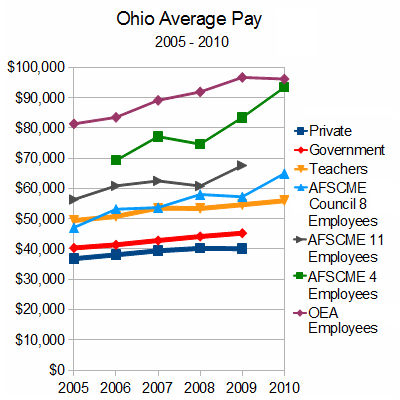
Ohio Average Pay: Public Unions vs. Private
Myths and truths about Ohio State Issue 2
Here’s a common myth:
State Issue 2 would “cut salaries and benefits.”
The truth:
Issue 2 would not cut salaries or benefits for any government employee. Employees would simply be asked to pay a modest share of their benefits, just like employees in the private sector do. For health care coverage, they would pay at least 15% of their overall plan. (Many local government employees currently pay less than 9% of their health care premium, while the average private sector worker pays upwards of 30%.) In addition, employees would be required to pay their personal share of a retirement plan (only 10%), rather than asking taxpayers to pay that share. That’s not too much to ask at a time when many private sector workers get no retirement benefit at all. Finally, Issue 2 requires that benefits apply equally to all public employees, so no one gets special treatment.
And another common myth:
State Issue 2 will eliminate government employee pensions.
The truth:
Government employees will still get a very generous pension benefit – an annual payment that averages their three highest annual salaries. That’s a pretty nice deal, when many private sector workers get no retirement benefit at all. State Issue 2 only ends a practice where some government union contracts require taxpayers to pick up the tab for BOTH the employer AND employee shares of a required pension contribution. In this economy, it’s simply not right to ask struggling taxpayers to foot the bill so government employees can get a free retirement. Issue 2 simply says government employees should pay their required share (10 percent) and taxpayers will contribute the employer share (14 percent).
Another myth:
State Issue 2 will cut teacher salaries.
The truth:
That’s one of the scare tactics government unions are using to turn people against these reforms. Nothing in Issue 2 determines salary levels. It only ends the practice of handing out automatic pay raises, or “step” increases, and longevity pay – or bonuses just for holding the job for a certain period of time. Issue 2 also asks that performance be added as a factor in teacher compensation, a goal President Barack Obama set out in his national education policy in 2009.
And another myth:
State Issue 2 will cost jobs
The truth:
Just the opposite is true. Ohio’s state and local tax burden ranks among the top third in the nation. As a result, companies large and small have left our state in pursuit of better tax incentives elsewhere, taking hundreds of thousands of jobs with them. If Ohio hopes to compete for new job growth, we have to make our state a more affordable place to live, work and do business. That starts with getting the cost of government under control so we can direct more of our limited resources into economic development, community revitalization and better schools.
The fiscal picture of local governments and school districts, especially, will improve as they are able to right-size their work forces and their expenditures on services. That will happen over time, not overnight, as new contracts are established.
Repeal SB 5, though, and it’s going to be awfully hard for local governments to manage their payrolls without resorting to larger-scale layoffs than would otherwise be necessary. And local governments will continue to be hamstrung by anti-merit seniority rules that lead to worker complacency and protect dead weight and time-servers.
Voting YES on Issue 2 will prevent layoffs by keeping public sector wages and benefits in line with what the private sector can afford to pay.
Despite the insistence of opponents, the effort to reform Ohio’s out-of-balance collective-bargaining law is not an expression of disrespect for or dissatisfaction with Ohio teachers, police officers, firefighters and other government employees. It is a much-needed attempt to restore control over public spending to the public officials elected to exercise that control.
It does not assert that public employees are worth less than the compensation they’re receiving, only that the compensation has grown faster than the public’s ability to pay for it.
[…]With more ability to control the escalation of salary and benefit costs, governments won’t be forced as often to impose layoffs, and might be able to afford to keep even more police and firefighters on the streets.
Again, no one is saying that public sector workers don’t matter – the question is whether we can afford to give them better wages and benefits than the private sector workers who are their customers and their employers. Public sector workers work for the public, and the public can only afford to pay so much.
Conclusion
Government employees are paid 43% more than private sector employees, in salary and benefits:
I think that people who care about the long-term prosperity of Ohio should vote “YES” on Issue 2 to make public and private salaries and benefits MORE EQUAL. Ohio is facing enormous economic pressure from the global recession, and everyone has to make sacrifices. Now is not the time for public sector workers to insist on higher wages and benefits, especially when the private sector workers who pay their salaries don’t make as much money, nor do they get the pensions, nor do they get the better job security. Ohio voters can certainly go back and renegotiate union salaries and benefits when Ohio is out of the recession.



 WINTERY KNIGHT