Tag Archives: Spending

Democrat lawmakers flee state to avoid voting on spending cuts

Video from Gateway Pundit.

Story from the Wall Street Journal.

Excerpt:

Democratic lawmakers fled the state in an effort to torpedo a closely watched vote on what would be the nation’s first major overhaul of union laws in years, as government workers flooded the statehouse for a third day seeking to block passage of the bill.

Surrounded by thousands of tightly packed protesters, including teachers who had been encouraged by union leaders to show up in force, state senators gathered around 11 a.m. to vote on Republican Gov. Scott Walker’s proposal to limit collective-bargaining rights for most state employees.

The governor’s proposal, part of a bill aimed at overcoming a $137 million deficit in the current budget and a projected $3.6 billion hole in the next two years, would allow collective bargaining on wages, but not pensions and health care. Workers would be required to pay more for both.

But a roll call revealed that the 14 Senate Democrats were absent, leaving the chamber short of the 20 votes needed to conduct business.

[…]Late Thursday, Gov. Walker, who could hear chanting every time he opened his office door, blasted the Democrats’ move as a “stunt” and urged them to return to vote on what he called as a “bold political move but a modest, modest proposal” that would preserve benefits for public employees that remained “better than what most people are getting across the state.”

The extraordinary scene was being followed in statehouses across the country, as a test case of both union clout and the political will of newly elected legislators. Wisconsin was at the front edge of voter discontent in 2010, with voters agitated about public spending electing Gov. Walker to succeed Democrat Jim Doyle and handing both houses of the legislature to the GOP.

[…]If the governor’s efforts succeed, other states are expected to try to follow, as governors grapple with deepening deficits. Many new governors in both parties have blamed the states’ fiscal crisis in part on what they say are overly generous benefits and pension obligations granted over many years to organized government workers.

Proposals similar to Gov. Walker’s have been made in New Jersey and Ohio. In Columbus, Ohio, thousands gathered Thursday to protest a Republican proposal that would eliminate collective-bargaining rights for many of that state’s 400,000 public-sector workers.

[…]Gov. Walker first introduced his “budget repair” bill just a week ago, setting off the firestorm that has swept the Capitol. Besides limiting collective-bargaining right for most workers—excepting police, firefighters and others involved in public safety—it would require government workers, who currently contribute little or nothing to their pensions, to contribute 5.8% of their pay to pensions, and pay at least 12.6% of health-care premiums, up from an average of 6%.

In exchange, Gov. Walker has pledged no layoffs or furloughs for the state’s 170,000 public employees. He has said 5,500 state jobs and 5,000 local jobs would be saved under his plan, which would save $30 million in the current budget and $300 million in the two-year budget that begins July 1.

The lawmakers are required by law to report to their posts to vote on all legislation, which is why the police were dispatched to locate them.

Here’s what the fuss is about:
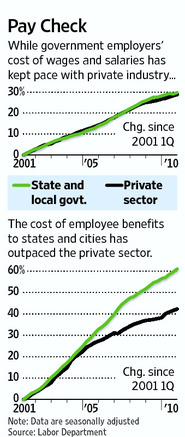
Public Sector Benefits

And Gov. Walker is not the only one trying to stop the massive transfers of wealth from the productive private sector to non-productive public sector.

Excerpt:

Lawmakers around the country are looking at new ways to prevent budget disasters by changing the rules for overburdened state employee pension funds. But they are meeting stiff resistance from public employee unions.

Two Arizona state lawmakers this week, including the speaker of the House, introduced their plan to salvage the state’s budget by significantly changing the public retirement system.

Following the lead of Gov. Chris Christie, R-N.J., a pair of New Jersey assemblymen on Monday put forth their legislative solution to make solvent a fund that’s $54 billion in the red.

Also on Monday, in his first budget address as governor, Florida’s Rick Scott announced his effort to “stabilize and secure” government employee pensions.

The moves are part of a larger battle over pension reform between conservative budget hawks and government worker unions.

The national debt is currently over 14 trillion, and scheduled to be at 26 trillion by 2021.

Michelle Malkin has a breakdown of teacher salaries and benefits here.
Obama budget is a ten-year, $1.5 trillion tax hike over present law

Here’s the analysis of Obama’s budget. (H/T The Blog Prof)

Excerpt:

President Obama released his budget this morning.  Rather than focusing on Washington’s over-spending problem, the budget calls for higher taxes on families and small businesses to pay for even more government spending.  Under the Obama budget, tax revenues will grow from 14.4% of GDP in 2011 to 20% of GDP in 2021.  By comparison, the historical average is only 18% of GDP.

Tax hike lowlights include:

  • Raising the top marginal income tax rate (at which a majority of small business profits face taxation) from 35% to 39.6%.  This is a $709 billion/10 year tax hike
  • Raising the capital gains and dividends rate from 15% to 20%
  • Raising the death tax rate from 35% to 45% and lowering the death tax exemption amount from $5 million ($10 million for couples) to $3.5 million.  This is a $98 billion/ten year tax hike
  • Capping the value of itemized deductions at the 28% bracket rate.  This will effectively cut tax deductions for mortgage interest, charitable contributions, property taxes, state and local income or sales taxes, out-of-pocket medical expenses, and unreimbursed employee business expenses.  A new means-tested phaseout of itemized deductions limits them even more.  This is a $321 billion/ten year tax hike
  • New bank taxes totaling $33 billion over ten years
  • New international corporate tax hikes totaling $129 billion over ten years
  • New life insurance company taxes totaling $14 billion over ten years
  • Massive new taxes on energy, including LIFO repeal, Superfund, domestic energy manufacturing, and many others totaling $120 billion over ten years
  • Increasing unemployment payroll taxes by $15 billion over ten years
  • Taxing management capital gains in an investment partnership (“carried interest”) as ordinary income.  This is a tax hike of $15 billion over ten years
  • A giveaway to the trial lawyers—not letting companies deduct the cost of punitive damages from a lawsuit settlement.  This is a tax hike of $300 million over ten years
  • Increasing tax penalties, information reporting, and IRS information sharing.  This is a ten-year tax hike of $20 billion.

Add it all together, and this budget is a ten-year, $1.5 trillion tax hike over present law. That’s $1.5 trillion taken out of the economy and spent on government instead of being used to create jobs.

The “tax relief” in the budget is mostly just an extension of present law, and also some refundable credit outlay spending in the tax code.  There is virtually no new tax relief relative to present law in the President’s budget.

So then how can the Obama administration claim that they are being fiscally responsible? Let’s see how. (H/T Hyscience)

Excerpt:

The Obama administration’s statement that the government will not be adding to the debt by the middle of the decade clashes hard against the facts, Republicans say, leaving officials straining to justify the budget claim they’ve pushed repeatedly over the past few days.

As it turns out, the administration is not counting interest payments. That means the budget team plans to have enough money to pay for ordinary spending programs by the middle of the decade. But it won’t have the money to pay off those pesky — rather, gargantuan — interest payments. So it will have to borrow some more, in turn increasing the debt and increasing the size of future interest payments year after year.

So how then, visibly agitated Republicans asked, can the administration claim that its 2012 spending plan sets the country on a course to “pay for what we spend” in just a few years?

Hyscience also linked to this McClatchy news article.

Excerpt:

He overlooks the fact that the government still would have to borrow to pay interest on the debt, much of it run up on his watch. Despite achieving “primary balance” in fiscal 2017, the government would have to borrow $627 billion to pay $627 billion in interest. Interest payments would rise annually through 2021.

Debt would rise as well, according to Obama’s proposed budget. Despite the budget reaching “primary balance,” the total gross government debt would rise from $21.9 trillion in fiscal 2017 to $22.9 trillion in 2018, $24 trillion in 2019, $25.2 trillion in 2020 and $26.3 trillion in 2021.

In all, the debt would jump by nearly $4.5 trillion in the four years after the government supposedly would stop adding to the debt because it had achieved “primary balance” – and that’s according to his own budget.

And a non-partisan fact-checking organization has found that Obama is lying about the budget. You can bet that the mainstream media will be backing him up, though.

Barack Obama offers to cut 775 million from 3,800,000 million budget

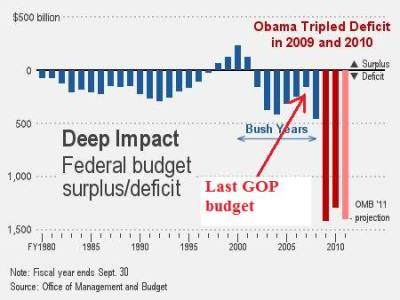
Last Republican budget was in 2007

From The Hill.

Excerpt:

President Obama’s budget director Jack Lew in a Sunday opinion piece outlined some off the “tough choices” Obama is willing to make to cut spending in his 2012 budget request due out on Feb. 14.

The piece details cuts that affect initiatives dear to the president: programs to help the poor and to clean up the Great Lakes near the president’s home state of Illinois.

The cuts are relatively small, however, in the larger scheme of things. In total, the $775 million in detailed cuts fall far short of demands by congressional Republicans and will do little toward tackling the deficit, which is estimated to be $1.5 trillion this year by the Congressional Budget Office. The cuts are in addition to a five-year spending freeze which the administration says will save $400 billion over the next decade.

[…][Lew] said “this cut is not easy for” Obama.

The 2012 deficit is projected to be 1,500,000 million. TWELVE TIMES what the last Republican budget was back in 2007, when unemployment was at 4.3%. Government spending means taking money away from productive workers and from the businesses that hire those productive workers.

To see a graphical representation of the cuts as a portion of the entire budget, click here. The cuts cannot be seen with the naked eye, so the there are several images in that post, each one more zoomed in than the last.