Tag Archives: Spending

Are Obama’s policies weakening America’s security, liberty and prosperity?

In this American Spectator piece entitled “Obama the Destroyer“, Quin Hillyer recounts the many deeds that Obama performed in order to weaken America.

Hilyer writes:

If somebody were deliberately trying to undermine the very fabric of these United States, he would first vow not just to change its policies but to completely “change America,” and then would do just about everything Barack Obama already has begun to do as president.

He then lists some of the specific areas that Obama has weakened:

  • contract law (which is part of the foundation of capitalism and free enterprise)
  • strict interpretation of the Constitution
  • counter-terrorism (released interrogation techniques)
  • responsible spending and size of government
  • energy production
  • missile defense
  • military preparedness and research
  • border security
  • transparency and free/open debate on legislation
  • freedom of choice in health care
  • the integrity of the voting/census system
  • diplomacy and foreign policy

I could name at least a half-dozen more areas not on that list, such as the Western Experience’s post about Obama’s decision to weaken our nuclear capabilities. In fact, Jason has a whole article on the Obama’s naive, weak foreign policy.

But foreign policy is one thing, what about the cost of the trillions in spending? Writing in the Weekly Standard, Irwin M. Stelzer explains that there are only two ways out of the massive deficits that Obama has run up: Higher taxes, which destroys economic growth and ships jobs overseas, and hyperinflation, which impoverishes the poorest among us by making them pay more for everything.

He lists all the mistakes that the ACORN lawyer has made, and concludes:

We are also certain to see the portion of our pay that we actually get to take home decline significantly. The debt that Obama is running up will have to be repaid. Already, there are grumblings in the market about the future of the dollar, with the Chinese not the only one of our creditors worrying that we will inflate our way out of our obligations. Run the presses, make dollars cheaper, and use the debased currency to repay debts.

…But inflation is not the only possibility. Instead, politicians, remembering the fate of Jimmy Carter when he allowed inflation to climb towards 20 percent, will try to restore fiscal sanity by raising taxes. Harvard economist Martin Feldstein, who supported the president’s stimulus package, puts the needed tax increase at $1.1 trillion over the next decade; the International Monetary Fund puts the figure at $1.9 trillion, a sum the magnitude of which is better understood when written as $1,900,000,000,000.

And don’t forget the looming problem of entitlements. You remember. Social Security and Medicare? Costs ballooning out of control? Matthew Continetti writes about it in the Weekly Standard:

The trustees conclude that a combination of lavish benefits, an aging population, and a moribund economy has brought the United States’s social insurance system close to bankruptcy. Medicare is already running a deficit, and the trustees say that it will be totally out of money by 2017. Social Security will be in the red as soon as 2016. That’s a problem not only for Social Security. It’s a problem for the federal budget.

…Meanwhile, bizarrely and perversely, Obama and the Democrats on Capitol Hill say that the only way to fix America’s spending problem–we are not making this up–is to spend more money. More on energy. Health care. Education. The three pillars of the president’s “new foundation.” Don’t worry about the cost, Obama says. The rich guy at the other table will pick up the bill.

What sort of person would spend trillions of dollars in a recession with a looming entitlement crisis? Oh, I know. An unqualified spendthrift who can’t even keep his own financial house in order.

Gateway Pundit reminds us that the Democrats understand that their cap and trade bill with hurt the poorest people the most. And they don’t care! Most of them are probably like Al Gore, who owns assets that will benefit from the unnecessary government regulations.

Gateway Pundit writes at the American Issues Project:

The potential cost of the democrat’s cap and trade policy is enormous. It will likely cost $700 to $1,400 dollars per family per year. The Department of Energy estimated that a similar bill, S. 2191, the Warner-Lieberman cap-and-trade proposal, will increase the cost of coal for power generation by between 161 percent and 413 percent. Human Events reported that the DOE estimated GDP losses (see chart) over the 21-year period they forecast, at between $444 billion and $1.308 trillion. There are estimates that the bill could increase unemployment by 2.7 percent or about 4 million jobs.

White House Budget Director Peter Orszag was on “This Week” with George Stephanopoulos in March. During his interview Orszag admitted that Obama’s proposed cap and trade energy legislation will increase energy costs for everyone. The Heritage Foundation reported that cumulative GDP losses for 2010 to 2029 approach $7 trillion. Single-year losses exceed $600 billion in 2029, more than $5,000 per household. Job losses are expected to exceed 800,000 in some years, and exceed at least 500,000 from 2015 through 2026. In Missouri and the Midwest where energy is “cheap” the democrat’s legislation would cause electricity rates to double. Even the far left Huffington Post admits that the approach taken by the Waxman-Markey bill does not alleviate the problem whereby household consumers will pay higher energy costs.

The article continues here.

Remember when Obama said this in 2008?

“Under my plan of a cap and trade system electricity rates would necessarily skyrocket. Businesses would have to retrofit their operations. That will cost money. They will pass that cost onto consumers.”

What? You voted for Obama and the MSM didn’t tell you that he said that? I’m shocked.
Who has the better economy? Canada or the USA?

Hans Bader at the Competitive Enterprise Institute reports:

1.2 million Americans have lost their jobs since the $800 billion stimulus package was signed into law.

The stimulus package has directly destroyed tens of thousands of jobs. A provision in the stimulus package that blocked 97 Mexican truckers from U.S. roads “caused Mexico to retaliate with tariffs on 90 goods affecting $2.4 billion in U.S. trade,” destroying 40,000 American jobs.

It also ignited a trade war with Canada. In response to vague “buy American” provisions in the stimulus package, “A number of Ontario towns, with a collective population of nearly 500,000, retaliated with measures effectively barring U.S. companies from their municipal contracts — the first shot in a larger campaign that could shut U.S. companies out of billions of dollars worth of Canadian projects.”

Yet, Obama had the audacity to claim that only passing the stimulus package would save us from “irreversible decline” and economic ““disaster”.

Obama’s policies echo those of Herbert Hoover, who helped spawn the Great Depression through his protectionism and tax increases.

Remember how Democrats used to complain about Bush and his “tax cuts for the rich”? Yeah, it’s strange how only people who pay taxes (59% of the public) can actually get tax cuts, isn’t it. But Obama has an even better idea: “tax hikes for the poor”.

The Washington Post reports on Obama’s new car tax: (H/T Heritage Foundation, Michelle Malkin, Stop the ACLU, Gateway Pundit)

A senior administration official said the new standards would raise the cost of an average car by $1,300, $600 of which could be attributed to the rules being announced today.

This is not to mention the electricity tax (cap and trade), the cigarette tax, taxing employee health care plans, and the rising cost of living caused by protectionism.

On the other hand, let’s take a look at Canada in relation to the United States, courtesy of the Cato Institute. (H/T Heritage Foundation)

The Cato Institute writes:

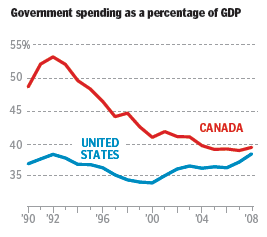
Spending: Spending by all levels of the Canadian government peaked at 53 percent of the country’s GDP in the early 1990s, then plunged to 40 percent in 2008. U.S. government spending has risen, reaching 39 percent of GDP in 2008. And with the stimulus package, that number is likely to jump even higher.

Government spending as % of GDP

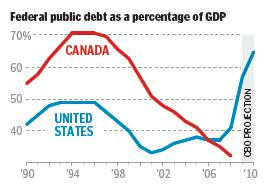
Debt: The Canadian government cut its debt from 71 percent of GDP in 1995 to 32 percent in 2008. Under President Obama’s budget plan, U.S. federal public debt will jump from 41 percent of GDP in 2008 to more than 60 percent next year.

Federal debt as % of GDP

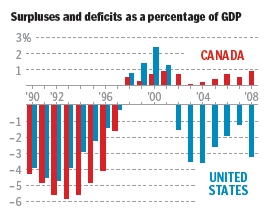
Deficits: Canada has balanced its budget every year since 1998 — not by raising taxes, but by cutting spending. The United States balanced its budget for four years in the late 1990s, but now deficits are so large that it’s difficult to imagine that ever happening again.

Surplus / Deficit as % of GDP

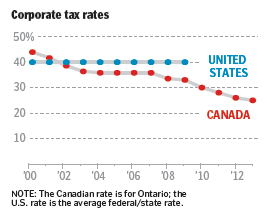
Corporate Taxes: Canada has cut the corporate tax rate from 28 percent to just 15 percent, and most provinces have trimmed corporate taxes as well. The U.S. federalstate rate stands at about 40 percent, and the Obama administration is planning to increase corporate taxes.

Corporate tax rates
Corporate tax rates

It’s important to note that the Liberal party in Canada is socially progressive, but moderate on fiscal issues. Of course, now that the Conservatives have been running things, it’s gotten even better. It would be great if they could win a majority. The biggest problem in Canada right now is the fascist Human Rights Commissions, but there are candidates from the Conservative Party who intend to abolish the HRCs in BC and Ontario.

Evaluating Democrat policies on the budget, health care and cap and trade

A Harvard economist says that tax hikes will kill the recovery: (H/T John Boehner, Mike Pence)

Harvard economist Martin Feldstein writes in the Wall Street Journal:

Even if the proposed tax increases are not scheduled to take effect until 2011, households will recognize the permanent reduction in their future incomes and will reduce current spending accordingly.  Higher future tax rates on capital gains and dividends will depress share prices immediately and the resulting fall in wealth will cut consumer spending further.  Lower share prices will also raise the cost of equity capital, depressing business investment in plant and equipment.

Tax hikes for the poor:

Mr. Obama’s biggest proposed tax increase is the cap-and-trade system of requiring businesses to buy carbon dioxide emission permits. The nonpartisan Congressional Budget Office (CBO) estimates that the proposed permit auctions would raise about $80 billion a year and that these extra taxes would be passed along in higher prices to consumers. Anyone who drives a car, uses public transportation, consumes electricity or buys any product that involves creating CO2 in its production would face higher prices…

But while the cap-and-trade tax rises with income, the relative burden is greatest for low-income households. According to the CBO, households in the lowest-income quintile spend more than 20% of their income on energy intensive items (primarily fuels and electricity), while those in the highest-income quintile spend less than 5% on those products.

Bye-bye, American manufacturing sector. Or maybe Obama will nationalize the entire industry, who can say? He’s already practically doing it now.

Remember the no tax increases pledge that Obama made? Kevin Boland writes:

If you drive a car or flip on a light switch – Democrats have a new national energy tax for you.  If you’re a small business owner or if you’re employed by one – Democrats have a new tax for you.  If you’re a charity – Democrats have a new tax for your donors.  If you’re looking to produce more American energy – Democrats have a new tax for you.  If you own stock – Democrats have a new tax for you.  And when you’re finally able to relax – after paying all your taxes to Uncle Sam – and you want to kick back, relax, and have a cold beer, you guessed it, Democrats may have a new tax for you too.

USA Today asks where the promised fiscal restraint of Mr. ACORN lawyer has gone off to. (H/T Mike Pence)

When it comes to federal spending, there’s a pattern emerging with President Obama, and it’s not a flattering one. The president says all the right things about the importance of getting the deficit under control, but his actions don’t come close to matching his rhetoric.

An early sign of the disconnect was his heavily publicized demand last month that his Cabinet secretaries shave $100 million from their administrative budgets. Obama said the cuts would “send a signal that we are serious about how government operates” and would help close the “confidence gap” with skeptical Americans. Those cuts amounted to a less-than-confidence-inspiring 0.003% of the 2009 budget, or about 3 cents out of every $1,000.

Then, when he unveiled his 2010 budget last week, Obama made a big deal of his demand for $17 billion in cuts, insisting that the cuts “even by Washington standards … are significant” and that $17 billion is “real money.”

The president got it backward. Out in the rest of the world, $17 billion is a ton of money. But in Washington, where the president is proposing to spend $3.6 trillion next year, $17 billion looks puny – a little less than half a percent of the budget, or the equivalent of cutting a $100 grocery bill by handing back a 50-cent pack of gum.

Anybody who read David Freddoso’s book or looked up Obama’s voting record could have known that his rhetoric was just lies for the gullible.

Over to the health care issue, where John Shadegg explains how capitalism is the right way to reduce health care costs.

President Obama’s pledge to work with health care providers and insurers to scale back costs misses the entire point: health care costs are so high because we are not giving patients choice and forcing insurers to compete.  We need robust market reforms – not symbolic gestures.  The way to lower prices is to put control in the hands of patients.  We need to empower Americans by giving them the freedom to either keep their employer plan or purchase the plan of their choice through a tax credit.  Choice and competition will drive prices down and quality up.

Shadegg goes on to explain why the Obama plan does none of this. And why should it? We already know that the Democrats want private health care to fail, so they can usher in single-payer health care. (Just they want private industry to fail so they can nationalize more of the free market)

Putting 120 million Americans on government coverage will create a monopoly that sends costs skyrocketing. Choice will be lost because the enormous government-run plan will put the private plans out of business.  In other words, if you like what you have, you will lose it.  And while health insurance will be provided, health care will not – like every nationalized health plan across the world, as costs escalate, care will be slashed, patients waitlisted, drugs denied.

Meanwhile, Michele Bachmann notes the looming entitlement crisis is now closer than ever, with the Medicare insolvency date moving earlier.

Yesterday, the Medicare and Social Security Trustees issued a new report that laid out unequivocally that our current Medicare and Social Security programs are on a path for financial implosion and are in need of serious reform.

In fact, the Medicare insolvency date has moved up to 2017.  And, that doesn’t include the impact of the so-called “stimulus” bill, which could accelerate insolvency by about 6 months.

And, we’re facing a strain on Social Security like never before, with nearly 80 million retiring Baby Boomers tapping into the funds soon we’ll be spending more to pay benefits than what the system receives in payroll taxes. Yet, we continue to carry on with the status quo, every now and then saying that we need to reform it, but not actually doing anything about it.

Michele is trying to do something about it, but the House is filled with Democrats who never ran a business in their entire lives.

I’ve introduced the Truth In Accounting Act to make government finances truly transparent and open.  Not only would financial commitments be crystal clear to Congress, but also to the taxpayers.

Currently, when Congress and the President prepare budget proposals and pass spending bills, they have the luxury of ignoring shortfalls year after year.  They prepare, present, and approve budgets which project these estimates over the short-term – usually five or ten years.  And, there are a lot of things that can be done on paper to paper over the long-term shortfalls.

My Truth in Accounting Act would require the President to consider these long-term shortfalls when he proposes his budget.  And, it would require both the GAO (Government Accountability Office) and the U.S. Treasury to report this information to the Congress so that the numbers can be used when we’re finalizing the annual budget.

Furthermore, my legislation would require that the report be translated into easily comprehensible terms so that nothing could be hidden by complex jargon.  The government’s fiscal imbalance would be presented in the whole, and as distributed per person, per worker, and per household.

I hope she is somehow able to pass this bill.