Tag Archives: Socialism

Will the Social Security and Medicare programs be there for young Americans?

Of course not, and the voting in Democrats that they seem to like to do is making it worse.

Here’s an article from the Daily Signal to tell about it.

Chart first:
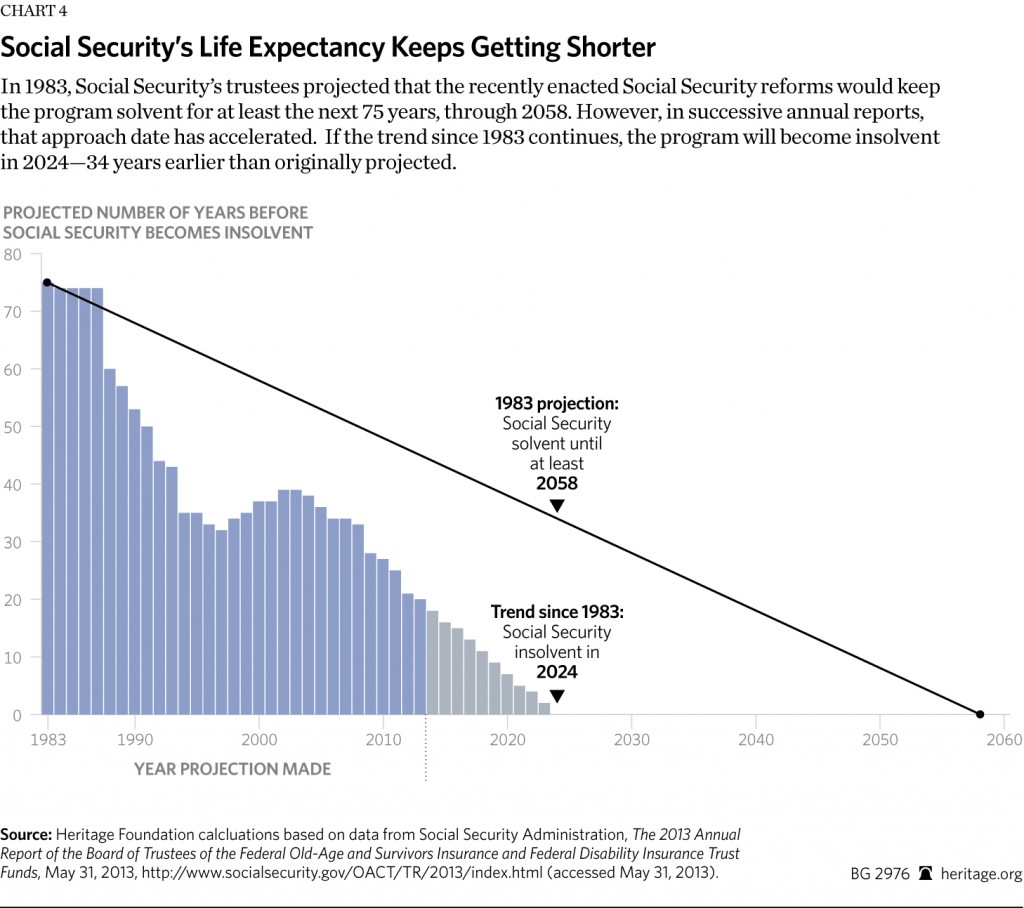
Social Security insolvent in 2024

And now the story:

Social Security’s trustees projected in 1983 that the recently enacted Social Security reforms would keep the program active for at least the next 75 years, through 2058. However, according to research by Rachel Greszler, a senior policy analyst, and James M. Roberts, research fellow for economic freedom and growth at The Heritage Foundation, that approach date has accelerated.

“If the trend since 1983 continues, the program will become insolvent in 2024—34 years earlier than originally projected,” Roberts writes.

Now you might think that the way Democrats appeal to younger voters, that they are taking care of this problem for them.

Well, here’s an article from Investors Business Daily.

Excerpt:

The White House recently conceded that President Obama’s executive order effectively legalizing an estimated 5 million undocumented immigrants means that newly legalized workers will contribute to Social Security and Medicare and be eligible for benefits.

Does the president have any idea how much money his action could cost the country — i.e., taxpayers?

[…]The Social Security and Medicare Trust Fund trustees estimate the two program’s combined long-term unfunded liabilities — the estimated amount the government will have to pay in benefits above what it expects to receive — at about $49 trillion. Obama’s amnesty action greatly exacerbates the problem, because retirees get back far more than they pay in.

[…]Because the U.S. pays hundreds of thousands of dollars in retirement benefits, on average, for each new retiree, whether part of Obama’s amnesty program or not, the president has just vastly worsened the long-term financial condition of the country’s two primary retirement safety nets.

But Obama’s newly legalized workers will impose even heavier losses than Steuerle’s examples.

Most workers pay into the programs for their working careers, between 40 and 50 years. But millions of Obama’s newly legalized are working-age adults with children, so many could be in their 40s or older.

Thus they could pay FICA taxes for the next, say, 15 or 20 years — less than half the average American worker — and be eligible for the full array of Social Security and Medicare benefits.

In addition, most will be lower-income workers. The U.S. Bureau of Labor Statistics estimates that foreign-born, full-time workers earn about 80% of native-born Americans ($33,500 vs. $41,900).

Social Security is a social insurance program and is structured to provide disproportionately more benefits for lower-income workers. Medicare pays the same regardless of how much a worker pays in.

To be sure, these new workers’ entry will likely help the trust funds initially, because most will be paying in rather than taking out.

Under current rules, workers must pay FICA taxes for 40 quarters (10 years total) before being fully eligible for the programs. But within a few decades the oldest will start retiring.

Given the demographic unknowns, estimating the amnesty’s financial cost to our retirement programs — and so to U.S. taxpayers — can only be approximate.

But using a basic simulation model, we believe the government will receive about $500 billion in payroll tax revenue (including Part B and drug premiums), and expect it to pay out some $2 trillion in benefits over several decades.

Yeah, so they are actually making it worse. But hey, at least we have redefined marriage, right?

As if that were not enough, there’s this lovely story from CNS News.

Excerpt:

The Daily Treasury Statement that was released Wednesday afternoon as Americans were preparing to celebrate Thanksgiving revealed that the U.S. Treasury has been forced to issue $1,040,965,000,000 in new debt since fiscal 2015 started just eight weeks ago in order to raise the money to pay off Treasury securities that were maturing and to cover new deficit spending by the government.

The only way the Treasury could handle the $942,103,000,000 in old debt that matured during the period plus finance the new deficit spending the government engaged in was to roll over the old debt into new debt and issue enough additional new debt to cover the new deficit spending.

This mode of financing the federal government resembles what the Securities and Exchange Commission calls a Ponzi scheme. “A Ponzi scheme,” says the Securities and Exchange Commission, “is an investment fraud that involves the payment of purported returns to existing investors from funds contributed by new investors,” says the Securities and Exchange Commission.

“With little or no legitimate earnings, the schemes require a consistent flow of money from new investors to continue,” explains the SEC. “Ponzi schemes tend to collapse when it becomes difficult to recruit new investors or when a large number of investors ask to cash out.”

Now you might ask yourself – are young people aware of these things? Of course not. What they learn in university is how to escape their repressive religious backgrounds by experimenting with risky, irresponsible sexual behavior. They are not aware of the situation, and when they vote, they vote like they were picking candidates on American Idol. I guess I can understand why young people act stupidly. They are concerned with what the culture tells them to be concerned about, and that’s legal baby-killing, redefining marriage to separate kids from their mom or dad, police shooting people who commit crimes, a nonexistent gender pay gap and global warming. What is appalling to me is when their parents vote Democrat… which is basically voting to have a higher standard of living for themselves, then passing the bill onto to their kids. It’s especially amazing when married women do this to their own kids. What are they thinking?
White House threatens veto of bipartisan small businesses tax cut bill

It’s actually for research and experimentation, and small businesses.

Investors Business Daily reports on the story.

Excerpt:

The White House move this week to torpedo a deal between House Republicans and Senate Democrats to extend dozens of expiring tax breaks suggests that the executive action legalizing 5 million unauthorized immigrants may have been no fluke: Compromise appears to be near the bottom of President Obama’s agenda for his last two years in office.

Despite — or perhaps because of — the Republican wave election that capsized Democrats’ Senate majority, Obama is tugging his party further left, which could make it harder for the GOP to govern effectively. A shift away from the center might seem counterintuitive, but it’s consistent with the Democrats’ post-mortem election analysis that put the blame on the party’s failure to focus enough on its economic agenda.

The White House’s veto threat, which apparently surprised dealmakers, was “really pretty stunning” considering that soon-to-be-demoted Majority Leader Harry Reid was its quarterback, said Chris Krueger, political analyst at Guggenheim Partners’ Washington Research Group.

In blowing apart the deal, estimated to cost $440 billion over 10 years, the White House lined up behind liberal Massachusetts Sen. Elizabeth Warren, who attacked it as “a massive handout to big corporations” that asks “working families to pick up the tab.”

The Obama administration used the same justification in explaining its threat to veto the bill if it reached the president’s desk: “It would provide permanent tax breaks to help well-connected corporations while neglecting working families.”

The centerpiece of the deal is a $160 billion provision to make permanent and expand a research and experimentation tax credit, an idea that the administration has supported. The next two biggest pieces, both about $73 billion over 10 years, would make permanent the American Opportunity tuition tax credit and an allowance for small businesses to write off capital investments permanently.

Individuals would be able permanently to deduct sales taxes instead of income taxes, important for residents of states like Florida and Texas, at a cost of $34 billion. Controversial wind production taxes would be extended but phased out over two years, costing $20 billion.

Other smaller pieces include extending a financial-crisis related provision to shield the value of written-down mortgage principal from taxation; making permanent an expanded deduction for users of mass transit; and making permanent tax-free charitable contributions from tax-protected retirement accounts.

That last point about being able to give away your retirement plan tax-free is huge for me, because that’s what I planned to do with my 401K when I retire, since it doesn’t look like I am going to ever get married. If that tax break on charitable deductions from retirement accounts is ever revoked, it would be bad news for the apologists and Christian scholars I donate to. But it’s in keeping with the leftist idea that individuals like me are only good for earning money, but it takes a big secular government to know how to spend it. They have other plans for my money, like free abortions, IVF and sex changes. Yay, big government!

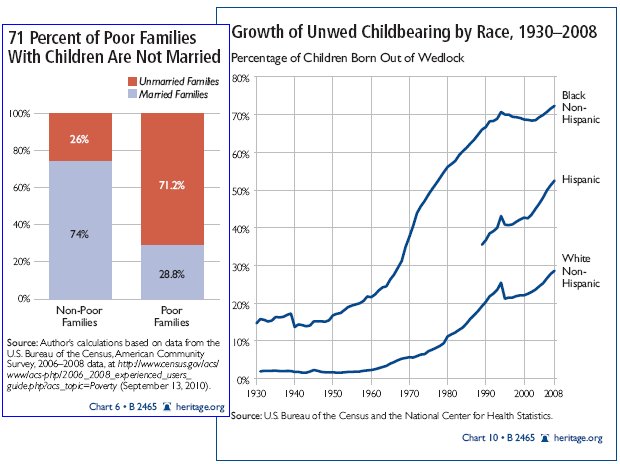
The biggest driver of income inequality is single motherhood

Welfare and out-of-wedlock births

Indian economist Aparna Mathur, whose work I’ve featured here before, writes about it in Forbes magazine.

Excerpt:

The fabric of our society is changing. In 1980, approximately 78 percent of families with children were headed by married parents. In 2012, married parents headed only 66 percent of families with children. In a new report, Bradford Wilcox and Robert Lerman explore the role of family structure with new data and analysis, and document how this retreat from marriage is not simply a social and cultural phenomenon. It has important economic implications for, amongst others, men’s labor force participation rates, children’s high school dropout rates and teen pregnancy rates. Since these factors are highly correlated with economic opportunity and the ability to move up the income ladder, this suggests that income inequality and economic mobility across generations are critically influenced by people’s decisions and attitudes towards marriage. Understanding the role of family structure is therefore key to understanding the big economic challenges of our time.

[…]Wilcox and Lerman document how the shift away from marriage and traditional family structures has had important consequences for family incomes, and has been correlated with rising family-income inequality and declines in men’s labor force participation rates. Using data from the Current Population Survey, the authors find that between 1980 and 2012, median family income rose 30 percent for married parent families, For unmarried parents, family incomes rose only 14 percent.

These differential patterns of changes in family income have exacerbated family-income inequality. Since unmarried parent families generally expand the ranks of low-income families, while high-income, high-education adults increasingly marry partners from similar socioeconomic backgrounds, inequality trends are worsened. Comparing the 90th percentile families to the 10th percentile families in 2012, the top 10 percent had incomes that were more than 11 times higher than the bottom 10 percent. However, if we restrict the sample to married families with children, the ratio drops to nearly 7, suggesting that within married families, income inequality is less stark. The authors estimate that approximately 32 percent of the growth in family-income inequality between 1979 and 2012 is associated with changes in family structure. Other research, studying the period 1968-2000, finds that the changing family structure, accounted for 11 percent of the rise widening of the income gap between the bottom and top deciles.

Another interesting observation relates to the trends in employment participation by men. The Wilcox-Lerman study finds that for married fathers, employment and participation rates have remained consistently higher than for married men with no children and unmarried men with no children. The authors speculate that between 1980 and 2008, about 51 percent of the decline in men’s employment rates can be associated with the retreat from marriage.

And why is single motherhood so ascendant today? Well, part of it is the loss of morality caused by secularism. If there is no God, then there is no way we ought to be, so let’s just do whatever makes us feel good, and pass the bill to the taxpayers. That only works, though, if we elect politicians who want taxpayers who are responsible to pay for the ones who are irresponsible.

So have we done that? Yes – Robert Rector explains in The Daily Signal.

He writes:

It is no accident that the collapse of marriage in America largely began with the War on Poverty and the proliferation of means-tested welfare programs that it fostered.

When the War on Poverty began, only a single welfare program—Aid to Families with Dependent Children —assisted single parents.

Today, dozens of programs provide benefits to families with children, including the Earned Income Tax Credit, Temporary Assistance for Needy Families, the Women, Infants and Children food program, Supplemental Security Income, food stamps, child nutrition programs, public housing and Section 8 housing, and Medicaid.

Although married couples with children can also receive aid through these programs, the overwhelming majority of assistance to families with children goes to single-parent households.

The burgeoning welfare state has promoted single parenthood in two ways. First, means-tested welfare programs such as those described above financially enable single parenthood. It is difficult for single mothers with a high school degree or less to support children without the aid of another parent.

Means-tested welfare programs substantially reduce this difficulty by providing extensive support to single parents. Welfare thereby reduces the financial need for marriage. Since the beginning of the War on Poverty, less-educated mothers have increasingly become married to the welfare state and to the U.S. taxpayer rather than to the fathers of their children.

As means-tested benefits expanded, welfare began to serve as a substitute for a husband in the home, and low-income marriage began to disappear. As husbands left the home, the need for more welfare to support single mothers increased. The War on Poverty created a destructive feedback loop: Welfare promoted the decline of marriage, which generated a need for more welfare.

A second major problem is that the means-tested welfare system actively penalizes low-income parents who do marry. All means-tested welfare programs are designed so that a family’s benefits are reduced as earnings rise. In practice, this means that, if a low-income single mother marries an employed father, her welfare benefits will generally be substantially reduced. The mother can maximize welfare by remaining unmarried and keeping the father’s income “off the books.”

For example, a single mother with two children who earns $15,000 per year would generally receive around $5,200 per year of food stamp benefits. However, if she marries a father with the same earnings level, her food stamps would be cut to zero.

So you see, the thing the left complains about the most is actually the thing they do the most to cause. They are all about taxpayer-funded welfare programs and growing government to make more and more people dependent. They are causing the income inequality and then complaining about what they cause.